CNC machinist training ranges from short online certificates to 9-month trade school programs with real shop immersion.
Not every program teaches G-code, CAD/CAM, or machine setup. Curriculum depth matters more than program length alone.
Virtual labs are a smart, low-risk starting point before hands-on training.
Public college programs often deliver strong value with real machine access at low cost.
The right program depends on your career goal, not just program length or brand name.
Compare 10 CNC machinist training programs, from online virtual labs to hands-on college and trade school options, with costs, formats, timelines, and best-fit recommendations.
CNC machinist training is not one-size-fits-all.
Some programs get you running machines in weeks. Others go deep into blueprint reading, manual machining, G-code, CAD/CAM, and full machinist-level skills. A few now offer virtual labs so you can explore the trade before committing to a real shop floor.
This guide compares the top 10 CNC machinist training programs by format, curriculum depth, cost, and best-fit learner. From virtual prep to trade school immersion, there is a match here for every starting point.
Unmudl is a skills-to-jobs marketplace built to connect adult learners with job-focused technical training. It is where this list starts.
Browse Courses on Unmudl Today!
Start with Mechatronics and Robotics Maintenance, designed for warehouse associates and equipment operators. Unmudl's platform connects you to Career Choice funding and training that employers actually want.
Unmudl matches you to hands-on training and hiring employers close to home. Sign up to see what's near you.
Good jobs, in your area.
Unmudl matches you to hands-on training and hiring employers close to home. Sign up to see what's near you.
Good jobs, in your area.
Unmudl matches you to hands-on training and hiring employers close to home. Sign up to see what's near you.
Good jobs, in your area.
Unmudl matches you to hands-on training and hiring employers close to home. Sign up to see what's near you.
What Is CNC Machinist Training?
CNC stands for computer numerical control. CNC machines follow programmed instructions to cut, mill, turn, drill, or grind materials with precision that manual machining cannot match at production scale.
CNC machinist training teaches you to work in that environment. Depending on the program, that includes reading blueprints, measuring parts to tolerance, operating CNC mills and lathes, following shop safety procedures, and working with G-code or CAD/CAM software.
Manufacturing and trades training programs vary sharply in depth. Some programs are operator-entry routes. Others prepare students for setup, troubleshooting, programming, and advanced machining work.
What Does a CNC Machinist Training Program Teach?
The strongest programs cover most of these core skills:
Not every program covers these equally. Knowing which skills matter for your role is step one before comparing programs.
CNC Operator vs. CNC Machinist vs. CNC Programmer
Many people search for "CNC machinist training" when they actually need operator or programmer training. The distinction matters.
CNC Operator training is the shortest, most beginner-friendly path. It focuses on running pre-written programs, loading parts, basic inspection, and print reading. Good for entering a shop fast.
CNC Machinist training goes deeper. It adds manual machining, metrology, machine setup, tolerances, and troubleshooting. This is the core of most certificate programs in this list.
CNC Programmer training adds G-code, M-code, CAD/CAM toolpaths, feeds and speeds, offsets, and sometimes multi-axis machining. The highest-skill tier.
Know which role you are targeting before you enroll. It changes which program is actually right for you.
How We Chose the Top CNC Machinist Training Programs
Generic "top 10" lists rank programs by brand recognition. This one does not.
Every program here was evaluated on curriculum depth, hands-on machine or lab access, beginner-friendliness, CNC programming coverage, blueprint reading and metrology inclusion, CAD/CAM depth, cost transparency, credential value, and employer alignment. Programs vague about curriculum or missing real machine access ranked lower regardless of name recognition.
Why Hands-On CNC Training Matters
Watching a CNC lathe cut a part on video is not the same as measuring a real part yourself and finding a tolerance failure.
Hands-on CNC machine training builds the decision-making and muscle memory that employers actually hire for. Machine setup, tool handling, inspection, and real production pressure are difficult to replicate in theory alone.
Virtual lab training lowers the barrier to entry. Real machine access is still essential for full machinist or programmer readiness.
We help people like you find new careers they love!
Contact us for a free consultation to begin your new career journey.
Top 10 CNC Machinist Training Programs
1. Unmudl: Smart CNC Machinist Virtual Lab
Unmudl's Smart CNC Machinist pathway is one of the most accessible online entry points into CNC training available today. The Smart CNC Machinist Virtual Lab is fully online, self-paced, and built around virtual simulations covering industrial safety, machining fundamentals, fluid systems, hydraulics and pneumatics, maintenance operations, and troubleshooting.
Learners complete the program by passing a final quiz with 80% or higher. Unmudl's internal review page shows a 5.0/5 rating from over 200 learner reviews.
Pros:
Free trial available with no financial commitment
Fully online and self-paced, accessible from anywhere
Virtual simulations for safety, machining fundamentals, and troubleshooting
Multiple course tiers from intro to accelerated
Cons:
Not a substitute for real machine-floor experience or deep CNC programming practice
Recommendation: Unmudl is the best CNC machinist training option for beginners who want an online virtual lab before moving into hands-on machining practice.
2. Lincoln Tech: CNC Machining and Manufacturing Career Training
Lincoln Tech's campus program at Mahwah, NJ runs 990 instructional hours across 46 weeks (day or afternoon schedule) or 68 weeks (evening). Students interested in advanced manufacturing training that pairs CNC with robotics, multi-axis machining, and CAD/CAM toolpaths will find Lincoln Tech among the most forward-looking programs on this list.
Format: Campus-based, hands-on labs with manual and CNC machines
Location: Mahwah, NJ
Duration: 46 or 68 weeks (990 instructional hours)
Cost: Not publicly listed; contact the campus for current pricing
Career support: Manufacturing employer partnerships and job placement assistance
Pros: Modern labs, robotics and multi-axis exposure, NIMS credential preparation, strong employer alignment
Cons: Program cost not publicly listed on the reviewed page
Recommendation: Lincoln Tech is best for students who want a structured campus program with CNC machining, advanced manufacturing, and robotics exposure.
3. NTMA Machinist Career College: Machinist Training
NTMA Machinist Career College in Santa Fe Springs, CA is one of the few training institutions designed specifically as a machinist school. The program progresses through five structured modules over approximately 9 months: machine technology fundamentals, conventional mills and lathes (levels I and II), surface grinders, CNC mills and lathes, and advanced CNC including EDM and robotics.
Format: In-person, classroom and shop floor blend (4 days per week)
Location: Santa Fe Springs, CA
Duration: 9 months / 905 total hours
Cost: $16,795 total per catalog fact sheet (includes tuition, books, tools, and supplies)
Goodwin University in East Hartford, CT offers an 18-credit CNC certificate with an accelerated option completable in 5 months full-time. Students train on CNC 3-axis milling and turning machines and learn advanced Mastercam alongside manufacturing processes, quality control, and safety.
5. Midlands Technical College: CNC Training Certificate
Midlands Technical College in South Carolina is one of the clearest examples of a well-structured, modular CNC pathway at a public college. The program takes approximately 10 months with individual course costs ranging from $629 to $695. Total estimated cost is approximately $4,908, excluding fees and equipment.
Format: Campus, with some hybrid options by term
Location: South Carolina campus system
Duration: 10 months (~258 class hours)
Cost: ~$4,908 estimated total ($629–$695 per course)
Curriculum: Blueprint reading, measurement tools, manual mills and lathes, CNC components, G-code and M-code, simulator-based CNC programming
Pathway: Credits stack toward a Machine Tool associate degree
Pros: Transparent course and cost structure, modular stackable path, G-code and simulator programming exposure
Cons: Delivery format varies by course; confirm schedule availability before enrolling
Recommendation: Midlands Technical College is best for learners who want a modular CNC training certificate with clear course structure and cost transparency.
6. Community College of Baltimore County: CNC Machinist Certificate
CCBC's in-person CNC Machinist Certificate at the Catonsville campus is one of the most curriculum-dense public college options in this comparison. Required courses include Machine Tool Processes I and II, Technical Blueprints, CADD/AutoCAD, GD&T, CNC Programming, Measuring and Gauging, CNC Milling, and CNC Lathe Operation.
Format: In-person at Catonsville, MD
Credits: ~31 credits
Cost: Not publicly listed; contact CCBC for current pricing
Curriculum: Machine tool processes, manufacturing principles, blueprint reading, CADD/AutoCAD, GD&T, CNC programming, measuring and gauging, CNC milling and lathe operation
Pros: Dense curriculum, full CNC programming coverage, GD&T and CADD/AutoCAD included
Cons: Cost and completion timeline require direct confirmation with the college
Recommendation: CCBC is best for students who want a serious credit-bearing CNC machinist curriculum with programming and design-related coursework.
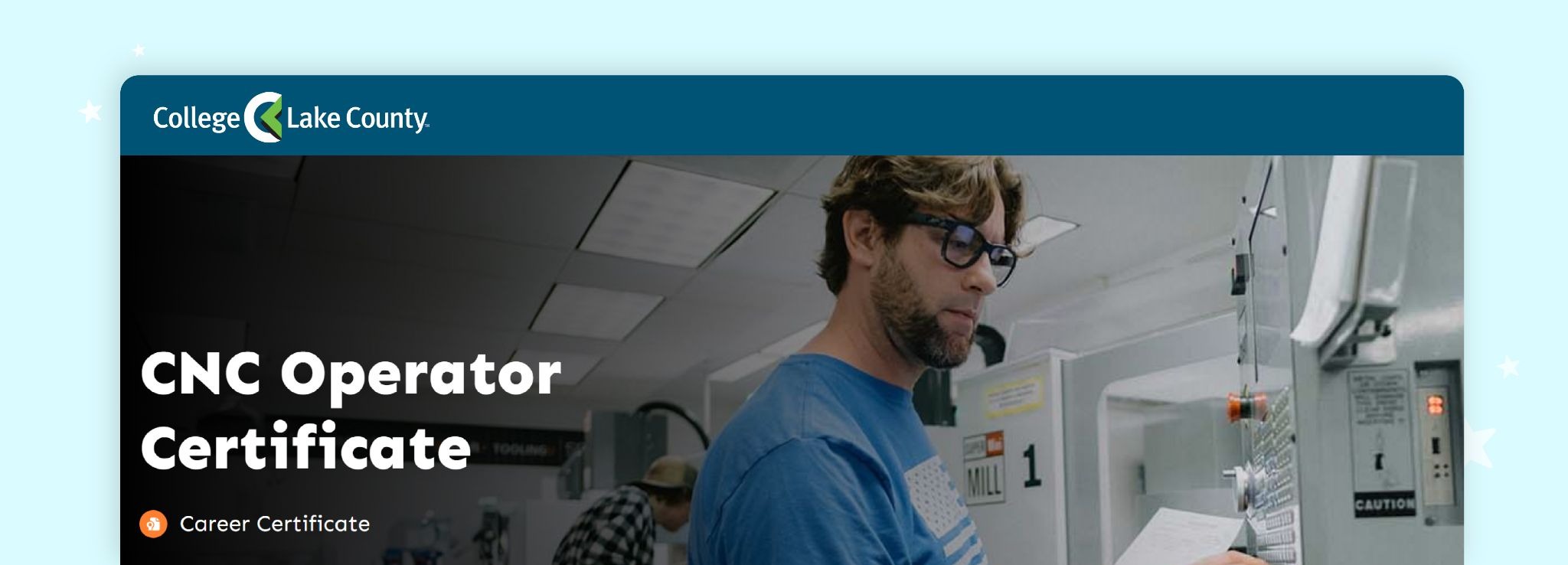
7. College of Lake County: CNC Operator Certificate
College of Lake County in Grayslake, IL offers one of the clearest beginner entry points on this entire list. The 8-credit CNC Operator Certificate completes in one semester, is aligned with NIMS industry standards, and stacks directly into CNC Setup Technician and CNC Programming certificates.
Recommendation: College of Lake County is best for beginners who want a fast, affordable CNC operator certificate that stacks into more advanced machining training.
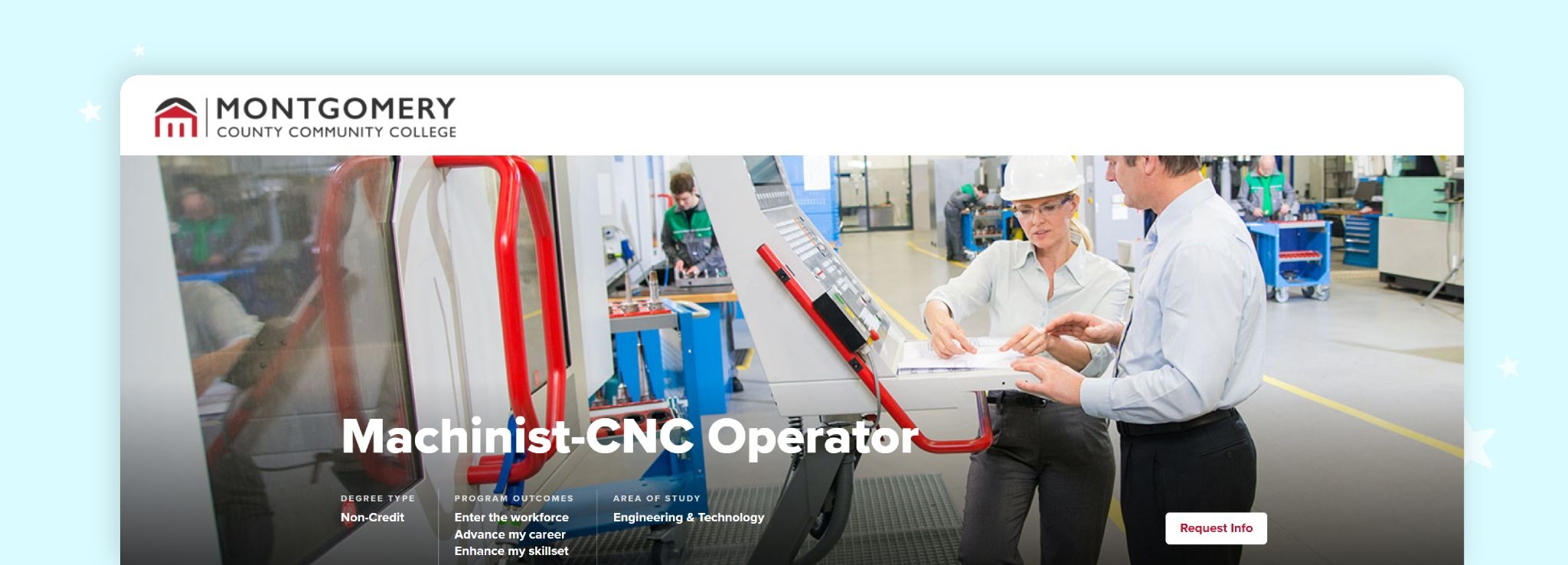
8. Montgomery County Community College: Machinist-CNC Operator Certificate
Montco's workforce development program splits into two 84-hour courses. CNC Operator Level 1 covers machine operation, tooling, and routine quality checks. Level 2 adds advanced setup techniques and manual CNC programming for mills and lathes.
Format: In-person / workforce development
Location: Blue Bell and Pottstown, PA
Duration: Not publicly stated on the program page
Cost: $1,950 per 84-hour course (two courses for full certificate)
Cons: Schedule and availability vary; confirm with the college before planning enrollment
Recommendation: Montgomery County CC is best for learners who want a practical non-credit CNC pathway that builds from operator to setup and manual programming.
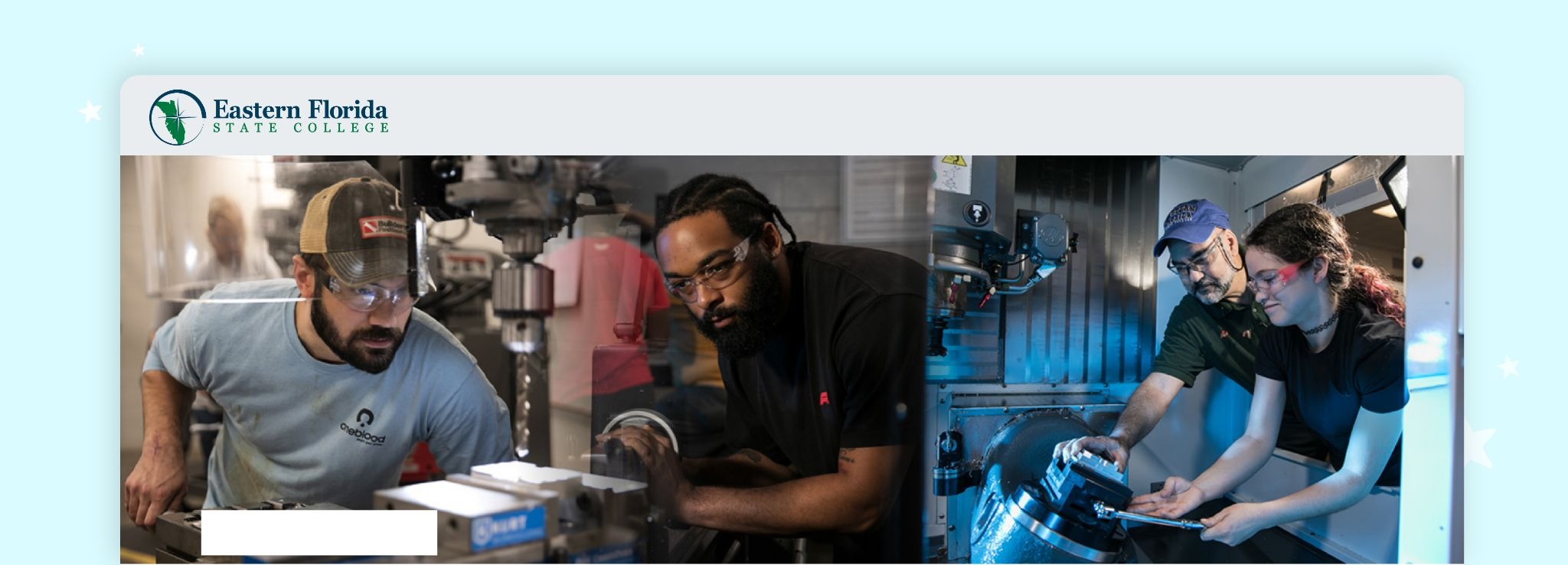
9. Eastern Florida State College: CNC Machinist Certificate
EFSC's 12-credit CNC Machinist College Credit Certificate was designed directly with local manufacturers. Four sequential courses build on each other: Intro to Machining (blueprint reading, precision tools, safety), Advanced Machining 1 (manual lathe and mill), Advanced Machining 2 (CNC programming and coordinate systems), and SolidWorks Fundamentals for CAD/CAM.
Pros: Low cost, real machine access, SolidWorks CAD/CAM included, local manufacturer curriculum input, stackable credit pathway
Cons: Sequential structure requires multiple semesters; not the fastest route
Recommendation: Eastern Florida State College is best for Florida learners who want affordable, hands-on CNC machinist training with CAD/CAM fundamentals.
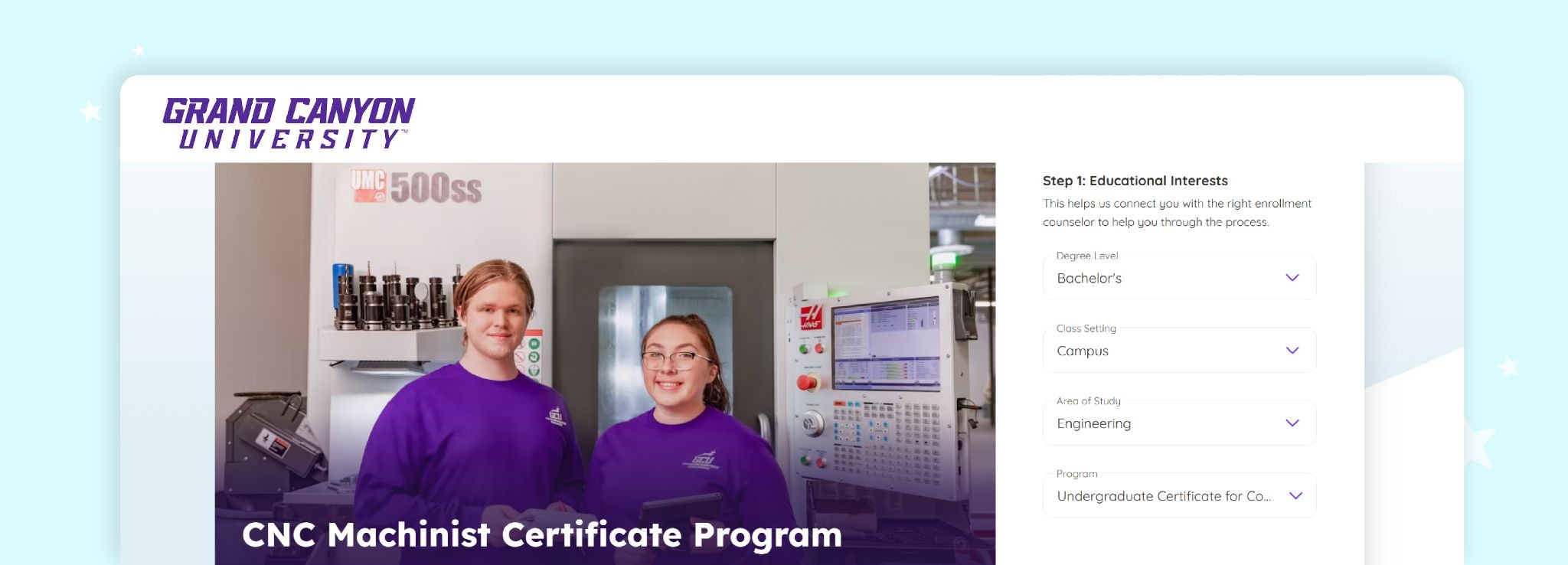
10. Grand Canyon University: CNC Machinist Certificate
GCU's 16-credit on-campus certificate in Phoenix, AZ is one of the most straightforward programs on this list. At $200 per credit, the total program cost runs approximately $3,200. Four courses over 15 weeks cover machining principles, G-code and M-code, offsets, blueprint reading, inspection, GD&T, and CNC mills and lathes.
Note: GCU holds a Trustpilot score of 2.1/5 from 11 reviews. These reflect broader institutional feedback, not CNC program-specific sentiment.
How to Choose the Right CNC Machinist Training Program
The right program matches your career goal, budget, schedule, and need for hands-on practice. Here is how to narrow it down.
Career goal first. Want to enter as an operator quickly? A short certificate from CLC, EFSC, or GCU gets you there. Want setup, programming, and machinist-level depth? Go with Lincoln Tech, NTMA, Goodwin, or CCBC.
Check hands-on lab hours. Ask how many hours are on real machines versus lectures or simulations. A number matters more than a vague "lab access" mention.
Verify CNC programming coverage. Basic G-code exposure is not the same as full manual programming or CAD/CAM toolpath work. Ask what the programming component actually covers.
Look for blueprint reading and metrology. Both appear in every BLS description of the machinist role. If a program skips them, that is a red flag.
Know the true total cost. Lab fees, tools, books, and supplies often are not included in headline tuition. Transparent programs like NTMA, CLC, Midlands Tech, and EFSC give you the full picture upfront.
Low-cost public college options like College of Lake County (~$1,400) and Eastern Florida State College (~$1,250 plus lab fees) offer real machine access at some of the lowest published prices in this comparison.
Mid-range modular programs like Midlands Technical College (~$4,908 total) and Montgomery County Community College ($1,950 per course) offer clear per-course cost visibility.
Higher-cost dedicated trade school programs like NTMA ($16,795 total per catalog) charge more, but tools, books, and supplies are all included in that figure.
Programs without public pricing (Lincoln Tech, Goodwin, CCBC) require contacting admissions for current totals.
A cheaper program without machine time is not a bargain. A more expensive program with strong employer connections and real machine access often delivers a faster return.
Online vs. In-Person CNC Machinist Training
Online CNC training handles safety concepts, CNC terminology, process flow, introductory G-code, and machining fundamentals well. Virtual labs like Unmudl's are a genuine tool for building confidence before machine access.
But online training cannot replace physical machine setup, tool loading, part measurement, handling real tolerances, or hands-on instructor feedback.
The smartest path for most beginners: build vocabulary and confidence online, then move into a hands-on program for real machine practice. Exploring in-demand job opportunities in manufacturing before you choose a training format can also clarify what employers are actually looking for.
Common Mistakes When Choosing CNC Machinist Training
Avoid these before you enroll:
Choosing by tuition alone without confirming machine access or supervised lab hours
Confusing CNC operator training with CNC machinist training (different outcomes, different timelines)
Assuming every certificate includes G-code or CNC programming (many do not)
Ignoring total cost (lab fees, tools, books, and supplies often are not in the headline tuition)
Choosing online-only training when your goal requires real machine-floor experience
Not asking about employer connections or apprenticeship pathways
Picking a long program when a short operator certificate is the right first step
Is CNC Machinist Training Worth It?
Yes, if you choose the right program for the right goal.
According to the Bureau of Labor Statistics, there are approximately 34,200 machinist job openings per year, driven largely by replacement demand. The 2024 median annual wage for machinists is $56,150. Employment is projected at a -2% change from 2024 to 2034, which means replacement openings matter more than net growth in this field.
That is a useful framing. CNC machining is a durable skilled trade, not a hype cycle. For learners who want hands-on technical work, are comfortable with math and precision measurement, and choose a program that teaches real setup, metrology, and machine operation, the training can pay off quickly.
Training quality matters more than the certificate brand. Check the CNC technician career guide to understand what employers actually look for before you apply.
Final Recommendation
If you are starting from zero, Unmudl is the lowest-risk first step available. The free trial costs nothing. The full Virtual Lab is $1,375 for 40 hours of online, self-paced CNC training with virtual simulations and a 5.0/5 learner rating from over 200 reviews. It builds the vocabulary, safety knowledge, and machining fundamentals you need before committing to a longer hands-on program.
Once you have validated your interest, shortlist two or three programs from this list, compare machine access, programming depth, and total cost, then contact the provider for current enrollment details.
What is CNC machinist training? CNC machinist training teaches learners to operate, set up, inspect, and sometimes program CNC machines. Programs range from short operator certificates to deep machinist and programmer pathways depending on the curriculum depth.
How long does CNC machinist training take? It ranges from a few weeks for virtual labs and short certificates to 9 months or longer for dedicated trade school programs with full shop immersion.
Can you learn CNC machining online? Online CNC training handles concepts, terminology, safety, and simulations well. Real machine practice is still needed for full job readiness. Online is a strong starting point, not a complete substitute for hands-on CNC machine training.
What is the difference between a CNC operator and a CNC machinist? A CNC operator runs machines and checks parts using pre-written programs. A machinist has broader setup, measurement, troubleshooting, and process knowledge and typically commands higher wages.
How much does CNC machinist training cost? From approximately $1,250 for affordable college certificates to $16,795 for a comprehensive trade school program. Always confirm the total cost including lab fees, tools, books, and supplies.
Can beginners take CNC machinist training? Yes. Most programs on this list are beginner-friendly. Check math prerequisites and whether supervised hands-on instruction is included before enrolling.
What is the best CNC machinist training program for beginners? Unmudl for online virtual lab entry. College of Lake County for an affordable operator certificate. Eastern Florida State College or Midlands Technical College for affordable hands-on college training. Grand Canyon University for a fast campus intro.
Explore our career-ready "Mechatronics and Robotics Maintenance" designed with employers to help you get hired faster. Train for industrial maintenance in ~10–12 weeks, earn a certificate and get ready to interview for technician roles.


_converted.webp)
.svg)