Career change ideas for mechanics do not mean starting over. Most of these jobs reuse the same diagnostics, preventive maintenance, and troubleshooting skills you already have, just aimed at different equipment.
The closest move is not always the best one. Industrial maintenance is the easiest pivot for most mechanics, but it is not automatically the highest paying or the least physical.
Pay and ease of entry usually move in opposite directions. The best-paying options on this list, like elevator repair and aircraft maintenance, come with an apprenticeship or a licensing process most mechanics do not expect going in.
"Less physical" rarely means office-only. Even lower-strain roles like fleet management and quality control inspection still involve real time on your feet.
Flat-rate pay looks fine on paper. It is usually the first thing mechanics point to when they explain why they started looking elsewhere.
Electric vehicles are not making mechanics obsolete. The value is shifting toward diagnostics, electrical systems, and battery work instead of routine maintenance.
Unmudl's Skills-to-Jobs marketplace connects mechanics directly with job-focused technical courses and open technician roles, without the guesswork of finding a program on your own.
Career change ideas for mechanics do not mean starting over. This guide compares 12 jobs that use your existing repair, diagnostics, and maintenance skills, from industrial maintenance and HVAC to aviation, mechatronics, and fleet roles.
Career change ideas for mechanics are jobs that reuse your diagnostic, repair, and troubleshooting instincts on different equipment, not a leap into something unrelated. You already know how to read a vague symptom, chase it to the actual cause, and fix the real problem instead of the obvious one. That instinct has a market value that goes well beyond the shop floor.
Automotive service technicians are projected to see 4% job growth through 2034, with about 70,000 openings a year, so the trade itself isn't disappearing. But plenty of mechanics aren't asking whether the job exists. They're asking whether there's a better version of it: steadier pay, less strain on the body, or a ceiling higher than "senior technician."
This guide breaks down 12 realistic career change for mechanics options, compared by how closely they match your current skills, what they pay, what training they actually require, how physical they are, and how future-proof they look. None of them ask you to forget everything you already know how to do.
Browse Courses on Unmudl Today!
Start with Mechatronics and Robotics Maintenance, designed for warehouse associates and equipment operators. Unmudl's platform connects you to Career Choice funding and training that employers actually want.
Unmudl matches you to hands-on training and hiring employers close to home. Sign up to see what's near you.
Good jobs, in your area.
Unmudl matches you to hands-on training and hiring employers close to home. Sign up to see what's near you.
Good jobs, in your area.
Unmudl matches you to hands-on training and hiring employers close to home. Sign up to see what's near you.
Good jobs, in your area.
Unmudl matches you to hands-on training and hiring employers close to home. Sign up to see what's near you.
What Are Career Change Ideas for Mechanics?
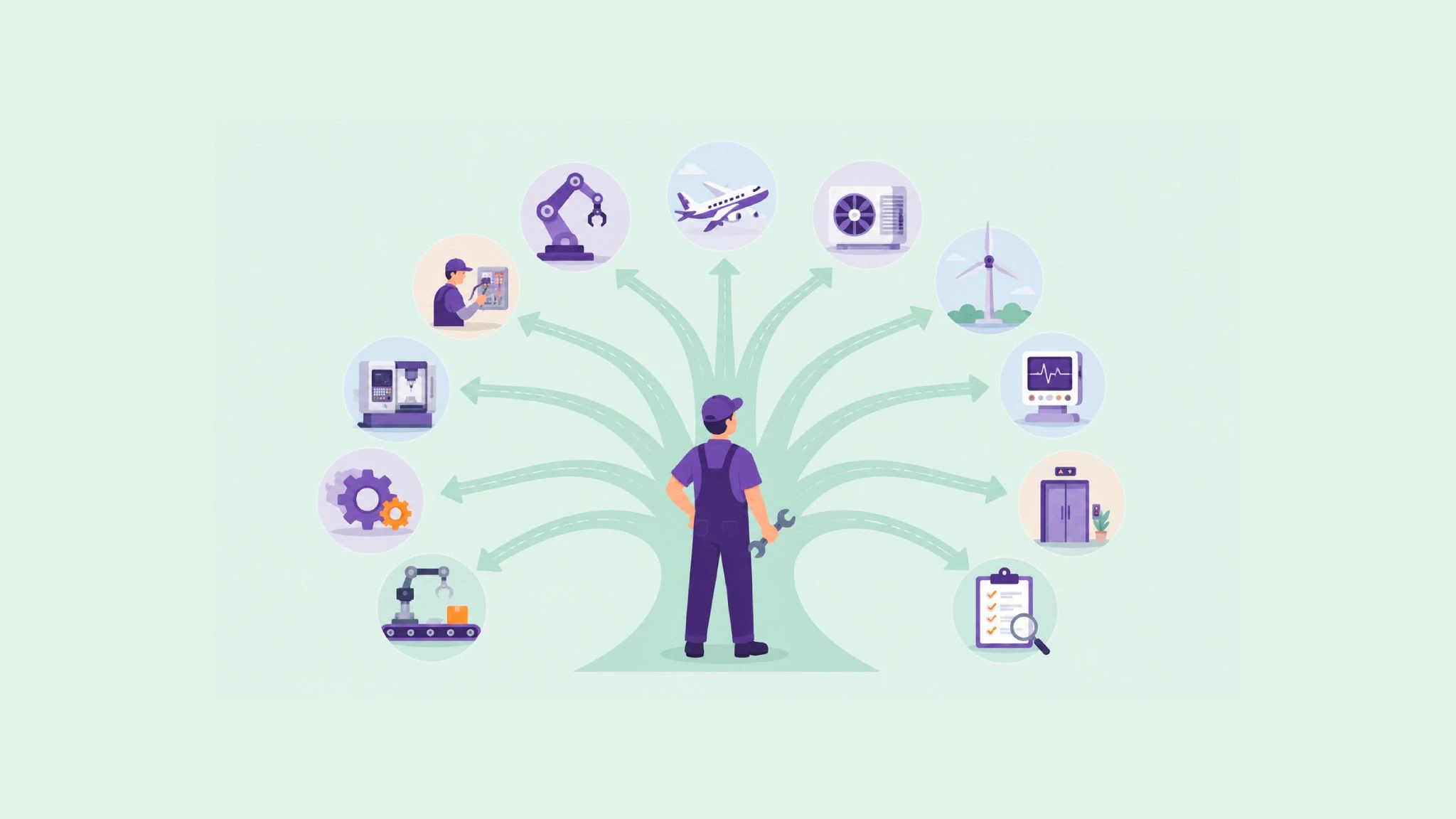
Career change ideas for mechanics are adjacent technical roles that reuse the same core skill set: diagnostics, preventive maintenance, electrical and mechanical troubleshooting, documentation, and safety procedures. They live in industrial equipment, aviation, HVAC, facilities, healthcare, energy, and fleet operations, not in some unrelated field you'd have to learn from scratch.
The framing that matters most is that you're not starting over. A mechanic who moves into industrial maintenance, heavy equipment, mechatronics, or aviation is changing which machine they work on, not throwing away the technical foundation underneath it. Comparing careers by tasks, wages, outlook, and training tends to work better than comparing job titles alone, and that method usually favors mechanics more than they expect.
Most mechanics start looking around for the same handful of reasons:
Flat-rate pay that swings with the shop's schedule
Tool and training costs that keep piling up
A body that's tired of standing on concrete all day
A ceiling that tops out at "senior technician"
Add electric vehicles and automation into the mix, and the smart move usually isn't leaving the trade. It's aiming your skills at a different machine, and a better paycheck.
Which Skills Actually Transfer When You Change Careers?
The most valuable thing you know isn't brand-specific repair knowledge. It's diagnostic thinking, and it's the mechanic transferable skill that shows up on almost every list of what employers actually want.
Fault isolation, testing a hypothesis, reading a scan tool, and verifying a repair all transfer directly to industrial machinery, aviation, HVAC, mechatronics, and biomedical equipment. So does preventive maintenance, which is largely what a maintenance technician does day in and day out. Factories, hospitals, fleets, and airports all pay for uptime, and preventive maintenance is the discipline that protects it.
A few categories of jobs that use mechanic skills are worth naming specifically:
Electrical, hydraulic, and pneumatic systems. The same logic that gets you through a diesel engine applies to conveyors, pumps, motors, and robotics.
Technical documentation and safety procedures. Reading service manuals and following lockout and safety rules translates directly into regulated fields like aviation and biomedical equipment.
Customer and team communication. Writing repair estimates, coordinating jobs, and mentoring newer techs are the foundation of supervisor, trainer, and technical sales roles.
That's the real meaning of transferable skills for mechanics: you don't relearn how to think, you just point the same thinking at a different machine.
We help people like you find new careers they love!
Contact us for a free consultation to begin your new career journey.
What Are the 12 Best Career Change Ideas for Mechanics?
These job options for former mechanics aren't ranked by salary alone. They're sorted by how close a fit they are for someone coming out of auto, diesel, or fleet work, which is a better predictor of whether you'll enjoy the move than the paycheck is. Quick comparison first, then a closer look at each of these alternative careers for mechanics.
Industrial Maintenance Technician: Best fit for auto, diesel, and fleet mechanics. $63,510 median pay, +13% growth. Entry through on-the-job training or a certificate.
Heavy Equipment Technician: Best fit for diesel and fleet mechanics. $62,740 median pay, +6% growth. Entry through postsecondary training.
Aircraft Mechanic: Best fit for precision-minded techs. $78,680 median pay, +5% growth. Entry through an FAA-approved school or the experience route.
HVAC Technician: Best fit for auto techs comfortable with customer-facing work. $59,810 median pay, +8% growth. Entry through a certificate plus EPA 608.
Elevator & Escalator Repairer: Best fit for techs chasing top pay. $106,580 median pay, +5% growth. Entry through an apprenticeship, often licensed.
Biomedical Equipment Technician: Best fit for detail-oriented techs. $62,630 median pay, +13% growth. Entry through a certificate or associate degree.
Mechatronics Technician: Best fit for techs who like automation. $70,760 median pay. Entry through a certificate or associate degree.
Wind Turbine Technician: Best fit for field-ready techs comfortable with heights. $62,580 median pay, +50% growth. Entry through technical school.
CNC Machinist: Best fit for precision and fabrication fans. $56,150 median pay, steady openings. Entry through on-the-job or technical training.
Stationary Engineer / Boiler Operator: Best fit for facilities-minded techs. $75,190 median pay. Entry through apprenticeship or license.
Fleet Maintenance Manager: Best fit for experienced diesel and fleet techs. $78,300 median pay, +3% growth. Entry through promotion from the shop floor.
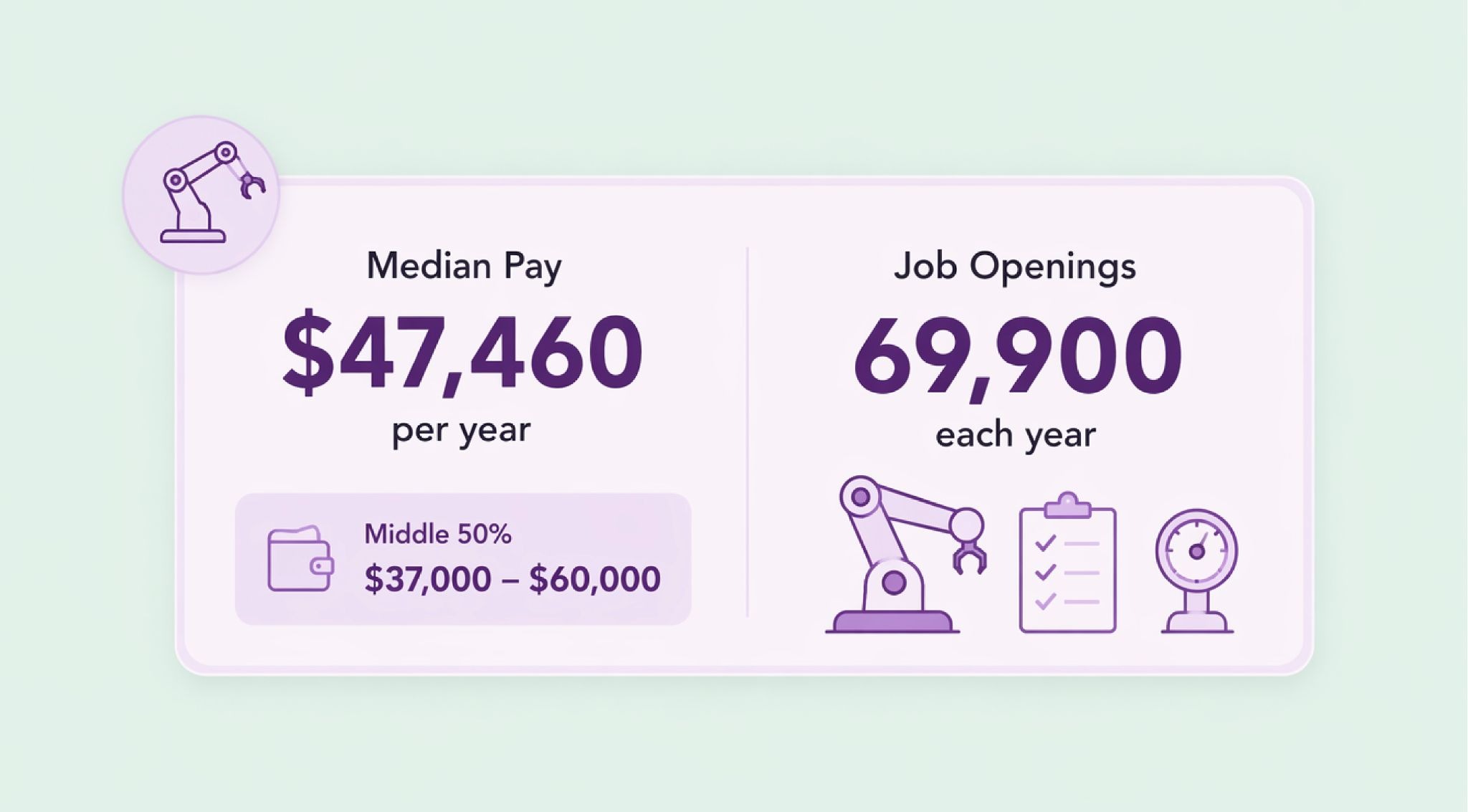
Quality Control Inspector: Best fit for detail-focused techs wanting lower strain. $47,460 median pay. Entry through on-the-job training.
Median pay reflects BLS May 2024 data. Sourcing for each role is linked in the write-up below.
1. Industrial Maintenance Technician
This is the closest move on the list for most auto and diesel mechanics. You already understand bearings, belts, motors, hydraulics, and preventive maintenance, and industrial maintenance just points that at production equipment instead of vehicles. You'll pick up programmable logic controllers, conveyor systems, and lockout/tagout procedures, usually through industrial maintenance technician training programs rather than a full degree, with BLS projecting 13% growth and a $63,510 median wage for the field. One Reddit thread from a diesel mechanic who made this exact switch reported three promotions in eighteen months and work that was noticeably easier on the body.
Best for: Auto, diesel, and fleet mechanics who want technical work without the customer-facing shop pressure.
2. Heavy Equipment Technician
For diesel and fleet mechanics, this is more of a specialization shift than a reinvention. You'll keep working on engines and hydraulics, just on excavators and agricultural machinery instead of trucks, with BLS projecting a $62,740 median wage alongside more field service and outdoor work. If you're weighing this against staying with vehicles entirely, it's worth reading through other career change ideas for diesel mechanics side by side.
Best for: Diesel mechanics and fleet techs who aren't ready to leave wrenching behind completely.
3. Aircraft Mechanic or Aviation Maintenance Technician
Aircraft maintenance rewards the same precision and documentation discipline you already practice, just under FAA rules. You'll need an FAA Airframe and Powerplant certification, earned either through 30 months of practical experience or an aviation maintenance technician career program that typically runs 18 to 24 months. It's a bigger pivot than most on this list, and the pay in the table above reflects that added rigor.
Best for: Mechanics who like rules, inspections, and safety-critical work.
4. HVAC Technician
HVAC uses the same systematic troubleshooting, electrical basics, and customer communication you already rely on, just on furnaces and compressors instead of engines, with BLS projecting 8% growth and steady demand nationwide. You'll need an EPA Section 608 certification to handle refrigerants, plus some on-the-job training. It's one of the most portable trades out there, attics and crawlspaces aside.
Best for: Auto techs who want a trade that travels well and don't mind customer-facing service.
5. Elevator and Escalator Installer or Repairer
If pay is the main goal, this is usually the top of the list. BLS puts the median wage at $106,580, mostly earned through apprenticeship rather than a degree. The catch is that it's not an easier job on the body. Confined spaces, heights, and on-call work come standard.
Best for: Mechanically strong techs chasing the highest ceiling who are fine completing an apprenticeship first.
6. Biomedical Equipment Technician
This is a strong option if you like precision work and want a cleaner environment than a shop floor. You'll calibrate and maintain hospital equipment instead of vehicles, usually after a biomedical equipment technician training program or associate degree, with BLS projecting 13% growth as hospitals lean harder on precision equipment upkeep.
Best for: Detail-oriented techs willing to trade shop grime for more formal, documentation-heavy work.
7. Mechatronics Technician or Electro-Mechanical Technician
Mechatronics blends mechanical, electrical, and automation troubleshooting into one of the most future-facing moves on this list. Mechatronics training for mechanics usually covers robotics, sensors, actuators, and PLCs, and it can lead toward robotics technician training or eventually a control systems technician career path once you're comfortable with automation logic. BLS pegs the median wage at $70,760 for this specific blend of skills.
Best for: Techs who already enjoy chasing electrical gremlins as much as mechanical ones.
8. Wind Turbine Technician
Wind is the fastest-growing job on this entire list, projected at 50% growth, though it's still a small occupation overall. The tradeoff is real: you're climbing towers over 200 feet with tools, in the field, in all kinds of weather.
Best for: Mechanics who want energy-sector work and are genuinely comfortable with heights and travel.
9. CNC Machinist or Machine Repair Path
If you like precision measurement and fabrication more than diagnosing what's wrong with something, this path fits better than most. A CNC technician career guide can walk you through blueprint reading, tolerances, and G-code basics. The broader category isn't growing fast, but BLS still counts roughly 34,200 openings a year from replacement demand alone.
Best for: Mechanics who'd rather build a part correctly than chase a fault.
10. Stationary Engineer or Boiler Operator
This one trades vehicles for buildings entirely: boilers, pumps, and mechanical rooms that keep a facility running, with BLS placing the median wage at $75,190. Licensing requirements vary by state, and schedules often include shifts since facilities run around the clock.
Best for: Mechanics who want building systems work instead of anything with wheels.
11. Fleet Maintenance Manager or Maintenance Supervisor
This is usually a promotion, not an entry-level switch. If you've already got the experience, the workflow knowledge, and some credibility with a crew, moving into supervision means less wrenching and more scheduling, budgeting, and vendor coordination. BLS counts this under first-line supervisors of mechanics, installers, and repairers, with a $78,300 median.
Best for: Experienced diesel and fleet mechanics ready to trade tools for a clipboard.
12. Quality Control Inspector
This won't be the highest-paying move on the list, but it's a legitimate lower-strain bridge into manufacturing for mechanics with strong attention to detail. You'll use gauges, tolerances, and inspection documentation instead of wrenches, and BLS puts the median around $47,460 with roughly 69,900 openings a year.
Best for: Detail-focused techs who want less physical intensity, even if it means a lower pay ceiling.
Which Career Change Is Best for Your Goal?
Instead of picking blind, sort by what you're actually trying to fix.
Closest to what you do now: Industrial maintenance technician, heavy equipment technician, and fleet maintenance roles keep the work pattern close to what you already know.
Highest pay ceiling: Elevator and escalator repairer, aircraft mechanic, and fleet maintenance manager are the high paying jobs for former mechanics on this list, usually earned after an apprenticeship or a promotion path.
Least physically demanding: Fleet maintenance manager, quality control inspector, and biomedical equipment technician trade some pay for less strain on your body. Worth knowing: BLS data on installation, maintenance, and repair jobs shows workers in this field spend an average of 80.8% of the day standing, so "less physical" is relative, not office-only.
Most future-proof: Mechatronics technician and industrial maintenance technician are the future proof careers for mechanics that lean hardest into where the industry is actually heading. EVs need less routine maintenance but more trained technicians for diagnostics and battery systems, which rewards mechanics who broaden their skills instead of staying narrow.
No degree required: Industrial maintenance, heavy equipment, HVAC, wind turbine, and most elevator apprenticeships all skip the four-year detour entirely.
How Do You Actually Make the Move?
Once you've picked a direction, the mechanics of switching come down to three things: the credential, the story, and the resources.
Start with the gatekeeper requirement. Most certifications for mechanics changing careers fall into one of two buckets: hard-gated or genuinely optional.
HVAC needs EPA 608.
Aviation needs an FAA A&P certification.
Elevator work runs through an apprenticeship almost every time.
Before you spend money on anything, confirm whether the job is licensed, apprenticeship-only, or genuinely open with a short certificate. Registered apprenticeships pay you while you train, with wages that increase as you go, which matters if you can't afford a full-time classroom detour.
Then rewrite the resume, not the person. "Worked on cars" undersells you badly. Try language like:
Diagnosed mechanical and electrical faults
Restored equipment uptime
Performed preventive maintenance
Used diagnostic tools to isolate root causes
Documented repairs and verified completed work
A functional or hybrid resume format works best for career changers specifically, because it leads with skills instead of burying them under old job titles.
A diesel mechanic career change usually reads differently on paper than an auto mechanic's does. If you're coming from auto work, lean on electronics, diagnostics, and customer communication: that points toward HVAC, industrial maintenance, and mechatronics. If you're coming from diesel or fleet work, lean on heavy systems, hydraulics, and uptime: that points toward heavy equipment, industrial maintenance, and stationary engineering.
Whichever direction you're headed, Unmudl's Skills-to-Jobs marketplace exists specifically to connect people with this kind of technical retraining, and it's worth a look before you pay for anything elsewhere. (Employers building a training pipeline for career-changers can also become an Unmudl partner.)
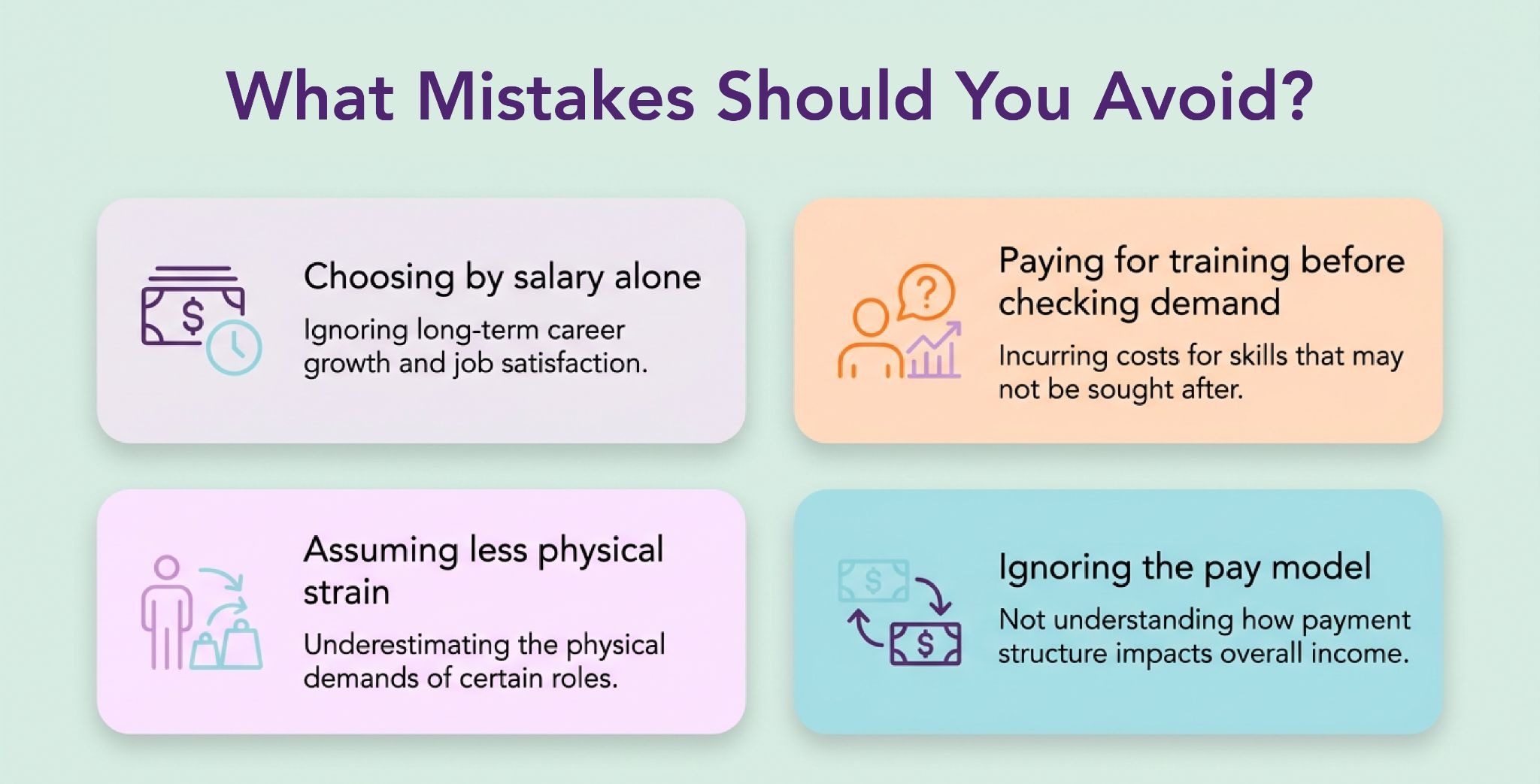
What Mistakes Should You Avoid?
A few patterns show up again and again in mechanics who make this switch, and most of them are avoidable.
🚫 Choosing by salary alone. Elevator work, aircraft maintenance, and wind energy all pay well, and all come with apprenticeships, licensing, or physical demands that don't show up in the salary line.
🚫 Paying for training before checking demand. Look at real job postings, BLS and O*NET data, and local workforce numbers before enrolling in anything.
🚫 Assuming every technician job is less physical. Wind turbine work, elevator repair, and field-based heavy equipment service are all still demanding on the body.
🚫 Ignoring the pay model. Flat rate, hourly, and apprenticeship wages behave very differently. In one Reddit thread about switching out of automotive, mechanics didn't hold back, calling flat rate "a scam" more than once.
🚫 Undervaluing what you already know. Diagnostics, documentation, and safety habits are the exact things that repackage well. Don't bury them under "mechanic" as one flat job title.
How Should You Choose the Right Path?
Choosing between mechanic career change options starts with one honest question: what are you actually trying to fix? Better pay, less physical strain, less customer pressure, a clearer schedule, or a longer runway before the job changes underneath you?
Then size up the pivot:
Small pivot: Industrial maintenance, heavy equipment, and fleet roles.
Medium pivot: HVAC, mechatronics, and stationary engineering.
Bigger pivot: Aircraft, biomedical equipment, and elevator work, with more gatekeeping in front of them.
From there, the next steps are the same no matter which job you're eyeing:
Pick three target roles.
Read ten real job postings for each one, and note what keeps repeating.
The mechanics who make this work well aren't the ones who found the "best" job on paper. They're the ones who matched the move to what they actually wanted.
What Do Mechanics Usually Ask About This?
What jobs can mechanics transition into? When people ask what jobs after being a mechanic actually look like, the honest answer is industrial maintenance, heavy equipment, HVAC, aircraft maintenance, mechatronics, biomedical equipment, fleet maintenance, and elevator repair, since all of them reuse diagnostics and preventive maintenance directly.
What's the best career change for diesel mechanics specifically? Heavy equipment technician, fleet maintenance, industrial maintenance, and stationary engineering all lean on the same hydraulics and uptime skills diesel work already builds.
What are the least physically demanding options? Fleet maintenance manager, maintenance supervisor, quality control inspector, and biomedical equipment technician all trade some pay for less time on your feet, though none of them are pure desk jobs.
Are mechanics being replaced by AI or electric vehicles? No, but the value is shifting. EVs need less routine maintenance but more trained technicians for diagnostics, electrical safety, and battery systems, which rewards mechanics who broaden their skills rather than stay narrow.
What certifications actually help? ASE if you're staying vehicle-adjacent, EPA 608 and NATE for HVAC, FAA A&P for aviation, NIMS for machining, and OSHA safety training across industrial, construction, and energy settings.
What Concepts Are Related to Career Change Ideas for Mechanics?
Transferable skills: Skills built in one job that carry directly into another. For mechanics, that means diagnostics, repair, preventive maintenance, safety habits, and documentation.
Preventive maintenance: Planned maintenance used to reduce failures and extend equipment life, and the core discipline behind industrial maintenance, fleet maintenance, and biomedical equipment work.
Industrial maintenance: Maintaining and repairing production machinery and automated equipment, which is why it's one of the closest career changes available to a mechanic.
Mechatronics: A field combining mechanical systems, electronics, sensors, and automation, built for people who already like both wrenches and wiring diagrams.
Registered apprenticeship: Paid, structured training with wages that rise as your skills do, and a credential recognized well beyond a single employer.
Flat-rate pay: A pay structure where technicians are paid by assigned labor time rather than actual hours worked, and one of the most common reasons mechanics start looking for something else.
Your wrench time already taught you the one skill that matters most: finding the real problem before you fix the wrong one. Point that at a new machine, and the career change takes care of itself.
Explore our career-ready "Mechatronics and Robotics Maintenance" designed with employers to help you get hired faster. Train for industrial maintenance in ~10–12 weeks, earn a certificate and get ready to interview for technician roles.
Yes. Mechanics already understand diagnostics, preventive maintenance, mechanical systems, electrical faults, tools, documentation, and safe repair practices. Additional training in motors, sensors, programmable logic controllers, hydraulics, or automated equipment can help close the remaining skills gap.
Do former mechanics need a degree to change careers?
Many adjacent technician careers do not require a four-year degree. Some employers accept mechanical experience plus a certificate, while aviation, elevator repair, HVAC, and other regulated fields may require a specific certification, license, or apprenticeship.
How should a mechanic describe transferable skills on a resume?
Focus on root-cause diagnostics, preventive maintenance, electrical troubleshooting, equipment reliability, technical documentation, safety, and customer communication rather than listing only vehicle-specific tasks. Include measurable results such as reduced repeat repairs, faster turnaround times, improved uptime, or the number of technicians trained.
How long does it take a mechanic to retrain for a new career?
A closely related transition may require only a short course or employer training, while licensed careers and apprenticeships can take considerably longer. Review several job postings for your target role and identify the requirements you consistently lack. This prevents you from paying for training employers do not actually request.
Can a mechanic move into industrial maintenance?Yes. Mechanics already understand diagnostics, preventive maintenance, mechanical systems, electrical faults, tools, documentation, and safe repair practices. Additional training in motors, sensors, programmable logic controllers, hydraulics, or automated equipment can help close the remaining skills gap.Do former mechanics need a degree to change careers?Many adjacent technician careers do not require a four-year degree. Some employers accept mechanical experience plus a certificate, while aviation, elevator repair, HVAC, and other regulated fields may require a specific certification, license, or apprenticeship.How should a mechanic describe transferable skills on a resume?Focus on root-cause diagnostics, preventive maintenance, electrical troubleshooting, equipment reliability, technical documentation, safety, and customer communication rather than listing only vehicle-specific tasks. Include measurable results such as reduced repeat repairs, faster turnaround times, improved uptime, or the number of technicians trained.How long does it take a mechanic to retrain for a new career?A closely related transition may require only a short course or employer training, while licensed careers and apprenticeships can take considerably longer. Review several job postings for your target role and identify the requirements you consistently lack. This prevents you from paying for training employers do not actually request.


.svg)




.webp)