Technician: Definition, Duties, Credentials, and Training

Technician duties and credentials

Technician refers to a working role in which a person applies technical know-how, set procedures, and instruments to hands-on tasks inside one defined area of work. A technician carries that role across the separately classified occupations rather than inside one standardized profession. The exact tasks, entry route, and regulation attached to the title change with the area. Three areas show the change. A pharmacy technician prepares medications under a pharmacist's direction. A sterile processing technician decontaminates and sterilizes reusable surgical instruments. An engineering technician supports testing and production alongside engineering staff. Each of those three workers answers to a different employer requirement under the same title.

A technician matters to an employer because technical systems have to be operated, inspected, maintained, prepared, and documented to a governing requirement. That requirement comes from the workplace, the manufacturer, the regulator, or the professional standard. The benefit of the applied function shows up in three places. A hospital gets calibrated patient-care devices. An operating room gets sterile instrument trays. A factory floor gets production machinery that runs to specification. The credentials and training behind each benefit follow the same area-by-area pattern. The definition, duties, credentials, and training of a technician are read occupation by occupation and never as one universal job description.

What Is a Technician?

A technician is an applied technical worker who turns established methods, specialized knowledge, tools, and equipment into operational work within one classified occupation. Technician work involves setting up, monitoring, operating, and maintaining instruments and equipment and conducting technical tests on them. The technician meaning is fixed by the occupational field attached to the title, not by the word standing alone. A pharmacy technician and a biomedical equipment technician share the label while holding different duties, entry education, and regulators. The label sits at the broad end of the occupational scale, a role family rather than a single profession. The role family narrows to one occupation only when a field name is attached to it.

Occupational classification is a coding system that assigns each occupation a title, a group, and a place in a hierarchy. The International Labour Organization (ILO) places technicians and associate professionals in Major Group 3 of its International Standard Classification of Occupations (ISCO-08) standard. The ILO defines that group by the practical application of concepts and operational methods. The United States Standard Occupational Classification (SOC) and the Occupational Information Network (O*NET) then divide the major group into separately classified occupations. A technician title resolves to one occupation and one task list. The answer to what technician means comes from the classified occupation rather than from an employer's job title. O*NET's 2026 records file Pharmacy Technicians, Medical Equipment Preparers, and Medical Equipment Repairers as three separate occupations. The classified occupation, and not the title, fixes the work that a technician does. The table below places a technician title inside each classification layer.

Classification LayerIssuing BodyWhat the Layer Fixes for a Technician TitleExample in This Article
Major Group 3, Technicians and Associate ProfessionalsILO, through the ISCO-08 standardThe role family, defined by the practical application of concepts and operational methodsEvery technician title the article names
Classified occupationUS Standard Occupational Classification (SOC)One coded occupation with its own title and entry educationMedical Equipment Repairers, the occupation that lists the biomedical equipment technician
Occupation recordO*NET, 2026 recordsThe ranked task list and the reported job titles under one occupationMedical Equipment Preparers, the occupation that carries the Sterile Processing Technician title
Posted job titleThe hiring employerThe location, shift, compensation, and preferred skills of one positionPatient care technician and EKG technician, titles with no separate BLS or O*NET profile
Common misreadingThe job seekerThe title alone is taken to fix the dutiesThe classified occupation, not the title, fixes the duties

What Does a Technician do?

A technician performs practical technical work that applies established procedures and specialized knowledge to equipment, systems, materials, information, or processes inside one specialty. Technicians convert that knowledge into operational tasks whose mix is set by the occupation and not by the title. A technician job is defined by the core function its occupation carries. Inspection and repair form the core for maintenance technicians. Sterilization forms the core for sterile processing technicians. Medication preparation forms the core for pharmacy technicians. The technician requirements that follow each core function differ in the same way, from equipment-maintenance skill in one occupation to prescription handling under a pharmacist in another.

Task data is the occupational record that ranks each work activity of an occupation by its importance to the job. Task data separates the function that carries an occupation from the functions that merely appear in it. A duty list read from one occupation never transfers whole to another. O*NET's 2026 task data for Medical Equipment Repairers assigns high importance to testing and calibrating medical equipment, performing preventive maintenance, inspecting and troubleshooting malfunctioning equipment, recording maintenance and repair information, and repairing or replacing components. The core function that a technician job carries is what separates one type of technician from the next.

What Are The Main Types of Technician?
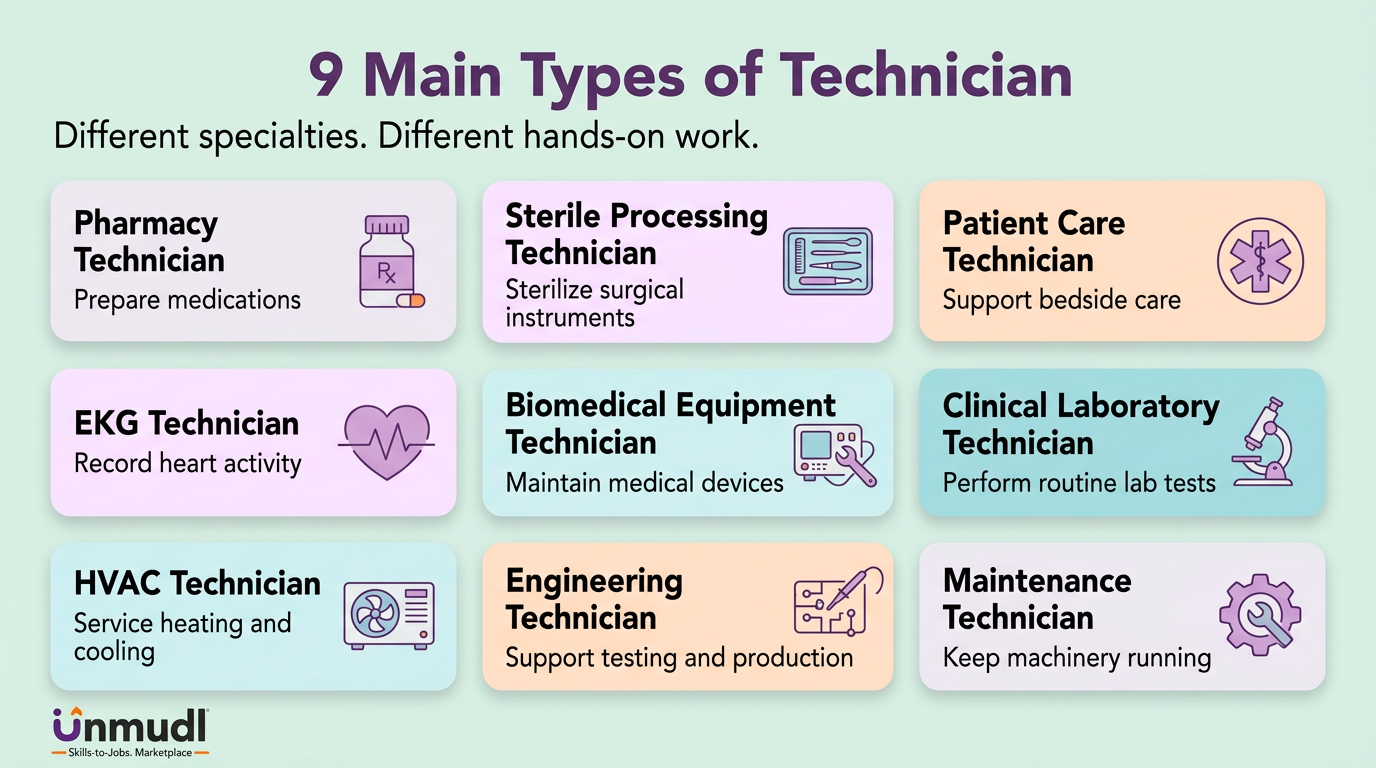
Nine technician specialties: pharmacy, sterile processing, patient care, EKG, biomedical equipment, clinical laboratory, HVAC, engineering, and maintenance

There are 9 main types of technician based on the occupational domain in which the technical knowledge is applied. The main types of technician are pharmacy technician, sterile processing technician, patient care technician, EKG technician, biomedical equipment technician, clinical laboratory technician, heating, ventilation, and air-conditioning (HVAC) technician, engineering technician, and maintenance technician. Each main type names the object the worker handles. The type name is a key to a task list, an entry route, and a credential set. The table below matches each main type to its classified occupation, its object, and its entry gate.

Main TypeClassified Occupation in the RecordObject HandledEntry Gate Named in the Article
Pharmacy technicianPharmacy Technicians (O*NET)MedicationsHigh school diploma, state registration or licensure, and the CPhT credential
Sterile processing technicianMedical Equipment Preparers (O*NET)Reusable surgical instrumentsCRCST credential after 400 documented hours
Patient care technicianNo separate BLS or O*NET profile under the titlePatientsEntry route outside the evidence gathered here
EKG technicianNo BLS or O*NET record filed under the titleHeart tracesEducation not stated here
Biomedical equipment technicianMedical Equipment Repairers (BLS)Patient-care devicesMonths of observed practice; certification voluntary
Clinical laboratory technicianMedical and Clinical Laboratory Technicians (BLS)Test resultsAssociate degree
HVAC technicianHeating, air conditioning, and refrigeration occupation (BLS)BuildingsPostsecondary nondegree award and EPA Section 608 certification
Engineering technicianElectrical and Electronic Engineering Technologists and Technicians (BLS, O*NET)CircuitsAssociate degree
Maintenance technicianIndustrial Machinery Mechanics; Maintenance and Repair Workers, General (O*NET)MachineryHands-on troubleshooting weighted above a course certificate
Common misreadingThe title is read as the occupationAny objectThe classified occupation, not the title, fixes the task list and the entry route

1. Pharmacy Technician

A pharmacy technician is a medication-preparation worker who prepares prescriptions under a pharmacist's direction inside the Pharmacy Technicians occupation. The work entails measuring, counting, labeling, recording, and storing medications and processing prescription information. The listed tasks form the occupational core. Equipment maintenance falls outside the occupational core. Preparing medications under direction keeps the legal responsibility for each prescription with the pharmacist while the worker carries the counting, labeling, and recording load. The role stays lawful only when the worker meets the registration or licensing rule of the State Board of Pharmacy that governs the pharmacy, since most states regulate the occupation.

The Bureau of Labor Statistics (BLS) counted 471,200 pharmacy technician jobs in 2025. The bureau projects 6% growth for the occupation from 2025 to 2035 and about 44,700 openings each year. Those openings are filled under two requirements. Regulators treat professional certification and state registration as two separate requirements. The same separation applies when the object handled is a surgical instrument rather than a medication.

2. Sterile Processing Technician

A sterile processing technician is a reusable-instrument decontamination worker whose reported job title falls under the Medical Equipment Preparers occupation. The tasks cover cleaning instruments, operating autoclaves, recording sterilizer-test results, assembling instrument trays, inspecting equipment for leaks and worn parts, and reporting defects. Cleaning and sterilizing reusable instruments returns each tray to service in a condition the next procedure is able to use. Reaching that condition is the competence the certified route tests. The certified route into the role opens only after the candidate documents hands-on experience. The Certified Registered Central Service Technician (CRCST) credential pairs an exam with a logged experience requirement.

The Healthcare Sterile Processing Association (HSPA) sets the CRCST experience requirement at 400 hours, a minimum of 10 weeks. HSPA divides the 400 hours into 120 hours of decontamination, 120 hours of preparing and packaging instruments, 120 hours of sterilization and disinfection, 24 hours of storage and distribution, and 16 hours of quality-assurance processes. Certifying bodies count a passed preparatory course and an earned credential as two different proofs of competence, on instrument trays and at the patient's bedside alike.

3. Patient Care Technician

A patient care technician is a bedside support worker who performs basic care tasks for patients under the supervision of nurses and other licensed clinical staff. Daily work includes helping patients with daily activities, taking and recording vital signs, collecting specimens for the laboratory, and reporting changes in a patient's condition to the nurse in charge. Carrying the routine bedside tasks frees the licensed staff for the assessments and treatments that only they are authorized to perform. The role stays within its scope only when every observation is passed to the supervising nurse. The worker records a change in condition rather than diagnosing it. The BLS and O*NET records used for this article carry no separate occupational profile under the patient care technician title. The entry route and wage for the role remain outside the evidence gathered here. Hospitals place the role beside the nurse on the ward, and the heart readings those patients need come from a separate type of worker.

4. EKG Technician

An EKG technician is a cardiac-testing worker who runs electrocardiogram (EKG) tests that record the electrical activity of a patient's heart. The job consists of preparing the patient, placing the electrodes, operating the recording equipment, and checking the trace for a clean signal. The finished recording passes to the physician who reads it. Producing a clean trace on the first attempt shortens the time between a physician's order and the reading the physician acts on. The recording is valid only when the electrodes sit at the correct positions and the equipment is maintained. A misplaced lead changes the trace the physician interprets. The research set behind this article holds no BLS or O*NET record filed under the EKG technician title. The education and pay for the role are not stated here. Clinics treat the recording equipment itself as patient-care equipment, and keeping that equipment calibrated belongs to a different type of technician.

5. Biomedical Equipment Technician

A biomedical equipment technician is a patient-care-equipment repairer whom BLS lists under the Medical Equipment Repairers occupation. The duties run through installing, testing, calibrating, maintaining, and repairing patient-care equipment, keeping maintenance and repair records, and explaining equipment operation to clinical staff. Keeping diagnostic and patient-care devices serviceable and calibrated protects the measurements a hospital takes from those devices. New repairers work independently only after observing experienced repairers for several months and taking manufacturer or third-party technical training. Professional certification stays voluntary for the occupation.

Medical equipment repairers held 71,800 jobs in 2025, according to BLS, and the occupation is projected to grow 13% by 2035 with about 8,200 openings each year. Employers gate independent repair work on months of observed practice rather than on a mandatory credential, on the same devices that a clinical laboratory relies on for its tests.

6. Clinical Laboratory Technician

A clinical laboratory technician is a medical-testing worker who performs routine medical tests inside the Medical and Clinical Laboratory Technicians occupation. The role covers operating laboratory equipment, conducting quality-control work, and maintaining that equipment. Technologists in the same laboratory handle the more complex procedures. Routine testing under quality control returns results that have been checked against defined criteria before a clinician reads them. Quality-control checks belong inside every test run, since the equipment maintenance and the test result share one bench.

The combined technologist-and-technician occupation stood at 343,000 jobs in 2025 in BLS data, with 3% projected growth to 2035 and about 20,800 openings each year. Laboratories divide the routine bench from the complex procedures by education rather than by title alone, and the building that houses the bench needs its own climate kept within specification.

7. HVAC Technician

An HVAC technician is a building-systems worker who installs, maintains, and repairs heating, ventilation, and air-conditioning (HVAC) equipment. The assignments include installing units and ductwork, checking refrigerant and airflow, diagnosing failed components, replacing parts, and testing the system after the repair. Keeping a building's climate system within specification protects the occupants, the stored materials, and the equipment that depend on a controlled temperature. Refrigerant handling remains legal only for a worker who holds the handling qualification the jurisdiction requires. The refrigerant itself is regulated separately from the trade. BLS gives the role a postsecondary nondegree award as its entry education and a long-term on-the-job training period. Building owners read the HVAC service record as part of the facility's maintenance history. The controls inside those units are designed by engineering staff, and engineering staff rely on their own type of technician.

8. Engineering Technician

An engineering technician is an applied-engineering worker who applies engineering theory and principles to building, testing, repairing, adjusting, and modifying components and systems. Most assignments run alongside engineering staff. Electrical and electronic engineering technicians work with circuitry, controls, test equipment, wiring diagrams, and malfunction analysis. Industrial engineering technicians apply the same theory to industrial-layout and manufacturing-production problems and coordinate equipment installation, startup, qualification, and release. Implementing and testing a design that engineers created closes the distance between a drawing and a working system. Working under an engineer describes most of the occupation and not all of it. The authorized scope comes from the employer and the occupation rather than from the engineering title above the worker.

In BLS data for 2025, electrical and electronic engineering technologists and technicians held 96,900 jobs. The projected growth for the occupation is 2% to 2035, with about 8,100 openings each year. Engineering staff hand the technician a design to implement, and maintenance staff receive the installed machinery to keep in repair.

9. Maintenance Technician

A maintenance technician is a machinery-upkeep worker who repairs, installs, adjusts, and maintains industrial production and processing machinery. O*NET records the title under Industrial Machinery Mechanics and as a sample title under Maintenance and Repair Workers, General. The work involves inspecting machinery for defects, diagnosing malfunctions, repairing or replacing components, consulting blueprints and manufacturers' manuals, recording repairs, and running repaired equipment to verify performance. Keeping production machinery within its service requirements reduces avoidable deterioration and exposes developing problems before failure. A repair on the machinery is complete only after the repaired equipment has been run to verify performance and the repair has been recorded.

In O*NET's 2026 skills data, Industrial Machinery Mechanics carry strong occupational importance for equipment maintenance, repairing, troubleshooting, operations monitoring, and operation and control. Employers weight hands-on troubleshooting above a course certificate when the machinery is complex, and troubleshooting is one of the duties every type of technician draws on.

Reading the 9 types by the object each one handles lets a candidate match a technician title to a classified occupation before choosing a training route. The objects are medications, instruments, patients, heart traces, devices, test results, buildings, circuits, and machinery. The classified occupation is what fixes the duties.

What Are The Duties of Technician?
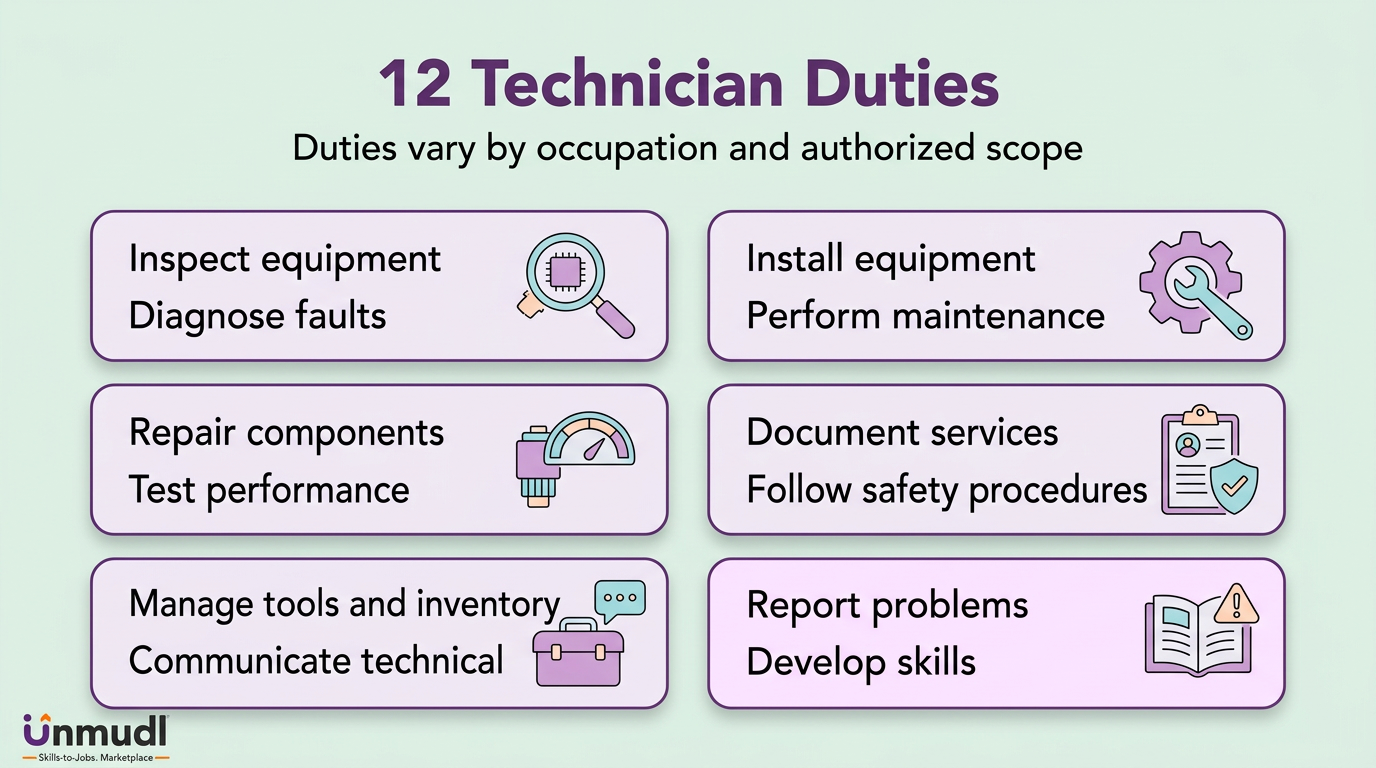
Twelve technician duties from inspecting equipment and diagnosing faults to reporting problems and developing skills

There are 12 main duties of a technician. The duties are work functions that occupational records show inside individual occupations, not credential names. The main duties of a technician are to inspect equipment, diagnose faults, install equipment, perform maintenance, repair components, test performance, document services, follow safety procedures, manage tools and inventory, communicate technical information, report problems, and develop skills. No single duty belongs to every technician occupation. Each duty below carries the occupation in which the record shows it.

1. Inspect Equipment

Equipment inspection is a pre-service examination of a device or system for physical defects, abnormal operation, wear, damage, calibration drift, or noncompliance. The inspection compares what the worker observes against the manufacturer procedure, the test criteria, and the workplace standard for that equipment. Identifying those conditions early raises the share of defects corrected before the equipment returns to service. An inspection counts as complete only when its result is documented against the criterion used. Visual judgment alone leaves nothing a later reader is able to check. O*NET's 2026 record for Medical Equipment Repairers gives inspection, testing, and troubleshooting a major role in the occupation. Supervisors read a documented inspection result as the starting point for any fault that needs a diagnosis.

2. Diagnose Faults

Fault diagnosis is the analytical process of identifying why equipment or a system is not operating as intended. The process separates the observed symptom from the component, control, software, or system condition responsible for it. The separation works through error information, operator reports, technical documentation, measurements, and controlled tests. Diagnosing before repairing lowers the number of parts replaced without curing the malfunction. Corrective work begins only after the cause has been isolated, since an adjustment made on the symptom leaves the responsible condition in place. BLS records that medical equipment repairers diagnose problems before adjusting mechanical, electronic, hydraulic, or software elements. Maintenance teams treat a confirmed cause as the specification for the repair or the installation that follows.

3. Install Equipment

Equipment installation is the placement, connection, configuration, and integration of equipment to specification so that the equipment enters service. Installation runs through manufacturer instructions, the electrical and mechanical requirements of the site, commissioning or acceptance criteria, and the required documentation. Verified installation raises the probability that equipment meets its specified operating criteria on the first day of service. Equipment enters service only after the correct setup has been verified, because an unverified installation carries its errors into every later maintenance visit. Industrial engineering technologists and technicians coordinate equipment installation, transfer, startup, qualification, and release, according to O*NET's 2026 record for the occupation. Operators receive installed equipment together with the maintenance schedule that keeps it serviceable.

4. Perform Maintenance

Maintenance is scheduled or condition-based work that keeps equipment functional and serviceable. Preventive maintenance follows a planned interval of inspection, servicing, adjustment, replacement, and testing. Predictive maintenance adds condition information that identifies developing problems. Maintaining equipment on a defined interval reduces the deterioration that turns a worn part into a stopped machine. The interval is set by the equipment, the manufacturer guidance, the operating conditions, and the applicable regulation, not by a generic technician schedule. BLS lists preventive maintenance among the core duties of medical equipment repairers. Maintenance teams log each interval so that a component found worn during maintenance moves straight to repair.

5. Repair Components

Component repair is corrective work that restores a system to specified operation by adjusting, repairing, or replacing parts after diagnosis. Repair entails disassembling the machinery, replacing the defective component with an appropriate part under the technical instructions, isolating hazardous energy where the work requires it, and reassembling to specification. Restoring specified operation returns the equipment to service and closes the fault that the diagnosis opened. Repair stays within the technician's authorized scope. The parts and the technical instructions come from the manufacturer's specification. In O*NET's 2026 record, Industrial Machinery Mechanics disassemble machinery and repair or replace defective components. Supervisors accept a repair as finished only once a performance test has confirmed the result.

6. Test Performance

Performance testing is the verification that serviced or installed equipment operates within its required specifications. The test applies defined acceptance criteria through appropriate measuring instruments and records the reading against each criterion. Testing against a stated criterion raises the objectivity of the evidence that the work produced its intended result. A test is valid only when it names the criterion and the instrument. An undocumented works-or-does-not-work check proves nothing to a later reader. Testing and calibration carry high importance for Medical Equipment Repairers in O*NET's 2026 task data. Auditors treat the recorded test reading as the first entry in the service documentation.

7. Document Services

Service documentation is the written record of inspection, maintenance, calibration, malfunction, repair, parts, and corrective-action information for a piece of equipment. A complete record identifies the equipment, the work performed, the result, the date, and the required follow-up inside the employer's system. Documenting each service raises the traceability of the equipment's history for later technicians, supervisors, auditors, and operators. The record is written at the time of the work, because a history reconstructed later loses the reading that made the work verifiable. BLS lists maintenance and repair records as a core duty of medical equipment repairers. Auditors read the service record as proof that the safety procedure was followed during the work.

8. Follow Safety Procedures

Safety procedure compliance is the application of the hazard controls required for the work being performed. The controls include personal protective equipment (PPE) under Occupational Safety and Health Administration (OSHA) standard 29 CFR 1910.132. The controls also include hazardous-energy control under 29 CFR 1910.147 and electrical-safety work practices under 29 CFR 1910.332. The exposure sets which control applies. Following the control matched to the hazard lowers the injury exposure that the equipment, the energy source, or the circuit presents. A general OSHA Outreach course does not satisfy the training a specific OSHA standard requires. The training is matched to the job and the hazard rather than to the technician title. OSHA's 29 CFR 1910.132(f) requires affected employees to be trained on when PPE is necessary, what PPE is required, how to wear it, its limitations, and its care, maintenance, useful life, and disposal. Employers retrain workers when a change in the workplace or the PPE makes the earlier training obsolete, and the same discipline governs the tools those workers draw from inventory.

9. Manage Tools and Inventory

Tool and inventory management is the control of the availability, condition, identification, storage, and replenishment of the tools, replacement parts, and supplies that technical work requires. The control runs on inventory records that show what is on hand, what is worn, and what falls below the reorder point. Keeping tools and parts under control reduces the delays that a missing tool or component adds to a service call. Inventory records are updated at each issue and return, because a record that lags the shelf reports parts that are no longer there. Medical Equipment Preparers maintain equipment and inventory records and order instruments or supplies when inventory is low, as O*NET's 2026 record shows. Supervisors read the inventory record alongside the service record, and both records feed the technical information a technician communicates.

10. Communicate Technical Information

Technical communication is the explanation of equipment operation, faults, service actions, risks, and limitations to coworkers, operators, customers, supervisors, or other specialists. The explanation identifies the equipment or system, the observed condition, the action taken, and any unresolved limitation, in speech and in writing. Communicating the condition and the action raises the safety of the operation that follows the service and the accuracy of the follow-up. The explanation avoids ambiguous pronouns and undocumented assumptions, since an operator acts on the words exactly as spoken. BLS states that medical equipment repairers communicate technical information verbally and in writing and demonstrate equipment use. Operators act on the technician's explanation until a problem report changes the status of the equipment.

11. Report Problems

Problem reporting is the escalation of a defect, an unsafe condition, an unresolved malfunction, or a service issue to the person responsible for the next action. The report names the equipment, the condition found, and the action the technician did not complete. The receiver of the report owns the next step. Reporting an unresolved condition prevents it from being treated as completed work. A report is filed at the moment the technician's scope ends, because a defect held until the shift ends is a defect operating in service. Reporting defective equipment to supervisors or staff appears among the tasks of Medical Equipment Preparers in O*NET's 2026 record. Supervisors close a report only after the corrective action is recorded, and closing reports well is a skill that develops with the equipment.

12. Develop Skills

Skill development is the maintenance and extension of occupational competence as equipment, software, procedures, and standards change. The work runs through studying technical specifications and manuals, taking training from the manufacturer or a third-party vendor, and completing the continuing education a held credential demands. Extending competence with the equipment raises the range of systems a technician is authorized to service. Continuing education stays current only when it is logged against the credential's reporting period. An expired credential no longer attests to the competence it certified. The Association for the Advancement of Medical Instrumentation (AAMI) requires at least 30 continuing education units (CEUs) in each 3-year reporting period to maintain a Certified Biomedical Equipment Technician (CBET) credential. Certifying bodies renew a credential on logged education, and a renewed credential is what lets a technician's authorized scope grow after entry.

Inspecting equipment, diagnosing faults, installing equipment, performing maintenance, repairing components, testing performance, documenting services, following safety procedures, managing tools and inventory, communicating technical information, reporting problems, and developing skills together make a technician's work traceable from the first inspection to the last report. The traceability holds only while each duty stays inside the occupation's authorized scope. Reaching that scope is the purpose of the entry route into each technician occupation.
How to Become a Technician?

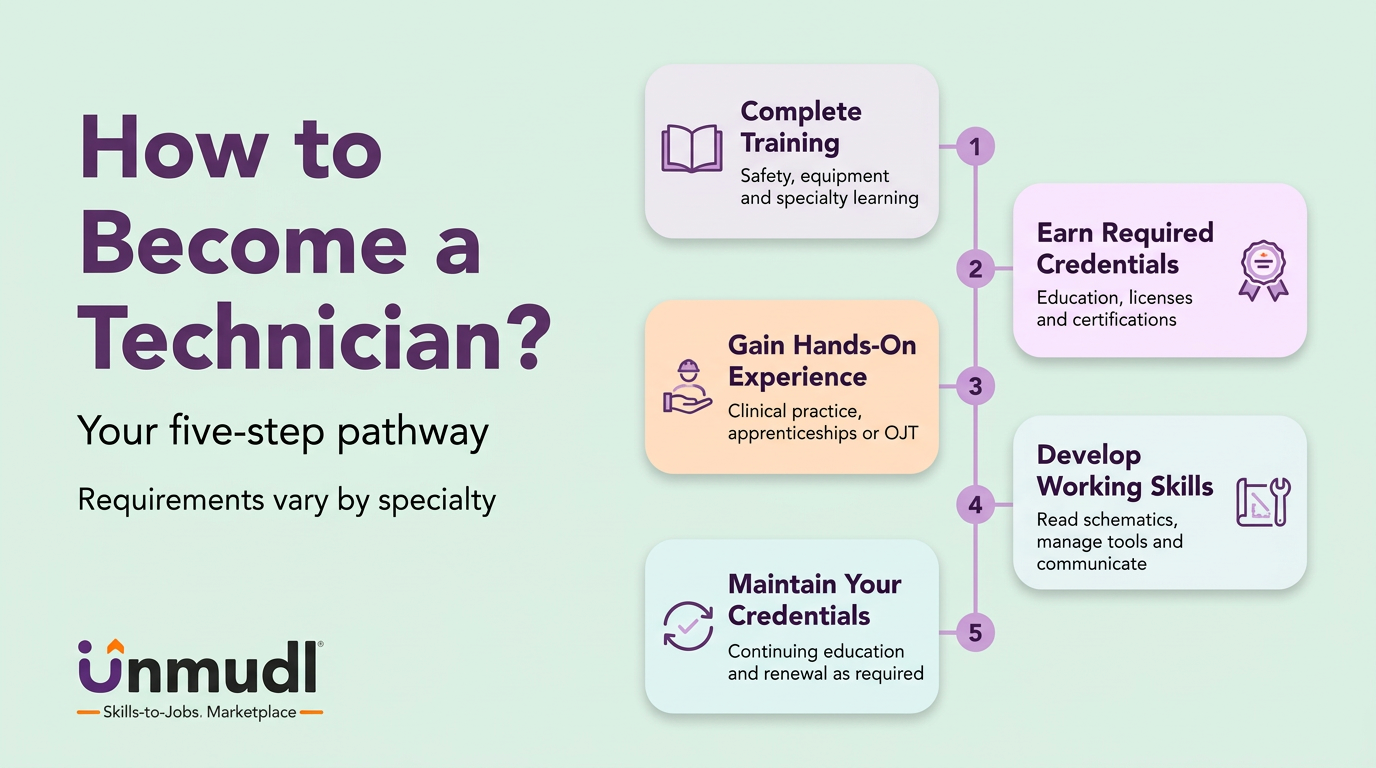
Five steps to become a technician: training, credentials, hands-on experience, working skills, and credential maintenance

Becoming a technician requires five steps. The steps are completing the training, earning the required credentials, gaining hands-on experience, developing the working skills, and maintaining the credential. The training step covers occupational health and safety training, equipment installation and preventive maintenance training, and fault diagnosis and systematic troubleshooting training. The same step covers sterile processing technician training, pharmacy technician training, the surgical technician program, and x ray technician certificate programs. The credential step covers the high school diploma, state registration or licensure, and three certifications. The three are the Certified Pharmacy Technician credential, the Certified Registered Central Service Technician credential, and the Environmental Protection Agency (EPA) Section 608 refrigerant handling certification. The experience step covers the externship or clinical rotation, the registered apprenticeship, and on-the-job training. The skills step covers reading technical drawings and schematics, managing tools and inventory, documenting services and reporting problems, and communicating technical information. The maintenance step covers continuing education, recertification, and specialty certification. The five steps are discussed below in the order a candidate meets them.

1. What Is the Training for a Technician?

The training for a technician is structured instruction that teaches the safety rules, the equipment procedures, and the diagnostic methods a worker applies before servicing equipment or patients without supervision. Technician training is delivered in three formats, which are the classroom course, the laboratory practice session, and the supervised clinical or field rotation. The classroom course supplies the theory of the system being serviced. The laboratory session converts that theory into a repeatable procedure on real equipment. The supervised rotation places the procedure inside a working pharmacy, hospital department, or job site. The length of that training varies by program. The BLS Occupational Outlook Handbook records two program lengths. Pharmacy technician programs award a certificate after 1 year or less, while heating, air conditioning, and refrigeration programs run from 6 months to 2 years. The seven training courses and programs for the role are set out below.

1.1 Occupational Health and Safety (OHS) Training

Occupational Health and Safety (OHS) training is hazard instruction that trains a worker to recognize, avoid, and report the physical, chemical, and electrical hazards of a workplace. OHS training covers hazard identification, PPE selection, lockout/tagout (LOTO) of energized equipment, and emergency response. The OSHA Outreach Training Program delivers this instruction as a 10-hour course for entry-level workers and a 30-hour course for workers with supervisory duties. A worker completes OHS training first because every later training module assumes the hazards are already known. HVAC technicians have one of the highest rates of injuries and illnesses of all occupations, which is why refrigerant handling and PPE use sit inside their safety instruction. Employers place OHS training before any equipment training.

1.2 Equipment Installation and Preventive Maintenance Training

Equipment installation and preventive maintenance training is platform instruction in which a worker learns to commission a new system and to service a running system on a fixed schedule. Installation training covers mounting, wiring, piping, and the commissioning test that proves the system meets its design specification. Preventive maintenance training covers the inspection interval, the filter or lubricant change, the calibration check, and the maintenance record. The two halves share one object, which is the equipment, and one goal, which is to stop a fault before the fault stops the equipment. An HVAC trainee meets this stage first in a formal program and again on the first job site. Supervisors pair the new hire with an experienced technician for the whole of this training, and fault diagnosis is the next method that pairing teaches.

1.3 Fault Diagnosis and Systematic Troubleshooting Training

Fault diagnosis and systematic troubleshooting training is method instruction that equips a worker to isolate the cause of a malfunction by testing one variable at a time. The method runs in four moves. First, the technician confirms the reported symptom on the equipment. Secondly, the worker reads the schematic to locate the components that produce that symptom. Thirdly, the worker measures each suspect component against its specification. Finally, the worker replaces or adjusts the failed component and retests the system. Root cause analysis (RCA) extends the method by asking why the component failed, so that the same fault does not recur. BLS names problem-solving skills as the quality HVAC technicians need to identify problems with malfunctioning systems and determine the best way to repair them. Training programs run the four moves on laboratory equipment before a trainee touches a customer system, and the same laboratory-first order governs the instrument work of sterile processing.

1.4 Sterile Processing Technician Training

Sterile processing technician training is decontamination instruction covering how a worker cleans, inspects, assembles, sterilizes, and stores reusable surgical instruments. A sterile processing technician program runs through the four areas of a sterile processing department (SPD), which are decontamination, assembly and packaging, sterilization, and sterile storage. The program covers microbiology, instrument identification, sterilizer operation, and the biological indicator test that proves a load is sterile. The externship inside the program places the student in a hospital or surgery center SPD, where the hours are logged by a supervisor. HSPA requires 400 hours of hands-on SPD experience for its CRCST credential. The certifying body, and not the school, sets that hour count. Employers read the logged SPD hours as proof that the training was applied, just as pharmacies read a completed dispensing program.

1.5 Pharmacy Technician Training

Pharmacy technician training is dispensing instruction under which a trainee learns to prepare, label, and record prescription medication under a pharmacist's supervision. Pharmacy technician training covers pharmacy arithmetic, recordkeeping, dispensing methods, pharmacy law and ethics, and the names, uses, and doses of medications. Vocational schools and community colleges deliver the training, and most programs include a clinical experience in a working pharmacy. The typical program awards a certificate within 12 months, and the longer programs lead to an associate's degree. The Pharmacy Technician Certification Board (PTCB) accepts completion of a PTCB-recognized education program as Pathway 1 to its certification exam. A pharmacy degree is accepted in place of the program. Pharmacies hire the trainee and start the on-the-job version of this training on the same day when no formal program is completed. An operating room role, in contrast, is entered through an accredited program.

1.6 Surgical Technician Program

A surgical technician program is perioperative instruction that readies a worker to prepare the operating room, arrange sterile instruments, and pass them to the surgeon during an operation. The program covers anatomy, physiology, microbiology, surgical procedures, sterile technique, and surgical pharmacology, and it places the student in operating room rotations under supervision. The programs are accredited by the Commission on Accreditation of Allied Health Education Programs (CAAHEP) or the Accrediting Bureau of Health Education Schools (ABHES). An accredited program awards a certificate in about 12 months or an associate degree in about 24 months. Graduation from one of those accredited programs is the eligibility condition for the Certified Surgical Technologist (CST) exam of the National Board of Surgical Technology and Surgical Assisting (NBSTSA). Hospitals treat the CST credential as the standard hiring signal for a surgical technician, and imaging departments hold the x ray technician to a registration of the same kind.

1.7 X Ray Technician Certificate Programs

X ray technician certificate programs are imaging instruction that qualifies a worker to position a patient, set the radiation exposure, and produce a diagnostic radiograph. The programs cover radiographic exposure, image processing, radiographic procedures, radiation protection, anatomy, and patient care, with clinical rotations in hospitals and imaging centers. Certificate programs run about 12 months, and associate degree programs run about 2 years, with accreditation from the Joint Review Committee on Education in Radiologic Technology (JRCERT). The American Registry of Radiologic Technologists (ARRT) has required an associate degree or higher, in any discipline, for its radiography exam since January 1, 2015. A certificate holder therefore pairs the certificate with a degree before testing. Imaging departments hire the radiographer who holds the ARRT registration and the state license that radiation regulation demands.

Completing the seven courses and programs gives the candidate the safety, equipment, and specialty knowledge that the credential step tests.

2. What Are the Credentials Required for a Technician?

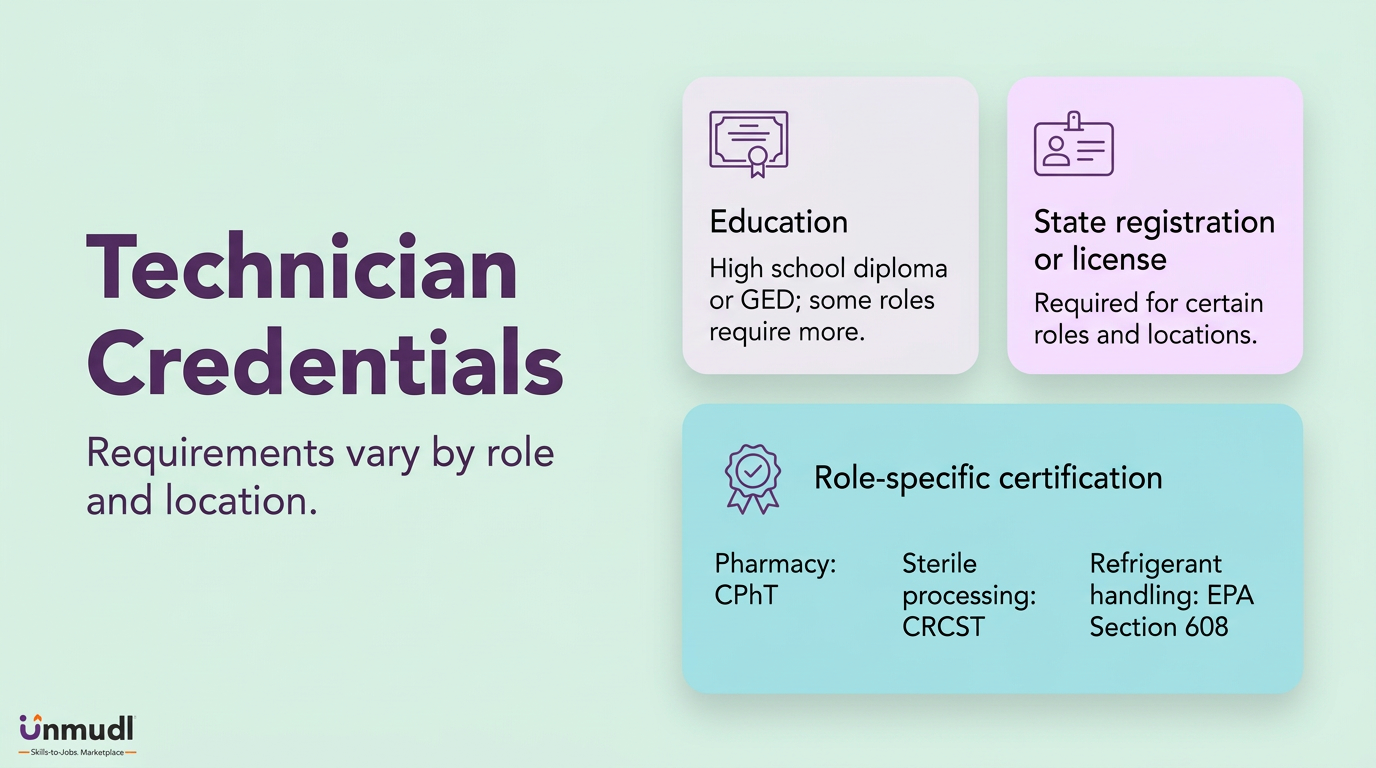
Technician credentials including education, state registration or licensure, and role-specific certifications

The credentials required for a technician are the high school diploma, the state registration or license, and the occupation-specific certification. Each one is demanded by an employer, a state board, or a federal agency before the worker performs regulated tasks. A credential is a formal award that a third party issues after verifying education, experience, or an exam result. The three credential types differ in their issuer. The diploma is issued by a school, the registration or license by a state board, and the certification by a professional body or a federal agency. BLS records the high school diploma as the entry award for pharmacy work and the postsecondary nondegree award as that award for HVAC work. The five credentials are described below in the order they are earned.

2.1 High School Diploma or Equivalent

A high school diploma or equivalent is the minimum education award every technician occupation requires before training or registration begins. The General Educational Development (GED) credential is the accepted equivalent. The diploma is the first item in the state requirements for pharmacy technicians. Students who want to become HVAC technicians are advised to take vocational education, math, and physics courses. Training programs and state boards verify the diploma at application. Admissions offices treat the diploma as an entry gate rather than as a qualification for the job itself, and the qualification for a regulated task comes from the state.

2.2 State Registration or Licensure

State registration or licensure is the permission a state board grants a worker to perform a regulated technician task inside that state. Registration records the worker with the board, and licensure adds a state exam or a training condition to the record. Most states regulate pharmacy technicians, according to BLS. The state requirements combine a diploma, a training program, an exam, fees, continuing education, a criminal background check, and a minimum age. Licensure for HVAC technicians and radiographers is set by individual states and localities, and CareerOneStop lists the licensing board requirement for each state. State boards renew the license on their own cycle, separate from certification renewal.

2.3 Certified Pharmacy Technician (CPhT) Credential

The Certified Pharmacy Technician (CPhT) credential is the national certification a pharmacy technician earns by passing the Pharmacy Technician Certification Exam (PTCE) of the PTCB. Eligibility runs through two pathways. Pathway 1 is graduation from a PTCB-recognized education or training program. Pathway 2 is a minimum of 500 hours of equivalent work experience as a pharmacy technician, complete at the time of application. The application also requires residence in the United States and full disclosure of criminal and State Board of Pharmacy actions. The National Healthcareer Association (NHA) offers the ExCPT exam as the second route to the same CPhT title. PTCB reports that its CPhT program is accredited by the National Commission for Certifying Agencies (NCCA) and that employers prefer the PTCB credential and a portion of them require it. Pharmacies read the CPhT credential as the technician's proof of medication-safety knowledge, and sterile processing departments read the CRCST the same way.

2.4 Certified Registered Central Service Technician (CRCST) Credential

The Certified Registered Central Service Technician (CRCST) credential is the entry-level sterile processing technician certification that HSPA awards after a 150-question exam and 400 documented hours of hands-on experience. The 400 hours are completed in a sterile processing department, either within the 5 years before the application or within 6 months after passing the exam under provisional certification. Provisional certification is revoked if the hours are not submitted inside that 6-month window. The Certification Board for Sterile Processing and Distribution (CBSPD) issues the Certified Sterile Processing and Distribution Technician (CSPDT) credential as the second certification in the same field. HSPA sets the exam at 150 multiple-choice questions in 3 hours. Employers prefer or require one of the two credentials for sterile processing technician jobs, whereas refrigerant work turns on a federal card rather than on an employer preference.

2.5 EPA Section 608 Refrigerant Handling Certification

The EPA Section 608 certification is the federal certification that the U.S. EPA requires of a technician who maintains, services, or disposes of equipment containing regulated refrigerants. Section 608 is the part of the Clean Air Act that governs refrigerant recovery, recycling, and disposal. The certification is earned by passing an exam, and BLS records the exam as part of most postsecondary heating, ventilation, air conditioning, and refrigeration (HVACR) programs. Certification is issued in four types, which are Type I for small appliances, Type II for high-pressure appliances, Type III for low-pressure appliances, and Universal for all three. The Section 608 card does not expire. Contractors verify the Section 608 card before assigning refrigerant work.

Holding the diploma, the state permission, and the occupational certification together lets the credential holder start the supervised experience that turns a credential into competence.

3. How Does a Technician Gain Hands-On Experience?

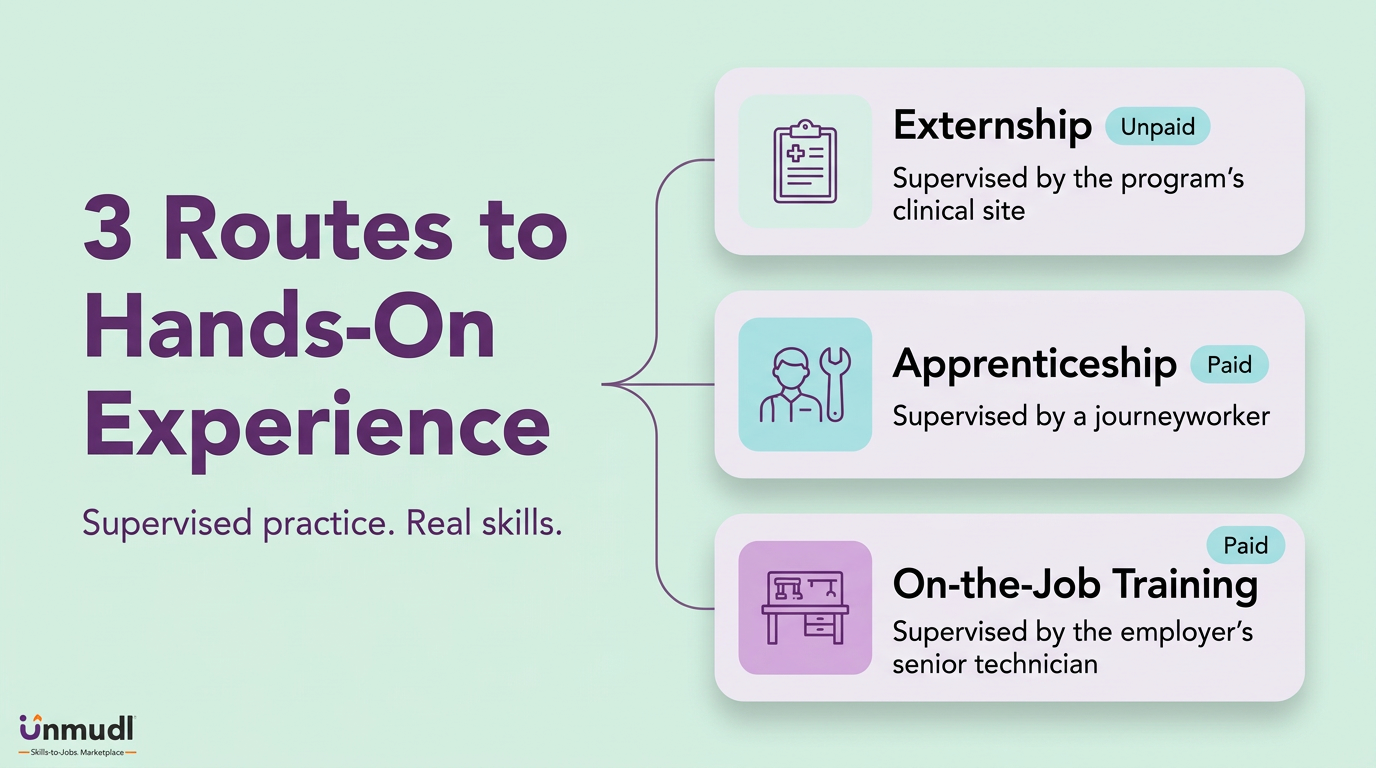
Three routes to technician hands-on experience: externship, apprenticeship, and on-the-job training

A technician gains hands-on experience through three routes, namely the externship, the apprenticeship, and employer-delivered on-the-job training. Hands-on experience is supervised practice on real equipment or real patients that a certifying body or an employer counts in hours. The three routes differ in who pays and who supervises. The externship is unpaid and supervised by a training program's clinical site. The apprenticeship is paid and supervised by a journeyworker. On-the-job training is paid and supervised by the employer's senior technician. BLS classifies the post-hire training period as moderate-term for a pharmacy technician and long-term for an HVAC technician. The three routes are explained below.

3.1 Externship or Clinical Rotation

An externship, or clinical rotation, is an unpaid, supervised placement inside a training program that puts the student in a working department for a fixed number of hours. The placement site is a pharmacy, a sterile processing department, an operating room, or an imaging department, depending on the program. The site supervisor logs the hours, and certifying bodies count the logged hours toward experience requirements. HSPA counts paid and volunteer SPD hours alike toward its 400-hour requirement, which is how a program externship counts. Sonography and radiography programs run the same placement as a clinical component in a hospital, a physician's office, or an imaging laboratory. Clinical sites convert a student's classroom procedure into a department's working routine, and an apprenticeship makes the same conversion on a wage.

3.2 Registered Apprenticeship

A registered apprenticeship is a paid, employer-sponsored training program registered with the U.S. Department of Labor or a state apprenticeship agency that combines on-the-job learning with related classroom instruction. The federal apprenticeship regulation, 29 CFR Part 29, sets the industry standard at a minimum of 2,000 hours of on-the-job learning. The same regulation recommends 144 hours of related instruction for each year of the apprenticeship. Programs run from 1 to 6 years, and the apprentice's wage rises in steps toward the journeyworker rate. HVAC, electrical, and industrial maintenance technicians train through this route. An HVAC apprenticeship teaches safety practices, blueprint reading, heating and cooling systems, and the use of tools across its term. Apprenticeship sponsors issue a Certificate of Completion at the end of the term, while on-the-job training ends when the employer judges the worker competent.

3.3 On-the-Job Training

On-the-job training (OJT) is paid instruction an employer delivers after hiring, in which a new hire performs basic tasks beside an experienced technician until the worker reaches competency. OJT starts with the simplest tasks. A new HVAC technician insulates refrigerant lines and cleans furnaces before cutting and soldering pipes or checking electrical circuits. A new pharmacy technician learns to perform the tasks of the job safely while working alongside experienced technicians, over a period that lasts less than 1 year. The moderate-term label on pharmacy OJT and the long-term label on HVAC OJT amount to a difference of months against years. Employers use OJT to add the site-specific procedure that no external program teaches.

Logging the externship, apprenticeship, or OJT hours gives the worker the experience record that certifying bodies and employers check, and the same hours are where the working skills are built.

4. What Are the Skills a Technician Must Develop?

The skills a technician must develop are reading technical drawings, controlling tools and inventory, documenting services, and communicating technical information. A skill is a learned ability that a worker applies on the job without direct instruction. The four skills sit on top of the training and the credentials, and they are built during the experience hours. BLS lists detail orientation, mechanical skills, math skills, problem-solving skills, communication skills, and technology skills among the qualities HVAC and pharmacy technicians need. The four skills follow below as instructions.

4.1 Read Technical Drawings and Schematics

Read the technical drawing before touching the equipment. A technical drawing is a scaled diagram that shows the position, dimension, and connection of every component in a system. A schematic is the symbolic version that shows the electrical or fluid path. Reading the drawing locates the component that a symptom points to, and it locates the isolation point that lockout/tagout needs. Blueprint reading is a listed subject in HVAC apprenticeship instruction. Practice the skill on the drawing of the equipment already installed at the job site. Workers who read schematics fluently cut the diagnosis time because they measure the right component first, provided the right instrument is in the tool set.

4.2 Manage Tools and Inventory

Keep the tool set complete and the parts inventory counted. Tool and inventory management, as a working skill, means the control of the hand tools, test instruments, consumables, and spare parts a technician needs to finish a service call without a second visit. Count the tools at the start and the end of each shift. Log the parts consumed against the work order so the stock level stays accurate. Pharmacy technicians organize inventory and alert pharmacists to shortages of medications or supplies as a listed duty, according to BLS. Supervisors read a clean inventory record as the sign of a worker who finishes calls in one visit, and the service record is where that visit is documented.

4.3 Document Services and Report Problems

Document every service in the record the employer uses. Service documentation, as a working skill, produces the written or digital record of the fault found, the parts replaced, the test results, and the time spent on a job. A computerized maintenance management system (CMMS) holds the record in industrial settings, and a pharmacy computer system holds the patient and prescription record in a pharmacy. Report any problem the service did not resolve to the supervisor in the same record. HVAC technicians keep records of work performed, including the time it took and the parts used, and detail orientation is the quality that record keeping demands. Auditors treat the service record as the proof that the maintenance happened, and the customer hears that proof in the technician's explanation.

4.4 Communicate Technical Information

Explain the fault, the fix, and the cost in the words the customer or the pharmacist uses. Technical communication is the translation of a diagnosis into a decision the listener can act on. State the symptom, the cause, and the recommended action in three sentences. Listen for the detail the customer adds, since that detail names the trigger condition. Communication skills appear in the BLS quality list for pharmacy technicians, who take prescription orders from pharmacists and doctors. Customer-service skills appear in the same list for HVAC technicians, who work in customers' homes and offices. Employers rate communication skills alongside technical skills in the hiring qualities they list.

Developing the four skills turns a credentialed worker into a productive one, and the productivity is what the credential must keep proving in each renewal cycle.

5. How Does a Technician Maintain the Credential?

A technician maintains the credential by completing continuing education, renewing the certification on its cycle, and adding a specialty certification as the scope of work expands. Credential maintenance is the set of conditions a certifying body imposes to keep a certification active after it is first awarded. The conditions differ by body. HSPA renews the CRCST every year against 12 continuing education credits and a $50 fee. PTCB renews the CPhT every 2 years against 20 hours of continuing education and a $55 fee. A credential that misses its renewal lapses, and a lapsed CRCST requires retaking the exam. The three maintenance activities are briefly discussed below.

5.1 Continuing Education

Continuing education (CE) is instruction a certified technician completes after certification, measured in hours or credits, to keep the credential current with new standards and technologies. CE covers updated sterilization standards, new instrument technologies, and changed regulatory guidance in sterile processing, and pharmacy law, patient safety, pharmacology, compounding, and immunization in pharmacy. PTCB requires that 1 of its 20 CE hours be in pharmacy law and 1 in patient safety, and it accepts no CE hours completed before the certification was granted. Up to 10 of the 20 hours come from in-service training documented by a supervising pharmacist. Certificants complete the CE inside the renewal cycle, on or before the expiration date, because the renewal application asks for that record.

5.2 Recertification

Recertification is the renewal application, the CE record, and the fee a certifying body processes to extend a certification for one more cycle. The cycle length is set by the body. HSPA runs an annual cycle for the CRCST, and the renewal requires 12 continuing education credits related to the central sterile processing field. PTCB runs an approximately 2-year cycle for the CPhT, CPhT-Adv, and CPTEd credentials. A late application incurs a late fee, and a certification that lapses moves to reinstatement, where PTCB requires 2 hours of pharmacy law instead of 1. Certifying bodies list the expiration date in the certificant's online account, beside any specialty credential the holder adds.

5.3 Specialty Certification

A specialty certification is an advanced credential a certified technician adds to prove competence in one narrower task set. PTCB offers the Certified Compounded Sterile Preparation Technician (CSPT) credential for the aseptic preparation of sterile medications, and the CSPT is renewable only while the holder's CPhT stays active. HSPA offers the Certified Instrument Specialist (CIS) and the Certified Endoscope Reprocessor (CER) credentials above the CRCST. In HVAC, manufacturer and industry certifications sit above the EPA Section 608 requirement, and BLS records them as optional credentials that individual employers prefer or require. Sterile compounding technician, nuclear pharmacy technician, and medication history technician are the specialized roles a pharmacy technician advances into with additional training. Employers read a specialty credential as the marker of a worker who is ready for a trainer or supervisory role.

Keeping the CE record, the renewal date, and the specialty credential current completes the five steps. A worker who holds all five moves from an entry-level post to a supervisor, trainer, or specialist role inside the same occupation, and the occupation is what sets the pay.

How Much Does a Technician Earn?

Technician hourly median pay examples for pharmacy, HVAC, and diagnostic medical sonography

A technician earns a median wage between $22.00 and $46.44 per hour in the United States, depending on the occupation, according to BLS wage data for May 2025. A pharmacy technician earns $22.00 per hour, about $3,813 per month, about $11,438 per quarter, and $45,750 per year. An HVAC technician salary stands at $29.33 per hour, about $5,084 per month, about $15,253 per quarter, and $61,010 per year. An ultrasound technician salary, recorded under the diagnostic medical sonographer title, stands at $46.44 per hour, about $8,049 per month, about $24,148 per quarter, and $96,590 per year. A surgical technician earns a median of $64,700 per year, and a radiologic technologist earns $81,390 per year in the same release. The monthly and quarterly figures are derived by dividing each annual median by 12 and by 4, and they are not published figures.

The average annual rate across the five technician occupations is $69,888, which is the derived mean of the five annual medians. The published median for the health technologists and technicians group is $58,180, and the median for all occupations is $50,980, both for May 2025. The wage of a technician rises with the entry education of the occupation. The high school diploma occupation pays $45,750, the postsecondary nondegree award occupations pay $61,010 and $64,700, and the associate's degree occupations pay $81,390 and $96,590.

Does a Technician Need a Degree?

No, a technician does not universally need a college degree, since each technician occupation sets its own minimum award. BLS sets the typical entry-level education at a high school diploma for a pharmacy technician and at a postsecondary nondegree award for an HVAC technician and a surgical technician. The same handbook sets it at an associate's degree for a diagnostic medical sonographer and a radiologic technologist. What degree you need to be a technician therefore follows the occupation you pick, not the technician title. A pharmacy technician certification through PTCB requires a recognized training program or 500 hours of work experience, not a degree. The ARRT radiography exam is the one case in this set that requires an associate degree in any discipline. Whichever award the occupation sets, a job posting is where the employer states it.

How to Find a Technician Job?

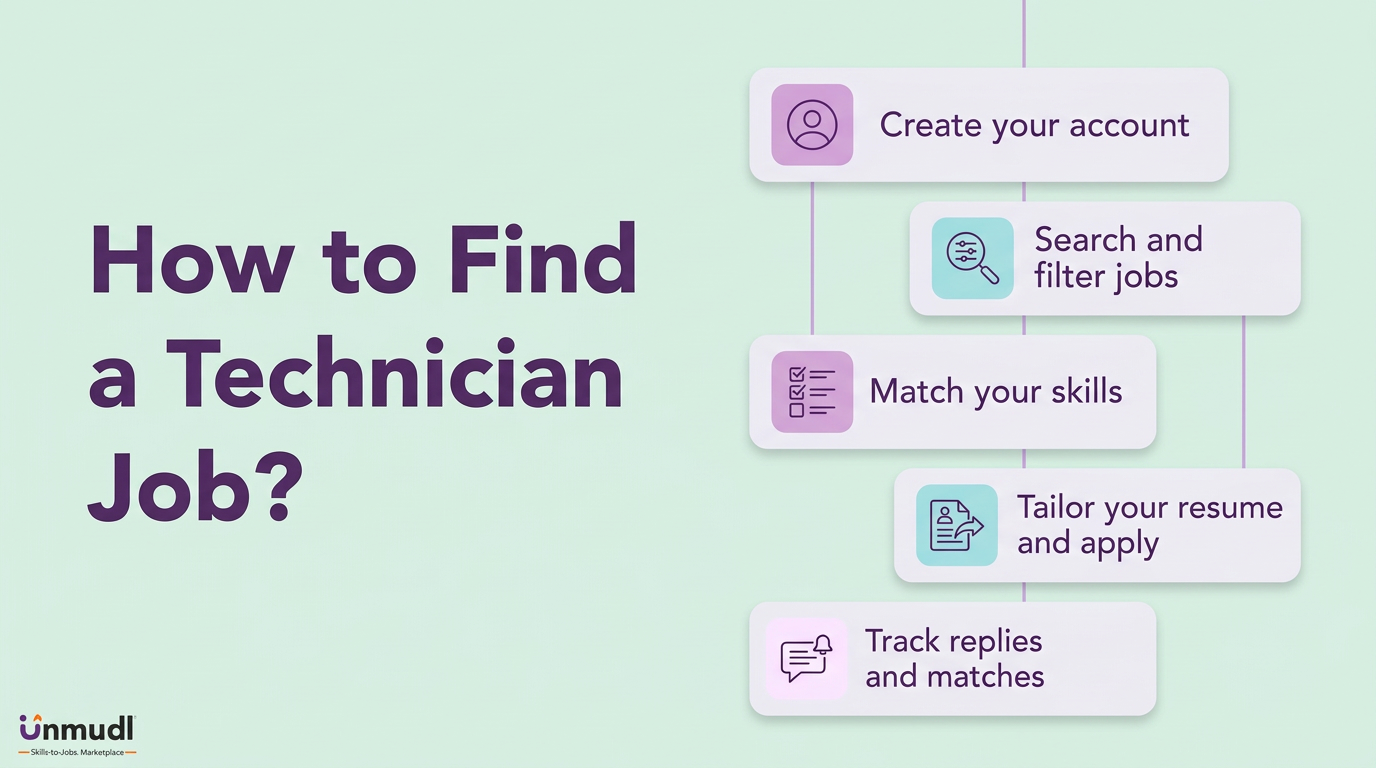
Steps to find a technician job: create an account, search and filter jobs, match skills, tailor a resume and apply, and track replies

A technician job is a paid position in which an employer assigns the applied technical work of one classified occupation to a worker under a posted title. The posted title carries the occupation, the location, the shift, the compensation, and the preferred skills. Preferred skills are the lines an employer reads first on an application. Sterile processing technician jobs, for example, sit under the occupation that O*NET names Medical Equipment Preparers. A search for that title returns postings that ask for cleaning, sterilizing, and instrument-inspection skills. Postings that list those skills are reached through a search channel. There are three channels for finding a technician job. The channels are employer career pages, general job boards, and skills-to-jobs marketplaces such as Unmudl. Unmudl posts openings from the employers that hire out of its courses. The steps to find one on Unmudl are listed below.

  1. Create a free marketplace account by entering your details, setting a password, and confirming the 6-digit code sent to your email.
  2. Open the Get Jobs tab, which is the marketplace's job board, and search by role, location, or industry.
  3. Filter the results by employment type, job type, employer, compensation, critical skills, benefits, relevant courses, shift preference, and location type.
  4. Read the posting's preferred-skills list against your own training record before applying.
  5. Click Apply Now to submit the application on the portal, where the attached resume is tailored to the posting's keywords.
  6. Track the response through the inbox and notifications tab, and get matched with employers in the Hiring Network.
Unmudl job board with job-title and location search fields and technician job listings

The job type filter is the board control that separates job openings from apprenticeships, work-based learning placements, and internships. The Unmudl job board listed 2,077 technician-related postings on 23 September 2026. Of those postings, 2,007 were job openings and 57 were apprenticeships. Employment through the board is not guaranteed, since each hiring decision belongs to the posting employer. Filtering by job type lets a candidate match the posting to the entry route that their credential supports, and the relevant-courses filter points to the course that route requires.

What is the Best Online Technician Course?

The best online technician course is the course whose learning outcomes map to the credential or occupation the learner has already chosen. Course quality has no meaning until the target occupation is named. An online pharmacy technician course prepares a candidate for the Pharmacy Technician Certification Examination and for the practice rules of the candidate's State Board of Pharmacy. A sterile processing technician course readies a candidate for the CRCST examination, while the hands-on experience hours are completed at a worksite rather than online. Completion of either course produces an assessment-based certificate. An assessment-based certificate is a non-degree education credential built around defined learning outcomes. The Institute for Credentialing Excellence (I.C.E.) separates that certificate from personnel certification, because certification validates competence against a standard independent of any single training event. Unmudl lists Biomedical Equipment Maintenance among its Unmudl Originals, an online on-demand course tagged with repairing, equipment maintenance, and troubleshooting skills for learners heading into medical equipment repair. Choosing the course by its target credential keeps the online study attached to the occupation the learner will be hired into, and the occupation names the systems that the hire will maintain.

Which Systems Does a Technician Maintain?

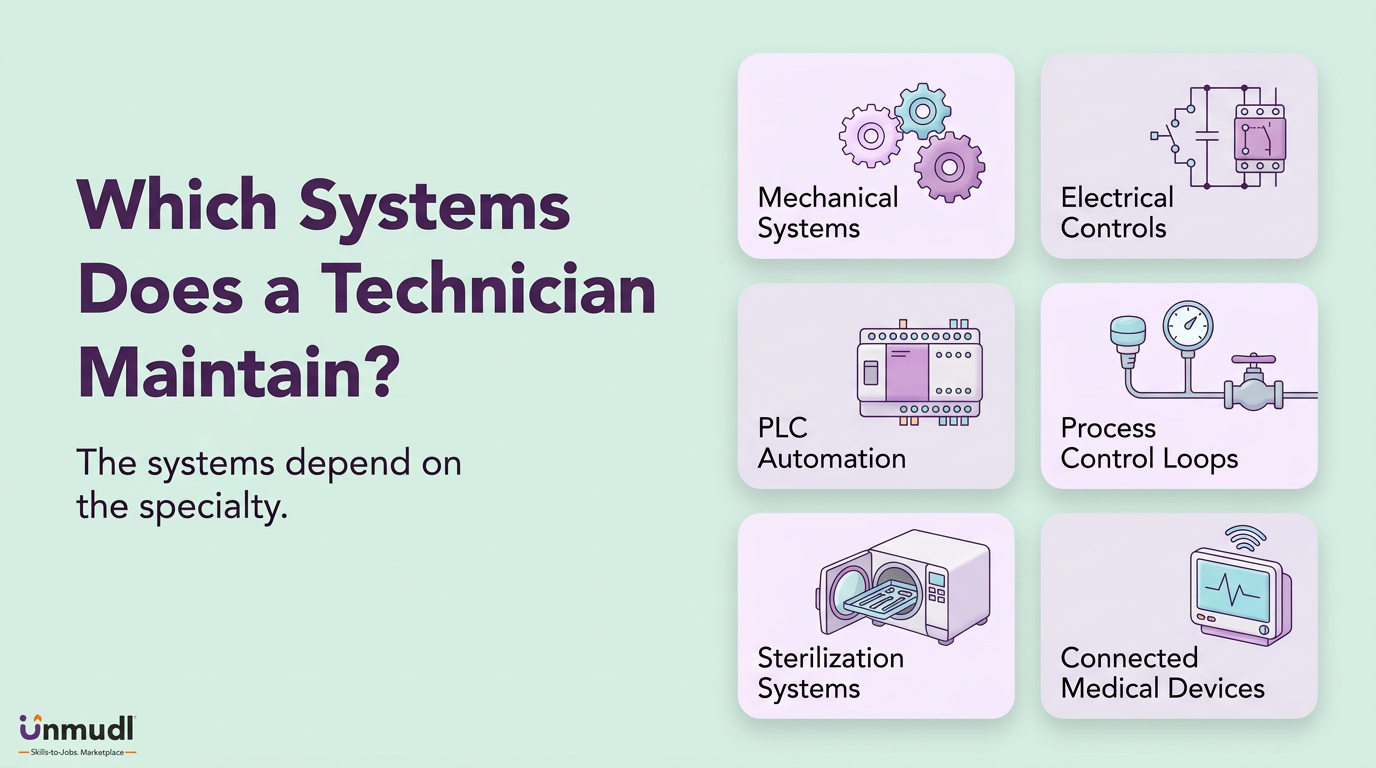
Six systems technicians maintain: mechanical, electrical controls, PLC automation, process control, sterilization, and connected medical devices

A system, in technician work, is an integrated arrangement of components that performs one function and drifts out of specification as a whole when any one component fails. The systems a technician maintains are set by the occupation. A moving assembly, a control circuit, an automation controller, an instrument loop, a sterilization line, and a connected medical device each belong to a different occupational profile. There are six system families across the technician occupations reviewed here. The families are mechanical systems, electrical and electronic control systems, programmable logic controller (PLC) automation systems, instrumentation and process control loops, sterilization and decontamination systems, and connected medical device and network systems. Each family is briefly discussed below.

Mechanical Systems

Mechanical systems are assemblies of moving components inside production and processing machinery whose alignment, lubrication, and wear decide whether the machine runs to specification. A mechanical assembly deteriorates through misalignment, lost lubrication, and worn parts. Its upkeep restores the alignment, replenishes the lubricant, and replaces the worn component before reassembly and a run test. Industrial Machinery Mechanics, the occupation O*NET files this machinery under, repair, install, adjust, and maintain this class of machinery. O*NET's 2026 skills record for that occupation places operation and control beside repairing, so the mechanic runs the machine as well as fixing it. Mechanics read the blueprint and the manufacturer's specification before the first component comes off, and the control circuit drawn on the same sheet belongs to a second family.

Electrical and Electronic Control Systems

Electrical and electronic control systems are circuits, electronic components, and electrical controls that switch, regulate, and protect the power a machine draws. A control fault is isolated by reading test-instrument measurements against the schematic. The reading continues until the failed component or the mis-set control is located. Electrical and Electronic Engineering Technologists and Technicians, the occupation BLS and O*NET record for this work, assemble, test, maintain, repair, and troubleshoot this circuitry and its control systems. The 2% growth BLS projects for the occupation to 2035 is the lowest figure among the technician types that carry a projection in this article. Repairers isolate hazardous energy before the repair on an energized circuit begins, and the controller that switches that energy is the next family.

Programmable Logic Controller (PLC) Automation Systems

PLC automation systems are industrial controllers whose hardware, programmed logic, inputs, outputs, and communications run automated machinery without an operator at every step. An automation fault appears either in the controller's diagnostics or in the machine's response to an input. The maintainer therefore reads the logic against the physical inputs and outputs. The controller platform installed at a site fixes which diagnostics, communications, and logic conventions that maintainer must read. Occupational profiles for industrial maintenance and for electrical and electronic technician work list PLC-related technology. The International Society of Automation (ISA) offers technician education covering industrial measurement, controls, automation, and PLC-related systems. Control crews treat the platform in use, not controllers in general, as the object of their upkeep, and the sensors feeding that platform form a loop of their own.

Instrumentation and Process Control Loops

Instrumentation and process control loops are chains of sensors, transmitters, control devices, and process signals that measure a variable and hold it at a set point. A loop fails when a sensor drifts, a transmitter mis-scales the signal, or a control device stops responding. Each part of the loop is checked within the worker's authorized scope. That scope is built through formal instruction. ISA's training catalog lists Introduction to Industrial Processes, Measurement and Control among its technician courses. That listing places loop maintenance in a named field of instruction. Loop knowledge lets the holder interpret a control strategy rather than only swap a failed part. Instrument crews log every loop check against the measurement standard the site uses, much as a sterilization line logs every sterilizer test.

Sterilization and Decontamination Systems

Sterilization and decontamination systems are autoclaves, sterilizer-test procedures, and sterile storage-and-distribution lines that return reusable medical instruments to a sterile state. A sterilization line fails when a sterilizer test fails or when a defective instrument passes into storage. Each test result is recorded and each defect is reported to the supervisor before the line moves on. The workers who run that line belong to one classified occupation. Medical Equipment Preparers is the classified occupation that carries the Sterile Processing Technician title. Preparers in that occupation operate the autoclaves, record the sterilizer-test results, and monitor the equipment's operation across the shift. Preparers hold a tray in decontamination until the matching sterilization record exists, and the patient-care devices those trays serve now carry a software layer of their own.

Connected Medical Device and Network Systems

Connected medical device and network systems are patient-care devices whose software, network connections, and electronic-health-record integration make the device an information node as well as a physical machine. A connected device fails through a software fault, a network fault, or a cybersecurity exposure as readily as through a mechanical one. Its maintenance therefore adds a digital layer to inspection and repair. Healthcare technology management (HTM) professionals are taking on greater cybersecurity and software responsibilities, according to AAMI's report The State of HTM, 2025, published on 5 January 2026. The same report, in which approximately 1,000 HTM professionals participated, records greater device complexity and closer integration with IT and electronic health records. That digital layer belongs to HTM rather than to every technician occupation. Device repairers now read a network log with the attention they give a calibration record.

Matching a system family to its occupation shows a candidate which failure modes the job will pay them to prevent. The failure modes sit in specific equipment, and that equipment is served with specific tools.

Which Equipment and Tools Does a Technician Work With?

Equipment and tools are the two object classes of technician work, equipment being the device that receives the service and tools being the instruments that deliver it. The equipment a worker handles follows the technician type. A biomedical equipment technician services patient-care devices. A sterile processing technician handles reusable surgical instruments. An industrial equipment technician works on production machinery. A pharmacy technician measures and counts medications on dispensing equipment. Every type wears personal protective equipment when a hazard is present. There are five equipment classes and four tool classes across those types. The equipment classes are patient-care and diagnostic medical equipment, reusable surgical instruments and autoclaves, industrial production and processing machinery, medication preparation equipment, and personal protective equipment. The tool classes are hand and portable power tools, test instruments and calibration standards, technical drawings and manufacturers' manuals, and CMMS software. Both sets are briefly discussed below.

Patient-Care and Diagnostic Medical Equipment

Patient-care and diagnostic medical equipment is the set of devices used on a patient whose mechanical, electronic, hydraulic, and software elements a biomedical equipment technician installs, tests, calibrates, and repairs. Biomedical equipment technician is the title BLS attaches to Medical Equipment Repairers in its occupational handbook. The repairer diagnoses the fault before adjusting any of those elements and demonstrates the device's operation to clinical staff after service. Calibration holds the device inside the manufacturer's specification. Preventive maintenance exposes deterioration before failure. The maintenance record ties both actions to a date. Demand for the recorded work is rising. BLS projects 13% growth for the occupation to 2035, the fastest rate of any technician type with a projection in this set. Repairers return no device to service without a passed performance test, and a sterile processing department returns no tray without a passed sterilizer test.

Reusable Surgical Instruments and Autoclaves

Reusable surgical instruments and autoclaves are the instrument sets that return from procedures for decontamination and the steam sterilizers that render them sterile again. An instrument tray is cleaned, inspected for leaks and for loose or worn parts, assembled, and sterilized before storage. Sterile processing technicians work under the classified occupation Medical Equipment Preparers. That occupation's reported task set includes assembling instrument trays and replenishing instrument stock when it runs low. Inventory replenishment keeps a tray from being held back for a missing instrument. Preparers report a defective instrument rather than pass it to the next tray, and the same rule governs a defective component on production machinery.

Industrial Production and Processing Machinery

Industrial production and processing machinery is the powered machinery that produces or processes material on a production line and that an equipment technician keeps running to output specification. A machine of this class is inspected for defects and its malfunction is diagnosed. The machine is then disassembled, the defective component is repaired or replaced, and a verification run confirms adequate performance. Industrial Machinery Mechanics, as O*NET classifies them, hold that task sequence. Maintenance and Repair Workers, General, a second classified occupation, list technician variants among their sample titles for the upkeep of machines and structures. An equipment technician title therefore appears inside occupations whose formal name omits the word. Mechanics consult the manufacturer's manual before the first fastener comes off, and a pharmacy's apparatus carries a procedure of its own.

Medication Preparation Equipment

Medication preparation equipment is the measuring, counting, labeling, and storage apparatus a pharmacy technician uses to prepare a prescription under a pharmacist's direction. Pharmacy Technicians, in O*NET's task record, measure, count, label, record, store, and process prescription information. The equipment therefore records a dose as well as dispensing it. Equipment maintenance is not the occupational core of that work, which separates the pharmacy technician from every repair occupation in this set. The regulated status of that work comes from the state and not from the equipment maker. Pharmacy technicians operate the equipment inside the scope their state pharmacy board allows, and protective equipment is the one class that is worn rather than serviced.

Personal Protective Equipment

Personal protective equipment (PPE) is the worn equipment that stands between a worker and a hazard the workplace has not engineered away. PPE has a useful life and a maintenance need of its own. A wearer cares for it, inspects it, and disposes of it at the end of that life. OSHA 29 CFR 1910.132(f) makes the useful life, the limitations, and the disposal of PPE part of the training an employer owes an exposed worker. The standard fixes no universal hour count and no calendar renewal for that training. Wearers replace a damaged item rather than adjust it, whereas a hand tool is inspected before each use.

Hand and Portable Power Tools

Hand and portable power tools are the handheld instruments, manual or powered, through which a worker applies force to a fastener, a component, or a material. A tool of this class carries its own hazard. Guarding, inspection before use, correct selection, and the matching PPE govern its operation. OSHA 29 CFR 1910 Subpart P holds the federal requirements for hand and portable powered tools and other hand-held equipment. The training obligation follows the tool and its hazard rather than the job title. Tool management keeps each tool available, identified, stored, and in condition, which prevents the service delay a missing tool causes. Crews inspect a tool before the shift rather than after the injury, and the test instrument is the one tool that is itself checked against a standard.

Test Instruments and Calibration Standards

Test instruments and calibration standards are the measuring devices and reference standards against which a serviced device's performance is compared. A performance test uses defined acceptance criteria and an appropriate instrument rather than an unrecorded pass-or-fail judgment. A calibration compares the instrument's reading with a traceable standard. The National Institute of Standards and Technology (NIST) Office of Weights and Measures provides laboratory-metrology education on measurement and calibration. That education supplies the traceability and uncertainty concepts a calibration record relies on. Traceability lets a later auditor follow a reading back to the standard that produced it. Calibration crews record the standard's identity beside every result, and the expected value comes from the drawing or the manual.

Technical Drawings and Manufacturers' Manuals

Technical drawings and manufacturers' manuals are the documented design and service information that connects a physical component to its intended condition. The documents include blueprints, wiring diagrams, schematics, layouts, and specifications. A drawing tells the reader where a component sits and what value it holds. A manual tells the reader the manufacturer's procedure for reaching that value. O*NET places reading blueprints, wiring diagrams, schematic drawings, and engineering instructions inside Electrical and Electronic Engineering Technologists and Technicians. Industrial machinery mechanics consult blueprints and manufacturers' specifications during troubleshooting and repair. Documentation of this kind turns a symptom into a located fault. Readers match the component in hand to the symbol on the sheet before any measurement is taken, and the measurement then goes into the work order.

Computerized Maintenance Management System (CMMS) Software

CMMS software is the maintenance-management application that holds work orders, asset records, schedules, maintenance histories, and parts information for the equipment a site owns. Each service action becomes a work order. The work order names the asset, the action, the outcome, the date, and the open follow-up, so the software keeps the traceability a paper record loses. O*NET identifies computerized maintenance-management software in maintenance occupations, including the occupation Maintenance Workers, Machinery. The training attaches to the employer's software and workflow rather than to any national syllabus. Users close a work order only after the follow-up field is filled.

Sorting the objects of a job into equipment served and tools used shows a candidate which hands-on competence each technician type is hired for, and the resume is where that competence is documented for an employer.

Does a Technician Need a Resume?

Yes, a technician needs a resume, since every employer in the hiring chain reads a documented record of skills, training, and experience before an interview is offered. A resume is the applicant-facing document that lists experience, education, skills, and credentials in the order a recruiter reads them. An applicant tracking system (ATS) reads the document before the recruiter does. Unmudl's resume-builder page puts the share of resumes filtered by applicant tracking systems before a human reviewer at 75%. That figure makes a single-column, standard-heading layout the safer format. The Unmudl resume-builder steps are listed below.

  1. Open the resume builder at unmudl.com/resume-builder and start without an account, an email, or a card.
  2. Enter your experience, skills, and education, which the builder arranges into a single-column ATS layout with the keywords recruiters scan.
  3. Create the free account to save the draft and download the ATS-compliant PDF.
  4. Apply through the marketplace's job board so the saved resume is tailored to each posting's keywords. A resume built that way names the applied role plainly, and the applied role is what separates a technician from an engineer.
Unmudl resume builder page with Build My Resume and See How It Works options

How Is a Technician Different From an Engineer?

A technician is different from an engineer in that the technician applies an established procedure to the condition of equipment while the engineer creates the design that procedure serves. An engineer, in the BLS engineering occupations, is the professional who creates a design. A mechanical engineering technician then installs, troubleshoots, maintains, tests, or helps implement that design. An engineering technician is the applied member of that pair. Industrial Engineering Technologists and Technicians, in O*NET's description, bring that theory to plant-layout and production problems in coordination with engineering staff. That relation puts no universal engineer above every technician, since medical equipment repairers, sterile processing technicians, and pharmacy technicians answer to clinical or pharmacy supervision instead. Education marks the second difference. An associate degree is the typical entry BLS sets for electrical and electronic engineering technologists and technicians. Their median wage stood at $78,190 a year, $37.59 an hour, in May 2025. A technician owns the equipment's condition, and an engineer owns its design. A pharmacy technician owns neither a machine nor a design, which makes the pharmacy career the one to judge on its own figures.

Is Pharmacy Technician a Good Career?

Yes, pharmacy technician is a good career for a worker who wants a regulated healthcare role, since BLS projects 6% employment growth from 2025 to 2035. The time it takes to become a pharmacy technician runs from under 1 year of on-the-job training to a postsecondary certificate of 1 year or less. The occupation's median pay sits below the all-occupations median of $50,980, which is the trade-off for the shortest entry route in this set. The career pays off only when the worker's training matches the requirements of the State Board of Pharmacy where the worker practices. The medication is the object of that work, and the object is also where a technician and a mechanic part ways.

What is the Difference Between Technician and Mechanic?

The difference between a technician and a mechanic lies in the object and the goal of the work, not in rank. A mechanic restores a machine's mechanical operation, while a technician applies a technical procedure to equipment, a system, a material, or information. A mechanic is a worker who overhauls, fits, tunes, and services machinery. Industrial Machinery Mechanics is the classified example of that worker. A mechanical engineering technician is the technician-side example. That worker installs, troubleshoots, maintains, and tests systems to help implement designs created with engineers.

BLS itself combines both words in the occupational title Automotive Service Technicians and Mechanics, so no categorical wall separates the two labels. Mechanical technician jobs are posted under maintenance and repair titles. The formal name of that occupation, Maintenance and Repair Workers, General, contains neither word. Employers define the label by the machinery in the posting rather than by a national hierarchy, and the training route behind the posting is what marks a skilled trade.

What is the Difference Between Technician and Skilled Trade?

The difference between a technician and a skilled trade is a difference of category: technician is a role label, while skilled trade is a field defined by its training structure. The two categories overlap rather than oppose each other. A skilled trade denotes a craft occupation entered through a structured work-and-learning route. Completion of a U.S. Registered Apprenticeship Program leads to a nationally recognized Certificate of Completion of Apprenticeship issued through the Office of Apprenticeship or a State Apprenticeship Agency. A technician role sits inside such a trade pathway when the work is maintenance or craft-based. The same role sits outside it when the work is laboratory, pharmacy, research, or engineering support.

A multi skilled technician is the clearest overlap. Maintenance and Repair Workers, General, in O*NET's description, apply multiple maintenance and craft competencies to keep machines, mechanical equipment, and structures in repair. A clinical laboratory technician enters with an associate degree and is the clearest non-trade example. Employers read the trade label from the training route and the technician label from the job's function.

More Technician Guides