
Industrial Maintenance Technician: Types, Duties, Training, Certification and Salary

An industrial maintenance technician is a skilled maintenance worker who keeps industrial production and processing machinery in operating condition. An industrial maintenance technician works on the machinery itself rather than the building around it, which separates the role from facility upkeep. Industrial maintenance is the discipline of preserving that operating condition before a fault stops the line and restoring it afterwards. Both halves of the discipline belong to the technician on the plant floor.

An industrial maintenance technician matters to a plant because every automated production line depends on machines that stay serviceable. Serviceable machines run at their designed rate, hold product quality and protect the operators around them. There are three main benefits of the role. The benefits are reduced downtime, longer equipment life and steady demand for the occupation. Reduced downtime follows from early detection, since a fault caught during inspection costs less than a fault that halts a line. Longer equipment life follows from lubrication, alignment and calibration, which slow the wear behind early replacement. Steady demand follows from automation, as automated conveyors, motors and rollers require continuing care from a worker who understands them. These three benefits are the reason the occupation is set out here through its types, duties, training, certification and salary.

What is an Industrial Maintenance Technician?
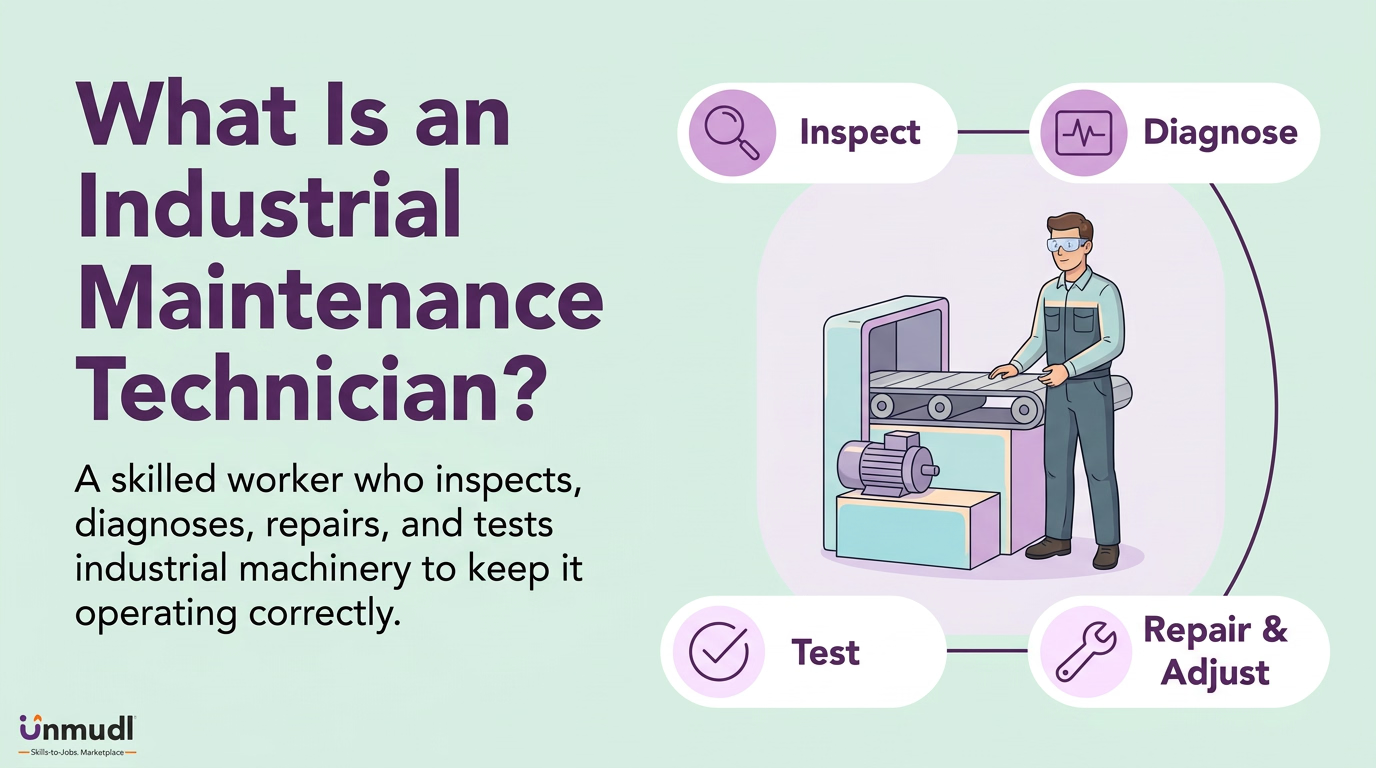
Industrial maintenance technician inspecting, diagnosing, repairing and testing industrial machinery

An industrial maintenance technician is a mechanical trades worker who diagnoses faults in industrial equipment and returns that equipment to service through repair, replacement and adjustment of its components. An industrial maintenance technician job involves reading a machine's condition, isolating the fault and proving the correction. That diagnostic work is coded federally as industrial machinery mechanics, and the occupational record lists industrial mechanic and maintenance technician among its reported job titles. An industrial mechanic vacancy therefore names the same occupation. Maintenance technician jobs cover a wider field, since the same title is also reported for general maintenance and repair workers who keep buildings in repair. The industrial qualifier narrows that field to production machinery. Industrial maintenance, the upkeep of that machinery, sits at the skilled end of the field because the worker diagnoses before disassembling. The Bureau of Labor Statistics (BLS) Occupational Outlook Handbook, updated August 27, 2026, sets the typical entry education for these mechanics at a high school diploma. The same handbook sets the typical on-the-job training at more than one year. The training year teaches the cycle of work that the job repeats.

What Does an Industrial Maintenance Technician Do?

An industrial maintenance technician works by keeping industrial machinery in working order through a cycle of inspection, diagnosis, corrective work and verification. The cycle begins when the technician inspects a machine for excessive wear, abnormal vibration or a controller error message. The inspection yields a symptom, and the symptom is traced to its source with a voltmeter, a diagnostic system or vibration analysis. The source determines the corrective work, from tightening a belt to replacing a bearing. The corrected machine is then run under normal load to verify that the repair holds, and verification sets the next inspection interval. Industrial maintenance runs as a loop, and industrial maintenance technician jobs differ in how much of it each employer assigns.

What are the Types of an Industrial Maintenance Technician?
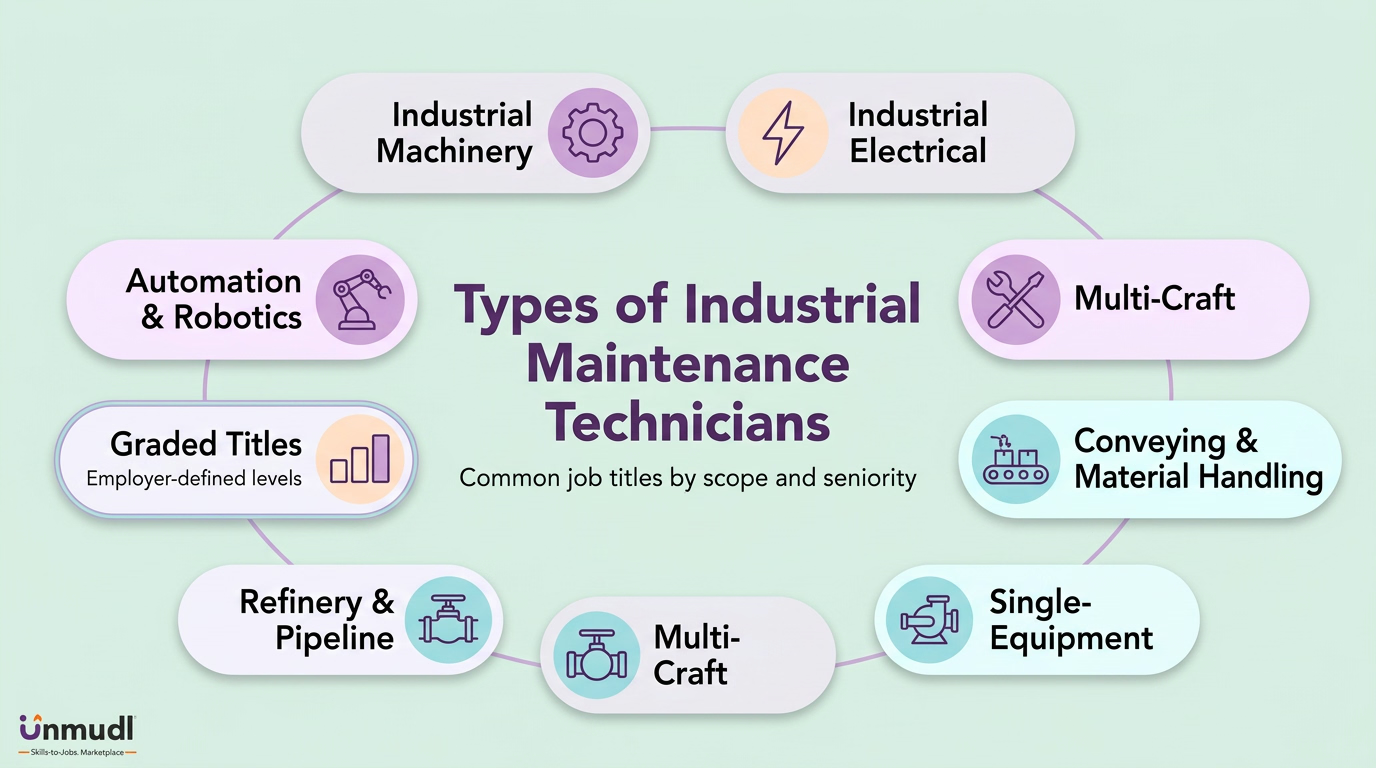
Industrial maintenance technician types grouped by machinery, electrical, automation, multicraft, material handling and equipment scope

There are six main types of industrial maintenance technician based on the equipment the technician is assigned to keep running. The types are maintenance mechanic, industrial electrical maintenance technician, industrial robot maintenance technician, industrial pump maintenance technician, industrial chiller maintenance technician and industrial generator maintenance technician. Maintenance jobs carry these titles when a plant wants a specialist, and the table below summarises the six types before each one is described.

TypeEquipment kept runningRepresentative taskWhere employers post it
Maintenance mechanicDrives, bearings and gearboxesReplacing a worn part and restoring alignmentAny production line, as the entry point
Industrial electrical maintenance technicianMotors, control panels and wiringTracing a circuit from supply to loadMulticraft teams, paired with a mechanic
Industrial robot maintenance technicianRobotic arms and their controllersRestoring repeatability and taught positionsCells where welding robots run
Industrial pump maintenance technicianPumps, seals and couplingsReplacing a failing seal and aligning the pumpRefinery and chemical plants
Industrial chiller maintenance technicianChillers, compressors and cooling loopsTesting the compressor under loadFood and pharmaceutical plants
Industrial generator maintenance technicianStandby generator sets and transfer switchesLoading the set to prove its outputSites where an outage means lost product
Shared groundProduction machinery in every caseThe inspect, diagnose, correct and verify cycleAny plant that wants a specialist

1. Maintenance Mechanic

A maintenance mechanic is a generalist tradesperson who services the mechanical side of production machinery, from drives and bearings to gearboxes. The mechanic disassembles a machine, replaces the worn part and restores the original alignment. That generalist scope covers a whole line with fewer specialists. Employers read the maintenance mechanic title as the entry point into industrial maintenance.

2. Industrial Electrical Maintenance Technician

An industrial electrical maintenance technician is an electrical specialist who maintains the motors, control panels and wiring that power production equipment. The specialist traces a circuit from supply to load and tests each stage. That electrical scope shortens the search for a stoppage that begins in the control circuit. Employers pair this type with a mechanic on multicraft teams.

3. Industrial Robot Maintenance Technician

An industrial robot maintenance technician is an automation specialist who keeps robotic arms and their controllers in calibrated working order. The specialist checks the robot's repeatability, replaces worn servo components and restores its taught positions. That robotic scope protects cycle time, because a drifting robot slows the whole cell. Employers assign this type wherever welding robots run.

4. Industrial Pump Maintenance Technician

An industrial pump maintenance technician is a rotating-equipment specialist who services the pumps, seals and couplings that move fluids through a process plant. The specialist monitors flow and pressure, replaces a failing seal and aligns the pump to its motor. That pump scope keeps the fluid supply continuous, as a failed pump stops every process downstream. Employers post this type in refinery and chemical plants.

5. Industrial Chiller Maintenance Technician

An industrial chiller maintenance technician is a refrigeration specialist who maintains the chillers, compressors and cooling loops that hold process temperatures within limits. The specialist checks the refrigerant charge, cleans the heat exchangers and tests the compressor under load. That chiller scope holds product quality stable, given that a warming loop pushes a process out of tolerance. Employers place this type in food and pharmaceutical plants.

6. Industrial Generator Maintenance Technician

An industrial generator maintenance technician is a power-systems specialist who services the standby generator sets that keep a plant running when utility power fails. The specialist tests the engine, alternator and transfer switch on a schedule and loads the set to prove its output. That generator scope protects uptime, which an untested set cannot deliver when needed. Employers keep this type on sites where an outage means lost product.

Reading the six types by their equipment lets a candidate match a maintenance job to the machinery they want to keep running.

What are the Duties of an Industrial Maintenance Technician?

There are six main duties of an industrial maintenance technician that recur in every plant whatever the equipment. The duties are inspecting machinery for wear, diagnosing malfunctions, repairing or replacing components, performing preventive maintenance, testing repaired equipment, and welding and fabricating parts. An industrial maintenance technician job description lists these six duties, and maintenance mechanic jobs list the same six under a shorter title.

1. Inspecting Machinery for Wear

Inspecting machinery for wear is the scheduled examination of belts, bearings, gears and seals for the signs that precede a failure. The technician walks the line, listens for a change in sound, checks temperature and vibration and records each finding. Earlier detection turns an unplanned stoppage into a planned repair. Supervisors set the inspection interval by the machine's duty cycle.

2. Diagnosing Malfunctions

Diagnosing malfunctions is the tracing of a symptom back to the component that produced it. The technician reads the controller's error message, tests the circuit with a voltmeter and consults the manufacturer's manual before removing any part. Diagnosis before disassembly shortens the repair, because the wrong part is never replaced. Supervisors expect a written cause with every repair order.

3. Repairing or Replacing Components

Repairing or replacing components is the corrective work that follows a confirmed diagnosis. The technician isolates the machine from its energy sources, removes the failed part, fits the new component and restores the original specification. A specification-true repair returns the machine to its designed rate. Supervisors hold the technician to the lockout procedure before any cover comes off.

4. Performing Preventive Maintenance

Performing preventive maintenance is the routine cleaning, lubrication, adjustment and calibration that stops a fault from developing at all. The technician follows a work order that names the machine, the task and the interval, and closes the order on completion. Preventive work extends service life, since friction and misalignment are removed before they cause wear. Supervisors track completed orders as the measure of maintenance discipline.

5. Testing Repaired Equipment

Testing repaired equipment is the operation of a machine under normal load after corrective work to prove that the fault is gone. The technician starts the machine, watches its speed, temperature and output, and compares each reading with the pre-failure values. A logged load test lets production resume without a repeat stoppage. Supervisors release a machine to operators only after that log is signed.

6. Welding and Fabricating Parts

Welding and fabricating parts is the cutting, joining and shaping of metal to replace a component that cannot be bought in time. The technician measures the broken part, cuts stock to size, welds the assembly and grinds it to fit. In-house fabrication shortens the wait, as a bracket welded on site is ready in hours. Supervisors assign welding to technicians who hold the plant's qualification.

Carrying out the six duties in this order keeps a plant's machinery running and earns the technician trust over every stage of its care.

Where does an Industrial Maintenance Technician Work?
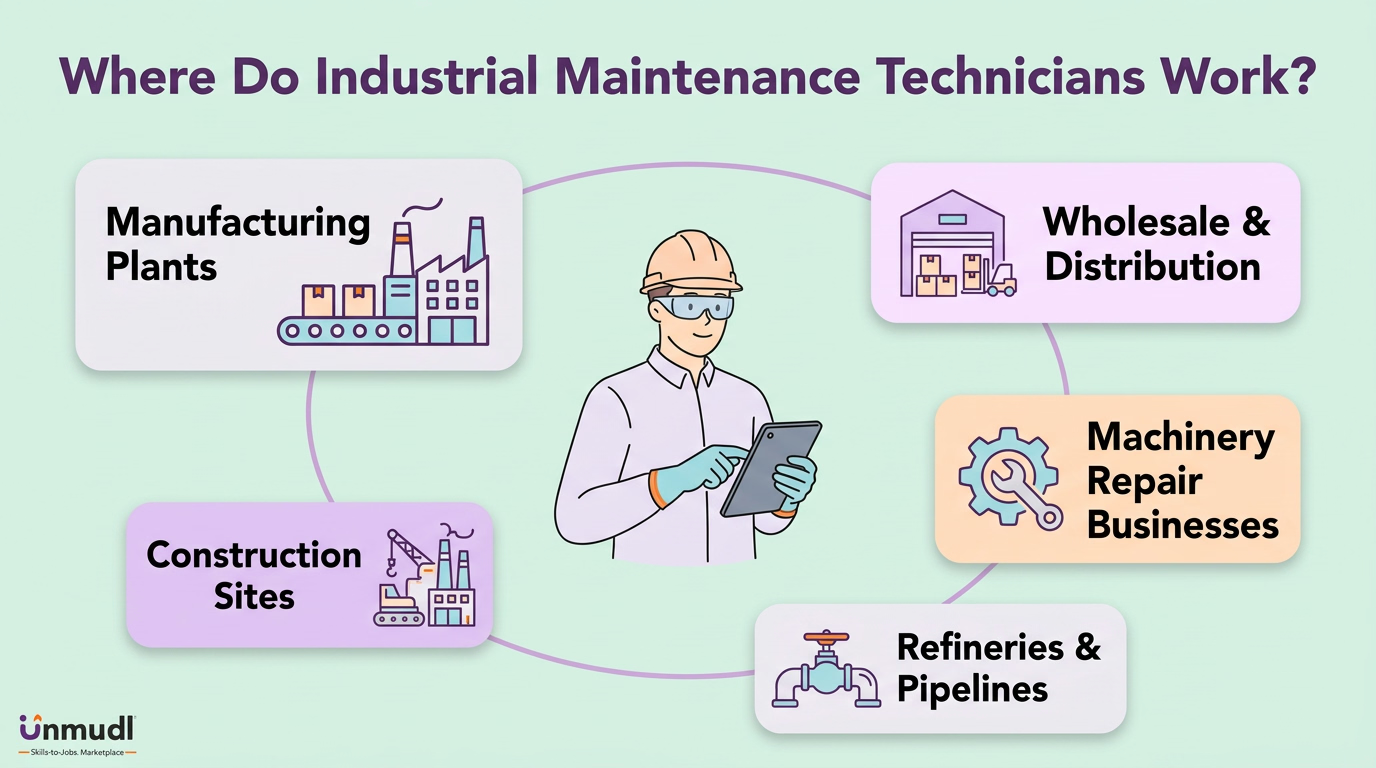
Industrial maintenance workplaces including manufacturing plants, distribution, machinery repair, construction and refineries

An industrial maintenance technician works primarily inside manufacturing plants, where production, processing, packaging and material-handling machinery must be kept running. BLS employment data for 2025 places 51% of the occupational group in manufacturing, 13% in wholesale trade, 11% in machinery repair services and 5% in construction. An industrial maintenance technician factory position is therefore the most common posting, but not the only workplace. The same occupation maintains refinery and pipeline machinery and staffs the contractors who service a plant from outside. Maintenance technician jobs outside the industrial setting are found in offices, hotels and other buildings. Reaching any of those workplaces starts from one set of preparation stages.

Industrial maintenance employment shares: manufacturing 51 percent, wholesale trade 13 percent, machinery repair 11 percent and construction 5 percent

How to become an Industrial Maintenance Technician?

Becoming an industrial maintenance technician requires five preparation stages. The stages are meeting the baseline education requirement, completing the training, earning the credentials, finishing a Registered Apprenticeship, and securing safety training with employer authorization. The five stages, in the order a candidate completes them, are listed below. Each later stage rests on the baseline education requirement that stage one sets.

1. Meet the Baseline Education Requirement

Baseline education is the minimum schooling a candidate holds before any maintenance training begins. The minimum schooling for industrial maintenance work is a high school diploma or a General Educational Development (GED) certificate. The diploma serves as the entry floor for the occupation and as the entry prerequisite for the apprenticeship route. Two actions satisfy this stage. The actions are earning the diploma and building the technical subjects on which later training depends.

1.1 Earn a High School Diploma or GED

Complete the diploma or the GED certificate before applying to any maintenance program. The diploma opens both the direct employer route and the apprenticeship route. The Department of Labor's 2025 Industrial Maintenance Mechanic apprenticeship framework names the same credential as its entry prerequisite. Individual apprenticeship programs list additions such as a driver's license or pre-entry drug testing. A candidate without the diploma qualifies for neither route.

1.2 Build the Technical Subjects that Maintenance Training Uses

Strengthen mathematics and technical reading during or after high school. Shop mathematics and blueprint reading are two subjects that employer training later covers. A candidate who already reads a drawing spends that training time on the equipment itself. Welding, electronics, and programming complete the subject list. The subjects form the foundation for the training stage.

2. What is the Training for an Industrial Maintenance Technician?

The training for an industrial maintenance technician is the technical instruction and supervised practical learning that prepares a worker to inspect, troubleshoot, maintain, and repair industrial machinery. The occupation sits in a medium-preparation job zone where one or two years of training combine work experience with learning from experienced workers. Three routes deliver the training. The routes are technical school instruction, employer on-the-job training, and online instruction paired with hands-on practice.

2.1 Enroll in a Technical School or Associate Degree Program

Choose a vocational school, a certificate program, or a two-year degree in industrial maintenance to establish mechanical and electrical theory before employment. An associate program in industrial maintenance covers welding, mathematics, hydraulics, and pneumatics. Hydraulics and pneumatics are the two fluid power subjects in that curriculum. School instruction is one route rather than the sole route, since the occupation's entry award stops at the diploma.

2.2 Complete Employer On-the-Job Training

Learn the plant's own equipment through workplace training that continues past the first year. Workplace training covers equipment setup, cleaning, lubrication, and hand-tool use alongside the classroom subjects, from shop mathematics to computer programming. Employer-hired trainers or equipment-manufacturer representatives deliver the instruction. The manufacturer representative matters because machinery configuration, maintenance documentation, controls, and safe work procedures differ from one plant to the next. Theory subjects that do not differ between plants move online.

2.3 Pair Industrial Maintenance Technician Online Training with Hands-on Practice

Use industrial maintenance technician online training for theory subjects and pair it with laboratory or workplace practice for equipment skills. Online training covers mathematics, blueprint interpretation, electronics, controls, and maintenance concepts, which are subjects taught away from operating machinery. Online coursework alone does not satisfy the practical preparation of the occupation, since the entry pattern rests on supervised equipment work. A defensible online program therefore attaches a laboratory block, an employer training block, or an apprenticeship. Each route ends in a credential that an employer reads.

3. What are the Credentials Required for an Industrial Maintenance Technician?

The credentials required for an industrial maintenance technician consist of the high school diploma as the only universal credential. The postsecondary certificate, the associate degree, and the Certified Maintenance & Reliability Technician (CMRT) certification serve as optional credentials. No single professional certification or college degree functions as a nationwide entry credential for the occupation. A state trade license applies only to a regulated task in a specific jurisdiction. The three optional credentials are described below.

3.1 Earn a Postsecondary Certificate

Complete a postsecondary certificate in industrial maintenance when the target employer expects focused technical education without a degree. A postsecondary certificate is a school credential rather than a professional certification. The Occupational Information Network (O*NET) 2026 education survey records the certificate as the most selected new-hire education at 47%. The diploma follows at 39%. Those percentages describe respondent judgments about preparation and not a legal requirement.

3.2 Consider an Associate Degree in Industrial Maintenance

Add the associate degree when a broader and more structured technical curriculum fits the target job. The associate degree is the least selected of the three new-hire education responses at 14%, and no bachelor's degree response appears in the survey. Employers read the degree as evidence of curriculum breadth rather than as a gate to the job. A certification earned on the job evidences practice rather than curriculum.

3.3 Obtain the CMRT Certification After Entering the Occupation

Apply for the CMRT certification once maintenance experience exists, since the credential is optional rather than an entry requirement. The Society for Maintenance & Reliability Professionals (SMRP) issues CMRT and tests maintenance practices, preventive and predictive maintenance, troubleshooting, and corrective maintenance. The initial exam fee is $250 for SMRP members and $300 for nonmembers. The certification runs on a 3-year cycle and requires 50 course hours for recertification. Hours also measure the term of a Registered Apprenticeship.

4. Complete a Registered Apprenticeship

A Registered Apprenticeship is a structured route that combines paid supervised work, related technical instruction, and a portable nationally recognized credential. The Department of Labor approved the Industrial Maintenance Mechanic National Occupational Framework on July 30, 2025, and the framework lists maintenance technician among its job titles. The apprenticeship route involves two decisions. The decisions are the approach and the term length, which are described below.

4.1 Choose the Apprenticeship Approach

Select one of the three approaches the framework supports, which are the time-based approach, the competency-based approach, and the hybrid approach. The time-based approach counts hours worked. The competency-based approach counts demonstrated skills. The hybrid approach counts both measures. Each approach pairs supervised on-the-job learning with related instruction, and the sponsor sets which approach applies to a given program.

4.2 Complete the Term Length of the Chosen Approach

Finish the term the framework assigns to the chosen approach. The time-based term runs 6,000 hours, the competency-based term runs 3 years, and the hybrid term runs 6,000 to 8,000 hours. A 6,000-hour term equals a calculated span of about three years at 40 hours a week. Completion delivers the portable credential that transfers between employers. An older 2020 competency framework listed a 1-year program, and that figure no longer describes the current national framework. The credential the current framework delivers still leaves one employer-specific stage.

5. Complete Safety Training and Employer Authorization

Safety training and employer authorization are the workplace-specific preparation that releases a technician to service machinery where hazardous energy is present. This preparation is not a portable credential, since the employer provides the instruction and the authorization applies to that employer's equipment. The stage has two parts. The parts are hazardous-energy training and the authorization that follows it.

5.1 Complete Hazardous-Energy Training Before Servicing Equipment

Complete hazardous-energy training before performing any servicing task where unexpected energization or stored energy presents a hazard. The Occupational Safety and Health Administration (OSHA) standard on the control of hazardous energy, 29 CFR 1910.147, requires the employer to train every authorized employee. The training covers recognizing the applicable hazardous-energy sources and the methods and means of energy isolation and control. Lockout/tagout is the common name for those methods, which only an authorized employee applies.

5.2 Secure Employer Authorization for Independent Work

Obtain the employer's authorization before carrying out maintenance independently. Authorization designates the worker as an authorized employee under the standard. The designation stays with that workplace rather than transferring to the next employer, so a technician who changes plants repeats the instruction on the new equipment. Employers gate independent servicing behind this authorization. Working through the five stages in sequence lets a candidate enter industrial maintenance work with every item that employers check. The pay attached to that work is set by national wage data.

What is the Average Salary of an Industrial Maintenance Technician?

The average salary for an industrial maintenance technician is $68,460 per year. That figure is the BLS May 2025 mean annual wage for Industrial Machinery Mechanics, the closest national occupational match for the title. Industrial maintenance technician pay per hour is $32.91, published directly as the mean hourly wage. The average pay per month is $5,705, and the average pay per quarter is $17,115. Both figures are calculated as one twelfth and one quarter of the annual mean, so they do not model overtime or bonuses. The median annual wage stands at $64,520 and is a different measure from the mean. The average rate per year is therefore $68,460. That annual rate rests on the entry award rather than on a college degree.

Does an Industrial Maintenance Technician Need a Degree?

No, an industrial maintenance technician does not need a college degree, since the occupation sets the diploma or its GED equivalent as the entry award. A Registered Apprenticeship reaches the same occupation through a 6,000-hour time-based term and no degree at all. An associate degree adds two years of theory on top of that award. The associate degree stays an optional route, and the machinery kept in working order defines the skill an employer tests.

Which Systems Do Industrial Maintenance Technicians Maintain?

Industrial maintenance technicians maintain six main system categories. The categories are production and processing machinery, conveying and material-movement systems, packaging systems, automated, robotic, and computer-controlled machinery, hydraulically actuated equipment, and refinery and pipeline-distribution machinery. The categories are divided by equipment function rather than by technician subtype, and each one is described below.

Production and Processing Machinery Systems

Production and processing machinery systems are the installed machines that perform a plant's core manufacturing or processing operation. A production machine on a manufacturing line is the representative example. The technician's relationship to production machinery runs through inspection, lubrication, adjustment, diagnosis, component replacement, and post-repair testing. Post-repair testing returns the machine to the line only once operation is verified.

Conveying and Material-Movement Systems

Conveying and material-movement systems are the belt-driven lines that transfer products or materials through a production facility. An automobile assembly-line conveyor belt is the clearest example. Automated conveyors contain belts, motors, and rollers that require regular care. Unusual vibration from a conveyor points to a worn belt or a failing motor bearing, so vibration is the first symptom a technician reads.

Packaging Systems

Packaging systems are the factory equipment that packages finished goods at the end of a production line. A packaging machine is maintained for its mechanical operating condition, not for the packaging process as a business function. That condition is preserved by diagnosing mechanical faults, correcting component problems, adjusting the equipment, and confirming operation before the line restarts.

Automated, Robotic, and Computer-Controlled Machinery

Automated, robotic, and computer-controlled machinery is the class of production equipment whose motion is directed by an onboard program rather than by an operator's hand. A robotic welding arm is the sourced example of this class. BLS records that industrial machines increasingly use computers. The technician therefore enters instructions for computer-controlled machinery and works alongside programmable logic controller (PLC) and supervisory control and data acquisition (SCADA) software. Working alongside control software does not make the worker a controls engineer.

Hydraulically Actuated Equipment

Hydraulically actuated equipment is industrial machinery that moves a load through pressurised fluid rather than through gears or belts alone. A hydraulic lift is the documented instance of hydraulically operated machinery. Mechanical maintenance of a hydraulic lift falls within the assigned scope where that lift sits on the plant floor. The assigned scope, not the fluid technology, decides whether a hydraulic system belongs to the job.

Refinery and Pipeline-Distribution Machinery Systems

Refinery and pipeline-distribution machinery systems are the pumps, valves, drives, and compressors that process and move product through a refinery or a distribution pipeline. Refinery and pipeline machinery extends industrial maintenance beyond the factory. The particular pumps or compressors assigned to a worker depend on the establishment and the job. Servicing the six system categories requires a distinct set of equipment and tools.

Which Equipment and Tools Does an Industrial Maintenance Technician Work With?

Industrial maintenance technicians work with three main kinds of shop equipment and four main kinds of tools. The equipment kinds are lathes, grinders and drill presses, welding equipment, and hoists. The tool kinds are hand tools, voltmeters and testing devices, computerized diagnostic systems and vibration analysis, and maintenance-management and industrial-control software. Shop equipment fabricates or lifts a component, whereas a tool measures or diagnoses, and the seven kinds are listed below.

Lathes, Grinders, and Drill Presses

Lathes, grinders, and drill presses are the machine-shop equipment that industrial machinery mechanics commonly use to fabricate or refinish a replacement part. A lathe turns a shaft to size, a grinder trues a worn surface, and a drill press bores a mounting hole. Machining a part in-house belongs to the repair stage that follows diagnosis.

Welding Equipment

Welding equipment is the arc or gas apparatus used to cut and join metal during a repair. BLS lists welding as a requirement for industrial machinery mechanics, and cutting and welding metal to repair, fabricate, or assemble equipment is an occupation-specific task. A listed requirement does not mean a universal one, since welding authorization follows the employer's procedures.

Hoists

Hoists are the lifting equipment that raises a heavy machine so that a mechanic can reach its underside. A maintenance worker uses a hoist to lift a heavy printing press for maintenance. Lifting with a hoist introduces stored-energy and crush hazards, so heavy-equipment handling sits inside the safety precautions the occupation requires.

Hand Tools

Hand tools are the manually powered instruments that loosen, tighten, and align mechanical components. Screwdrivers and socket wrenches are the hand tools a maintenance worker uses to align a motor. Motor alignment belongs to routine or basic machinery maintenance, which sits apart from more extensive industrial-machinery repair.

Voltmeters and Testing Devices

Voltmeters and testing devices are the electrical instruments that measure a machine's circuits during diagnosis. A voltmeter reads voltage at a motor or control terminal so that an electrical fault is separated from a mechanical one. Test results and machine error messages are then analysed before a malfunctioning component is replaced.

Computerized Diagnostic Systems and Vibration Analysis

Computerized diagnostic systems and vibration-analysis methods are the condition-monitoring tools that locate the source of abnormal machine vibration. Vibration analysis traces a shaking conveyor to a belt or bearing problem before disassembly begins. Diagnosing the fault before disassembly prevents a repair that is assumed from a symptom alone.

Maintenance-Management and Industrial-Control Software

Maintenance-management and industrial-control software are the digital tools that schedule work orders and read a machine's control logic. Maintenance planning, inventory-tracking, and SAP enterprise-resource-planning software administer parts and work orders, while PLC ladder-logic and SCADA software expose the control program. Reading a control program does not authorise modifying it. Using the seven kinds of equipment and tools together is the skill set a course teaches.

What is the Best Industrial Maintenance Technician Course?

The best industrial maintenance technician course is one that spans electrical, mechanical, fluid-power, pneumatic, and robotics systems and pairs online instruction with laboratory practice. That laboratory pairing is the deciding criterion, and Mechatronics and Robotics Maintenance on Unmudl meets that criterion. The course was developed with Amazon and Intel, includes virtual and in-person labs, and is endorsed by the Advanced Robotics for Manufacturing (ARM) Institute. The same course aligns to Smart Automation Certification Alliance (SACA) microcredentials and connects to live technician job listings. The course assumes prior hands-on experience, so a beginner starts with Multi-Craft Technician Level 1 on the same platform. A completed course then needs a resume that presents it to an employer.

How to Build a Resume for Maintenance Technician Jobs?

Building a resume for maintenance technician jobs takes three steps on the Unmudl AI Resume Builder. The steps are open the builder, enter the information, and save and download the applicant tracking system (ATS) resume, which are listed below.

  1. Open the Unmudl Resume Builder. Go to unmudl.com/resume-builder and click Start Building. The builder opens immediately with no account or login required.
    Unmudl resume builder opening screen with the Build My Resume button
  2. Enter the information. Fill in the name, contact details, work history, education, and skills, drawing the skill wording from the posted job description. The tool formats the content into a single-column, ATS-compliant layout as each field is completed.
    Selecting basic information and profile details in the Unmudl resume builder
  3. Save and download the ATS resume. Click the finish option after the last section is complete. The builder prompts the creation of a free Unmudl account to save progress and export the resume as a PDF.

Following the three steps produces a PDF resume that passes applicant-tracking software and supports the career decision that follows.

Is Industrial Maintenance Technician a Good Career?

Yes, industrial maintenance technician is a good career, but only when the worker accepts hands-on machinery work, protective equipment, and on-call, night, or weekend schedules. Demand is the strongest evidence. BLS projects Industrial Machinery Mechanics to grow from 446,900 jobs in 2025 to 526,600 in 2035. That 18% increase is driven by automated manufacturing machinery that requires maintenance. Physical and hazard exposure is the trade-off, and the same trade-off separates this role from general maintenance work.

What is the difference between Industrial Maintenance Technician and Maintenance Technician?

The primary difference between an industrial maintenance technician and a maintenance technician is the object maintained, not the job title. A maintenance technician, in the general-maintenance sense, is a worker who applies two or more craft skills to keep machines, mechanical equipment, and building structures in repair. The industrial role's goal is the operating condition of production machinery, pursued with lathes, computerized diagnostics, and PLC software. The general role's goal is usable equipment and facilities, pursued with saws, drills, wrenches, and hammers. An industrial machine maintenance example is diagnosing conveyor vibration. A general example is repairing a building component in a hotel. The industrial technician is the second neighbouring title, and it differs on a different axis.

What is the difference between Industrial Maintenance Technician and Industrial Technician?

An industrial maintenance technician differs from an industrial technician in equipment condition versus engineering support. An industrial technician, in the documented sense of Industrial Engineering Technologists and Technicians, denotes a worker applying engineering principles to manufacturing layout and production problems under engineering staff. The maintenance role's goal is restored machinery, reached through diagnosis and repair with hand tools and vibration analysis. The industrial technician's goal is workflow, quality, and production-rate improvement, reached with engineering drawings, computer-aided design (CAD) tools, calipers, and micrometers. A maintenance example is replacing a failed conveyor bearing. An industrial technician example is a time-and-motion study of the same line.

Learn In Demand Skills Employers Are Hiring For

Explore our career-ready "Mechatronics and Robotics Maintenance" designed with employers to help you get hired faster. Train for industrial maintenance in ~10–12 weeks, earn a certificate and get ready to interview for technician roles.
No items found.
No items found.
Last updated on:
October 19, 2026
No items found.