What is a Control System Technician?
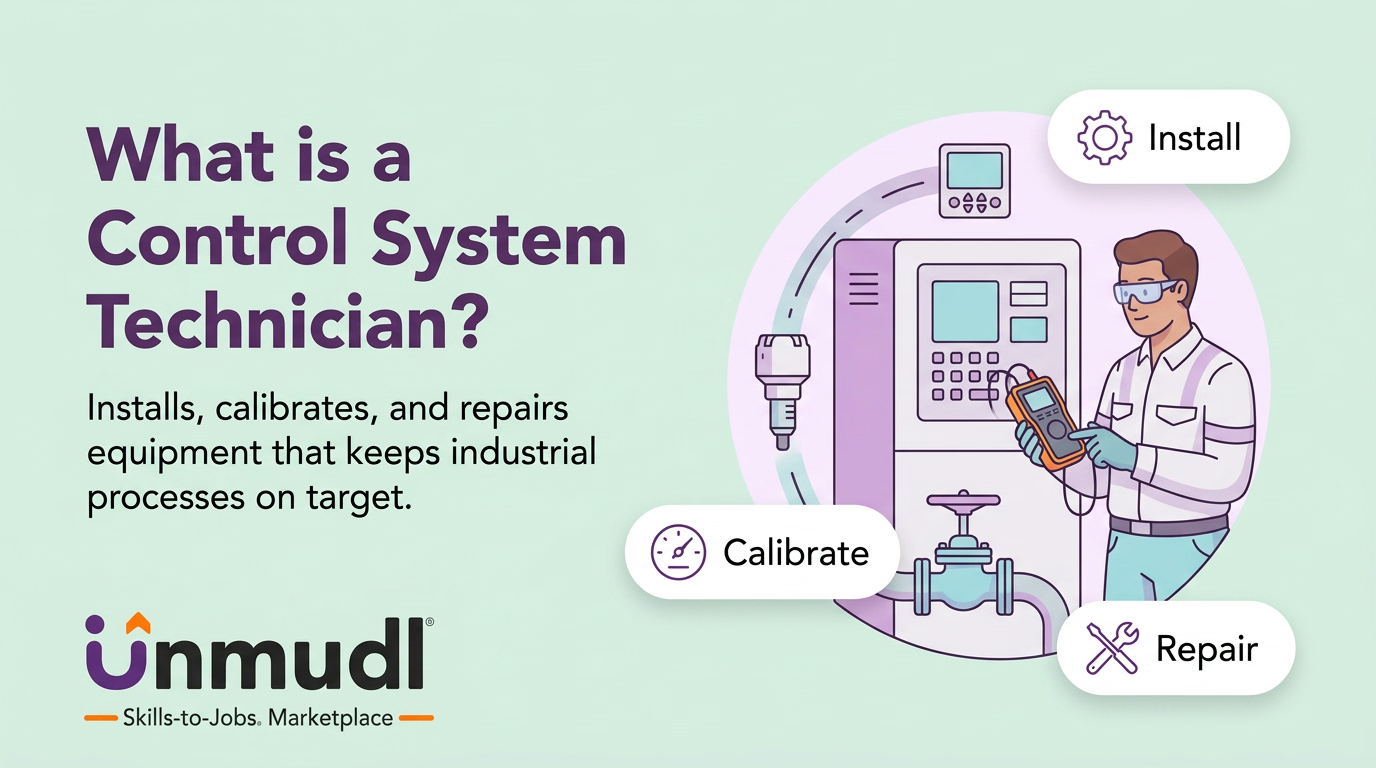
A control system technician is an industrial automation technician who installs, calibrates, and repairs the field instruments and control circuits that hold a process variable at its setpoint. A control system technician owns the hardware side of automation, meaning the instrument, the circuit, and the final control element rather than the control strategy. The instrumentation and controls technician title names the same worker inside a utility. The control systems technician spelling names the same worker in a job posting. The two titles denote one occupation with one task set.
The occupation sits at the technician tier of the automation hierarchy. The technician tier stands above the equipment operator and below the controls engineer. Field experience grades the tier rather than degree level. The International Society of Automation (ISA) fixes that scope in its Certified Control Systems Technician (CCST) program. The CCST program records that a certified technician calibrates, documents, troubleshoots, and repairs or replaces process instrumentation. That instrumentation measures and controls level, temperature, pressure, flow, and other process variables (the measured quantities a loop regulates).
What Does a Control System Technician do?
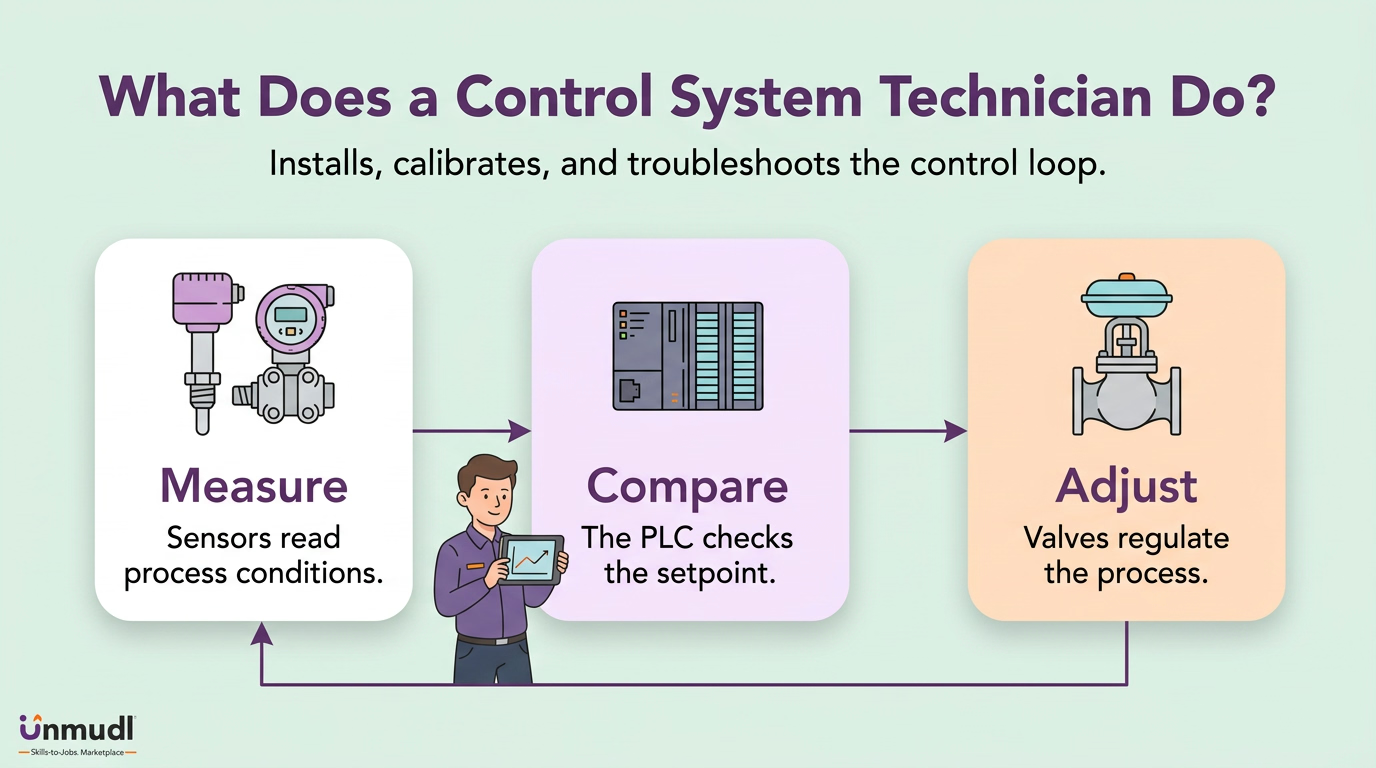
A control system technician works by converting a measured process value into a corrected control action through a loop of instrument, controller, and final element. The loop starts at the sensor. The sensor feeds a transmitter. The transmitter scales the raw signal and passes it to a programmable logic controller (PLC). The PLC compares the signal with the setpoint the operator entered. The comparison drives a control valve or a motor back toward the setpoint. The technician owns every handoff in that chain, so the worker wires the sensor, ranges the transmitter, loads the logic, and strokes the valve. A human-machine interface (HMI) then displays the loop to the operator. Diagnosing a deviation on that display closes the cycle, since the reading points the worker to the failed handoff. The family of system that houses the loop separates one technician type from another.
What are the Types of Control System Technician?
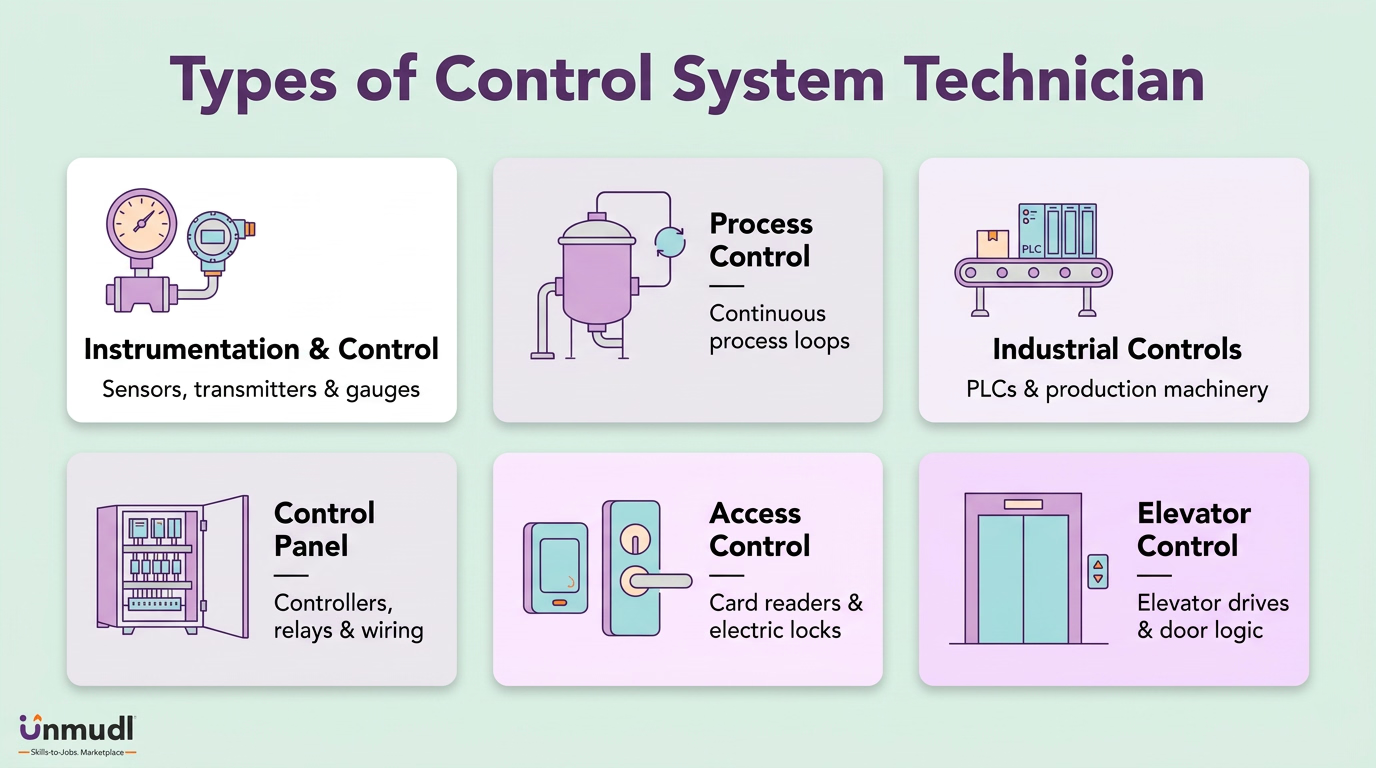
There are six main types of control system technician based on the family of controlled system the worker installs and services. The process-side types are the instrumentation and control technician, the process control system technician, and the industrial controls technician. The remaining types are the control panel technician, the access control system technician, and the elevator control system technician. Each type is briefly discussed below. The table below sets the six types against the controlled system, the worksite, and the employer named for each.
| Type | Controlled system | Typical worksite | Employer that staffs the type |
|---|---|---|---|
| Instrumentation and control technician | Field instrument: transmitter, analyzer, and gauge | Power station or water utility | Utilities |
| Process control system technician | Continuous loops of a whole process unit | Refinery, chemical plant, or food plant | Refineries |
| Industrial controls technician | Discrete machine control through a PLC and its modules | Factory floor production line | Manufacturers |
| Control panel technician | Enclosure: controller, relays, terminal strips, and power supplies | Panel shop bench | Panel shops |
| Access control system technician | Card readers, electric locks, and door controllers | Building entry points | Facility owners |
| Elevator control system technician | Controller, drive, and door operator logic of a passenger car | Route of buildings | Elevator contractors |
| Excluded type | Fire or intrusion circuit of an alarm panel | Building low-voltage trade, not process control | Alarm system contractors |
1. Instrumentation and Control Technician
An instrumentation and control technician concentrates on the field instrument itself. The field instrument means the transmitter, the analyzer, and the gauge. This type spends the shift ranging, zeroing, and documenting instruments in a power station or a water utility. Utilities staff this type to keep a generating unit from tripping on a false reading.
2. Process Control System Technician
A process control system technician maintains the continuous loops of a refinery, a chemical plant, or a food plant. A continuous loop tolerates no downtime, so the worker tunes the controller while the process runs. Refineries assign this type to a whole process unit rather than to a single machine.
3. Industrial Controls Technician
An industrial controls technician services discrete machine control on a factory floor. Discrete control steps a conveyor or a press through a PLC and its input and output modules. The role reads ladder logic, swaps a failed module, and re-times a sequence. Manufacturers place this type on the line so that a stopped machine restarts within the shift.
4. Control Panel Technician
A control panel technician builds and wires the enclosure of a control system. The enclosure houses the controller, the relays, the terminal strips, and the power supplies. Such a technician lands each conductor on its numbered terminal and tests continuity. Panel shops employ this type at the bench, ahead of every field installation.
5. Access Control System Technician
An access control system technician installs and programs the card readers, electric locks, and door controllers of a building entry system. Entry control is a low-voltage building system, so this type works to a security specification and a fire code. Facility owners hire this type when a door must decide who passes and log the decision.
6. Elevator Control System Technician
An elevator control system technician maintains the controller, the drive, and the door operator logic of a passenger car. Vertical transport is life-safety equipment. The worker therefore proves the safety circuit before returning a car to service. Elevator contractors field this type on a route of buildings rather than at a single site.
Matching a type to its system family lets a candidate choose the equipment they will keep in service and the site they will report to. Whichever type the candidate picks, the equipment in service demands the same six duties.
What are the Duties of Control System Technician?
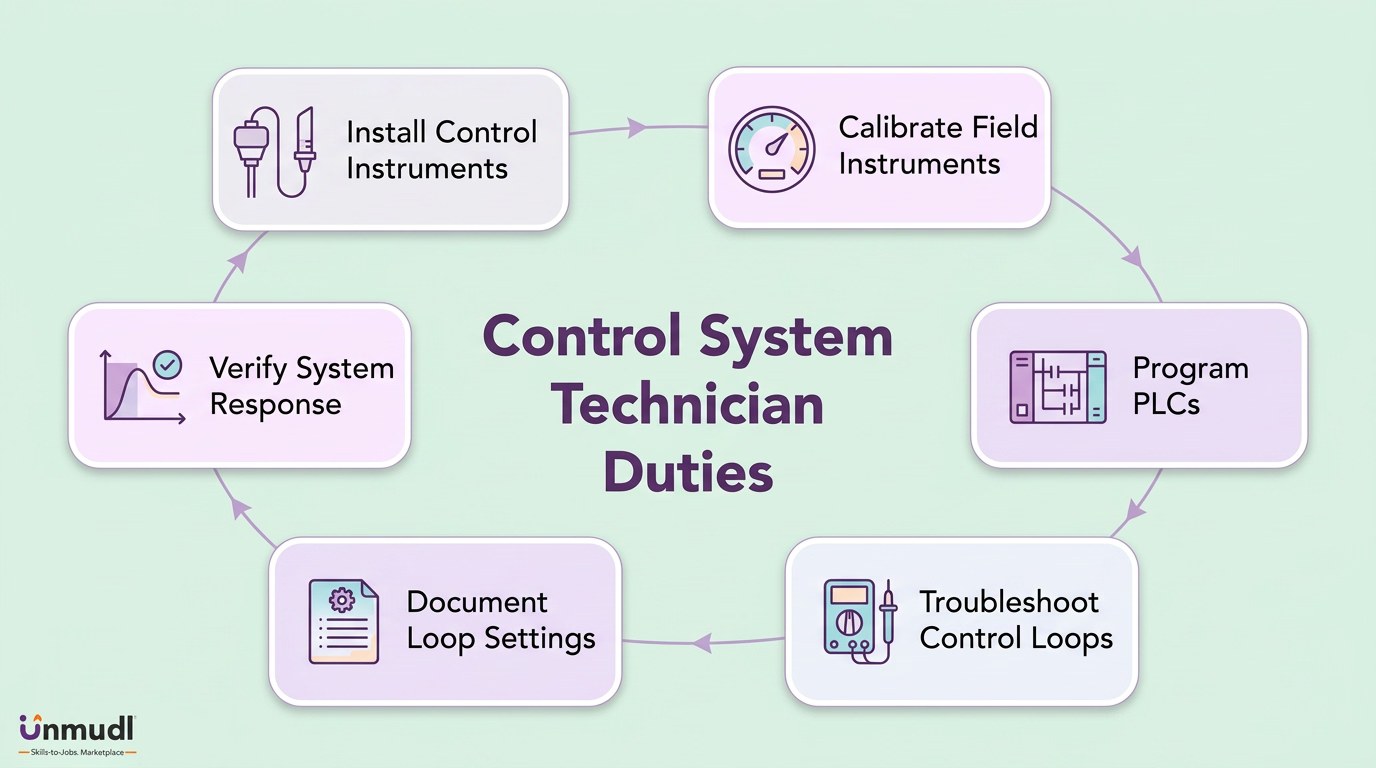
There are six main duties of a control system technician. The duties follow the life of a control loop from first wiring to routine verification. The duties are installing control instrumentation, calibrating field instruments, programming programmable controllers, troubleshooting control loops, documenting loop settings, and verifying system response. Each duty is set out below.
1. Installing Control Instrumentation
Installing control instrumentation mounts the sensor, the transmitter, and the final control element on the process. The worker then terminates the signal wiring to the controller along the loop drawing. Power is applied only after the conduit run is checked. Supervisors release a loop for calibration only after the installation matches the drawing.
2. Calibrating Field Instruments
Calibrating field instruments proves a transmitter reports the true value across its full range. A calibration applies a known pressure or current to the instrument. The worker adjusts zero and span until the error falls inside the tolerance. An electrical instrumentation technician carries the same duty onto the current and voltage signals of the loop. Supervisors keep the calibration record as proof of a true reading.
3. Programming Programmable Controllers
Programming programmable controllers loads the logic behind every control action. Controller logic is written in ladder or function block form. The worker edits the routine, sets the alarm limits, and downloads the program to the PLC before testing every input. Supervisors approve a logic change only after the test record shows each output responding as designed.
4. Troubleshooting Control Loops
Troubleshooting control loops finds the failed handoff when a process drifts, oscillates, or trips. A fault hides in the sensor, the wiring, the controller, or the final element. The worker isolates each stage with a multimeter until the reading breaks from the expected value. Supervisors measure this duty by how fast the loop returns to service.
5. Documenting Loop Settings
Documenting loop settings records the range, the tuning constants, the alarm limits, and the calibration date of every instrument. A documented setting lets the next worker restore a loop without re-tuning from scratch. The loop sheet is therefore updated at the end of each job. Auditors treat the loop documentation as evidence of a process under control.
6. Verifying System Response
Verifying system response confirms a loop behaves as designed once the instrument, the logic, and the final element are back in service. Verification watches the process variable on the supervisory control and data acquisition (SCADA) screen during a setpoint change. The worker times the response against the design. Supervisors close the work order on a verified response, never on a completed repair alone.
Carrying the six duties in loop order keeps a plant's instrumentation reading true from the day it is wired to the day it is replaced.
Where does a Control System Technician Work?
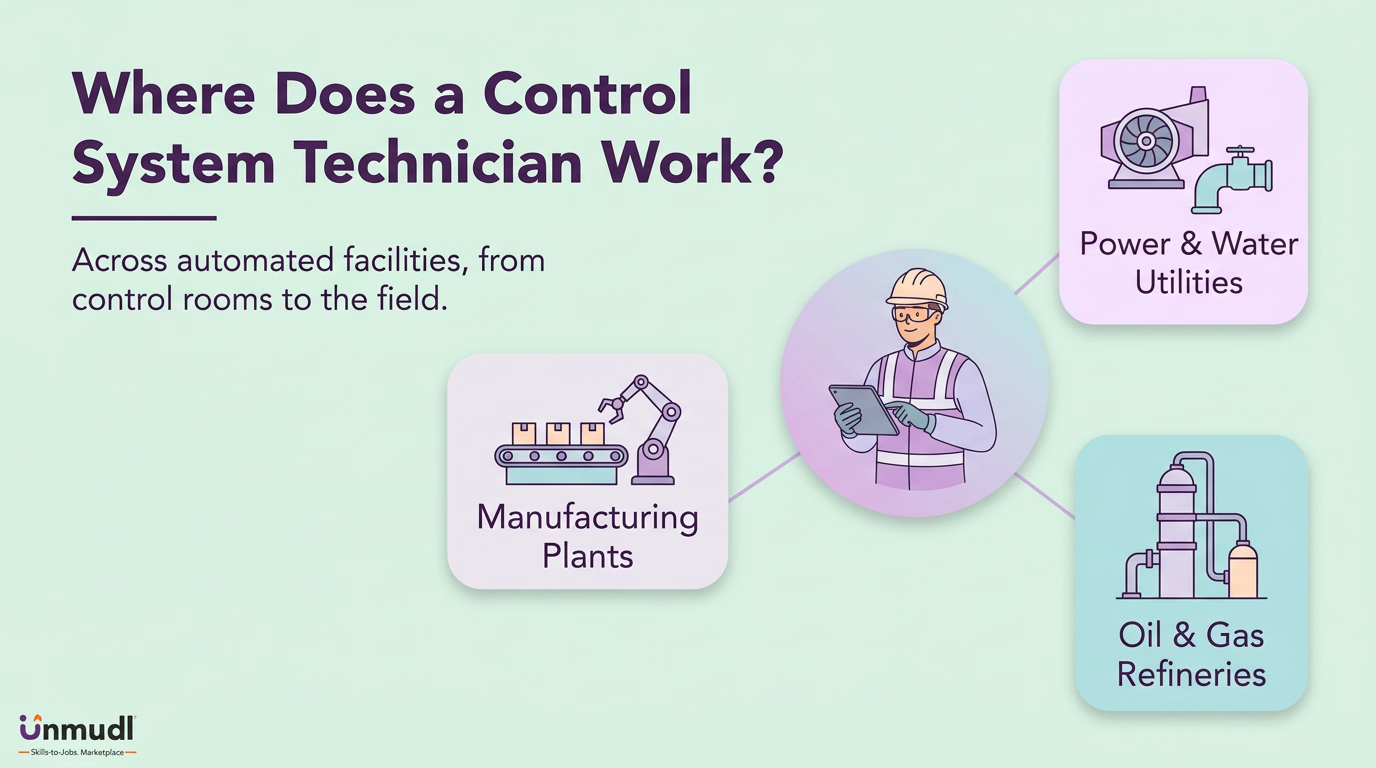
A control system technician works in any facility that runs an automated process, chiefly a manufacturing plant, a power or water utility, and an oil and gas refinery. A manufacturing plant places the worker on the production floor beside the controlled machines. A power utility places the worker in a generating station, where instrumentation and control circuits keep a turbine online. A refinery places the worker at a control room desk and on the process unit in turn. The split between desk and field defines the working conditions. The worker meets noise, machinery, and outdoor weather around pumps and pipelines on one shift, and configuration software at a workstation on the next. An alarm system technician wiring a control panel for a building's fire or intrusion circuit works in a separate low-voltage trade. A control system technician stays with industrial process control rather than with building security. Entry into that industrial trade runs along a staged route.