What Are The Types Of Technician?
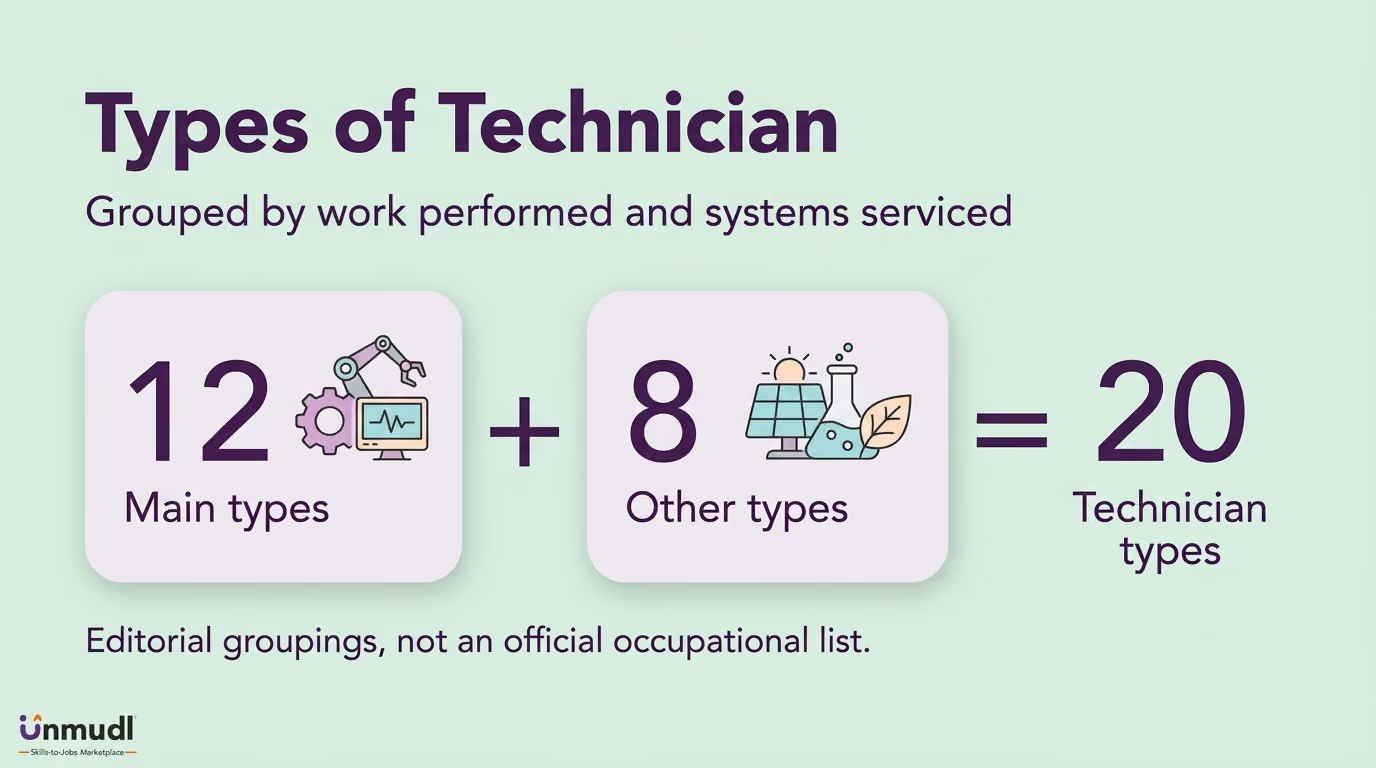
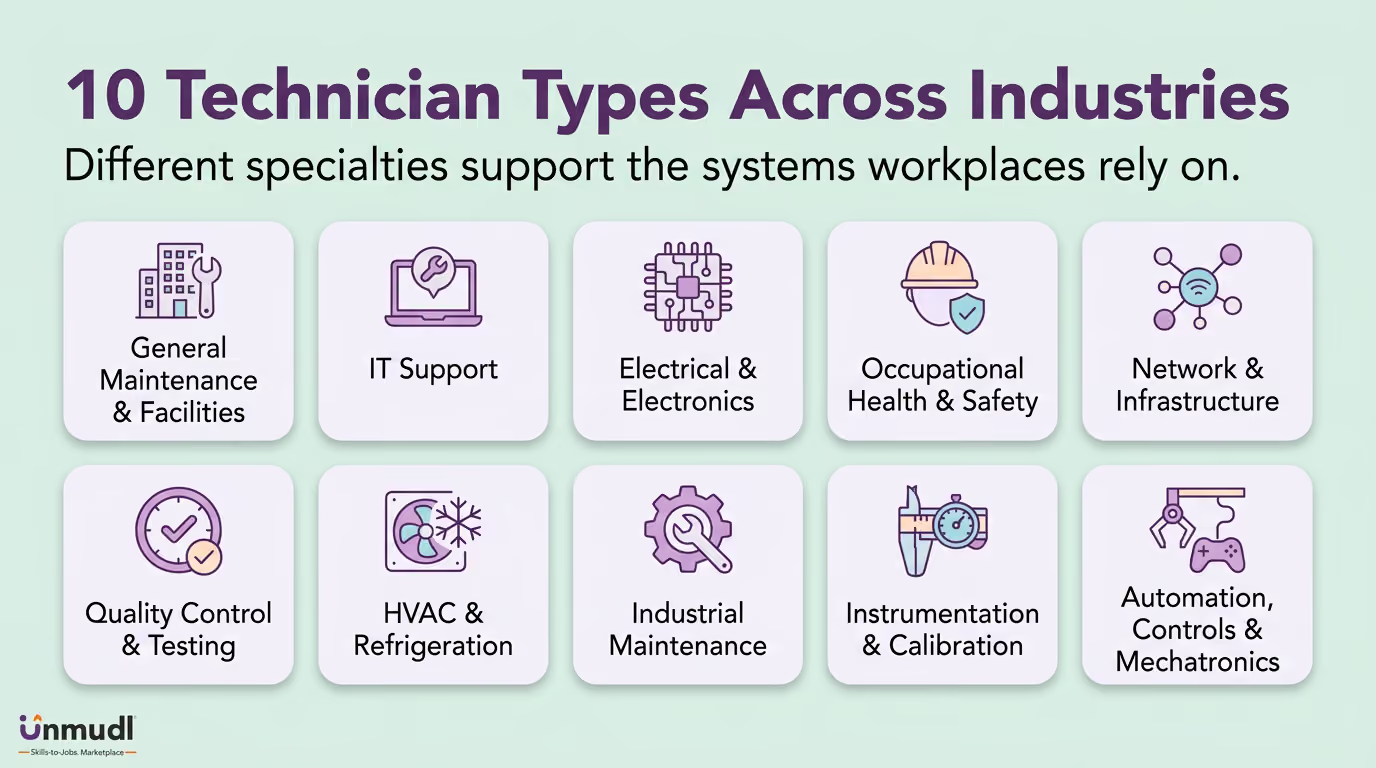
There are 12 main types of technician based on the work performed and the system serviced. There are 8 other types covering civil, energy, biomedical and laboratory, environmental, safety, consumer-equipment, forensic, and emerging hybrid work. The total number of technician types in this classification is 20. The main technician types are General Maintenance and Facilities Technicians, Mechanical and Industrial Technicians, Electrical and Electronics Technicians, Automation, Controls and Robotics Technicians, Instrumentation, Measurement and Calibration Technicians, Manufacturing and Production Technicians, Quality, Testing and Inspection Technicians, HVAC (heating, ventilation, and air-conditioning), Refrigeration and Building-Systems Technicians, IT (information technology), Computer and Data Technicians, Telecommunications, Networking and Media Technicians, Automotive and Transportation Technicians, and Healthcare and Clinical Technicians. These different types of technicians are editorial groupings mapped onto official occupations rather than an official list. Inside the healthcare group, the types of medical technicians are separate occupations rather than one generic medical job. Each of the 12 main types is defined below. The table below pairs each main type with the object it services and the work performed on it.
Main typeObject servicedWork performed on itGeneral Maintenance and FacilitiesA buildingInspects, diagnoses, and repairs building and mechanical faultsMechanical and IndustrialA machineSupports machine design and testing, maintains production machineryElectrical and ElectronicsA circuitBuilds, tests, calibrates, troubleshoots, and repairs electrical equipmentAutomation, Controls and RoboticsAn automated lineInstalls, programs, troubleshoots, and maintains robotic equipmentInstrumentation, Measurement and CalibrationA measuring deviceInspects, adjusts, and tests devices against known standardsManufacturing and ProductionA production processSets up equipment, inspects output, and improves workflowQuality, Testing and InspectionA product specificationSamples, measures, tests, and evaluates products against specificationsHVAC, Refrigeration and Building-SystemsA climate systemInstalls, inspects, maintains, and repairs heating and cooling equipmentIT, Computer and DataA computer networkMaintains computers, servers, software, and the networks connecting themTelecommunications, Networking and MediaA communications linkInstalls, tests, and repairs switching, routing, fiber, and cable equipmentAutomotive and TransportationA vehicleDiagnoses, inspects, maintains, and repairs transport systemsHealthcare and ClinicalA patientPerforms diagnostic, laboratory, imaging, and patient-support proceduresCommon misreadingThe employer's job titleAssigns no type by itself, because the duty set decides the type
1. General Maintenance and Facilities Technicians
General maintenance and facilities technicians are multi-craft maintenance workers who keep buildings, machines, and mechanical equipment in working order. The craft range of a facilities technician spans preventive inspection, routine repair, and fault diagnosis across several trades. One multi-craft role gives a site a single point of maintenance capability for everyday building issues. Diagnose the fault before any repair. Route specialist work to the matching trade.
2. Mechanical and Industrial Technicians
Mechanical and industrial technicians are machinery-focused workers who either support the design and testing of mechanical equipment or maintain production machinery on the plant floor. The two sides of the mechanical role are engineering support and plant maintenance. The two sides are not synonyms. The pairing secures continued availability of the machines a factory depends on. Verify every repaired or tested machine against its operating requirements.
3. Electrical and Electronics Technicians
Electrical and electronics technicians are circuit-level workers who build, test, calibrate, troubleshoot, and repair electrical and electronic equipment. The equipment of an electronics technician ranges from industrial controls to transmitters. Duties, not the word electrical, decide the category. The role keeps equipment measurable, testable, and compliant with its design. Test before replacing a part. Confirm operation after the repair.
4. Automation, Controls and Robotics Technicians
Automation, controls and robotics technicians are systems-integration workers who install, program, troubleshoot, and maintain automated, electromechanical, and robotic equipment. The system of a robotics technician links sensors, controllers, actuators, and software into one production function. The integration yields automated equipment that keeps performing its intended process. Troubleshoot the whole control loop. Separate a programming fault from a mechanical or electrical one.
5. Instrumentation, Measurement and Calibration Technicians
Instrumentation, measurement and calibration technicians are measurement-science workers who inspect, adjust, and test measuring devices against known standards. The standard of a calibration technician is the reference that proves whether a reading is trustworthy. Calibration delivers reliable measurement for process control, product testing, and scientific work. Compare the device with a suitable standard first. Log the result before any adjustment.
6. Manufacturing and Production Technicians
Manufacturing and production technicians are process-support workers who set up equipment, inspect output, improve workflow, and feed quality information back into production. The duty mix of a production technician separates the role from a production operator who mainly runs the machine. The role pays off as steadier flow, consistency, and process capability. Define the process problem first. Document whether a change improves output or merely moves the problem.
7. Quality, Testing and Inspection Technicians
Quality, testing and inspection technicians are verification workers who sample, measure, test, and evaluate materials and products against written specifications. The specification of a quality technician turns a product into observable acceptance or rejection evidence. Inspection earns a defect caught before it travels further down the process or reaches a user. Isolate nonconforming material. Keep inspection separate from corrective engineering.
8. HVAC, Refrigeration and Building-Systems Technicians
HVAC, refrigeration and building-systems technicians are climate-system workers who install, inspect, maintain, and repair heating, cooling, ventilation, and refrigeration equipment. The fault domains of an HVAC technician are refrigeration, controls, electrical supply, and air distribution. The four domains are related but distinguishable. The gain from the trade is temperature control in homes, hospitals, schools, and plants. Inspect the system before repair. Verify the controls afterwards.
9. IT, Computer and Data Technicians
IT, computer and data technicians are user-support and network-support workers who maintain computers, servers, software, and the networks connecting them. The scope of an IT technician runs from a desktop fault to a network outage. Database and data-science work belongs elsewhere. The support preserves endpoint devices and connected services in a usable state. Reproduce the reported symptom. Note the fix. Escalate anything beyond support scope.
10. Telecommunications, Networking and Media Technicians
Telecommunications, networking and media technicians are infrastructure workers who install, test, and repair the switching, routing, fiber, and cable equipment that carries communications. The path of a telecommunications technician runs from the central office through outside plant to the customer premises. The payoff of the trade is a preserved physical link between network and user. Locate the fault from signal measurements. Verify every new or repaired link.
11. Automotive and Transportation Technicians
Automotive and transportation technicians are vehicle-service workers who diagnose, inspect, maintain, and repair cars, trucks, heavy equipment, and other transport systems. The specialties of a transportation technician divide by vehicle family. Passenger-car, diesel, rail, and aviation work are separate occupations. The work turns a diagnostic finding into a repair that restores the vehicle. Confirm the symptom with instruments. Test the repaired system against manufacturer requirements.
12. Healthcare and Clinical Technicians
Healthcare and clinical technicians are patient-care workers who perform diagnostic, laboratory, imaging, and patient-support procedures. The scope of a clinical technician is set occupation by occupation. Complexity separates the types of technologists from the types of technicians. A laboratory technician runs routine tests. A laboratory technologist handles complex procedures. The group converts samples, images, and measurements into information for treatment. Follow the occupation-specific procedure. Preserve every patient and test record.
Reading the 12 main types together shows that the types of technician jobs divide by the object serviced. The objects are a building, a machine, a circuit, an automated line, a measuring device, a production process, a product specification, a climate system, a computer network, a communications link, a vehicle, and a patient. The object serviced is the first dimension used when the types are classified.
How are The Types For Technician Classified?
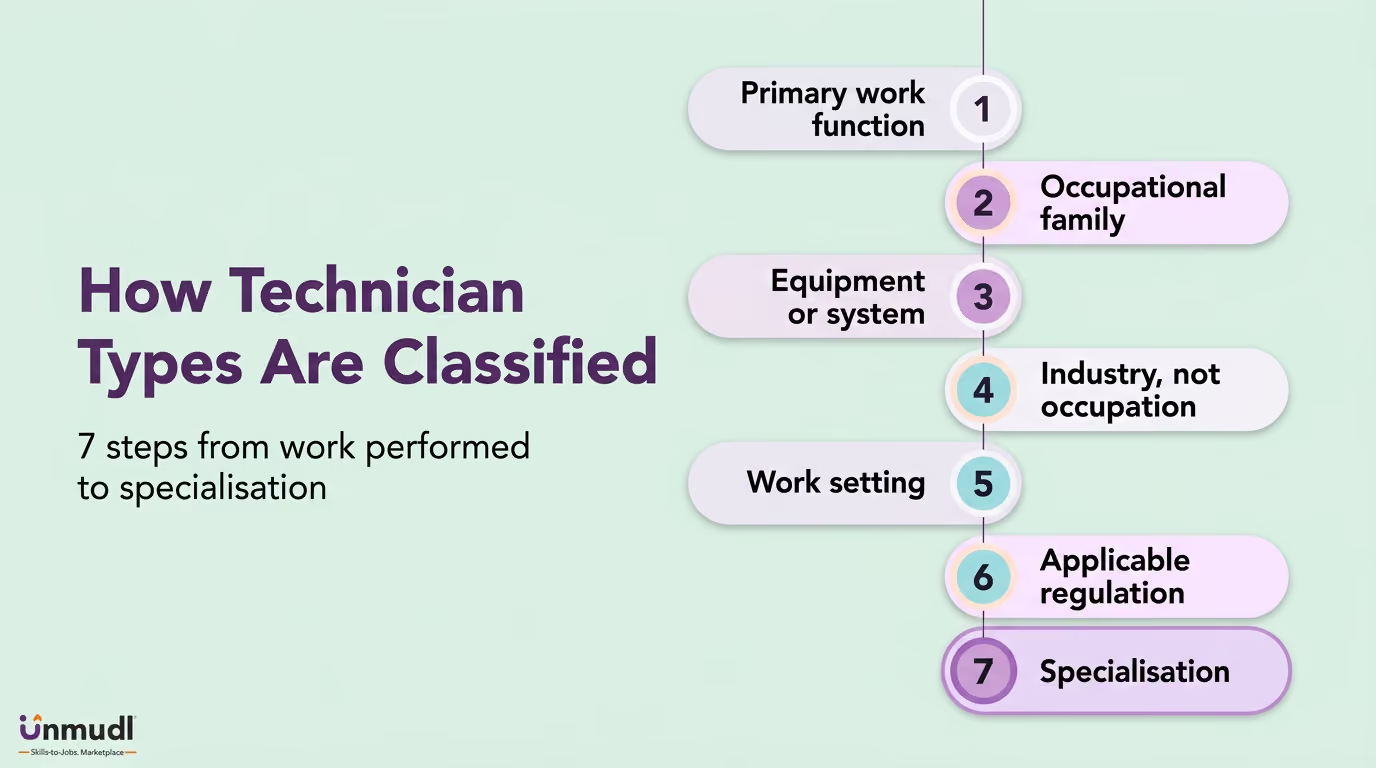
The types of technician are classified in seven steps that move from the work performed to the narrowest specialisation. The steps are classifying by primary work function, locating the occupational family, identifying the equipment or technical system, separating the industry from the occupation, recording the work setting, checking the regulation attached to the work, and narrowing to the specialisation within the occupation. The same seven steps sort every narrower set of technician types. Applied to maintenance, the types of maintenance technicians divide by the system maintained. Applied to vehicles, the types of automotive technicians divide by the vehicle system serviced. Inside healthcare, the types of ultrasound technicians belong to the diagnostic-imaging branch. Across engineering, the types of engineering technicians divide by the discipline supported. Within mechanical work, the types of mechanical technicians split into engineering support and machinery maintenance.
1. Classify by the Primary Work Function
Begin the classification with the work the technician actually performs, because the primary work function is the first discriminator in the federal occupational system. Define the function as the duty set occupying most of the working day. The duty set covers inspecting, diagnosing, testing, calibrating, repairing, installing, or supporting equipment. Place a worker who primarily repairs a machine in a repair occupation whatever production title the employer prefers. Place a process-control worker in an operator occupation instead. A function-first rule protects against title-driven misclassification. Job titles vary from one employer to the next. Duties stay constant across employers. Write the duty set down before reading the title. Let the duty set decide the category.
2. Locate the Occupational Family
Locate the family that the function belongs to, since federal occupations sit inside major, minor, broad, and detailed groups rather than under one technician heading. Treat the Occupational Information Network (O*NET) as the finer layer beneath the SOC structure. The finer layer adds data-level occupations, tasks, tools, and alternate titles. Expect engineering, maintenance, healthcare, computer, production, and life-science technicians to fall into six separate families. The shared suffix technician carries no classification weight. Locating the family draws a clean boundary between roles that sound alike. A mechanical engineering technician assists design. An industrial machinery mechanic maintains plant equipment. Write the family name beside the type. Keep one type inside one family.
3. Identify the Equipment or Technical System
Identify the system the technician services, since similar functions diverge once the equipment differs. Distinguish an HVAC unit, a robotic cell, a communications switch, an automobile, a measuring device, and a laboratory instrument as separate systems. Each system carries its own knowledge base, tools, procedures, and fault modes. A robotics technician troubleshoots controllers, sensors, and robot mechanisms. A calibration technician compares a device against a standard. A system-level identification buys a precise match between the technician and the training the equipment demands. The match also predicts the tools carried to the job. Name the system in the type label itself. Avoid a label that names only the function.
4. Separate the Industry From the Occupation
Separate the industry that employs the technician from the occupation the technician holds, because the two are different dimensions in official data. Read industry as the answer to where the work happens. Read occupation as the answer to what the work is. Treat a phrase such as manufacturing technician with care. Manufacturing names either the work itself or merely the sector employing an electrical, IT, maintenance, safety, or laboratory technician. The reward of the separation is one occupation measured across every sector employing it. A maintenance occupation therefore appears in property, factories, government offices, and hotels at once. Attach the industry as a second label. Keep it from overwriting the occupational label.
5. Record the Work Setting
Record the setting in which the work is done, since each physical environment changes the daily context of the role. The settings are a laboratory, a hospital, a factory floor, a construction site, a customer's premises, an outdoor line, and an office. Define work setting as the physical environment plus the people the technician interacts with. Those people are users, patients, or production crews. Expect the setting to shape equipment exposure, scheduling, protective requirements, and safety rules. A recorded setting supplies a secondary classifier for the type. The secondary classifier explains why two technicians with one function experience different jobs. Use the setting as a secondary label only. Never let it override the primary duties.
6. Check the Regulation Attached to the Work
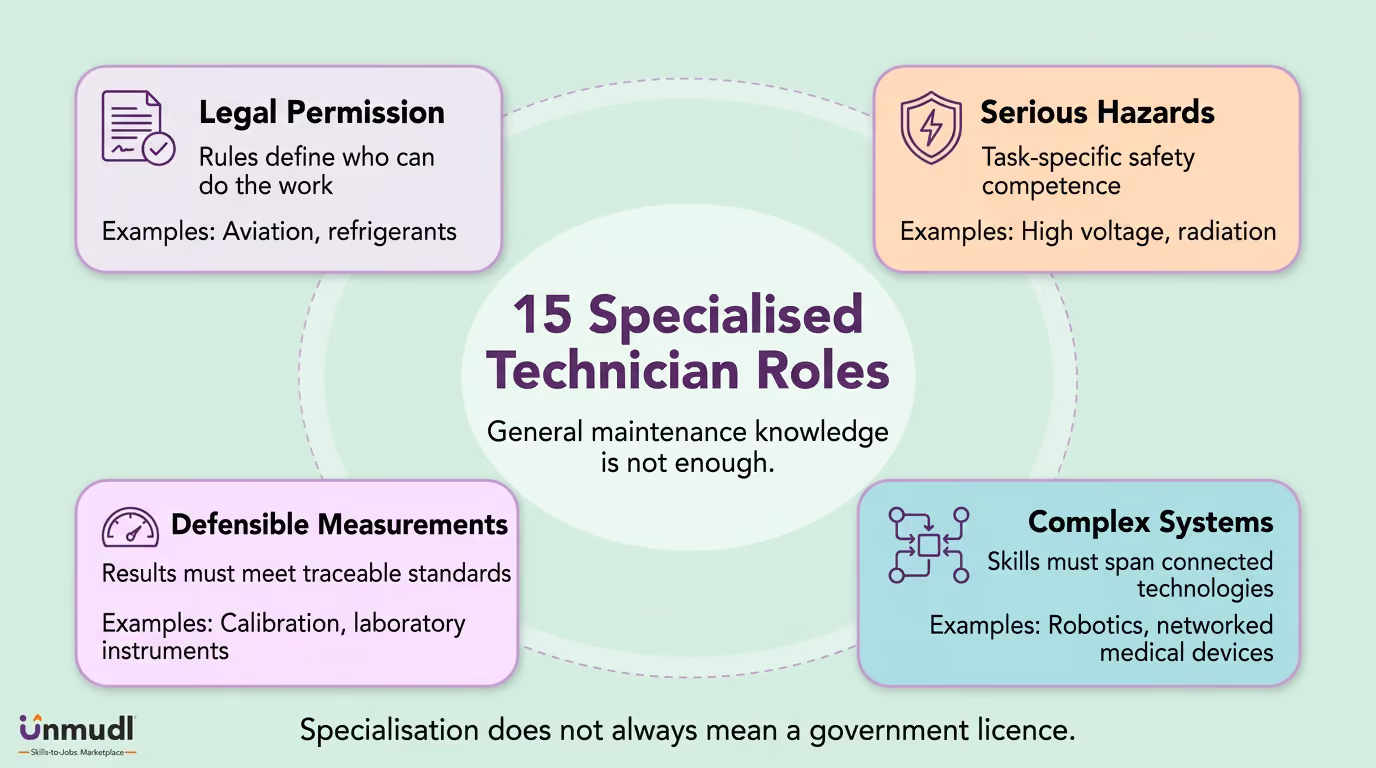
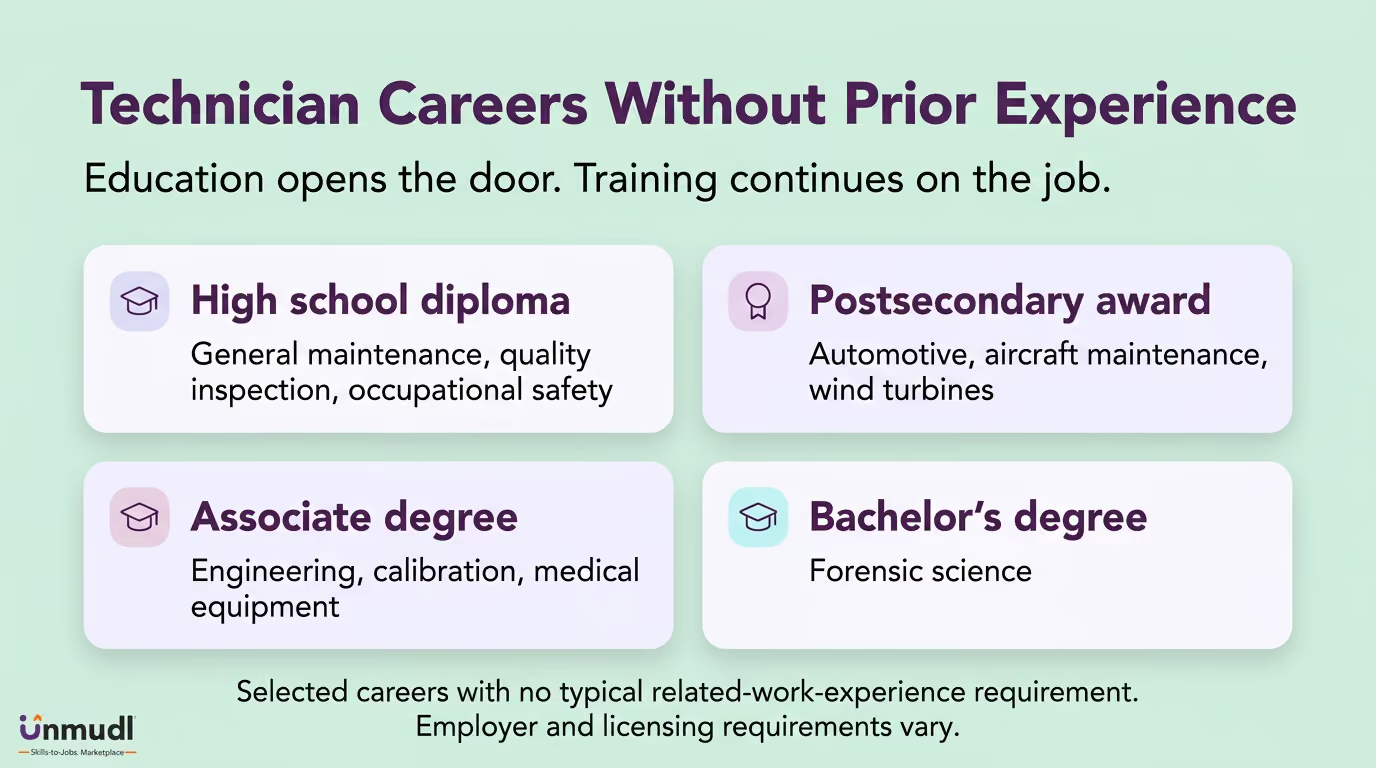
Check whether the work is subject to a licence, a certification, a safety qualification, or a regulatory rule, because regulation creates real subtypes within a technician category. Define regulation as a requirement attached to a particular activity or occupation. The word technician by itself implies no licence. Refrigerant handling, aircraft maintenance, energised high-voltage work, and clinical procedures each carry their own qualification regime. Generic facilities repair carries none. The regulatory check draws a line between a legally gated specialisation and a merely demanding one. Confirm the rule with the regulator for the actual activity. Never generalise one occupation's licence to the whole type.
7. Narrow to the Specialisation Within the Occupation
Narrow the classification last to the specialisation inside the identified occupation, since a broad occupation divides by technique, system, or assignment once its family is fixed. Define specialisation as an additional constraint on the general function. The constraint originates in equipment complexity, safety risk, legal authority, measurement requirements, or employer-specific technology. Clinical laboratory work splits by laboratory discipline. Telecommunications work splits by central-office, customer-premises, line, or tower assignment. HVAC work splits by installation, service, refrigeration, or controls. The advantage of leaving specialisation until last is a subtype that inherits a correct family and system before it is named. Name the specialisation only after the occupation is settled. Keep the broad occupation as the parent label.
Running the seven steps in order turns a loose job title into a classified technician type with a function, a family, a system, an industry, a setting, a regulatory status, and a specialisation. That classified type is also the unit federal employment data counts when it measures which types most industries hire.