Robotics Technician: Types, Duties, Training, and Salary

A robotics technician is the hands-on industrial specialist who keeps robotic equipment and automated production systems working on the factory floor. A robotics technician sits between the engineer who designs a machine and the operator who runs it. The occupation carries an alternate title, automation technician, because the same wiring, diagnostic, and repair skills serve every automated cell on a production line. Employers use the two titles interchangeably, so the robotics technician career opens in every plant that runs robots.

The importance of a robotics technician rises with every robot a factory adds. Each installed unit needs commissioning, calibration, and repair from one worker who understands both its electronics and its mechanics. The benefit of the occupation to a candidate is a short entry route, since a two-year degree or a postsecondary certificate opens the door. The benefit to an employer is uptime, because a resident technician restores a stopped line faster than an outside contractor. The robotics technician salary rewards that uptime with a wage that varies by industry and climbs in research and development plants. Those rewards begin with a clear definition of the role itself.

What is a Robotics Technician?
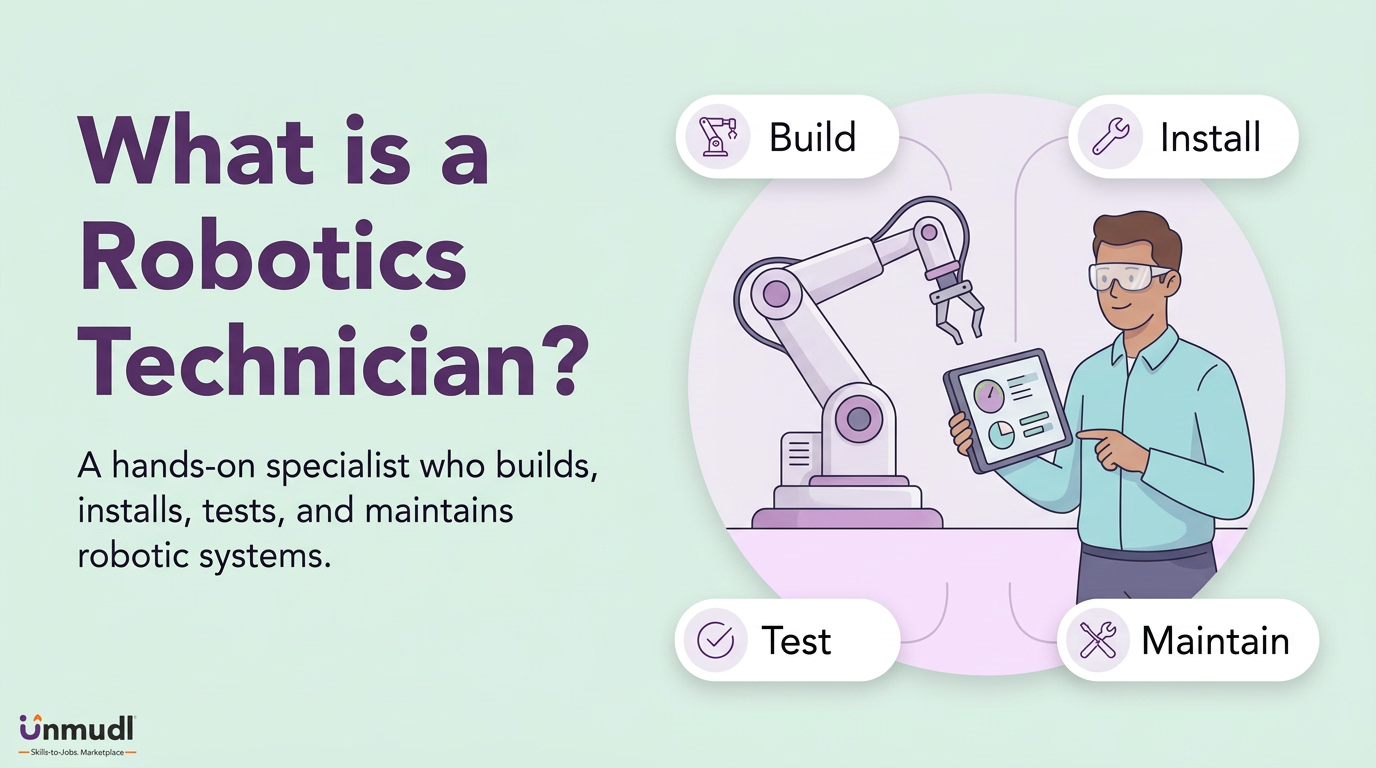
Robotics technician building, installing, testing and maintaining robotic systems

A robotics technician is a skilled-trades occupation whose holder builds, installs, tests, or maintains robotic equipment or related automated production systems, as the Occupational Information Network (O*NET) record for the occupation, updated in 2026, defines it. The definition places the robot technician on the implementation side of automation robotics, where the machine already exists and must be made to work. Implementation then gives way to upkeep, because a working cell drifts, wears, and faults over time. Engineers design the automated process, and the technician executes and sustains it under their guidance. The boundary between the two roles therefore rests on design authority, and the tasks of the technician follow from that boundary.

What Does a Robotics Technician do?

A robotics technician works by keeping a robotic cell in specification through installation, calibration, repair, and troubleshooting. The work starts when a new robotic arm arrives on a production line and the technician mounts it, wires it, and calibrates its axes. Calibration hands over to programming, where the technician loads the motion routine. A running arm then enters the maintenance cycle, which the technician services on a schedule to prevent unplanned stops. Unplanned stops still occur, and the technician traces each fault through the electronics, the mechanics, and the programmable controller until the cause is isolated. Each of those activities belongs more to one kind of robotics technician than to another.

What are the Types of Robotics Technician?
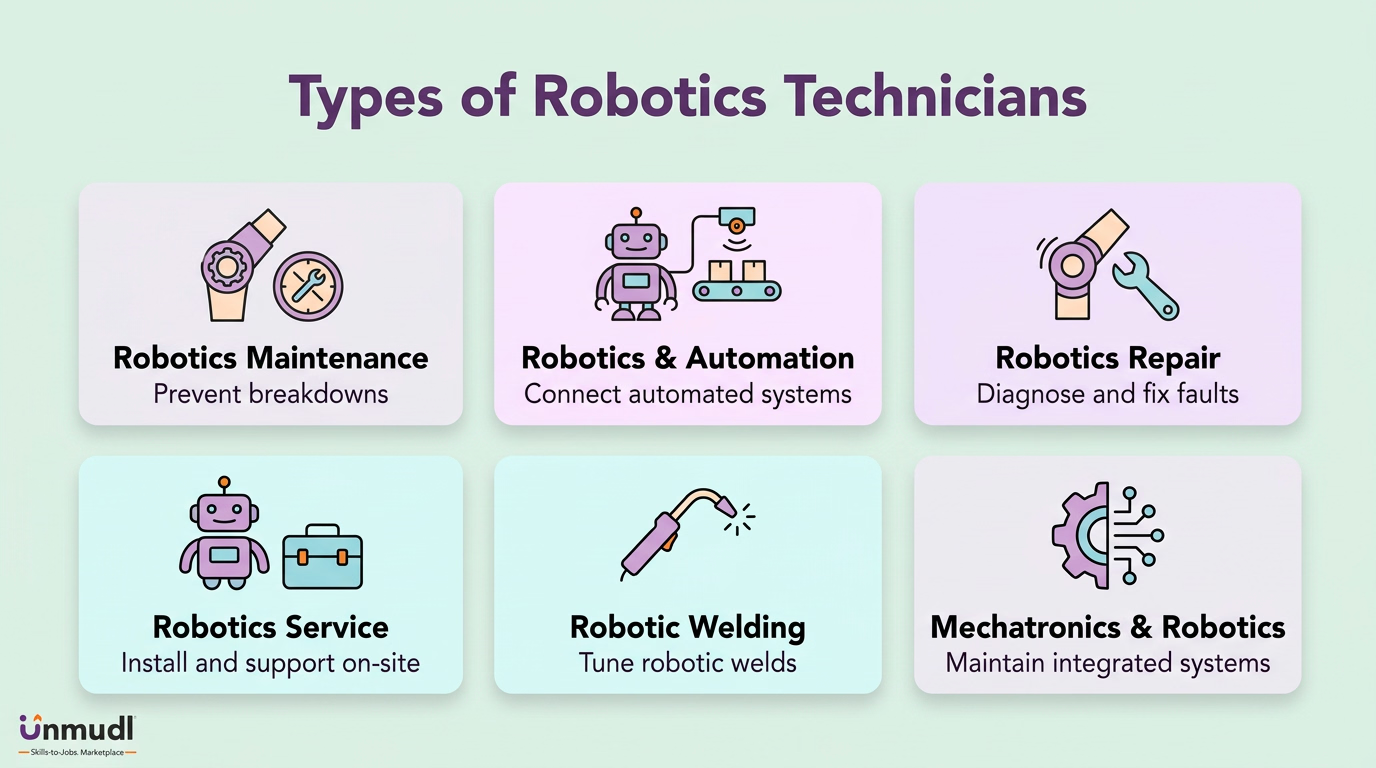
Six robotics technician specialties: maintenance, automation, repair, service, robotic welding, and mechatronics and robotics

There are six main types of robotics technician based on the stage of the robot's life cycle and the industrial system the technician serves. The types are robotics maintenance technician, robotics and automation technician, robotics repair technician, robotics service technician, robotic welding technician, and mechatronics and robotics technician, which are briefly discussed below.

1. Robotics Maintenance Technician

A robotics maintenance technician is a preventive specialist who keeps installed robots from failing. The preventive specialist inspects, lubricates, and replaces wearing parts on a fixed schedule. The benefit of the schedule is uptime, since a planned stop of minutes replaces an unplanned stop of hours. Plant managers assign this type to lines where one robot halt idles a whole shift.

2. Robotics and Automation Technician

A robotics and automation technician is a systems generalist who supports every automated machine in a cell, not the robot alone. The systems generalist wires conveyors, sensors, and programmable controllers into one working sequence. The gain from that breadth is faster commissioning, because one worker owns the whole cell. Employers post this type wherever robots and fixed automation share a line.

3. Robotics Repair Technician

A robotics repair technician is a corrective specialist who restores a robot after a fault has stopped it. The corrective specialist traces the failed part to a board, a cable, or a motor and exchanges it. The payoff of a dedicated repair role is speed, as diagnostic skill grows with every fault already solved. Manufacturers keep this type on call where stoppages are costly.

4. Robotics Service Technician

A robotics service technician is a field specialist who travels to customer sites on behalf of a robot manufacturer or integrator. The field specialist installs new units, performs warranty work, and trains the customer's staff. The advantage of the travelling role is exposure, since one technician meets many plants and robot models in a year. Robot makers staff this type to protect their installed base.

5. Robotic Welding Technician

A robotic welding technician is a process specialist who runs and maintains robots that weld. The process specialist tunes torch angle, wire feed, and weld parameters along with the motion path. The value of the pairing is quality, because a weld robot performs only as well as the person who set its process. Automotive and heavy-fabrication shops hire this type for high-volume welding lines.

6. Mechatronics and Robotics Technician

A mechatronics and robotics technician is a cross-disciplinary specialist who works across mechanical, electrical, and control systems. The cross-disciplinary specialist reads a hydraulic schematic and a ladder-logic program with equal ease. The strength of the combined skill set is range, as the technician moves between fulfilment centres and assembly plants. Large logistics employers recruit this type by name for their automated warehouses.

Reading the six types by life-cycle stage and by system lets a candidate choose a specialty by the machines they want to keep running. The daily duties behind every specialty share one core set.

Type of Robotics TechnicianLife-Cycle StageSystem ServedTypical Employer
Robotics maintenance technicianPreventive upkeep of installed robots on a fixed scheduleThe installed robot and its wearing partsPlant managers on lines where one robot halt idles a whole shift
Robotics and automation technicianCommissioning of the whole automated cellConveyors, sensors, and programmable controllers wired into one sequenceEmployers whose robots and fixed automation share a line
Robotics repair technicianCorrective restoration after a fault has stopped the robotThe failed board, cable, or motorManufacturers where stoppages are costly
Robotics service technicianInstallation, warranty work, and customer training at the siteNew units across many plants and robot modelsRobot makers and integrators protecting their installed base
Robotic welding technicianRunning and tuning of robots that weldTorch angle, wire feed, weld parameters, and motion pathAutomotive and heavy-fabrication shops with high-volume welding lines
Mechatronics and robotics technicianCross-disciplinary work across mechanical, electrical, and control systemsHydraulic circuits and ladder-logic programs in automated warehouses and assembly plantsLarge logistics employers recruiting the type by name
Shared core of all six typesInstallation, calibration, repair, and troubleshootingEvery automated cell on a production lineEvery plant that runs robots

What are the Duties of Robotics Technician?
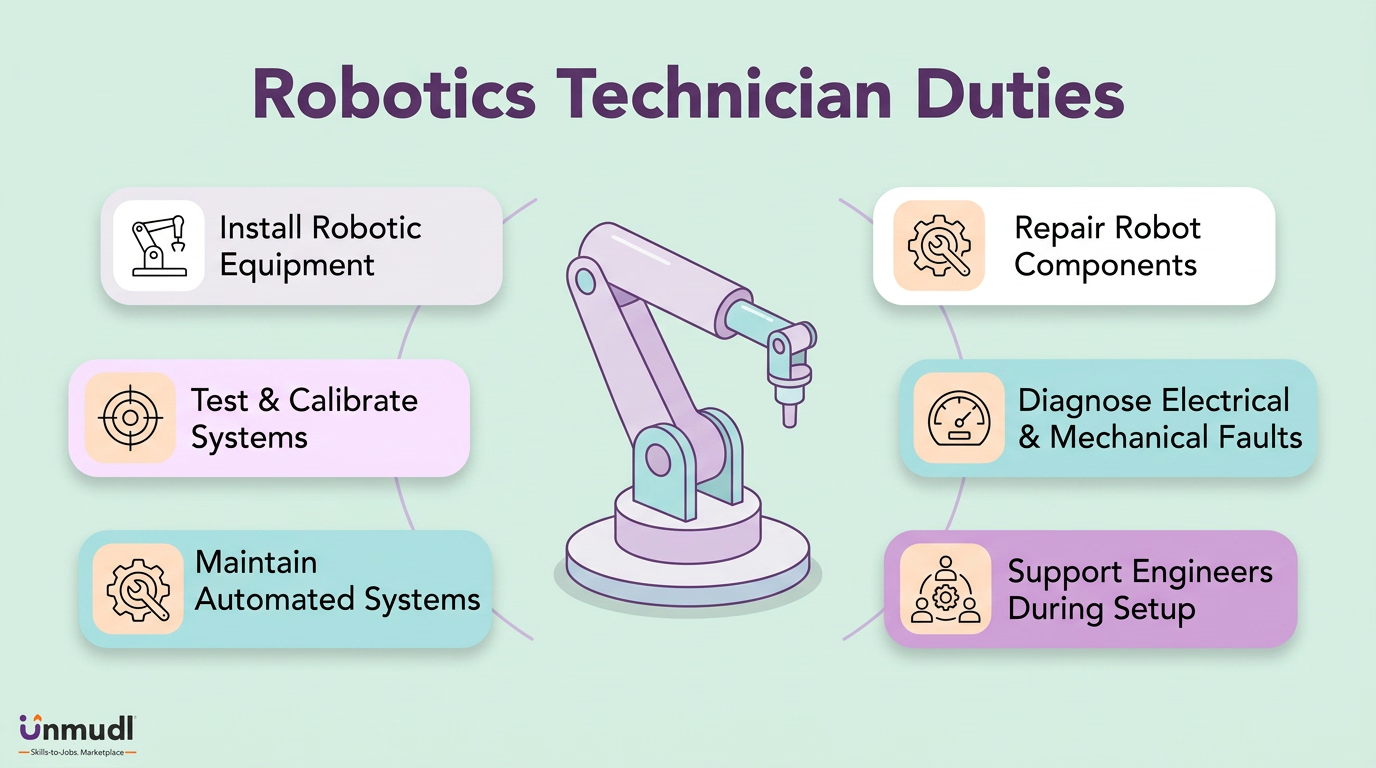
Robotics technician duties covering installation, testing, calibration, maintenance, repairs, diagnosis and engineering setup support

There are six main duties of a robotics technician that together form the robotics technician job description across employers. The duties are installing robotic equipment, testing and calibrating robotic systems, maintaining automated production systems, repairing robot components, troubleshooting electrical and mechanical faults, and supporting engineers during setup, and each duty is explained below.

1. Installing Robotic Equipment

Installing robotic equipment is the founding duty in which the technician anchors, wires, and powers a new robot on the line. The installation follows the manufacturer's drawings so that every cable, guard, and sensor sits where the design places it. A correct installation prevents the alignment faults that surface weeks later as scrapped parts. Technicians treat installation as the point where reliability is decided.

2. Testing and Calibrating Robotic Systems

Testing and calibrating robotic systems is the verification duty that proves a robot moves exactly where its program says. The technician jogs each axis, measures its position against a reference, and corrects any offset. Accurate calibration protects the tooling and the parts the robot handles. Technicians repeat the calibration after any collision or relocation.

3. Maintaining Automated Production Systems

Maintaining automated production systems is the scheduled duty that keeps the whole cell, not just the robot, in working order. The technician checks conveyors, grippers, and pneumatics at a fixed interval and replaces consumables before they fail. Scheduled care converts surprise breakdowns into planned pauses. Technicians log every maintenance action so the next visit starts from a known state.

4. Repairing Robot Components

Repairing robot components is the corrective duty that returns a faulted robot to service. The technician replaces a defective circuit board, sensor, controller, encoder, or servomotor and verifies the repair under load. A fast repair limits the production lost to a single failure. Technicians keep critical spares on hand to shorten that repair time.

5. Troubleshooting Electrical and Mechanical Faults

Troubleshooting electrical and mechanical faults is the diagnostic duty that finds the cause behind a stopped robot. The technician reads the schematic, meters the circuit, and inspects the drive train until the fault is isolated to one part. Systematic diagnosis stops the waste of swapping parts on guesswork. Technicians rate this duty as the skill that separates a seasoned worker from a new hire.

6. Supporting Engineers During Setup

Supporting engineers during setup is the collaborative duty where the technician builds and tests what the engineer has designed. The technician assembles the prototype cell, runs the trial program, and reports what the design does on real hardware. That feedback shortens the gap between a drawing and a working line. Technicians stop short of designing the process, which stays with the engineer.

Carrying out the six duties, from installation to engineer support, keeps a production floor at the uptime a plant manager expects. The floor itself differs by the place a technician works.

Where does a Robotics Technician Work?

A robotics technician works in industrial settings where robots run production, chiefly factory floors, testing laboratories, and field service sites. The factory floor is the primary setting, since manufacturing holds the largest installed base of robots and needs the most upkeep. Manufacturing itself spans automotive, aerospace, medical device, and robotics equipment plants. The testing laboratory is the second setting, where the technician proves out new cells with engineers before the cells reach production. The field is the third setting for the robotics service technician. The robotics service technician travels from a manufacturer or integrator to a customer's plant to install, fix, or upgrade units in place. Working conditions move with the setting, from a quiet laboratory to a noisy floor beside running machinery. Employers in all three settings expect one core preparation route.

How to become a Robotics Technician?

Becoming a robotics technician requires five stages of preparation. The stages are completing robotics training, earning the required credentials, gaining experience through an apprenticeship, building the practical skills employers test, and starting the robotics technician career. The Bureau of Labor Statistics (BLS) and O*NET place the occupation in Job Zone 3, which means medium preparation from vocational school, related work experience, or an associate degree. Robotics training spans secondary coursework, a postsecondary program, and lab practice. The credentials stage adds the college award, a manufacturer's certification, and an industry certification. The apprenticeship stage registers the candidate, logs mentored hours, and completes classroom instruction. The skills stage covers schematic reading, wire harness assembly, and employer training, and the career stage covers the job application and continued learning. The five stages are described below.

1. Complete Robotics Training for a Robotics Technician

Robotics training is the formal instruction in electronics, mechanics, automation, and robot programming that prepares a candidate to install and maintain robotic equipment. Robotics training runs 1 to 2 years at a community college or trade school and totals about 60 credit hours. Robotics training divides into three stages of study. The stages are high school coursework, a certificate or degree program, and lab practice, which are explained below.

1.1 Finish High School Coursework in Mathematics, Physics, and Electronics

High school coursework is the foundation stage of robotics training, built on algebra, physics, and basic circuit theory. Algebra supplies the arithmetic behind motor speed and gear ratio calculations. Physics explains the force and torque inside a robotic arm. Circuit theory prepares the student to read wiring diagrams. A high school diploma or a General Educational Development (GED) certificate closes this stage and opens the postsecondary program.

1.2 Enroll in a Robotics Technician Certificate or Associate Degree Program

A robotics technician program is a postsecondary course of study in robotics technology, mechatronics, automation, or electrical technology that awards a certificate or an associate degree. The certificate version at the University of Houston–Downtown runs 14 modules on industrial robotics processes and robot programming, while the associate degree version adds general education courses across 2 years. Both versions teach circuit analysis, digital control, and pneumatics. The classroom theory of both versions is then applied to real machines in the lab.

1.3 Practice PLC, Sensor, and Robot Programming Skills in the Lab

Lab practice is the hands-on stage of robotics training where the student operates real robotic arms, sensors, and programmable logic controllers (PLCs). A PLC is the industrial computer that sequences an automated cell. Lab exercises teach the student to calibrate a sensor, write a basic robot program, and restore a cell after a fault. The Hagerstown Community College certificate adds robot welding and simulation exercises. Finishing the training earns the first credential a candidate shows an employer.

2. Earn the Credentials Required for a Robotics Technician

A credential is a postsecondary award or certification that evidences competence to an employer. Credentials for the occupation divide into three groups based on the issuing body. The groups are the postsecondary award from a college, the vendor certification from a robot manufacturer, and the industry certification from a manufacturing skills body. No federal or state license governs the occupation, so every credential stays optional, as explained below.

2.1 Obtain the Associate Degree or Postsecondary Certificate

Reported robotics technician education requirements: bachelor's degree 18 percent, associate degree 45 percent and postsecondary certificate 23 percent

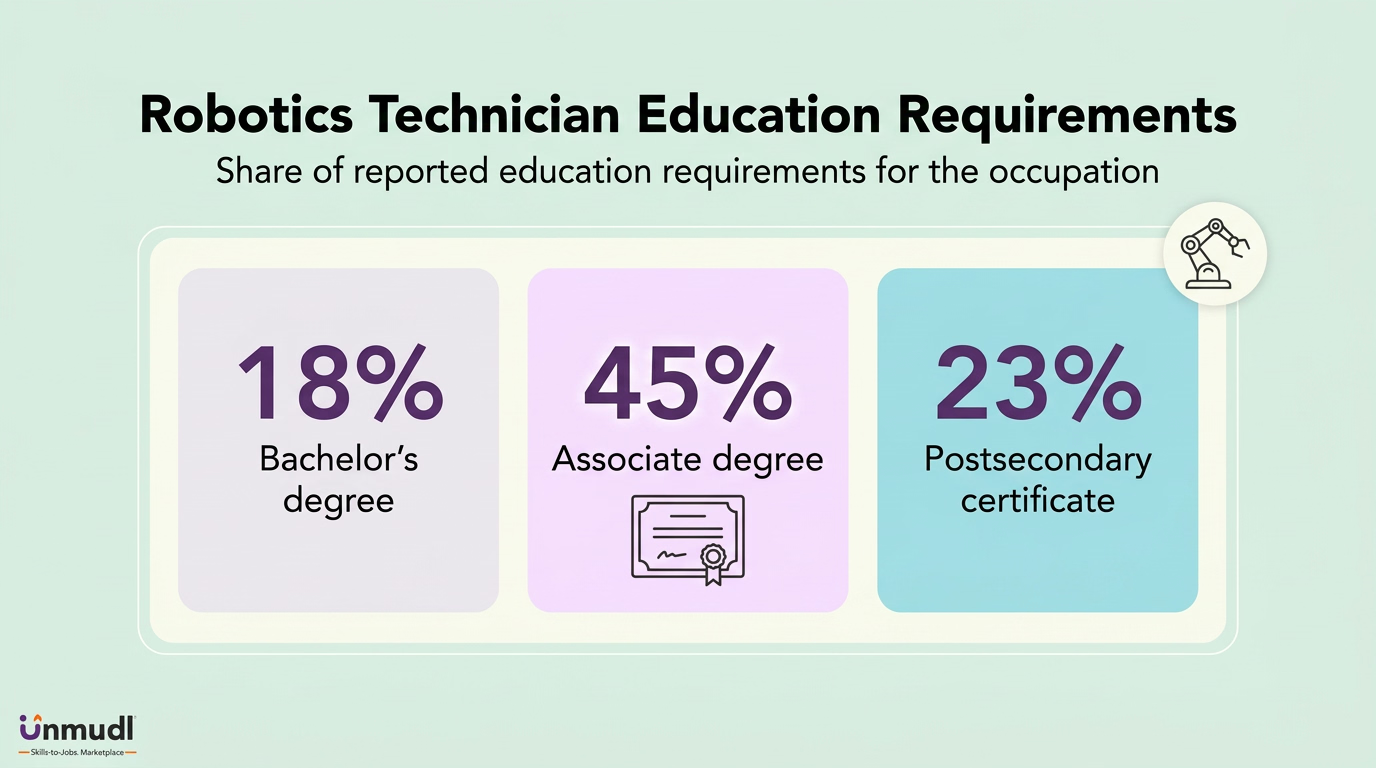
The postsecondary award is the credential employers request most often for robotics technician hiring. An associate degree appears in 45% of the education requirements reported for the occupation, a postsecondary certificate in 23%, and a bachelor's degree in 18%. The 2026 O*NET occupation record for Robotics Technicians reports those shares. The associate degree therefore outnumbers the bachelor's degree by 2.5 to 1, a ratio derived from those shares. Employers read the award as proof of a finished robotics curriculum.

2.2 Add a Vendor Certification Such as the FANUC Certified Robot Operator

A vendor certification is a credential issued by a robot manufacturer that verifies the holder operates and troubleshoots that manufacturer's robots. FANUC issues the FANUC Certified Robot Operator (FCR-O) at Level I and Level II. Level I covers basic robot operation. Level II covers fault troubleshooting on FANUC controllers. A plant that runs FANUC robots reads the FCR-O as proof that a new hire needs no orientation.

2.3 Pursue an Industry Certification Such as the MSSC Certified Production Technician

An industry certification is a brand-neutral credential from a manufacturing skills body that verifies production knowledge. The Manufacturing Skill Standards Council (MSSC) issues the Certified Production Technician (CPT), which now includes foundational robotics and automation content. The CPT differs from the FCR-O by covering safety, quality, and Industry 4.0 concepts instead of one controller. Industry certifications travel with the technician between employers. One credential, the apprenticeship certificate of completion, is issued only after hours worked for an employer.

3. Gain Experience Through a Robotics Technician Apprenticeship

Robotics apprenticeship combining employer registration, mentored paid training and classroom instruction

A robotics technician apprenticeship is a registered program that combines paid on-the-job training with classroom instruction under standards approved by the U.S. Department of Labor. The Tooling U-SME framework sets 1,500 to 2,000 on-the-job hours plus at least 144 classroom hours. The apprenticeship runs in three steps. The steps are registration, mentored hours, and related technical instruction, which are explained below.

3.1 Register With an Employer That Sponsors the Apprenticeship

Registration is the enrollment step in which an employer sponsor, the apprentice, and the Department of Labor sign the training agreement. The employer sponsor owns the apprenticeship, so a candidate finds a registered program before any hours count. Registration fixes the wage schedule, the hour targets, and the mentor.

3.2 Log 1,500 to 2,000 On-the-Job Training Hours Under a Mentor

On-the-job training is supervised work on the factory floor in which the apprentice wires, assembles, and repairs robots beside an experienced technician. The mentor assigns tasks such as mechanical assembly, motor wiring, and sensor replacement. Each task is logged against the hour target. The hour target equals about 9 to 12 months at 40 hours a week, a duration derived from the hour count.

3.3 Complete at Least 144 Hours of Related Technical Instruction

Related technical instruction (RTI) is the classroom component of the apprenticeship that teaches automation fundamentals, PLC programming, and safety. The 144-hour minimum equals 18 full class days, a figure derived from an 8-hour day. Finishing both hour counts releases the certificate of completion. The certificate proves the hours served, and a skills test proves what those hours taught.

4. Build the Practical Skills Employers Test for a Robotics Technician

Practical skills are the hands-on electrical and mechanical abilities that employers verify with a skills test before they hire a robotics technician. Hiring managers weigh the skills test above academic pedigree. The test covers two skill groups, and a third group is taught after hiring. The groups are schematic reading with a multimeter, wire harness and motor wiring, and employer training, which are covered below.

4.1 Read Schematics and Use a Multimeter

Schematic reading is the ability to trace a wiring diagram from the power source through every relay, sensor, and drive. A multimeter measures voltage, current, and resistance at each point on that diagram. Confirming the diagram with the multimeter isolates a fault in minutes. Working technicians rank schematic reading and electrical fundamentals as the top two skills for the role.

4.2 Assemble Wire Harnesses and Wire Motors, Servos, and Drives

Wire harness assembly is the manual task of bundling, terminating, and routing the conductors that connect a robot controller to its motors, servos, and drives. A servo is a motor with position feedback that moves each robot joint. The drive converts controller signals into the current the servo needs. Employers set a wire harness build as the practical hiring test, and IPC wiring standards define an acceptable result.

4.3 Complete an Employer Training Program on Specific Equipment

An employer training program is product-specific instruction that a company gives a new robotics technician after hiring. New technicians receive this instruction because a college program covers robots in general rather than the plant's own models. Amazon runs a Robotics and Mechatronics program with Universal Technical Institute (UTI) for high school graduates without a prior degree. Employer programs shorten the gap between the classroom and the first repair. That first repair marks the start of the career.

5. Start the Robotics Technician Career

A robotics technician career is the employment path that begins with an entry-level technician post and advances toward senior technician and specialist roles. The career opens into a workforce of 15,000 robotics technicians employed in 2024, with growth of 1% to 2% projected through 2034. Demand stays firm despite slow growth, because 85% of automation firms reported difficulty filling technical roles in 2023. The two steps of the career stage are the job application and continued learning, which are outlined below.

5.1 Apply for Entry-Level Robotics Technician Jobs

An entry-level robotics technician job is a first technician post that lists a postsecondary award, hands-on experience, and preferred certifications as its requirements. Job postings name the certifications the employer prefers, such as FCR-O Level I or the MSSC CPT. Reported job titles for the same post include automation technician and robotics maintenance technician. Landing the post under any of those titles starts the learning rather than ending it.

5.2 Continue Learning as Robot Technology Changes

Continued learning is the ongoing study of new controllers, servo programming, and automation methods after the first hire. Robot models change faster than college curricula, so a technician refreshes skills through manufacturer courses and online tutorials. Following the five stages from robotics training to continued learning turns a candidate into a working robotics technician. The working technician then draws the wage the occupation pays.

What is the Robotics Technician Salary?

The robotics technician salary is $35.53 per hour, which equals $73,900 per year at the May 2025 median. BLS reports the figure for the electro-mechanical and mechatronics technician group that contains the occupation. The annual median divides into $6,158 per month and $18,475 per quarter, both derived arithmetically from the yearly wage. Industry moves the wage both ways, since research and development employers pay a median of $101,580 while engineering services pay $64,220. The question of how much a robotics technician makes therefore settles at a median rate of about $74,000 per year. The entry award behind that wage is shorter than a bachelor's degree.

Does a Robotics Technician Require a Degree?

No, a robotics technician does not require a bachelor's degree, since employers set the entry award at the two-year level for most openings. A robotics technician degree at the associate level meets the education line in the largest share of postings. The bachelor's degree trails the associate degree by more than two to one in the 2026 O*NET education shares for the occupation. Employers accept the shorter award because the role repairs machinery rather than designing it. Whichever award a candidate holds still has to reach a hiring manager through a resume.

How to Build Robotics Technician Resume?

A robotics technician resume is a single-column document that lists work history, skills, education, and completed robotics training courses. The single column matters because applicant tracking software, called an ATS, parses that layout without error. An ATS screens every submission for the terms a job posting carries before a recruiter opens the file. Unmudl's free resume builder formats the document for that screening and starts without a login. Building a robotics technician resume on Unmudl takes six steps. The steps are opening the builder, entering the details, matching the keywords, tailoring the draft per job, saving the file, and listing the completed training. Each step is described below.

  1. Open the builder: Go to unmudl.com/create-resume or click Build My Resume on the Unmudl site. The tool launches at once, and no account is asked for at this stage.
    Unmudl resume builder opening screen with the Build My Resume button
  2. Enter the details: Type the work history, the skill set, and the education into the fields. Place finished robotics training programs and vendor certifications under Education or Skills, since those fields are the ones the screening software reads first.
  3. Match the keywords: Let the builder lift terms such as robotics, automation, and named robot models from technician postings into the matching sections. Term matching raises the chance that an ATS selects the file for a technician role.
  4. Tailor the draft for each job: Use the auto-tailor feature when applying through Unmudl. The feature inserts the wording of one specific job description into the draft, which makes each submission read as a fit for that opening.
    Selecting basic information and profile details in the Unmudl resume builder
  5. Save and download the file: Register a free Unmudl account once the draft is complete, then download the resume as a PDF. Unmudl charges nothing for the build or the download.
  6. List the completed training: Name every finished robotics certificate or module with its institution and its dates under Education or Certifications. The builder awards no credential itself, so the named program is what shows an employer the hands-on preparation.

Following the six steps in order gives a candidate a screening-ready file to attach to every application.

How to Apply for Robotics Technician Jobs?

A robotics technician job application is a submission that routes a candidate's profile and resume to an employer's hiring portal for one posted opening. Unmudl's job board carries that routing. The marketplace lists technician openings, stores the candidate profile, and redirects each application to the employer's own page. Applying for robotics technician jobs on Unmudl takes seven steps. These steps are searching the job board, signing up, completing the profile, reviewing the job details, applying through the listing, submitting the materials, and following through with the employer. The seven steps are listed below.

  1. Search the job board: Enter Robotics Technician, Mechatronics, or Automation on the Find Jobs page together with a location. Filter the results by full-time or apprenticeship where the listing type matters.
  2. Sign up or log in: Create a free Unmudl account and verify the email address. The marketplace accepts applications only from a registered profile.
  3. Complete the profile: Attach the built resume and fill in the experience, skill, and education fields. Graduates of robotics technician schools enter the certificate name under Education, where employers read it during screening.
  4. Review the job details: Open each robotics or mechatronics listing and read the stated requirements. CBRE's Mechatronics and Robotics Technician posting asks for one or more years of technical training and prefers an associate degree from a technical school.
  5. Apply through the listing: Click Apply Now on the job page once the profile is complete. Unmudl then redirects the applicant to the employer's application page rather than collecting the submission itself.
  6. Submit the materials: Upload the tailored resume, the cover letter, transcripts, and certificates on the employer's site as the form requests.
  7. Follow through with the employer: Finish the remaining steps on the hiring platform and state how each listed qualification is met. Unmudl connects the candidate to the opening and issues no interview guarantee.

Completing all seven steps in sequence moves a candidate from a search result to a filed application. The preparation behind that application begins with a course.

What is the Best Online Robotics Course?

The best online robotics course for an aspiring robotics technician is Unmudl's Mechatronics and Robotics Maintenance course, a self-paced training developed with Amazon and endorsed by the ARM Institute. The course targets industrial robotics and equipment maintenance roles. Its curriculum spans electrical systems, mechanical systems, fluid and pneumatic systems, and industrial automation, with motor control, relay logic, and safety practice inside those areas. A robotics online class of this scope aligns with the requirements employers write into technician postings because major employers shaped the syllabus. Completion earns credit toward four industry microcredentials and a Unmudl certificate of completion. That certificate makes the course function as a robotics certificate program rather than a degree. A companion Virtual Lab course adds troubleshooting simulations to the main content. Learners need a high school diploma and basic mechanical or electrical experience before enrolling. The maintenance focus of the course also marks where the robotics technician role borders the automation technician role.

What is the Difference Between Robotics Technician and Automation Technician?

The primary difference between a robotics technician and an automation technician is the scope of the equipment each one keeps running, not the skill set. An automation technician is a production technician who maintains the control systems of a whole automated line. Those control systems include the PLCs that sequence conveyors, sensors, and machines. A robotics technician confines that work to the robot and its directly attached production equipment. O*NET records Automation Technician as a reported job title inside the Robotics Technicians occupation, so one posting carries either title for an overlapping role.

The goal of the robotics technician is a robot that runs to specification, while the goal of the automation technician is a line that runs without a stoppage. The tools follow the goals. A robotics technician wires servomotors, replaces encoders and controllers, and tests circuit boards with a multimeter, for example on a new arm being calibrated on a production line. An automation technician programs and troubleshoots PLC logic and control panels across the line that arm feeds, for example by clearing a relay fault that halted a conveyor. Reading the equipment scope settles which title a posting means, and the mechatronics technician sits beside both titles on the same floor.

What is the Difference Between Robotics Technician and Mechatronics Technician?

The primary difference between a robotics technician and a mechatronics technician is the breadth of the machinery each one services, not the discipline. A mechatronics technician is an electro-mechanical technician who installs and services equipment combining electrical, mechanical, and fluid or pneumatic systems, from motor drives to hydraulic presses. A robotics technician is a specialization within that occupation. BLS files Robotics Technicians under Electro-Mechanical and Mechatronics Technologists and Technicians, and O*NET assigns the specialization its own sub-code, 17-3024.01.

The goal of a mechatronics technician is every electro-mechanical machine on the floor running in sync, while the goal of a robotics technician is the robot cell running to its program. Their toolsets split along the same line. A mechatronics technician works hydraulic and pneumatic circuits, motor controls, and relay logic across presses, conveyors, and packaging machines, for example by restoring pressure on a pneumatic actuator. A robotics technician works servomotors, encoders, sensors, and robot controllers, for example by repairing a defective circuit board on a robotic arm. Employers such as Amazon and CBRE merge the two scopes into one Mechatronics and Robotics Technician title when a single worker covers both.

Learn In Demand Skills Employers Are Hiring For

Explore our career-ready "Mechatronics and Robotics Maintenance" designed with employers to help you get hired faster. Train for industrial maintenance in ~10–12 weeks, earn a certificate and get ready to interview for technician roles.
No items found.
No items found.
Last updated on:
October 19, 2026
No items found.