

Mechatronics Technician: Types, Duties, Training, and Salary

A mechatronics technician is a skilled worker who installs, tests, and maintains automated electromechanical systems. A mechatronics technician keeps those systems running where mechanical machinery, electronics, and computerized controls are integrated into one machine. The machine is a computer numerical control (CNC) machine, an automated assembly line, or an industrial robot. An industrial robot and its control circuits are designed by a mechatronics engineer. The engineer's design is then implemented, calibrated, and repaired at the equipment level by the technician. The equipment level is where mechanical, electrical, and electronic components meet, and the technician is the expert in how they work together.

The importance of a mechatronics technician comes from the automated equipment that modern manufacturing depends on. Automated equipment stops producing when a sensor, a motor, or a control program fails. The failure is restored by the technician as the hands-on support for the line. That restoring role bridges the mechanical and the electrical domains, so one worker covers the ground of a pure mechanic and a pure electrician. The same worker holds a stable career. The occupation counts 15,700 workers in the United States in 2025, grows by 3% between 2025 and 2035, and opens about 1,400 positions each year. Each position pays a median of $73,900 per year. The position asks for a two-year award or a shorter postsecondary award rather than a license, so the entry route stays technical rather than legal.

Mechatronics workforce and pay snapshot showing median annual pay, employment, projected growth and annual job openings

What is a Mechatronics Technician?
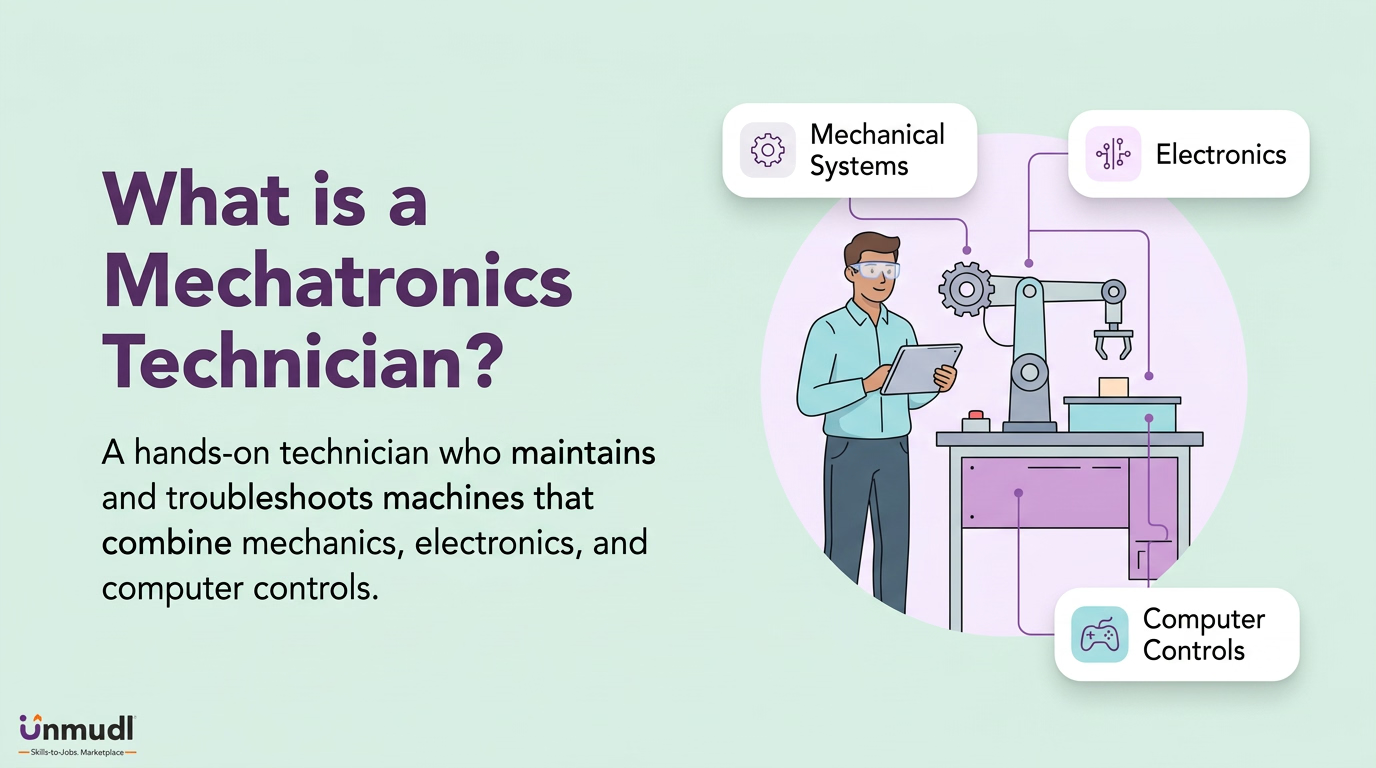
Mechatronics technician maintaining machines that combine mechanical systems, electronics and computer controls

A mechatronics technician is a technician-level member of the electro-mechanical and mechatronics occupation who operates, tests, maintains, and adjusts electromechanical equipment. The same technician also assists engineers in testing robotics equipment. The robotics equipment is a computer-controlled mechanical system built from sensors, servomotors, pneumatic and hydraulic actuators, and programmable logic controllers (PLCs). The system is repaired, upgraded, and tested by the technician, while its design stays with the engineer.

Occupational classification is the coding system that groups this title with its sibling titles. The classification places mechatronics technician, electro-mechanical technician, and mechatronics and robotics technician under one heading, since employers apply the three titles to one set of duties. That one heading is "Electro-Mechanical and Mechatronics Technologists and Technicians" in the Occupational Outlook Handbook of the U.S. Bureau of Labor Statistics (BLS), which describes the group as workers who install, repair, upgrade, and test electronic and computer-controlled mechanical systems. The heading carries the Standard Occupational Classification (SOC) code 17-3024, and the Occupational Information Network (O*NET) files the same code for the mechatronics title.

What Does a Mechatronics Technician Do?

A mechatronics technician works by reading schematics and manuals, assembling and calibrating machinery with precision tools, and diagnosing faults in sensors, motors, and control circuits. The diagnosing starts at a test instrument. An oscilloscope or a voltmeter measures the circuit. The measurement isolates the failed component. The failed component is replaced or rewired. The rewiring is followed by a test of the refurbished equipment before the equipment returns to operation. Operation on an automated line means one worker programs a robotic arm, adjusts a conveyor motor's wiring, and calibrates a control panel sensor in one shift. The shift ends with documented test results. BLS lists detail orientation and problem-solving skills as the two qualities that those results depend on. Supervisors read those results as the record of the machine's condition. Employers then title the worker by the machine family that record covers.

What are the Types of Mechatronics Technician?
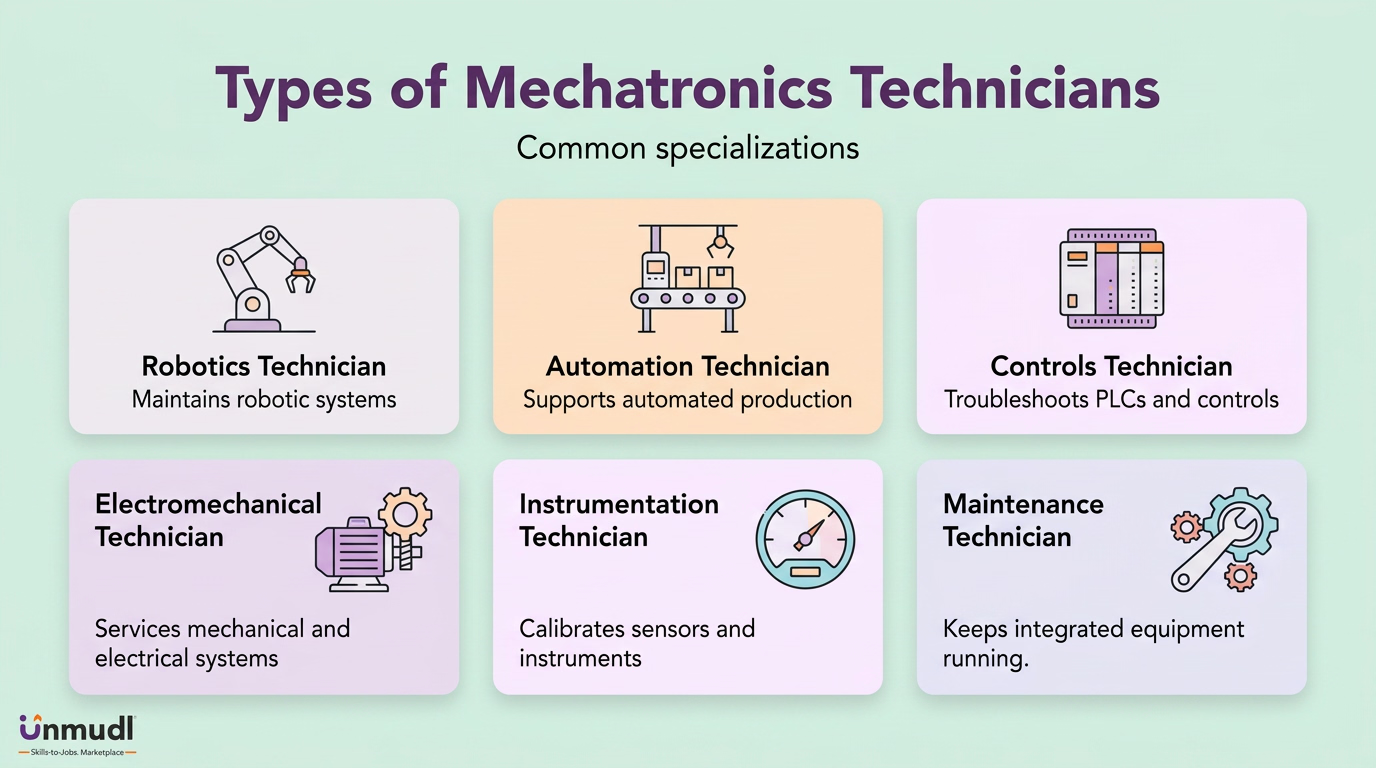
Mechatronics specializations in robotics, automation, controls, electromechanical equipment, instrumentation and maintenance

There are six main types of mechatronics technician based on the equipment family and the industry the technician serves. The types are mechatronics and robotics technician, mechatronics maintenance technician, industrial mechatronics technician, automotive mechatronics technician, mechatronics and controls technician, and mechatronics engineering technician, which are briefly discussed below.

1. Mechatronics and Robotics Technician

A mechatronics and robotics technician services industrial robots and the automated cells built around them. The robot cell holds a robotic arm, its servo motors, and the controller that runs the arm's program. The program is updated and the arm's operation is verified on the line. Employers post this title for robot-dense assembly lines, Amazon's Perris, California site among them.

2. Mechatronics Maintenance Technician

A mechatronics maintenance technician keeps existing automated equipment in working condition through inspection, preventive service, and repair. Preventive service covers motors, conveyors, and PLC-controlled systems on a fixed schedule. The schedule reduces unplanned stoppages. Plant maintenance departments hire this type for round-the-clock coverage.

3. Industrial Mechatronics Technician

An industrial mechatronics technician supports the whole plant floor rather than one machine family. The plant floor combines CNC machines, packaging lines, and hydraulic presses. Each of those machines is troubleshot across every layer by this generalist. Manufacturers that run many equipment types under one roof value breadth over depth.

4. Automotive Mechatronics Technician

An automotive mechatronics technician works on vehicle assembly lines and on the mechatronic systems inside vehicles. A vehicle assembly line runs robotic welding arms and conveyor controls, and both are installed and tested by this type. The vehicle itself carries sensors, actuators, and electronic control units with the same diagnostic logic. Transportation equipment plants form the main employer group.

5. Mechatronics and Controls Technician

A mechatronics and controls technician specializes in the control layer of automated equipment. The control layer consists of controllers, control panels, sensors, and the wiring between them. The wiring is traced and the controller logic is adjusted when a machine's behavior drifts from its specification. Process plants rely on this type for control faults.

6. Mechatronics Engineering Technician

A mechatronics engineering technician assists engineers in testing and designing robotics and electromechanical equipment. The engineers hand over a prototype, and the prototype is assembled, instrumented, and measured. The measurement data returns to the engineer for the next design revision. Engineering services firms and research laboratories place this type beside the design team.

The table below compares the six types by the equipment family each one services and by the employer setting that posts the title.

TypeEquipment FamilyEmployer Setting
Mechatronics and robotics technicianIndustrial robots and their automated cellsRobot-dense assembly lines
Mechatronics maintenance technicianMotors, conveyors, and PLC-driven systemsPlant maintenance departments
Industrial mechatronics technicianCNC machines, packaging lines, hydraulic pressesManufacturers running many equipment types
Automotive mechatronics technicianRobotic welding arms, conveyor controls, and vehicle control unitsTransportation equipment plants
Mechatronics and controls technicianControllers, panels, sensors, and their wiringProcess plants
Mechatronics engineering technicianPrototypes of robotics and electromechanical equipmentEngineering firms and research labs
Common groundOne core set of six duties across every familyOne entry route across every setting

Reading the six types together lets a candidate pick an equipment family and an industry before choosing a training route. Each type then carries the same core set of duties whatever the family.

What are the Duties of Mechatronics Technician?
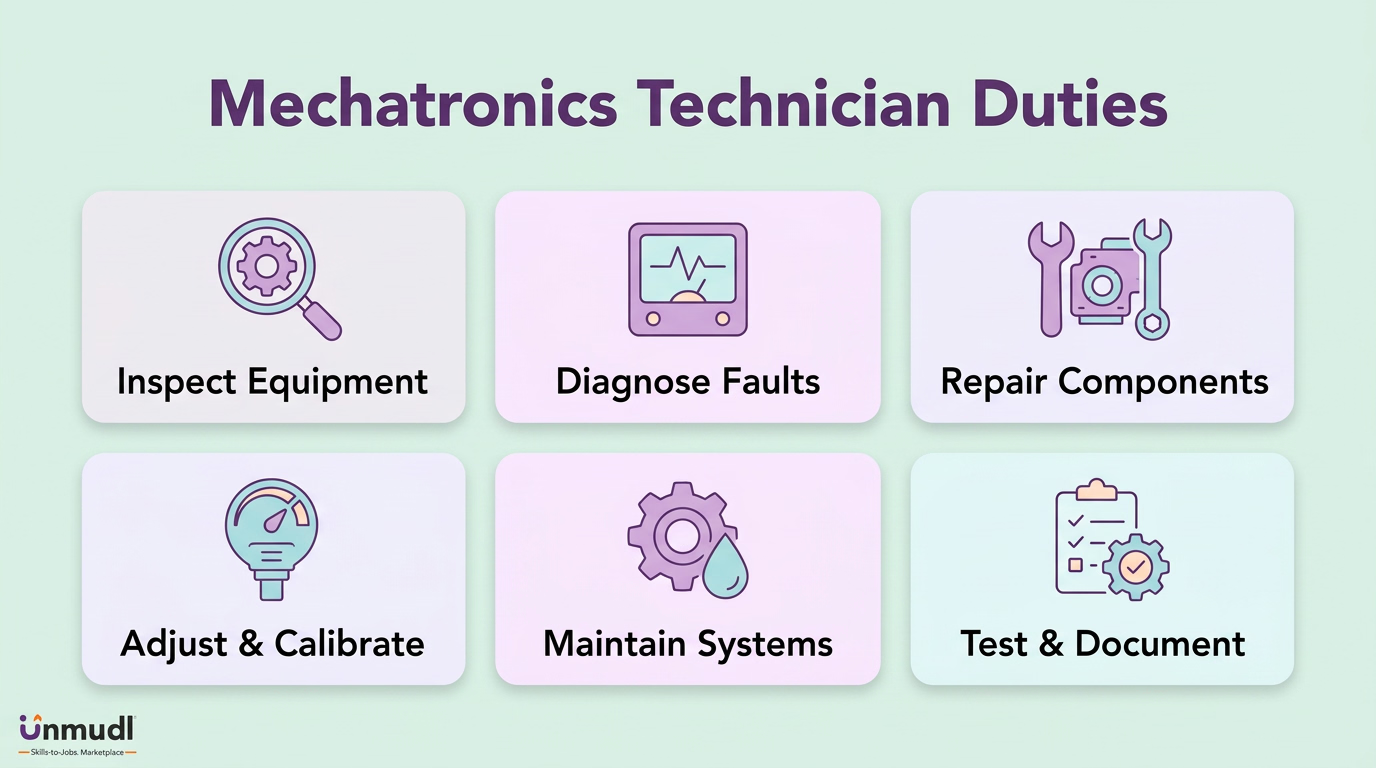
Six mechatronics duties: inspect equipment, diagnose faults, repair components, adjust and calibrate, maintain systems, and test and document

A mechatronics technician job description carries six main duties, each covering one stage in the life of an automated machine from its first drawing to its documented test. The duties are reading blueprints and schematics, installing automated equipment, calibrating sensors and controls, troubleshooting faults, repairing hydraulic and pneumatic assemblies, and testing and documenting equipment. Each duty is defined below.

1. Reading Blueprints and Schematics

Reading blueprints and schematics turns an engineer's drawing into a physical assembly. The drawing states dimensions, wiring paths, and component positions. Each position is checked against the real machine before any part is fitted. The fitting follows the manual, so the assembled system matches its design. Technicians who read drawings fluently shorten every later duty.

2. Installing Automated Equipment

Installing automated equipment places new machinery on the line and connects its mechanical, electrical, and control parts. The mechanical parts are aligned and fastened with precision tools. The electrical parts are wired to power and to the control panel. The control parts receive their program only after the wiring is verified. Technicians install in the sequence the schematic prescribes.

3. Calibrating Sensors and Controls

Calibrating sensors and controls sets a machine's measurements to their true values. A control panel sensor reports a position, a pressure, or a temperature. The report is compared with a reference instrument, and the comparison exposes any offset. The offset is corrected in the sensor or in the controller's settings. Technicians calibrate after every installation and after every repair.

4. Troubleshooting Faults

Troubleshooting faults locates the cause of a stopped or misbehaving machine. The cause sits in a sensing, driving, or switching part. Each candidate part is tested until the faulty one is found. The faulty part is repaired or replaced before the line restarts. Technicians troubleshoot across every domain in one visit.

5. Repairing Hydraulic and Pneumatic Assemblies

Repairing hydraulic and pneumatic assemblies restores the actuators that move a machine. A hydraulic actuator moves by fluid pressure and a pneumatic actuator moves by compressed air. Both fail through leaks, worn seals, and blocked valves. The worn seal is replaced, the valve is cleared, and the pressure is reset to the specification. Technicians repair the actuator on the machine itself.

6. Testing and Documenting Equipment

Testing and documenting equipment proves a new or refurbished machine is ready for operation. The test runs the machine through its cycle. The cycle's readings are recorded and filed as the machine's condition report. That report tells the next shift what was changed and what was measured. Technicians document every test so the line runs safely.

Carrying out the six duties in order keeps an automated line running from one shift handover to the next. The shift handover happens on a factory floor, and the floor is one of several workplaces the occupation fills.

Where does a Mechatronics Technician Work?
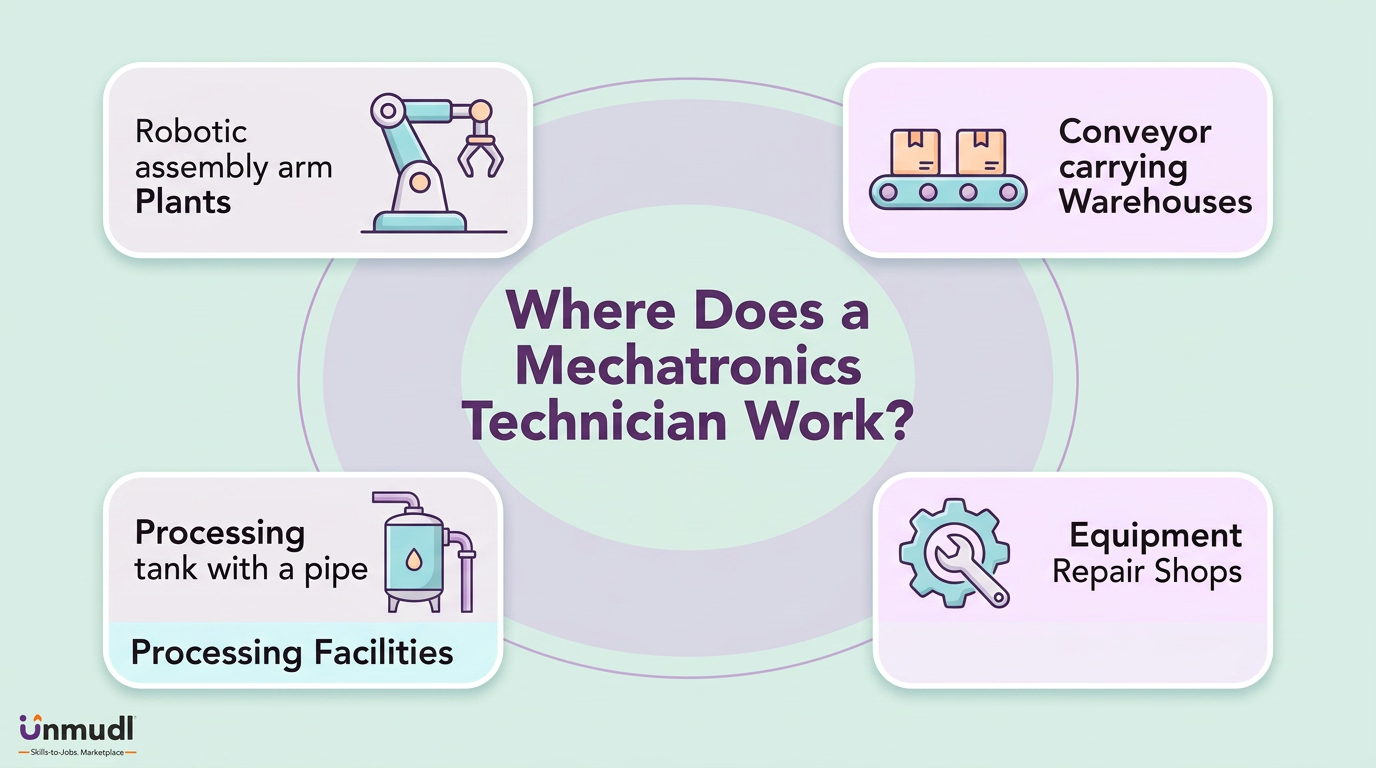
Mechatronics technician work settings including plants, warehouses, processing facilities and equipment repair shops

A mechatronics technician works in manufacturing and industrial facilities, on factory floors and production lines, and in laboratories and engineering offices. The factory floor is where automated equipment and robots are maintained. The laboratory is where prototypes are tested and problems are analyzed. Both settings sit inside five industries. BLS data place 13% of the occupation in engineering services, 11% in machinery manufacturing, and 11% in computer and electronic product manufacturing. Scientific research and development services hold 10% and transportation equipment manufacturing holds 9%. Transportation equipment plants use the technician on robotic welding arms. Research firms use the same worker to calibrate a new automated machine. The calibration also reaches worksites outside the plant, since robotic equipment is operated at offshore rigs and in hazardous environments through remotely operated devices. Hazardous environments still keep the work hands-on with automated equipment. Every one of those settings hires the worker through the same entry route.


How to become a Mechatronics Technician?

Becoming a mechatronics technician takes five steps. The steps are completing the training, earning the credentials, choosing the education pathway, finishing an apprenticeship, and gaining experience before applying for a job. The training runs from high school math and science through a postsecondary program to practice on industrial trainers and robots. The credentials cover the PMMI (Association for Packaging and Processing Technologies) mechatronics technician certification, the Smart Automation Certification Alliance (SACA) certificates, and employer-preferred qualifications. The education pathway splits into an associate degree, a technical certificate, and an online modular route. The apprenticeship runs through a registered sponsor, logged hours, and a trade certificate, and the experience step runs through a maintenance job, a troubleshooting record, and the application itself. BLS places the whole route inside education and practice, so the five steps end in an award and a work record. The five steps are explained below.

1. What is the Training for a Mechatronics Technician?

Mechatronics technician training is structured instruction in mechanical, electrical, and control systems delivered by a technical school, a community college, or an apprenticeship sponsor. The instruction covers PLCs, hydraulics, mechanical design, and robotics basics. The instruction runs in three stages. The stages are the high school foundation, the postsecondary program, and the hands-on practice.

1.1 Build a Foundation in High School Math and Science

Build the foundation with algebra, geometry, physics, and basic electronics in high school. These four subjects supply the number sense and circuit sense that a technical program assumes on day one. Reading mechanical drawings and electrical schematics alongside them prepares a student for blueprint work. The diploma itself is the minimum entry ticket for every program and apprenticeship.

1.2 Enroll in a Postsecondary Mechatronics Program

Enroll in a two-year mechatronics, electromechanical technology, or industrial maintenance program at an accredited college. A typical associate program carries around 60 semester credit hours. Green River College's mechatronics associate degree reaches 94 credits over 2 years. Coursework in these programs pairs electronics, mechanics, and motor controls with laboratory time in machining, circuit analysis, and PLC programming.

1.3 Practice on Industrial Trainers and Robots

Practice troubleshooting on the motors, conveyors, and controller-driven rigs that the program laboratory provides. Laboratory practice turns theory into repair skill, since a faulty sensor on a training rig behaves exactly like one on a production line. The repair skill built on real trainers and robots is the skill employers screen for at hiring. Completing the three stages in order hands a candidate the skill that a certificate then attests to.

2. What are the Credentials Required for a Mechatronics Technician?

Credentials for a mechatronics technician are voluntary certifications that attest to competence in electricity, PLCs, hydraulics, and robotics. No state or federal license is required for the occupation. The credential set has three members. The members are the PMMI Mechatronics Certification, the SACA certificates, and the employer-preferred qualifications. Each credential is earned by passing an exam at the end of a training course. Employers read the three as proof of skill rather than as a legal gate.

2.1 Earn the PMMI Mechatronics Certification

Earn the Mechatronics Certification from PMMI. The PMMI certification covers the fundamentals of electricity, PLCs, and hydraulics across four industry-standard modules. A candidate holds the certification after passing all four end-of-course exams. The PMMI credential is the broadest of the three because it spans every domain a technician services.

2.2 Earn the SACA Robotics and Control Systems Certificates

Earn the Robotics Technician certificate and the Control Systems certificate from SACA. The Robotics Technician certificate follows a week-long workshop and an online test with a 70% passing score. The certificate expires after 3 years, so a holder renews it on a 3-year cycle. Both SACA credentials target the robotic and control side of the job.

2.3 Meet the Employer-Preferred Qualifications

Meet the preferred qualifications an employer prints in the job posting. Amazon, for example, lists an Electrical Maintenance certificate or 2 or more years of PLC experience as preferred for its mechatronics and robotics technician openings. Manufacturer PLC training from a controls vendor fills the same slot on a resume. BLS names the Manufacturing Skill Standards Council (MSSC) and manufacturer-specific programs as further voluntary certificate sources. A candidate without any of the three credentials relies on education and experience alone at the interview. Holding one of the three credentials lets a candidate prove competence before the education record is opened.

3. What is the Education Pathway for a Mechatronics Technician?

Mechatronics technician education is the postsecondary award that opens entry into the occupation, namely an associate degree or a postsecondary certificate. The education pathway divides into three routes. The routes are the associate degree route, the technical certificate route, and the online modular route. Every route reaches the same occupational baseline, and the longer route improves job prospects.

3.1 Choose the Associate Degree Route

Choose the associate degree route for the fullest preparation. An Associate of Applied Science in Mechatronics, Electro-Mechanical Technology, or Industrial Technology takes 2 academic years and covers electronics, mechanics, PLCs, robotics, and safety. The associate degree is the most common award among working technicians, and its general education courses support later advancement into supervisory roles.

3.2 Choose the Technical Certificate Route

Pick the technical certificate route for a faster and cheaper entry. A one-year Mechatronics Certificate from a trade school or community college concentrates on core technical skills and drops most general education courses. The certificate takes 1 to 2 years and costs less than the degree, and the trade-off is a narrower promotion ceiling.

3.3 Choose the Online and Modular Route

Take the online and modular route to combine remote coursework with local laboratory access. Colleges with hybrid programs deliver CAD, electronics fundamentals, and PLC subjects online. The student then completes the laboratory hours at a local campus. Short online courses, such as a 35-hour introductory mechatronics course, also serve as a starting point and require only a high school diploma. Choosing among the three routes fixes the classroom side of training, and an apprenticeship fixes the paid side.

4. What is the Apprenticeship for a Mechatronics Technician?

A mechatronics technician apprenticeship is a registered program of 3 to 4 years that pairs paid on-the-job training with classroom instruction under a Department of Labor sponsor. The Department of Labor lists the apprenticeship under the Electromechanical Technician title, so no apprenticeship carries the mechatronics name itself. The apprenticeship runs in three moves. The moves are registering with a sponsor, logging the hours, and finishing with a trade certificate.

4.1 Register with a Department of Labor Sponsor

Register with a sponsor, which is a manufacturer or a union that holds a federal apprenticeship registration. Entry requires a high school diploma, proven math proficiency, and in some programs a qualification test. Apprenticeship seats are competitive and absent in some regions, so the college routes remain the more common entry into mechatronics work.

4.2 Log the On-the-Job and Classroom Hours

Log more than 8,000 hours of on-the-job training and around 576 hours of classroom instruction, with the split set by state and federal standards. The classroom hours cover industrial electricity, motor controls, PLCs, hydraulics, and safety. The on-the-job hours rotate the apprentice through conveyor systems, robotics, and packaging equipment, and the apprentice draws wages through every rotation.

4.3 Finish with a Trade Certificate or Associate Degree

Finish the apprenticeship with a trade certificate, or with an associate degree when a partnering community college delivers the classroom portion. The completion award records the full hour count and the equipment families covered, which gives the graduate a credential and a work history at once. Apprenticeship graduates enter the labor market with wages already earned. Finishing the three moves gives an apprentice both an award and the first entries of a work record.

5. How to Gain Experience and Apply for a Mechatronics Technician Job?

Experience for a mechatronics technician is documented time spent troubleshooting and repairing automated equipment outside the classroom. The experience step converts training and credentials into a hireable record. The step has three actions. The actions are taking a maintenance job, building a troubleshooting record, and applying for technician roles.

5.1 Take an Internship or Entry-Level Maintenance Job

Take an internship or a maintenance aide position while the program or apprenticeship is still running. The aide position exposes the trainee to live motors, conveyors, and control panels under supervision. One plant worker who completed mechatronics training moved from machine operator toward a maintenance mechanic role by stating that goal to the maintenance manager.

5.2 Build a Troubleshooting Record

Build a written record of every fault diagnosed and every repair completed. The record lists the equipment, the symptom, the test instrument used, and the fix, and it becomes the evidence a hiring manager asks for. Employers weigh demonstrated troubleshooting skill alongside the formal award, so a thin record undercuts a strong transcript.

5.3 Apply for Mechatronics Technician Roles

Apply for open positions once the award, the credential, and the record are in place. The openings cluster in California, Texas, Massachusetts, Pennsylvania, and Florida, which hold the largest employment counts in the occupation. A candidate who applies inside those five states meets the densest set of postings. Following the five steps in order moves a candidate from a high school classroom to a paid technician post with a credential, a record, and a route to promotion. That technician post carries a published median pay rate.

What is the Mechatronics Technician Pay?

Experience, location and industry as factors shaping mechatronics technician pay

Mechatronics technician pay is $35.53 per hour at the national median for May 2025, as BLS reports it. The hourly rate converts to $6,158 per month, $18,475 per quarter, and $73,900 per year on a 2,080-hour work year, with the monthly and quarterly figures derived by arithmetic. The annual rate therefore settles at $73,900, between a bottom tenth under $47,840 and a top tenth over $109,890. Half of the workers in the occupation earn more than that median and half earn less. Indeed data for early 2026 put the median for mechatronics and robotics technicians at about $73,000, in line with the BLS figure. A 2026 Amazon posting in California put the mechatronics and robotics technician salary at $35.00 per hour. The mechatronics technician salary at Amazon therefore sits on the same level at about $72,800 per year. The Amazon title pairs mechatronics with robotics, and the pairing places a robot arm inside the paid scope of the work.

Can Mechatronics Technician Work on Robot Arm?

Yes, a mechatronics technician can work on a robot arm, since the occupation's scope covers unmanned, automated, robotic, and electromechanical equipment. The technician working on robotic arm tasks sets up the arm, calibrates its servo motors, updates its program, and verifies its operation on the production line. A career guide places the arm on an automotive assembly line as the standard example of that programming task. Core control programs and mechanical redesigns of the arm belong to engineers. High-voltage rewiring or proprietary robot programming calls for additional credentials or supervision, and those credentials widen with each technician level.

What are the Levels of Mechatronics Technician?

There are three levels of mechatronics technician, and the levels are Technician I, Technician II, and Technician III. The three levels are employer-defined, since no national leveling scheme exists for the occupation. Technician I is the entry level that covers 0 to 2 years of experience. The entry-level technician follows established procedures, performs routine maintenance with hand tools, and assists senior colleagues. Technician I asks for a basic training certificate. Technician II is the mid level that covers 3 to 5 years. The mid-level technician diagnoses complex faults, completes independent repairs, and programs PLCs. Technician II carries an associate degree or an equivalent certification. Technician III is the senior or lead level that begins at 6 years. The senior technician handles advanced troubleshooting, leads new equipment installations, interprets engineering specifications, and mentors the team.

The four dimensions that separate the three levels are responsibility, troubleshooting complexity, supervision, and credentials. Responsibility rises from following procedures to creating solutions for new problems. Troubleshooting complexity rises from simple faults to multi-system integration issues. Supervision shifts from working under a lead to overseeing maintenance teams or projects. Credentials accompany each step upward, so a senior technician holds an advanced certificate in automation controls. The titles Junior Mechatronics Technician and Senior Mechatronics Technician mark the two ends of the same ladder. Reading the four dimensions together lets a candidate place a job posting on the ladder before writing the resume for it.

How to Build the Mechatronics Technician Resume?

Building a mechatronics technician resume takes four steps on the Unmudl Resume Builder. The steps are opening the builder, entering the details, highlighting the technician skills, and saving the download. The builder is free and produces a single-column format that applicant tracking systems (ATS) read without error. The four steps are listed below.

  1. Open the Resume Builder at unmudl.com/resume-builder, which needs no login to start.
  2. Enter the work history, technical skills, and education into the provided fields, which the builder arranges into ATS-compliant sections.
  3. Highlight the technician skills in the Skills and Experience sections, such as equipment maintenance, machine repair, PLC troubleshooting, and robotics maintenance, which match the terms employers screen for.
  4. Save the resume and download it as a PDF, which prompts a free Unmudl account at this final stage only.

Completing the four steps gives a candidate an ATS-ready PDF that carries the maintenance and repair terms the job listings request. Those listings sit on the same platform's job board.

How to Apply For Mechatronics Technician Jobs?

Applying for mechatronics technician jobs takes seven steps on the Unmudl job board. The steps are signing in, completing the profile, searching the role, viewing the details, checking the qualifications, clicking Apply Now, and following the employer's instructions. The seven steps are listed below.

  1. Sign in or register a free account at unmudl.com/search-jobs, which the platform requires first.
  2. Complete the Unmudl profile with skills, experience, and an uploaded resume before any application.
  3. Search the term Mechatronics Technician in the search box, or filter the results by industry and location.
  4. View the job details by clicking a title, which opens the employer, location, duties, and requirements.
    Mechatronics and robotics job listings displayed on Unmudl
  5. Check the qualifications under Preferred Skills, such as Ensure Equipment Maintenance, Machine Maintenance, and Repair, against the profile.
  6. Click Apply Now on the listing, which redirects the applicant to the employer's own application portal.
    Mechatronics and Robotics Apprentice listing with the Apply Now panel on Unmudl
  7. Follow the employer's instructions on that portal, since each listing asks for its own documents or forms.

Working through the seven steps carries a candidate from a profile to a submitted application. The qualifications on those listings raise the question of whether a dedicated school is needed to meet them.

Is It Necessary to Join Mechatronics Technician School?

No, joining a mechatronics technician school is not necessary, since the occupation sits in Job Zone 3 of O*NET. Job Zone 3 requires training in vocational schools, related on-the-job experience, or an associate's degree. Mechatronics technician skills in electronics, mechanics, and control systems decide the hire. Those skills come from a college program, a registered apprenticeship, or supervised plant practice, and a skills-focused course supplies them without a full school enrollment.

Unmudl lists three courses that build those skills. The courses are Introduction to Mechatronics, Mechatronics and Robotics Maintenance, and Mechatronics and Robotics Maintenance: Virtual Lab. Introduction to Mechatronics covers the fundamental math, safety, and basic electrical and mechanical systems for a beginner. The maintenance course covers the electrical, mechanical, fluid, and communication systems behind equipment upkeep for a learner with prior experience. The Virtual Lab adds hands-on simulations for troubleshooting industrial systems. The introductory course runs 35 hours online at $700, the maintenance course runs 80 hours self-paced at $1,375, and the Virtual Lab runs 40 hours at $1,375. Each course admits a learner with a secondary diploma or its equivalent and ends in a Unmudl completion certificate. The electromechanical content of the maintenance course points to the neighboring occupation that shares the technician's classification.

What is the difference between Mechatronics Technician and Electro Mechanical Technician?

The difference between a mechatronics technician and an electro mechanical technician lies in the depth of automation each one services, not in their federal classification. Both titles share one occupational code. An electromechanical technician services machinery that pairs mechanical systems with basic electronic controls, such as motors, pumps, and conveyors, and the goal is keeping that machinery in mechanical order. The mechatronics role services machinery that adds sensors, PLCs, robotics, and computer automation to the same mechanics, and the goal is holding the automated line within tolerance.

Both technicians carry hand tools, meters, and hydraulic wrenches, while the mechatronics technician adds PLC software and advanced control interfaces to that kit. An electromechanical technician services a factory press or a heating, ventilation, and air conditioning (HVAC) system, for example. The mechatronics counterpart programs a CNC machine or calibrates the sensors on a robotic line. Employers use the two titles interchangeably, so the duties vary more by company than by name. The industrial technician title differs from both by purpose rather than by wording.

What is the difference between Mechatronics Technician and Industrial Technician?

A mechatronics technician differs from an industrial technician in purpose, since the first keeps automated machines running and the second improves how those machines are used. An industrial technician, formally an industrial engineering technician, applies engineering theory and principles to problems of industrial layout and manufacturing production. The mechatronics role installs, troubleshoots, and repairs the equipment itself, so the two roles meet on the same factory floor with opposite objects of work.

The tool kits follow the two purposes. An industrial technician works with computer-aided design (CAD) diagrams, supervisory control and data acquisition (SCADA) software, statistical methods, and time-motion studies to set production rates and remove bottlenecks. The mechatronics worker handles test instruments, multimeters, PLC software, and mechanical tools on motors, sensors, and control software. In an automotive factory, for example, the mechatronics technician programs and maintains the robotic welders, whereas the industrial technician rearranges the equipment placement along the line to raise throughput. That reach across the mechanical, the electrical, and the control layers is what the mechatronics title carries beyond the plain technician title.

What to know about Mechatronics Technician Besides Technician?

A mechatronics technician is, besides a technician, an integration trade that is part mechanic, part electrician, and part controls technician. The integration trade combines skills from mechanical engineering, electrical engineering, and control engineering in a single worker. A mechanical technician handles mechanical assemblies alone, and an electrical technician handles circuits alone, whereas the integration trade troubleshoots across both domains and the computer controls that join them. Fixing an automated packaging machine, for example, requires rewiring a sensor and recalibrating a control program in one visit. That multi-domain reach earns the role its practitioner nickname of the Swiss Army knife of an industrial plant.

The integration trade also sits apart from the mechatronics engineer, who owns the drawing that the technician turns into a running machine. The engineer owns the design of the system, and the technician owns the condition of the equipment. Within the wider technician family, the mechatronics title is the member tied specifically to advanced automated machinery and robotics. Knowing that position between the engineer above and the general technician beside lets a candidate read a job title for the automation depth it demands.

Learn In Demand Skills Employers Are Hiring For

Explore our career-ready "Mechatronics and Robotics Maintenance" designed with employers to help you get hired faster. Train for industrial maintenance in ~10–12 weeks, earn a certificate and get ready to interview for technician roles.
No items found.
No items found.
Last updated on:
October 19, 2026
No items found.