Maintenance Technician: Types, Duties, Career Path, and Salary

Maintenance technician refers to a skilled trades occupation that keeps machines, mechanical equipment, and buildings in working order across more than one craft. A maintenance technician inspects an asset, finds the fault behind a malfunction, and services the parts that wear. The service restores the equipment before a breakdown stops the work around it. The asset changes with the workplace, from a hotel boiler room to a production line. That change in assets separates the role from an industrial technician, whose work improves the production process rather than the condition of the equipment. Multi-craft breadth is the defining trait of the occupation. The breadth explains why employers write maintenance technician jobs around plumbing, electrical, heating, cooling, and carpentry tasks in one posting.

Maintenance technicians matter because every building and every machine deteriorates with use, and deterioration turns into downtime when nobody intercepts it. Preventive work intercepts the deterioration, keeping tenants housed, students in class, and production lines moving. Employers gain lower repair bills, safer worksites, and equipment that reaches its full service life. Workers gain an entry route at high-school level, a wide choice of settings, and a ladder into specialized trades or supervision. The career decision rests on four facets: the types of the occupation, the duties it carries, the career path that develops it, and the salary it pays.

What is a Maintenance Technician?

A maintenance technician is a multi-craft repair worker who inspects, diagnoses, services, and repairs equipment or building systems so that those assets stay usable. A maintenance technician draws on two or more craft areas in one shift. The technician job stops at the edge of licensed work, where an electrician, a plumber, or a refrigeration mechanic takes over. Asset condition ties the four activities together: inspection establishes condition, diagnosis names the fault, service slows deterioration, and repair restores function.

An industrial maintenance technician represents a narrower specialist within the same title space whose assets are production machinery rather than buildings. The general role, by contrast, is classified by the U.S. Bureau of Labor Statistics (BLS) as General Maintenance and Repair Workers. The BLS Occupational Outlook Handbook, updated August 27, 2026, records 1,621,800 workers in that occupation in 2025. Every worker in that count does the same core work.

What Does a Maintenance Technician Do?
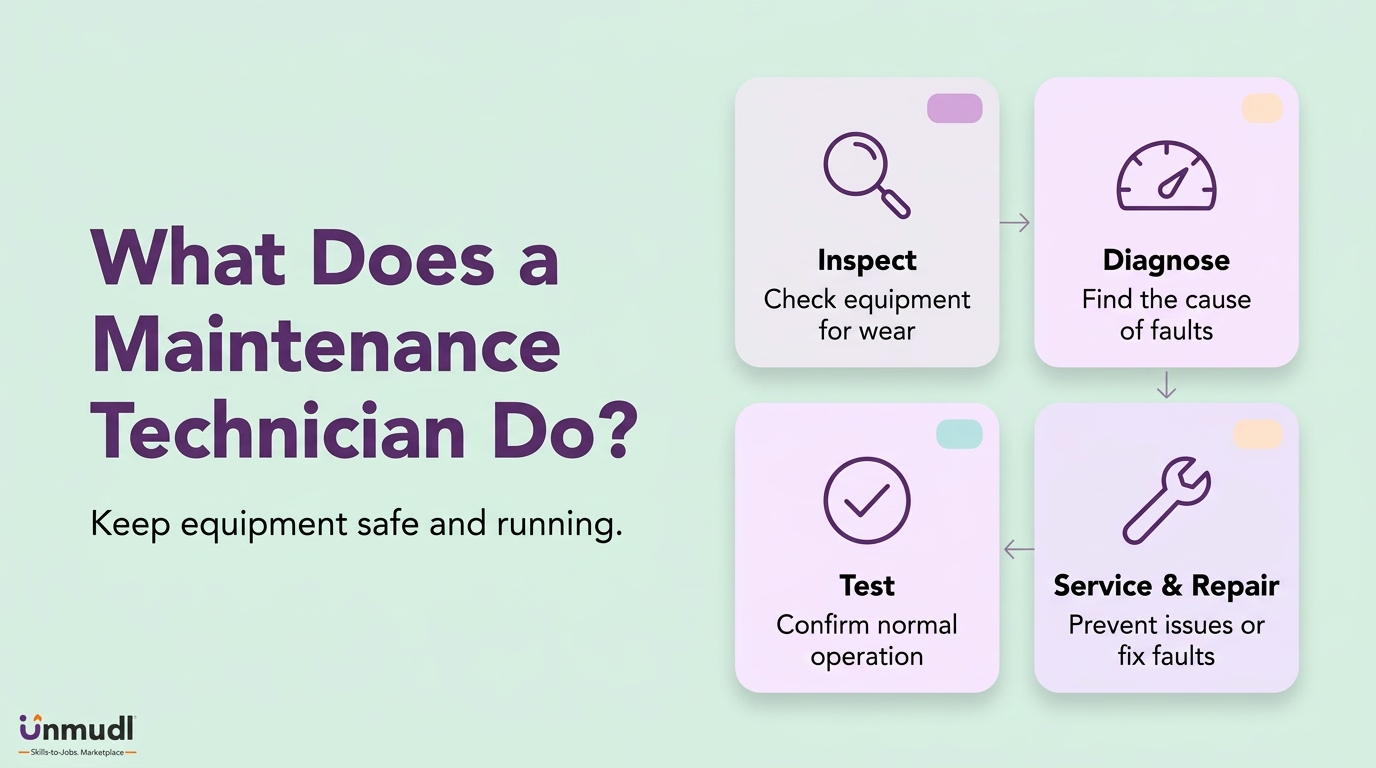
Maintenance technician workflow: inspect equipment, diagnose faults, service and repair, then test operation

A maintenance technician works by assessing the condition of an asset, identifying the fault, carrying out preventive service or corrective repair, and testing the asset afterward. Assessment starts with a walk-through of drives, motors, belts, fluid levels, and filters. The walk-through surfaces abnormal wear. Abnormal wear tells the worker which component to adjust or replace. The replacement is followed by a test run, and the test run proves that normal operation returned. The asset decides which maintenance jobs fill the day. A building brings occupant requests and heating, ventilation, and air-conditioning (HVAC) checks, and conveyors and packaging equipment wait for a manufacturing maintenance technician. Manufacturing work shifts the role toward machinery, which is why a factory posting reads differently from a property posting. The posting names the asset, and the asset sorts the occupation into its types.

What are the Types of Maintenance Technician?
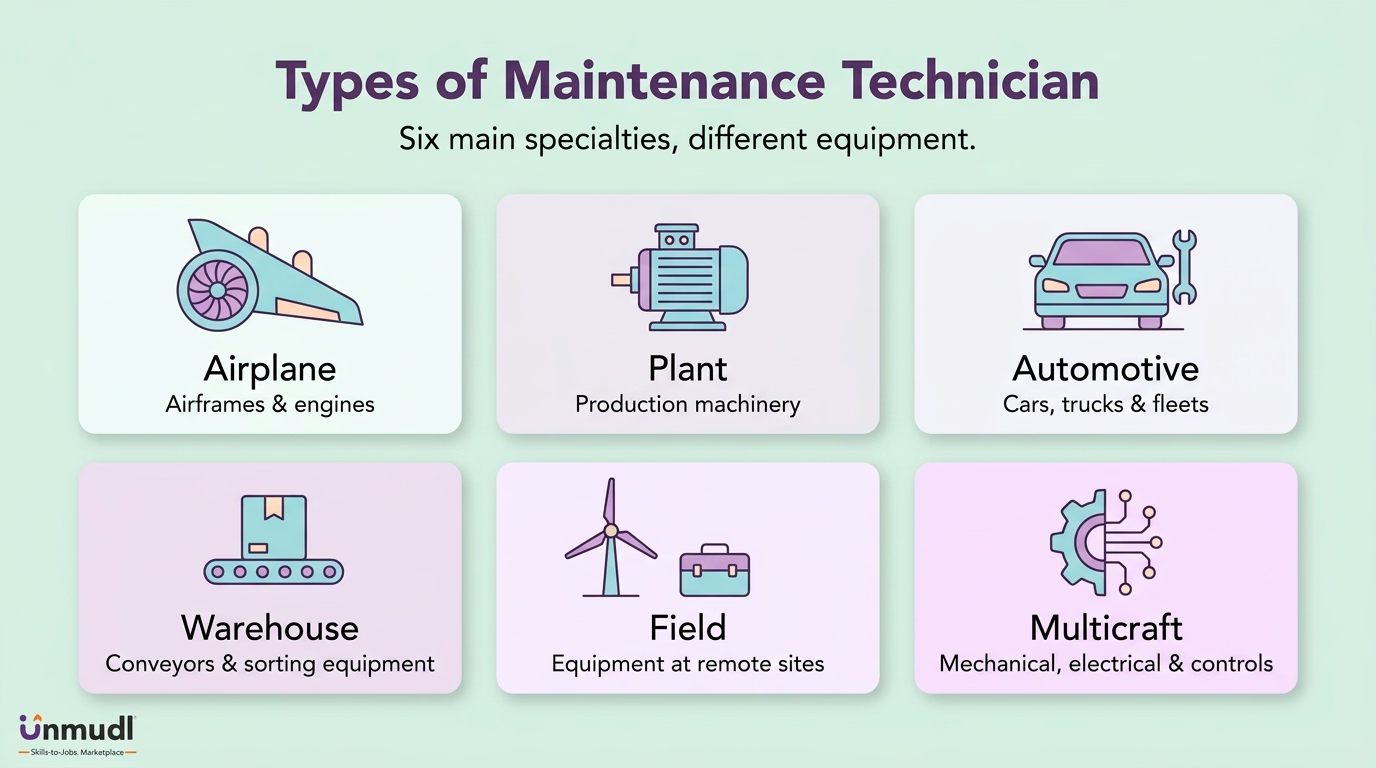
Six maintenance technician specialties: airplane, plant, automotive, warehouse, field and multicraft

There are six main types of maintenance technician based on the asset and the setting served. The main types are airplane maintenance technician, plant maintenance technician, automotive maintenance technician, warehouse maintenance technician, field maintenance technician, and multicraft maintenance technician. Three other types are advertised by employer name or by task, giving nine types in total. The other types are Amazon maintenance technician, pool maintenance technician, and cleaning maintenance technician.

The table below compares the nine types by the asset kept running, the setting or employer, and the basis of the type.

TypeAsset Kept RunningSetting or EmployerBasis of the Type
Airplane maintenance technicianAirframes and engines under a federal certificateAirlines and repair stationsAsset and setting
Plant maintenance technicianConveyors, motors, pumps, and packaging linesManufacturing plantAsset and setting
Automotive maintenance technicianCars, trucks, and fleet vehiclesFleet operators and dealershipsAsset and setting
Warehouse maintenance technicianConveyors, dock doors, forklifts, and sorting equipmentDistribution buildingAsset and setting
Field maintenance technicianCell towers, pipelines, and wind turbinesCustomer or remote sites served by service companiesAsset and setting
Multicraft maintenance technicianMotors, starters, and controls across mechanical, electrical, and control systemsLarge plant covered by a small crewAsset and setting
Amazon maintenance technicianConveyors, sorters, and roboticsFulfillment centerEmployer name
Pool maintenance technicianPumps, filters, heaters, and chemical balanceSwimming poolsTask
Cleaning maintenance technicianBuilding fabric plus janitorial upkeepOne buildingTask

1. Airplane Maintenance Technician

An airplane maintenance technician is an aviation mechanic who keeps airframes and engines airworthy under a federal certificate. The certificate carries an airframe rating, a powerplant rating, or both. The ratings decide which parts of the aircraft the holder signs off. Airlines and repair stations hire the technician for scheduled checks between flights.

2. Plant Maintenance Technician

A plant maintenance technician works as an industrial mechanic who keeps production machinery running inside a manufacturing plant. Production uptime measures the work. The technician services conveyors, motors, pumps, and packaging lines on a preventive schedule. Hydraulic, pneumatic, and electrical systems sit inside the same machines. Manufacturers pair the role with planned shutdowns and breakdown response.

3. Automotive Maintenance Technician

An automotive maintenance technician refers to a vehicle mechanic who services cars, trucks, and fleet vehicles on a mileage or time schedule. Oil, filters, brakes, tires, and fluids form the routine service list. Diagnostic scanners read the fault codes behind a warning light. Fleet operators and dealerships hire the technician to keep vehicles on the road.

4. Warehouse Maintenance Technician

A warehouse maintenance technician is a facilities mechanic who maintains conveyors, dock doors, forklifts, and sorting equipment inside a distribution building. Throughput measures the work, because a stalled conveyor stops every order behind it. Material-handling equipment and the building fabric share the same technician. Distribution companies schedule the role around peak shipping seasons.

5. Field Maintenance Technician

A field maintenance technician operates as a mobile repair worker who travels to equipment installed at customer or remote sites. Cell towers, pipelines, and wind turbines are the typical assets. Each visit combines inspection, servicing, and repair in one trip, since no workshop sits nearby. Service companies dispatch the technician by route and by fault ticket.

6. Multicraft Maintenance Technician

A multicraft maintenance technician holds mechanical, electrical, and control skills in one cross-trained role. Cross-training removes the hand-off between a mechanic and an electrician. One worker diagnoses a motor fault and rewires the starter in the same call. Manufacturers post the role where a small crew covers a large plant.

An Amazon maintenance technician maintains conveyors, sorters, and robotics inside a fulfillment center. A pool maintenance technician services pumps, filters, heaters, and chemical balance at swimming pools. A cleaning maintenance technician combines janitorial upkeep with light repair in one building role. Reading the six main types against the three other types lets a candidate choose a type by the asset they want to keep running. The duties stay constant across all nine.

What are the Duties of a Maintenance Technician?
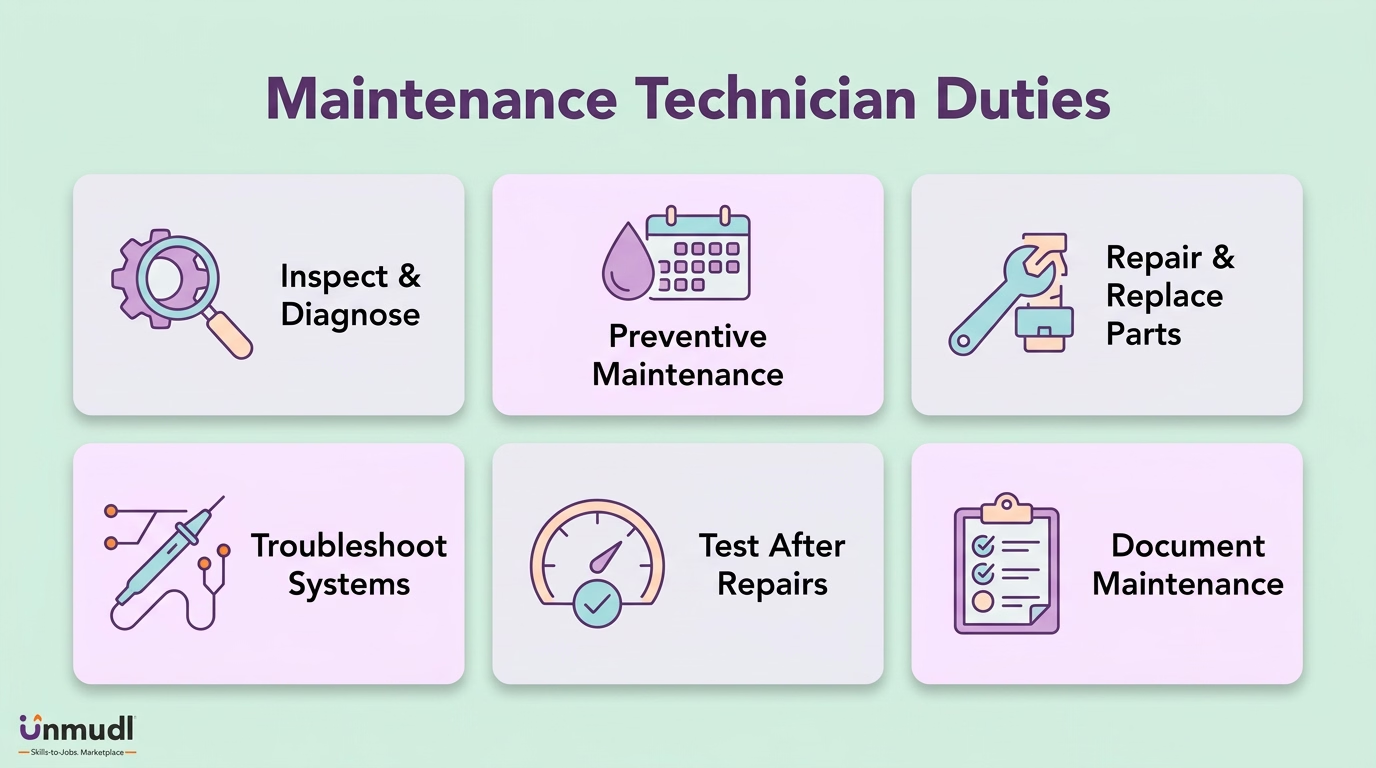
Six maintenance duties: inspect and diagnose, preventive maintenance, repair and replace, troubleshoot, test and document

There are six main duties of a maintenance technician across every setting, and the maintenance technician duties and responsibilities in a job posting draw on that set. The duties are equipment inspection and diagnosis, preventive maintenance, corrective repair and part replacement, system troubleshooting, post-repair testing, and maintenance documentation.

1. Equipment Inspection and Diagnosis

Equipment inspection and diagnosis is the condition-assessment duty that opens every maintenance task. Inspection examines drives, motors, belts, and filters on a fixed round. The round surfaces abnormal wear or operation. Diagnosis then names the fault behind the abnormality by operating or testing the machine. Supervisors treat the round as the evidence base for every later repair decision.

2. Preventive Maintenance

Preventive maintenance is the scheduled-service duty that slows deterioration before it turns into failure. Lubrication, filter changes, belt tensioning, and fluid top-ups run on a calendar or a meter reading. The schedule spreads the work across the year. The spread keeps emergency call-outs rare. Supervisors build the preventive calendar from the manufacturer's service intervals.

3. Corrective Repair and Part Replacement

Corrective repair and part replacement is the restoration duty that returns a failed asset to service. The technician disassembles the equipment, removes the defective component, installs the replacement part, and reassembles the machine in sequence. Hand tools, power tools, and hoists carry the physical work. Supervisors gate the repair where licensed trade work begins.

4. System Troubleshooting

System troubleshooting is the fault-isolation duty that handles a malfunction with no obvious cause. The technician reads the error message, traces the circuit or the fluid path, and tests each stage until the failing stage is found. Supervisors expect the trace on paper so the same fault is found faster next time.

5. Post-Repair Testing

Post-repair testing is the verification duty that proves a repair restored normal operation. The technician runs the machine and checks the readings against expected values. A passed test releases the asset back to production, while a failed test sends the job back to diagnosis. Supervisors sign off the work order only after the test passes.

6. Maintenance Documentation

Maintenance documentation is the record-keeping duty that closes each task and feeds the next one. The technician logs the fault, the parts used, and the test result in a work order or a maintenance management system. The log builds the service history of the asset, and the history sets the next inspection date. Supervisors read the history when they plan shutdowns and order parts.

Carrying the six duties in one role makes the worker a cross-system technician, and the workplace decides which duty fills the shift.

Where Does a Maintenance Technician Work?
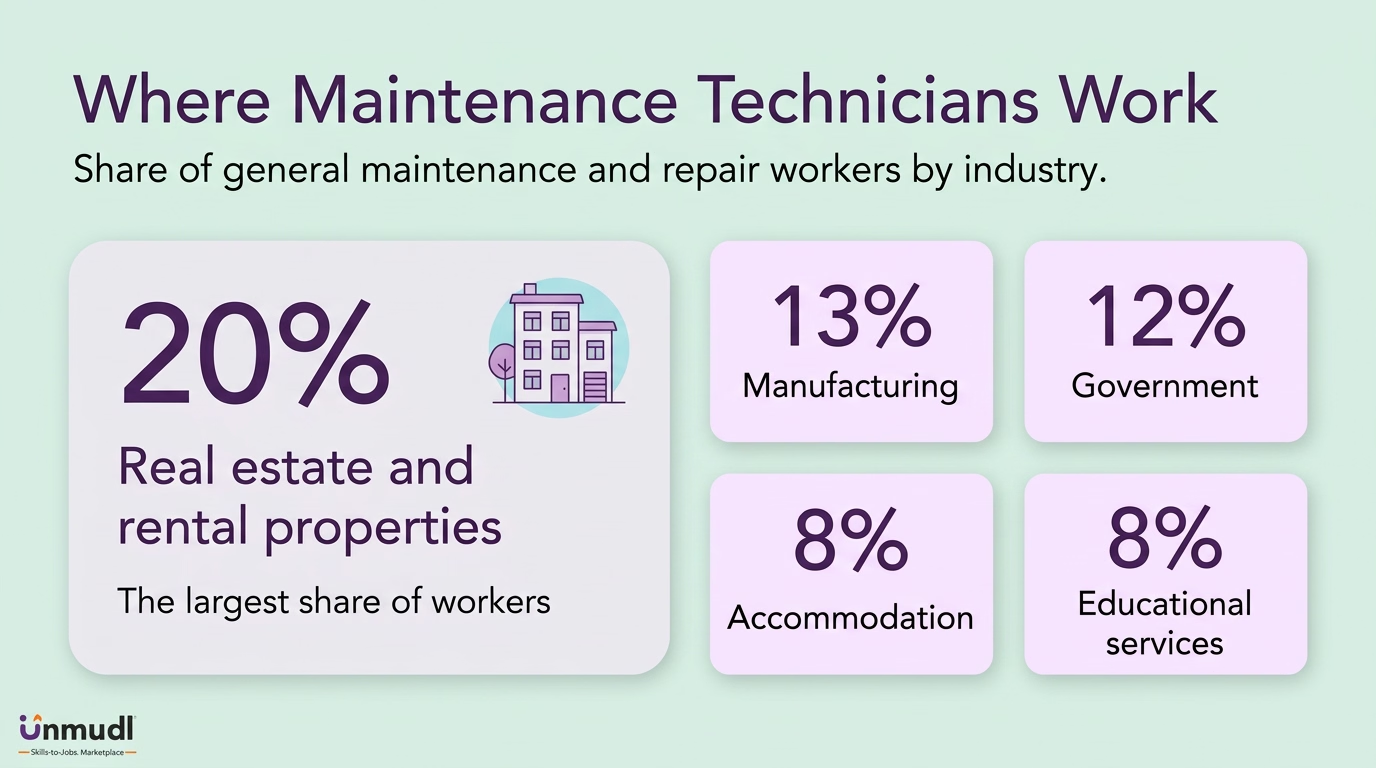
Maintenance worker employment shares in real estate, manufacturing, government, accommodation and educational services

Maintenance technicians work in apartment complexes, hotels, hospitals, schools and campuses, government buildings, offices, and manufacturing plants. Real estate and rental properties employ the largest share of the general occupation at 20% of workers. Manufacturing follows at 13%, government at 12%, and accommodation and educational services at 8% each, according to BLS data for 2025. A facilities maintenance technician sits on the building side of that spread, handling HVAC, plumbing, and electrical checks across a property or a campus. A general maintenance technician covers the same building fabric plus assorted equipment in one site. An electrical maintenance technician belongs to a separate occupation rather than a setting, because wiring work beyond basic fixtures passes to a licensed electrician. The setting also brings ladders, cramped positions, heat and cold, and on-call duty for emergency repairs. Entering that setting follows a documented pathway rather than a license.
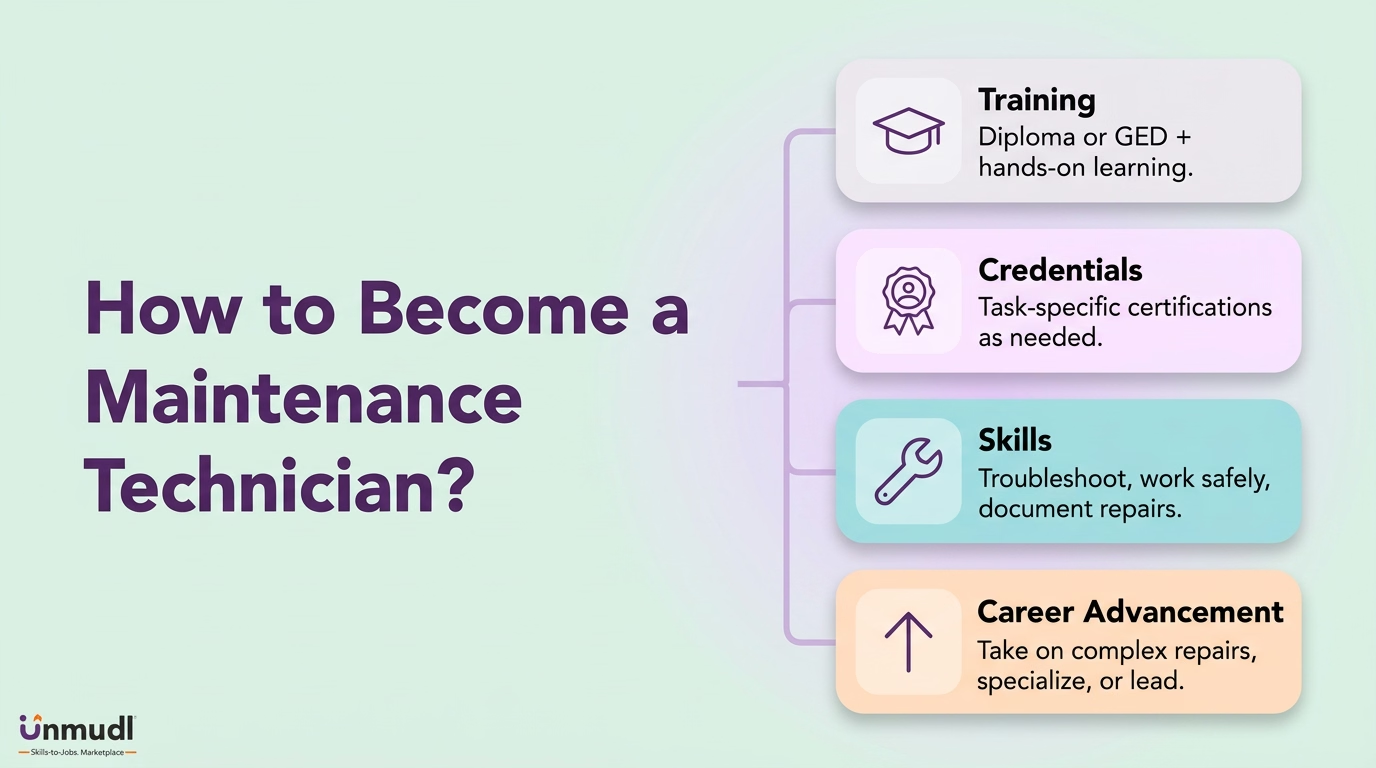

How to Become a Maintenance Technician?

Four stages of becoming a maintenance technician: training, credentials, skills and career advancement

There are four stages in how to become a maintenance technician, according to the General Maintenance and Repair Workers profile in the BLS Occupational Outlook Handbook. The stages are training, credentials, skills, and career advancement. Training covers a high school diploma, technical fundamentals, supervised experience on the job, and a registered apprenticeship. Credentials cover refrigerant, forklift, professional, and jurisdictional authorizations. Skills cover diagnosis, safe work, and record keeping. Career advancement covers harder assignments, a trade specialization, and a supervisory role. The four stages are explained below.

1. What is the Training for a Maintenance Technician?

The training for a maintenance technician is a secondary credential followed by moderate-term on-the-job training of more than 1 month and up to 12 months. Maintenance technician training runs through four steps. The steps are the diploma, the technical program, supervised on-the-job experience, and the Registered Apprenticeship. The technical step draws on high school technical classes, trade or vocational schools, or community colleges. Each step builds competence in inspecting, diagnosing, maintaining, and repairing equipment and structures.

1.1 Complete a High School Diploma or Equivalent

Complete high school or earn an equivalent credential as the first step. The diploma is the typical entry-level education for the occupation, and the occupation attaches no prior work-experience requirement to it. A GED (General Educational Development) credential satisfies the same entry rule at public employers such as the Arkansas Department of Shared Administrative Services. That department's 2026 Maintenance Technician classification lists no required certificate. Maintenance technician education requirements therefore begin at the secondary level.

1.2 Learn Mechanical, Electrical, and Building Fundamentals in a Technical Program

Learn mechanical, electrical, and building-maintenance fundamentals in a technical class, a vocational school, or a community college. A maintenance technician school is an alternative preparation route rather than a nationally required credential. The Occupational Information Network (O*NET) places the occupation in Job Zone Three, where preparation combines vocational schooling, related experience, or an associate degree. Occupations in that zone take one to two years of on-the-job and informal training with experienced workers.

1.3 Gain Supervised On-the-Job Experience

Gain supervised on-the-job experience under an experienced maintenance worker. On-the-job experience is the mechanism through which a beginner moves from observing repairs to performing them. A new worker starts with simple assignments such as checking fluid levels and filters. Moderate-term training reaches occupational competency within 12 months at most, which caps the supervised period.

1.4 Enter a Registered Apprenticeship for Industrial Specialization

Enter a Registered Apprenticeship when the intended work centers on production machinery. A Registered Apprenticeship is a Department of Labor-vetted program that pairs structured instruction with progressively demonstrated competence. O*NET links the occupation to the apprenticeship titles Building Maintenance Repairer and Industrial Maintenance Repairer. The Industrial Maintenance Mechanic framework approved on July 29, 2025 runs 6,000 hours time-based, 6,000 to 8,000 hours hybrid, or 3 years competency-based. Those hours apply to industrial specialization, not to every technician. Task-matched credentials apply to every technician instead.

2. What are the Credentials Required for a Maintenance Technician?

The credentials required for a maintenance technician are task-dependent legal authorizations rather than one universal license. Four credential categories apply to the occupation. The categories are refrigerant certification, forklift certification, the optional Certified Maintenance and Reliability Technician (CMRT) designation, and specialty licenses. Maintenance technician certification therefore follows the systems on the job description, not the job title.

2.1 Obtain EPA Section 608 Certification for Refrigerant Work

Obtain U.S. Environmental Protection Agency (EPA) Section 608 certification before servicing equipment that releases regulated refrigerants. Section 608 certification is a federal legal credential under the Clean Air Act that never expires. The EPA issues four types: Type I for small appliances, Type II for high-pressure appliances, Type III for low-pressure appliances, and Universal for all covered equipment. An apprentice services refrigerant systems only under close supervision of a certified technician.

2.2 Complete Employer Certification for Powered Industrial Trucks

Complete employer-certified training before operating a forklift or another powered industrial truck. Powered industrial truck certification is an employer-issued qualification under Occupational Safety and Health Administration (OSHA) rule 29 CFR 1910.178(l), not a portable maintenance license. OSHA requires formal instruction, practical training, and a workplace performance evaluation before independent operation. The employer re-evaluates each operator at least once every three years.

2.3 Earn the Certified Maintenance and Reliability Technician (CMRT) Designation

Earn the CMRT designation to document multi-skilled maintenance knowledge. CMRT is an optional professional certification issued by the Society for Maintenance and Reliability Professionals (SMRP). The examination covers four domains: maintenance practices, preventive and predictive maintenance, troubleshooting and analysis, and corrective maintenance. SMRP renews the credential every three years against 50 course hours.

2.4 Verify State and Local Specialty Licenses

Verify state and local licensing before performing electrical, plumbing, or boiler work beyond general repair. A specialty license is a jurisdictional authorization that varies by state and locality. General maintenance workers replace switches, outlets, and circuit breakers without a trade license. Work above that level goes to a licensed electrician, plumber, or heating, air-conditioning, and refrigeration technician. Maintenance technician qualifications are therefore checked against the worksite jurisdiction before the first regulated task.

3. What Skills Does a Maintenance Technician Need?

The skills a maintenance technician needs are equipment maintenance, repairing, troubleshooting, operations monitoring, quality-control analysis, and equipment selection. O*NET names those six capabilities in its transferable-skill model for the occupation. Three practice areas exercise the six skills on the job. The practice areas are troubleshooting and repair, safety and energy isolation, and maintenance documentation. Skills for maintenance technician work are built during supervised training and tested on live equipment.

3.1 Build Troubleshooting and Repair Skills

Build troubleshooting and repair skills on the equipment the employer owns. Troubleshooting is the diagnosis of a malfunction by operating or testing machinery before a correction is chosen. A technician traces a fault from its symptom to the failing part, replaces the defective part, and tests the equipment afterward. Repair skill grows with each completed work order.

3.2 Practice Safety and Energy-Isolation Procedures

Practice safety and energy-isolation procedures on every assignment. Safety practice is the routine use of protective equipment and lockout steps around hazardous machinery. In O*NET's respondent data for the occupation, 44% of workers report hazardous-equipment exposure every day and 58% wear protective equipment every day. The occupation also carries one of the higher occupational injury and illness rates. Protective equipment shields the worker, and the written record shields the next repair.

3.3 Document Maintenance and Repair Work

Document maintenance and repair work after each task. Maintenance documentation is the recording of repair information that feeds the next maintenance decision. A technician logs work requests, reports equipment malfunctions, and records completed repairs. The record lives in a computerized maintenance management system (CMMS). Accurate records turn one repair into evidence for preventive maintenance. That evidence also shows a supervisor which worker is ready for harder work.

4. How Does a Maintenance Technician Advance in the Career?

A maintenance technician advances by moving from supervised simple tasks to complex repair, then into a specialized trade or a supervisory role. The maintenance technician career path has three steps. The steps are progression to machinery overhaul, specialization in electrical, HVAC, or plumbing work, and movement into supervisory or management positions.

4.1 Progress From Simple Assignments to Machinery Overhaul

Progress from simple assignments to machinery overhaul as the supervisor releases harder work. Machinery overhaul is the most complex assignment in the BLS progression model for the occupation. Progression begins with observing an experienced worker, continues through simpler jobs, and ends with overhaul work. Work that exceeds the technician's authorization goes to a specialist.

4.2 Specialize in Electrical, HVAC, or Plumbing Work

Specialize in electrical, HVAC, or plumbing work after gaining general experience. A specialized trade is a separately classified occupation with its own entry rules and its own wage profile. Industrial machinery work shows the wage difference: the industrial machinery mechanics, machinery maintenance workers, and millwrights group earned a May 2025 median of $64,100, above the general-maintenance median. The same industrial group projects 14% employment growth from 2025 to 2035. A specialized trade also feeds the supervisory rung of the path.

4.3 Move Into Supervisory and Facilities Management Roles

Move into a supervisory or facilities management role once the technician plans work procedures for others. A facilities management position is a management occupation that individual employers gate behind a college degree. Experienced workers in the occupation progress toward supervisory or management roles, so the path is open but not qualification-free. Following the four stages in order lets a candidate move from the diploma to a supervisory role without one mandatory national credential. Each rung of that path also moves the wage.

How Much Does a Maintenance Technician Earn?

A maintenance technician earns $25.86 per hour, $4,481.67 per month, $13,445 per quarter, and $53,780 per year on the national arithmetic mean in BLS May 2025 wage data. The monthly and quarterly figures are the annual mean divided by 12 and by 4. The median wage sits lower at $23.84 per hour and $49,590 per year. Industry moves the median: manufacturing pays $61,500 and accommodation and food services pays $39,590. How much a maintenance technician makes on average therefore settles at $53,780 per year. That wage is reached without a college award.

Does a Maintenance Technician Need a Degree?

No, a maintenance technician does not need a college degree, since BLS sets entry education for the occupation at a high school diploma or an equivalent credential. A maintenance technician degree is an employer preference rather than an occupational requirement. In O*NET's 2021 education survey, 63% of respondents reported a postsecondary certificate for a new hire, 25% a high school diploma, and 7% some college without a degree. A postsecondary certificate is not a college degree. The certificate instead documents competence on the systems the job assigns.

Which Systems Do Maintenance Technicians Maintain?

Maintenance technicians maintain five principal system groups, and a job advertised as systems maintenance technician draws on the same set. The groups are mechanical machinery and equipment, HVAC, plumbing and piping, electrical and control, and building and structural systems. A maintained system is an interconnected set of equipment or building components whose condition is inspected, serviced, adjusted, or repaired. A building maintenance technician checking systems covers several groups at a basic level and escalates complex work.

Mechanical Machinery and Equipment Systems

Mechanical machinery and equipment systems are the drives, motors, belts, fluids, and filters that keep a facility's machines running. Maintaining this group involves inspecting drives and belts, checking fluids and filters, testing machinery to diagnose malfunctions, and replacing worn components. Machinery upkeep shifts toward industrial machinery mechanic work when production equipment dominates the assignment.

Heating, Ventilation, and Air-Conditioning (HVAC) Systems

HVAC systems are the climate-control assets that condition indoor air across a property. HVAC upkeep sits within general building maintenance, so a technician changes filters, checks heating and cooling operation, and reports faults. The specialist boundary of HVAC systems arrives at refrigerant handling, which passes to refrigeration mechanics.

Plumbing and Piping Systems

Plumbing and piping systems are the water-supply, drainage, and pipe networks that serve a building or plant. Pipe fitting and repair of plumbing systems fall within the cross-craft scope of the occupation. A technician therefore clears minor blockages, replaces fittings, and seals leaking pipe sections. Complex plumbing work exceeds that scope, because advanced plumbing repairs require a specialized licensed worker.

Electrical and Control Systems

Electrical and control systems are the switches, outlets, circuit breakers, wiring, and control instruments that power and regulate a facility. General maintenance covers the repair of those items at fixture level. The electrician boundary remains in force for electrical systems, so work requiring licensed expertise is coordinated with an electrician.

Building and Structural Systems

Building and structural systems are the roofs, windows, doors, floors, stairs, walls, and woodwork that form the fabric of a property. Structural upkeep keeps that fabric serviceable through repair of floors, stairs, carpentry-related elements, and structural components. The maintained building fabric is the asset in this group, and the implements that repair it are the equipment and tools of the trade.

Which Equipment and Tools Does a Maintenance Technician Work With?

A maintenance technician tools list divides into four kinds of equipment and three kinds of tools. The kinds are hoists, precision measuring and diagnostic equipment, welding and fabrication equipment, maintenance and control software, hand tools, power cutting and drilling tools, and alignment tools. Tools for maintenance technician work are the implements that inspect, measure, handle, repair, or record, and equipment maintenance technicians draw on all seven kinds.

Hoists and Material-Handling Equipment

Hoists and material-handling equipment are the lifting devices that move components too heavy to handle by hand. A hoist supports controlled handling during disassembly, movement, and reassembly of machinery. The heaviest loads move by forklift, and the employer's OSHA evaluation gates who drives it.

Precision Measuring and Diagnostic Equipment

Precision measuring and diagnostic equipment consists of the instruments and electrical or electronic testing devices that establish an asset's condition ahead of any adjustment. A voltmeter reads a circuit, and a precision instrument measures clearance or wear. Diagnostic equipment turns inspection into evidence, and that evidence feeds the decision to adjust, replace, or escalate a fault.

Welding and Fabrication Equipment

Welding and fabrication equipment is the machine-shop gear used to develop or install replacement parts when a component is not available off the shelf. Operating welding equipment appears among the detailed work activities of the occupation. Fabrication work is role-dependent, so welding requires separate employer qualification and safety controls before a technician strikes an arc.

Maintenance and Control Software

Maintenance and control software is the digital equipment that records work orders and monitors building or plant controls. A CMMS logs preventive tasks and repair history. Digital direct control (DDC) software manages building energy, and supervisory control and data acquisition (SCADA) software oversees industrial processes. Software records for the occupation come from 2023 employer job postings, not from a rule binding every technician.

Hand Tools

Hand tools are the hammers, wrenches, and screwdrivers that support fastening, loosening, adjustment, disassembly, and repair. A wrench tightens a coupling, a screwdriver secures a cover plate, and a hammer seats a bearing. The size and type of hand tool follow the equipment being serviced, which makes the hand-tool set the most portable part of a technician's kit.

Power Cutting and Drilling Tools

Power cutting and drilling tools are the drills and saws used where material must be drilled, cut, removed, or fitted during a repair. A drill opens a mounting hole, and a saw trims a replacement panel to size. Powered tools demand task-specific safe-work procedures, so cutting and drilling stay tied to the assignment rather than travelling into every maintenance task.

Alignment Tools

Alignment tools are the levels, plumb bobs, and straightedges that set the position of functional parts and control instruments. A level trues a mounting surface, a plumb bob sets a vertical reference, and a straightedge checks flatness across a machine bed. Alignment tools measure and align rather than service an independent system, which closes the boundary between a tool and a maintained asset. Handling every kind of tool on live equipment is what a training course teaches.

What is the Best Training Course For Maintenance Technician?

The best training course for a maintenance technician targeting automated-equipment or industrial maintenance is Foundations of Automated Equipment Maintenance on Unmudl. The course opens with no prerequisites and covers industrial safety, hand tools, dimensional measurement, engineering drawings, pneumatics, hydraulics, electrical circuits, mechanical drives, and robotics. Maintenance technician training for apartment, hotel, or campus facilities requires alignment to the systems and licensing of that setting instead. Free maintenance technician training on the marketplace exists only as a 14-day trial of Introduction to Mechatronics. A completed course then belongs on the resume.

How to Build a Resume for Maintenance Technician Jobs?

Building a resume for maintenance technician jobs on Unmudl takes three steps. The steps are opening the builder, adding experience, skills, and education, and saving and downloading the PDF, and they are listed below.

  1. Open the Unmudl resume builder at unmudl.com/create-resume. No account, email, or credit card is needed to begin, and the builder starts a single-column, applicant tracking system (ATS)-compliant layout.
    Unmudl resume builder opening screen with the Build My Resume button
  2. Add your experience, skills, and education in the builder's fields. A maintenance technician skills resume carries only the abilities true of your record, such as equipment troubleshooting, and the builder surfaces job-relevant keywords from that content.
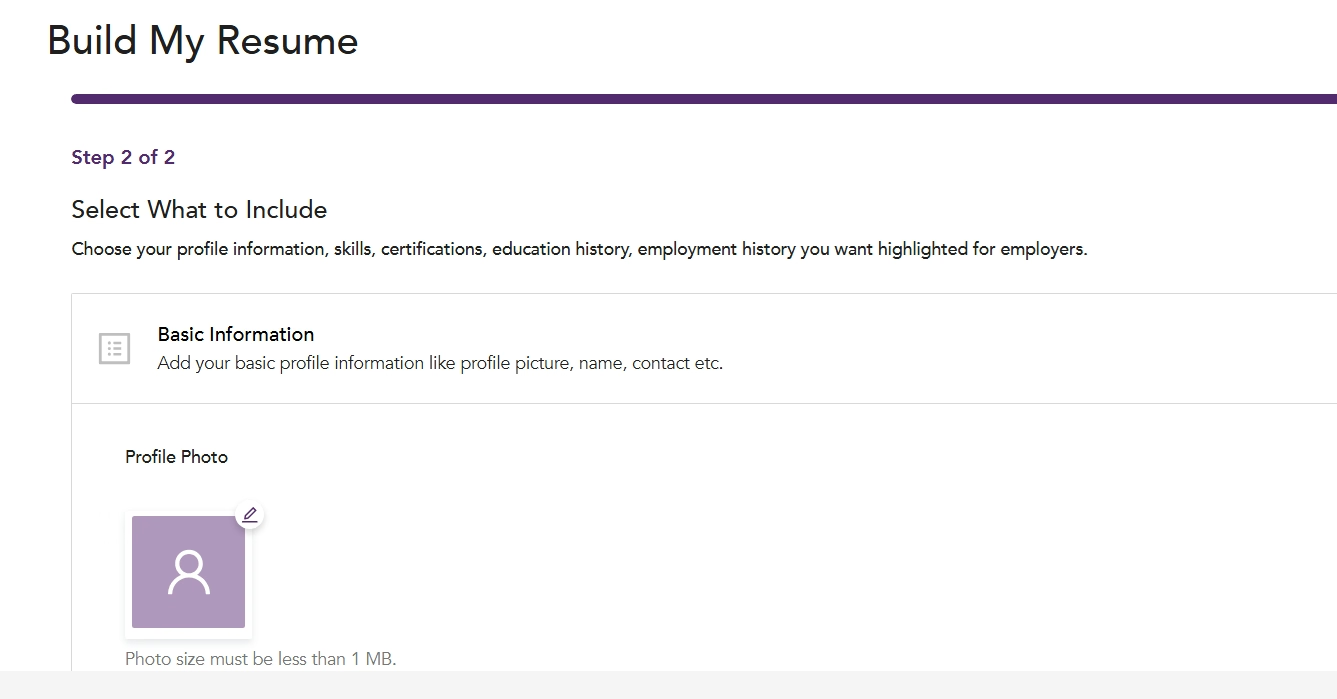
    Selecting basic information and profile details in the Unmudl resume builder
  3. Save and download the completed resume as a PDF after creating a free Unmudl account. The saved file stands in for a maintenance technicians resume template, because the builder applies standard section headings and common fonts automatically.

Completing the three steps gives a candidate a formatted PDF resume without a design stage. The resume carries the candidate into a career that is judged by its pay, its outlook, and its physical demands.

Is Maintenance Technician a Good Career?

Yes, maintenance technician is a good career for a worker who wants hands-on repair work, but only when the physical demands and on-call repairs of the job are acceptable. Maintenance careers open at a low barrier, since no single national license gates entry to the trade. BLS projects 4% employment growth from 2025 to 2035 and 148,700 openings per year for the occupation. Those figures cover the general occupation and not its industrial neighbors.

What is the Difference Between Maintenance Technician and Industrial Technician?

The difference between a maintenance technician and an industrial technician is what each role optimizes: the condition of physical assets against the performance of the production process. An industrial technician is an industrial engineering technician who applies engineering principles to layout and manufacturing-production problems. The goal of the industrial technician is better quality, cost, or automation efficiency, pursued with engineering drawings, process data, computer-aided design (CAD) software, and calipers. For example, an industrial technician identifies an automation change that cuts cost on a production line, whereas a maintenance technician diagnoses a faulty motor and replaces the component. A second neighbor shares the maintenance half of the title.

What is the Difference Between Maintenance Technician and Industrial Maintenance Technician?

The difference between a maintenance technician and an industrial maintenance technician is the scope of the asset: multi-craft upkeep of buildings and equipment against specialized upkeep of production machinery. An industrial maintenance technician is an industrial machinery mechanic who repairs, installs, adjusts, and maintains production machinery and plant systems. The industrial role aims at reliable production equipment, reached with voltmeters, welding equipment, blueprints, and programmable logic controller (PLC) or SCADA software. For example, an industrial maintenance technician reads a machine error message, tests the circuit, and replaces the defective part. A maintenance technician on a property instead checks a belt drive and calls a specialist beyond authorization. A female industrial maintenance technician works to the same definition, duties, and tool set, since the occupational framework defines competencies by the work performed and not by sex.

Learn In Demand Skills Employers Are Hiring For

Explore our career-ready "Mechatronics and Robotics Maintenance" designed with employers to help you get hired faster. Train for industrial maintenance in ~10–12 weeks, earn a certificate and get ready to interview for technician roles.
No items found.
No items found.
Last updated on:
October 19, 2026
No items found.