12 Top Robotics Technician Training Programs (Prices + Details)
Last updated on:
June 18, 2026
Key Takeaways
There is no single best robotics technician training program. The right choice depends on your starting skill level, preferred format, and career goal.
Career-entry programs and OEM robot brand training are two different product types. Comparing them without knowing the difference leads to bad enrollment decisions.
Most online programs use simulation software like RoboLogix or VR, not physical robots. Confirm what kind of lab access a program actually provides before enrolling.
Not all programs cover PLCs or control systems. Always verify that programmable logic controllers are part of the curriculum before committing.
OEM credentials like FANUC CERT I are a recognized signal, but employers prioritize hands-on troubleshooting and teach pendant experience over certification status.
Program costs range from $425 for a short online module to over $35,000 for a 12-month career school. Higher cost does not mean a better fit for your situation.
Unmudl's Mechatronics and Robotics Maintenance is the only program in this comparison that combines self-paced online, an in-person lab, and a virtual lab under a single enrollment. Rated 4.87 out of 5 from 85 learner reviews and ARM-endorsed with active employer connections to Amazon and Intel.
Choosing the right robotics technician training program means comparing more than price. This article covers 12 programs by format, duration, hands-on access, and credential type so you can match the right option to your starting point and goal.
A robotics technician training program prepares learners for practical work involving industrial robots, automated production systems, programmable logic controllers, electrical and mechanical troubleshooting, and robotic equipment repair. These programs are built for the plant floor, not a research lab or engineering design office.
There is no single best robotics technician training program for every learner. The right choice depends on your starting skill level, preferred delivery format, budget, need for physical lab access, and whether you want broad career-entry training or brand-specific robot upskilling.
This article compares 12 programs across format, curriculum, hands-on access, credential type, and pricing. Whether you are exploring robotics technician training as a career changer, manufacturing worker, veteran, or recent graduate, this comparison of the best robotics technician training programs gives you the decision layer you need before enrolling.
Browse Courses on Unmudl Today!
Start with Mechatronics and Robotics Maintenance, designed for warehouse associates and equipment operators. Unmudl's platform connects you to Career Choice funding and training that employers actually want.
Prices reflect published amounts at time of writing. Verify directly with each provider before enrolling.
We help people like you find new careers they love!
Contact us for a free consultation to begin your new career journey.
How to Choose the Right Robotics Technician Training Program
Before comparing programs, understand what you are actually comparing. These 12 options fall into four distinct types, and comparing them without knowing the difference leads to bad enrollment decisions.
Career-entry programs vs OEM training
Career-entry programs like Unmudl, UTI, George Brown, and Ivy Tech cover broad robotics and automation training: electrical systems, PLCs, mechanical systems, troubleshooting, and industrial robotics. OEM courses from Kent State, Yaskawa, and ABB focus on one robot brand or controller family. These are not interchangeable, and they should not be evaluated side by side without that context.
Online vs in-person
Flexible, job-focused technical courses offer scheduling freedom and remote access. Campus-based programs offer physical robot labs, teach pendant practice, and real troubleshooting experience under downtime pressure. Some programs give you both paths.
Certificate vs degree
Options here range from CEUs and short completion certificates to technical certificates, AAS degrees, and graduate certificates. Check what employers in your target role actually expect before choosing a credential level.
Key skills to look for in any robotics and automation technician training:
Programmable logic controllers (PLC programming) and ladder logic
Electrical and mechanical troubleshooting
Industrial robots, robot safety, and end-of-arm tools
Preventive and corrective maintenance
Sensors, servomotors, and motor controls
Pneumatic systems and fluid power
Hands-on lab projects, robotics simulation software, or physical lab access
Industrial networking
Top 12 Flexible Online Robotics Technician Training Programs
These online robotics technician programs suit learners who need schedule flexibility, remote access, or a lower-commitment starting point before moving into a longer campus program.
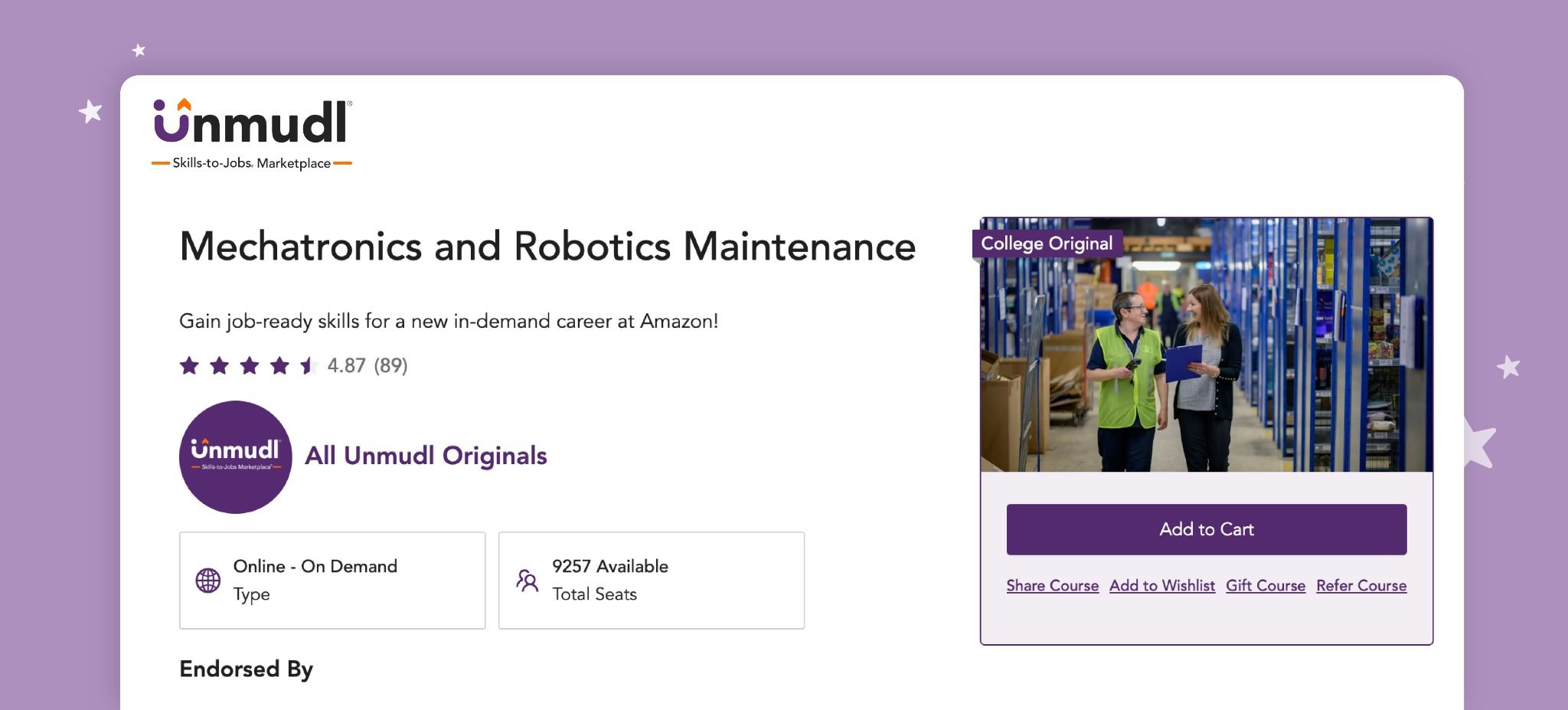
1. Unmudl — Mechatronics and Robotics Maintenance ⭐
Best for: Working adults and manufacturing workers who need practical, job-aligned robotics maintenance fundamentals on a flexible schedule.
Unmudl is a skills-to-jobs marketplace built to connect learners directly to employers and industry-verified training. The flagship course, Mechatronics and Robotics Maintenance, covers six core competency areas: fundamental skills, electrical systems, mechanical systems, fluid systems, industrial systems, and communication. Troubleshooting, ladder logic, and motor control are built directly into the learning outcomes.
The course is ARM Institute endorsed and was developed in conjunction with Amazon. Intel and Amazon are listed as employers actively hiring from this course, which makes the employer-side alignment visible and concrete.
Format, duration, and pricing:
Flexible delivery: online self-paced, in-person lab, or virtual lab / approximately 80 hours (~10 weeks at 8 hours per week)
Price: ~$1,400 (online from $1,375 / in-person from $1,500)
Course-page rating: 4.87 out of 5 from 85 reviews
Three ways to take the training:
Unmudl gives learners real flexibility in how they access this course:
Virtual lab option: The virtual robotics maintenance lab delivers simulation-based lab work for learners who prefer a remote immersive environment
The course aligns with four SACA microcredentials: Electrical Systems 1, Mechanical Power Systems 1, Pneumatic Systems 1, and Variable Frequency Drives 1. The course itself does not grant SACA certification, but the alignment gives learners recognized industrial skills language that employers understand.
Flexible delivery with in-person and virtual lab paths available
ARM-endorsed and employer-connected (Amazon and Intel actively hiring)
Practical maintenance focus across six industrial skill areas
SACA microcredential alignment for recognized skills language
Strong learner reviews at 4.87 out of 5
Cons:
Self-paced format requires personal discipline to complete
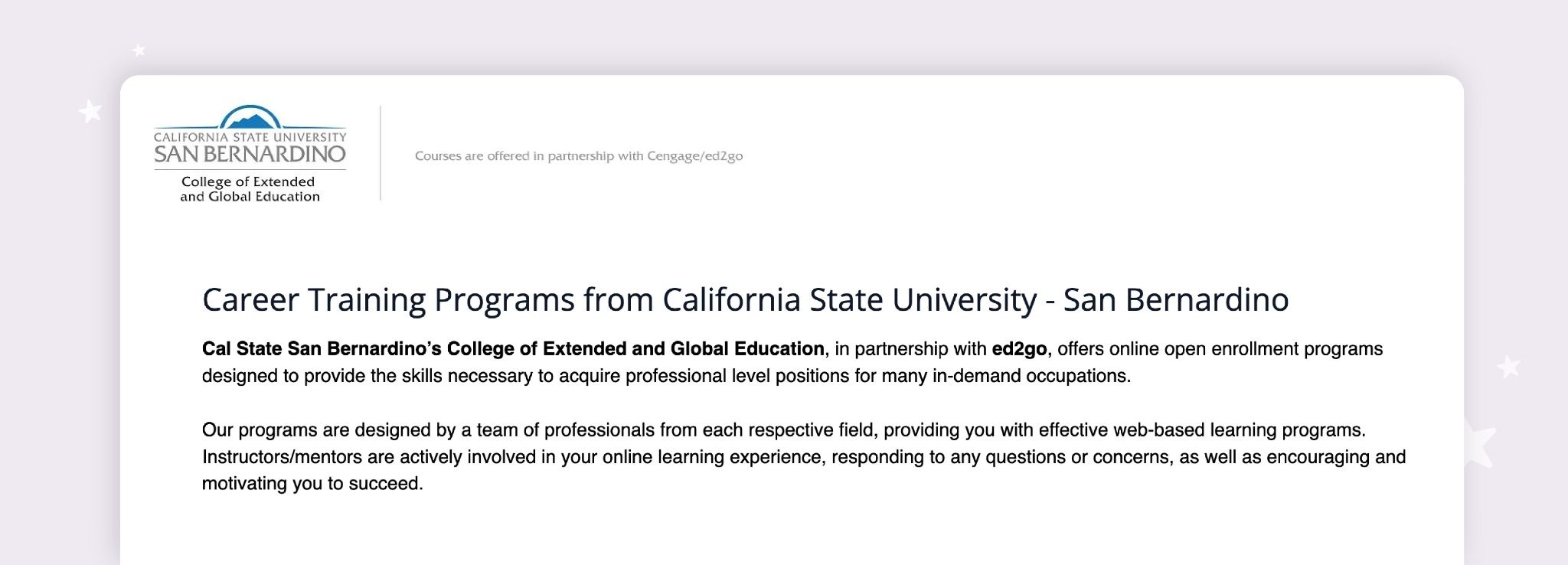
2. California State University San Bernardino — Robotics Technician with VR Training
Best for: Learners who want online robotics technician training with an immersive VR simulation environment.
CSUSB's online program bundles a Meta Quest 3 VR headset into the enrollment package. Published topic areas include math, safety, quality, electrical systems, automation, and mechanical systems. Learners receive 12 months to complete the course.
Price: $3,185 (pay-over-time via Affirm available)
Important note: The official CSUSB page is dynamically rendered, which limits independent syllabus verification. Confirm current curriculum details directly with CSUSB before enrolling.
Pros: VR headset included, online flexibility, fundamentals coverage across key topic areas Cons: Full syllabus harder to independently verify; physical robot lab is not the primary focus
Recommendation: CSUSB is the best online robotics technician training option for learners who want an immersive VR simulation experience without campus attendance.
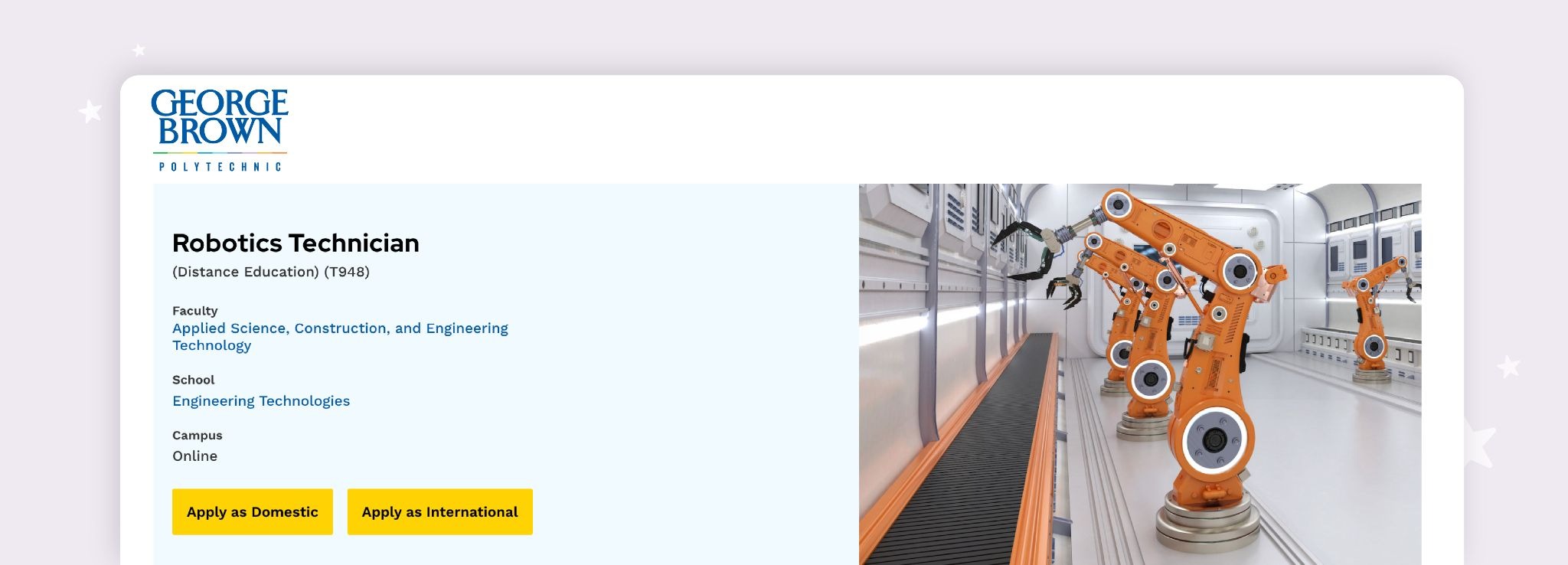
3. George Brown College — Robotics Technician Program (Distance Education T948)
Best for: Learners who want a college-backed online robotics technician certificate with structured simulation-based lab projects.
George Brown's fully online, self-directed program covers 14 modules including industrial robot classifications, manipulators, drive systems, servo systems, vision systems, robot programming, safety, AI, and autonomous robots. Lab projects run through RoboLogix simulation software based on the FANUC LR Mate series, with teach pendant logic that is familiar across FANUC and Motoman systems.
Duration: approximately 28 weeks, no fixed time limit
Pricing: $1,660 domestic full, or $490 initial registration plus $90 per remaining module (pay-as-you-learn)
Credential: George Brown College Certificate
Not PGWP eligible (relevant for international learners)
Pros: Established college provider, low entry cost, structured 14-module curriculum, transparent pricing Cons: Distance education format only; no physical robot lab access
Recommendation: George Brown is the best online robotics technician certificate for learners who want simulation-based training with a structured curriculum at a low, transparent entry price.
4. University of Houston-Downtown — Robotics Technician Certificate Program
Best for: Learners comparing affordable, university-affiliated online robotics technician certificate programs with clearly stated pricing and flexible pacing.
UHD's online robotics technician certificate program runs 14 modules from Introduction to Robotics through AI and Autonomous Robotics. RoboLogix simulation powers lab projects including Pick and Place, Arc Welding, Spot Welding, and Spray Painting environments. Learners can take up to 2 years with continuous enrollment.
Pricing: $490 to start (pay-as-you-learn) or $1,660 full registration
That pricing structure matches George Brown exactly, which makes the two programs easy to compare. The main differentiators are curriculum structure, module progression, and provider background.
Pros: Transparent pricing, diverse simulation lab environments, flexible enrollment window, university affiliation Cons: Simulation-only format; no physical robot lab
Recommendation: UHD is the best online robotics technician certificate for learners who want a university-affiliated simulation program at a clearly stated, low entry cost.
Top Campus-Based Robotics and Automation Technician Programs
These programs suit learners who want structured hands-on training, physical lab access, and broader workforce credentials.
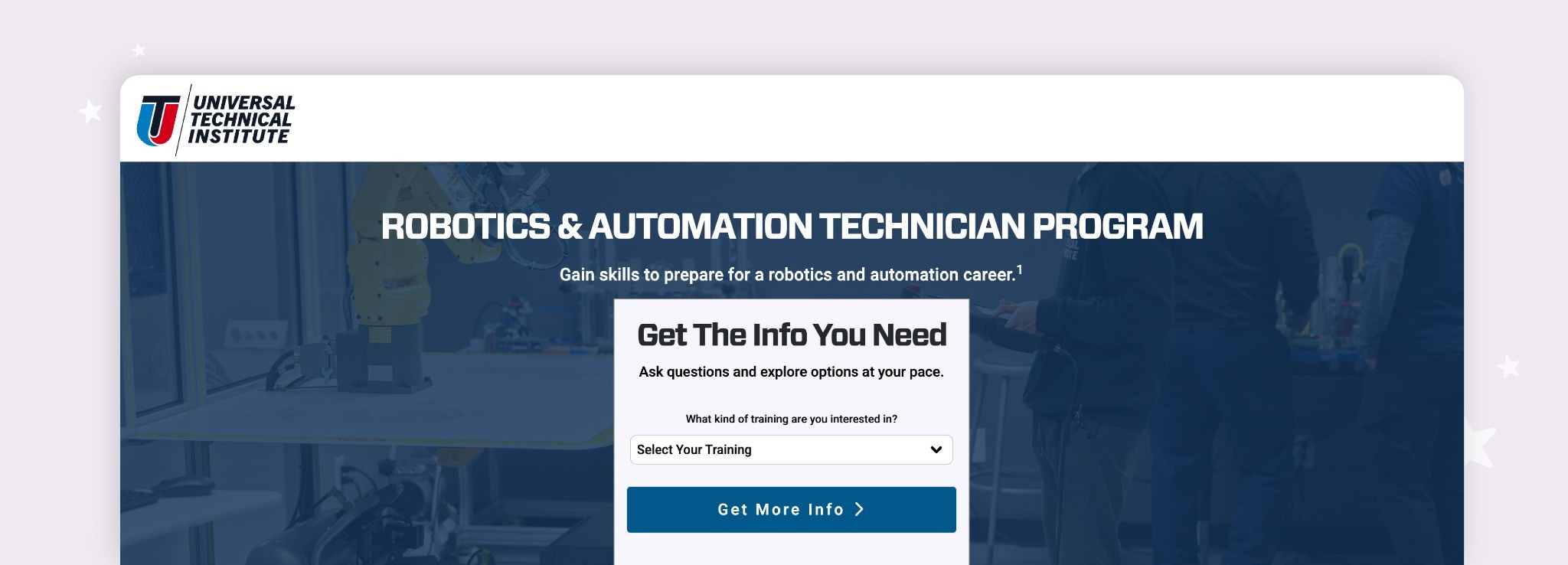
5. Universal Technical Institute — Robotics & Automation Technician Program
Best for: Learners who want a lab-heavy robotics and automation technician program in a dedicated career-school environment.
UTI's hands-on robotics technician training program runs approximately 12 months and logs 697.5 class hours plus 577.5 lab hours. The curriculum covers electrical systems, robotics, fluid power, motor controls, mechatronics, industrial networking, PLCs, smart sensors, troubleshooting, CAD, and manufacturing systems. Graduates also earn OSHA 10 and CPR/First Aid certifications.
Credential options vary by campus: certificate, diploma, AAS, or AOS. Tuition at the Lisle, Illinois campus runs approximately $35,380.
The program's real focus is automation technician work: electrical panels, PLC programming, instrumentation, and troubleshooting, not robot design or R&D. That aligns precisely with what most manufacturing employers are actually hiring for.
Recommendation: UTI is the best hands-on robotics and automation technician program for learners who prioritize physical lab time and can commit to a full career-school investment.
6. Ivy Tech Community College — Advanced Automation & Robotics Technology
Best for: Indiana learners who want a public-college pathway with stackable credentials and a potential workforce grant.
Ivy Tech offers multiple credential layers across 20 Indiana locations in hybrid and in-person formats: an AAS ($13,379), a Technical Certificate ($6,065), and a Mechatronics Certificate ($4,816). Program outcomes include designing, programming, and troubleshooting PLCs, robots, and industrial software, plus electrical and mechanical troubleshooting, diagnostic testing, and component-level repairs.
Indiana residents may qualify for the Next Level Jobs Workforce Ready Grant, potentially making some credentials free. Embedded industry credentials include MSSC Certified Production Technician, OSHA, and Siemens Level 1.
Pros: Stackable credential options, public-college pricing, workforce grant potential, 20 locations Cons: Indiana-specific program; not a quick single-course solution
Recommendation: Ivy Tech is the best community college automation and robotics technician pathway for Indiana learners who want long-term, stackable credential options.
7. Oakton College — Robotics and Vision Technician Certificate
Best for: Learners who want a short, affordable college certificate combining industrial robotics with machine vision systems.
Oakton's 14-credit industrial robotics certificate program can be completed in one semester. The course sequence covers automation overview, fluid power or programmable controllers, industrial robotics, and machine vision systems. Learners build hands-on experience programming industrial robots, designing algorithms, and integrating vision systems into automated workflows.
Tuition is $136.25 per credit hour for District 535 residents and online/hybrid classes, putting the base cost at approximately $1,908 for 14 credits before fees.
The robotics-plus-vision pairing is the key differentiator. Machine vision is increasingly relevant for inspection, guidance, and smart manufacturing roles, and few short certificates address both together.
Pros: Short completion time, robotics plus machine vision coverage, affordable, industry advisory committee oversight Cons: Regional program; check course delivery availability and current schedule
Recommendation: Oakton is the best short robotics technician certificate for learners who want practical training combining industrial robots with machine vision systems.
8. MassMakes — Robotics Technician Training Certificate Program
Best for: Massachusetts-based learners who want a workforce-pathway approach to automation and robotics skills.
MassMakes functions as both a training provider and a workforce pathway hub, connecting learners to partner institutions including Cape Cod Community College. The program's skills language is practical and job-aligned: install, maintain, troubleshoot, and repair automated equipment; wire and program basic PLC systems; configure automation networks; use multimeters, oscilloscopes, and function generators; troubleshoot mechatronic and robotic systems in manufacturing environments.
Schedule and pricing details are not published on the official page. Contact MassMakes directly for enrollment logistics.
Pros: Strong practical-skills language, manufacturing automation focus, regional employer connections Cons: Less transparent on logistics and pricing than most college program pages
Recommendation: MassMakes is the best robotics technician training option for Massachusetts-based learners connected to the regional advanced manufacturing ecosystem.
Advanced and OEM Robotics Technician Training Programs
These programs are not beginner-first. They are designed for learners who already have a technical background, or who need targeted robot programming and maintenance training for a specific brand they work with.
9. Michigan Technological University — Industrial Robotics Certificate
Best for: Engineers and senior technicians with a bachelor's degree who want graduate-level industrial robotics technician training with FANUC lab work and cybersecurity exposure.
Michigan Tech's graduate certificate totals 11 credits (8 core, 3 elective). The two core courses combine FANUC robot operation, programming, and troubleshooting with robotic vision systems and RoboGuide simulation. Students work on industrial-scale FANUC robots and have opportunities to earn FANUC industry certificates within the coursework. Electives include network security and cybersecurity for industrial control systems, which directly addresses where smart manufacturing is heading.
Admission requires a bachelor's degree (typically 3.0 GPA). No flat tuition rate is published.
Pros: Graduate rigor, FANUC lab work on industrial-scale robots, robotic vision systems, cybersecurity elective options Cons: Not suitable for entry-level learners; bachelor's degree required; per-credit pricing varies
Recommendation: Michigan Tech is the best advanced industrial robotics certificate for engineers and senior technicians who want graduate-level FANUC training with a forward-looking cybersecurity component.
10. Kent State University — FANUC Robot Training
Best for: Technicians who need authorized FANUC robot programming and operation training with a recognized industry credential.
Kent State is a FANUC Authorized Certified Education Training Facility with training delivered by FANUC-certified professors. The 32-hour, in-person course in Kent, Ohio covers teach pendant operation, controller navigation, frame setup, motion types, I/O configuration, fault recovery, ROBOGUIDE simulation, and 24 laboratory exercises. Online pre-work modules are delivered up to two weeks before the in-person sessions.
Price: $1,935 / 3.0 CEUs
Credential: FANUC Robotics CERT I
Teach pendant familiarity and fault recovery ability matter more to most employers than certification alone. The CERT I credential, though, is a recognized signal that this specific authorized training was completed.
Pros: FANUC-authorized facility, 24 hands-on lab exercises, CERT I credential, pre-work modules included Cons: Brand-specific and short duration; not a broad career-entry robotics program
Recommendation: Kent State is the best FANUC robot programming training option for technicians targeting FANUC-heavy manufacturing environments who want an authorized, hands-on credential.
11. Yaskawa Academy — YRC1000 Maintenance with Programming Overview
Best for: Maintenance technicians who work with or will work with Yaskawa/Motoman robot cells.
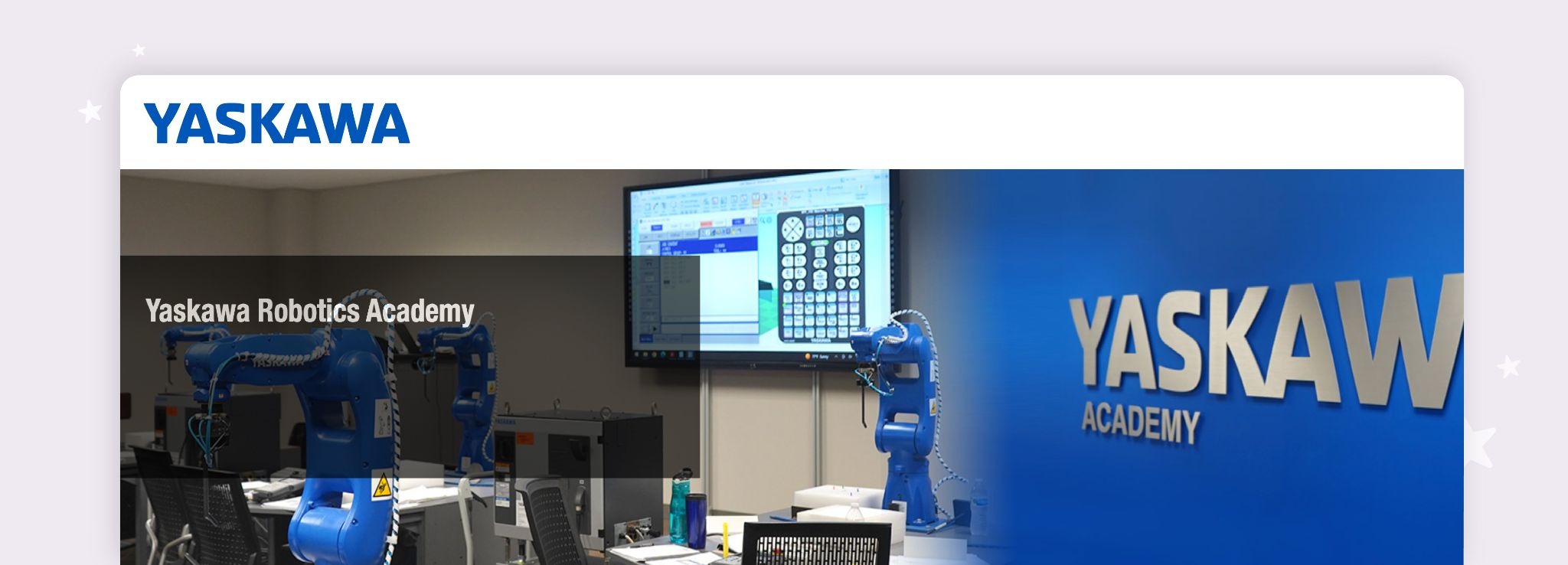
Yaskawa's 4-day course is held in a 13,400-square-foot training facility in Miamisburg, Ohio, with class sizes typically at 12 or fewer. The curriculum covers YRC1000 controller hardware, circuit board replacement, I/O, power distribution, servopack and motor/reducer replacement, preventive maintenance, robot calibration, and TCP setup. A programming overview is included.
Price: $2,000 / 26 contact hours / 2.6 CEUs
No prior programming required, but YRC1000 Basic Programming is strongly recommended
CEUs require 70% or higher on the final exam
Pros: Maintenance-deep OEM curriculum, small class size, large dedicated physical training facility Cons: Yaskawa-specific only; prerequisite course strongly recommended before attending
Recommendation: Yaskawa Academy is the best robot maintenance training option for technicians responsible for maintaining Yaskawa YRC1000 and AR-series robot cells.
12. ABB Robotics Training — United States Courses
Best for: Technicians, engineers, and employers who need ABB-specific robot programming, troubleshooting, or maintenance training.
ABB University's U.S. robotics catalog includes 50-plus instructor-led courses across seven U.S. locations, with virtual instructor-led, self-paced online, and plant-site training options available. For technicians, key courses include Programming I for Material Handling (4.5 days), Electrical Troubleshooting (4.5 days, approximately 50% hands-on), and Mechanical Maintenance courses (2 to 2.5 days depending on robot model). The online self-paced option (US519) runs 5 to 6 hours for $425.
Open enrollment day rates: 1 day ($1,250), 2 days ($1,600), 3 days ($2,336), 4 days ($2,700), 5 days ($3,028).
ABB is a training catalog, not a single unified program. Advanced courses carry prerequisites. If you are new to ABB training, identify the specific robot family and controller you work with before selecting a course.
Pros: Extensive OEM catalog, multiple delivery formats, strong brand-specific depth across programming and maintenance Cons: Catalog structure can confuse beginners; prerequisites required for advanced courses
Recommendation: ABB is the best robotics training ecosystem for technicians and employers who specifically need ABB robot programming, maintenance, or troubleshooting training.
What Do Robotics Technician Training Programs Teach?
Strong programs cover more than robot operation. Here is what the best robotics technician and automation technician training covers:
Industrial robotics and robot safety Robot classifications, robot controllers, end-of-arm tools, teach pendants, motion paths, fault recovery, and safety procedures for robot cells.
PLC training and control systems Programmable logic controllers, ladder logic, I/O systems, and motor controls form the backbone of every robot cell environment. Building control systems fundamentals before jumping into brand-specific robot training gives you a significant advantage on the plant floor.
Electrical and mechanical troubleshooting Diagnostic testing, multimeter use, servomotors, conveyors, reducers, and component-level repair under real production conditions.
Mechatronics and maintenance fundamentals Fluid power, pneumatic systems, preventive maintenance, and corrective maintenance. Starting with Introduction to Mechatronics gives beginners a solid cross-disciplinary foundation before specializing in robotics.
Simulation and virtual labs Hands-on lab projects using RoboLogix, RoboGuide, RobotStudio, and VR-based training build robot logic understanding before you ever work on physical equipment.
Machine vision and smart manufacturing Vision sensors, automated inspection, industrial networking, and robot-to-system integration, all of which are growing in relevance as manufacturing systems become more connected.
Understanding mechatronics vs robotics helps you choose the right training path from the start. If you want to build automated equipment maintenance fundamentals before specializing in robot systems, that foundation pays off quickly in the field. Explore the full range of mechatronics courses if you want to develop skills across both mechanical and electrical systems before focusing on robotics specifically.
How Much Does a Robotics Technician Training Program Cost?
Unmudl: ~$1,400 (online from $1,375 / in-person from $1,500)
George Brown: $490 start / $1,660 full
UHD: $490 start / $1,660 full
Oakton College: ~$1,908
Kent State: $1,935
Yaskawa Academy: $2,000
ABB Robotics Training: $425–$3,028+
CSUSB: $3,185
Ivy Tech: $4,816–$13,379
Michigan Tech: Per-credit (graduate)
UTI: ~$35,380
MassMakes: Not published
A higher price does not always mean a better outcome for your specific situation. An online simulation-based certificate at $1,660 and a $35,000 career-school program serve very different learners with very different goals.
Are Robotics Technicians in Demand?
The short answer: yes. And the gap between available talent and employer need is growing.
According to the BLS, industrial machinery mechanics, machinery maintenance workers, and millwrights are projected to grow 13% from 2024 to 2034, with approximately 54,200 openings per year. The more direct BLS category, electromechanical and mechatronics technologists and technicians, projects about 1,300 openings annually with roughly 1% growth through 2034.
The employer side tells a sharper story. A 2024 Manufacturing Institute report estimated that 1.9 million manufacturing positions may go unfilled by 2033, with over 65% of manufacturers naming talent acquisition as their primary business challenge.
On the technology side, IFR's 2024 data and 2025 trends report recorded 523,000 global industrial robot installations and explicitly listed "robots addressing labor shortage" as a top 2025 industry trend. North America saw double-digit order growth in Q4 2024 and Q1 2025.
The demand is not for robot engineers designing new systems. It is for trained technicians ready to fill robotics technician jobs in installation, maintenance, troubleshooting, and automated production line support. Browse jobs that match your skills to see how this demand translates into real openings right now.
Final Recommendation
For learners who want a practical, flexible entry into robotics technician training, Unmudl's Mechatronics and Robotics Maintenance is the standout choice in this comparison.
It is the only program here offering three access formats under a single enrollment: self-paced online, in-person lab, and virtual lab. Start at your own pace and add hands-on practice when you are ready, without switching to a separate program.
The course is ARM Institute endorsed and developed with Amazon. It covers electrical, mechanical, fluid, and industrial systems alongside troubleshooting and motor control, the exact skills employers are actively hiring for. Priced from ~$1,400 and rated 4.87 out of 5 from 85 learner reviews.
Not sure yet? A free trial is available before you commit to a full enrollment.
Explore our career-ready "Mechatronics and Robotics Maintenance" designed with employers to help you get hired faster. Train for industrial maintenance in ~10–12 weeks, earn a certificate and get ready to interview for technician roles.
robotics technician training program teaches the practical skills needed to install, operate, maintain, and troubleshoot industrial robots and automated production systems. Robotics technician education and training typically covers robot safety, PLC programming, electrical and mechanical troubleshooting, and hands-on or simulation-based lab work.
How long does robotics technician training take?
it depends on the course, and training can take anywhere from 4 days to a year, depending on the program's focus and intensity.
Can you complete robotics technician training online?
Yes. Unmudl, George Brown, UHD, and CSUSB all offer fully online delivery. Most online programs use RoboLogix simulation or VR environments rather than physical robot labs, which is an important distinction to understand before enrolling.
What is a robotics technician training program? robotics technician training program teaches the practical skills needed to install, operate, maintain, and troubleshoot industrial robots and automated production systems. Robotics technician education and training typically covers robot safety, PLC programming, electrical and mechanical troubleshooting, and hands-on or simulation-based lab work.How long does robotics technician training take? it depends on the course, and training can take anywhere from 4 days to a year, depending on the program's focus and intensity.Can you complete robotics technician training online?Yes. Unmudl, George Brown, UHD, and CSUSB all offer fully online delivery. Most online programs use RoboLogix simulation or VR environments rather than physical robot labs, which is an important distinction to understand before enrolling.



.svg)









.jpg)
