Top 8 Biomedical Equipment Technician Training Programs in 2026
Last updated on:
July 1, 2026
Key Takeaways
Compare 8 biomedical equipment technician training programs, from online self-paced courses to hands-on college, certificate, and apprenticeship pathways.
Biomedical equipment technician training is one of the most overlooked paths into healthcare technology.
No medical degree. No nursing license. What you need is solid technical training and the ability to keep the machines hospitals run on working properly.
The numbers back this up. According to the Bureau of Labor Statistics, medical equipment repairers earn a median annual wage of $62,630, with 13% job growth projected from 2024 to 2034 and roughly 7,300 new openings every year.
But picking the right program is harder than it looks. BMET training programs fall into four main types:
Online course-based upskilling
Private BMET certificate programs
Community college certificate programs
Stackable certificate-to-degree pathways
Each leads to different credentials, different costs, and very different levels of hands-on training.
This guide covers the top 8 biomedical equipment technician training programs so you can find the one that actually fits your goals. You can also browse biomedical and technician courses to explore options as you read.
Browse Courses on Unmudl Today!
Start with Mechatronics and Robotics Maintenance, designed for warehouse associates and equipment operators. Unmudl's platform connects you to Career Choice funding and training that employers actually want.
Unmudl matches you to hands-on training and hiring employers close to home. Sign up to see what's near you.
Good jobs, in your area.
Unmudl matches you to hands-on training and hiring employers close to home. Sign up to see what's near you.
Good jobs, in your area.
Unmudl matches you to hands-on training and hiring employers close to home. Sign up to see what's near you.
Good jobs, in your area.
Unmudl matches you to hands-on training and hiring employers close to home. Sign up to see what's near you.
What Is Biomedical Equipment Technician Training?
Biomedical equipment technician training is career-focused education that prepares learners to inspect, test, maintain, troubleshoot, and repair medical equipment used in hospitals, clinics, home healthcare settings, and medical device service environments.
You will see several terms used interchangeably: BMET training programs, biomedical equipment technology certificate, medical equipment repairer training, biomedical equipment maintenance training, and medical device repair training. These overlap more than they differ. What changes is delivery format, credential type, hands-on depth, and cost structure.
What Does a Biomedical Equipment Technician Learn?
Strong BMET programs cover basic electronics, circuit analysis, biomedical instrumentation, anatomy and physiology, medical terminology, calibration, preventive maintenance, troubleshooting, electrical safety testing, service documentation, networking, and hospital safety standards.
The best programs now include cybersecurity awareness and EHR-connected device management. FDA guidance on cybersecurity in medical devices makes clear that connected equipment creates real risks that today's technicians need to understand going in.
BMET Certificate vs CBET Certification: What Is the Difference?
This trips up a lot of prospective students, so it is worth clearing up.
A BMET certificate is awarded by a school or training provider when you complete their program. CBET certification is a separate professional credential from AAMI that typically requires documented work experience plus a passing exam score. Finishing a training program does not automatically make you CBET certified. Some programs prepare you for that exam later, but they are two different things.
Is Biomedical Equipment Technician Training Worth It in 2026?
Yes. The data is clear.
Biomedical Equipment Technician Salary and Job Outlook
BLS data shows the median annual wage for medical equipment repairers is $62,630 as of May 2024. Hospital-based roles average $74,560. The field is projected to grow 13% from 2024 to 2034, generating roughly 7,300 openings per year across hospitals, clinics, medical device companies, and independent service organizations.
All baby boomers will be 65 or older by 2030 according to the U.S. Census Bureau, and chronic diseases remain the leading drivers of U.S. healthcare costs. More patients with complex conditions mean more diagnostic equipment, patient monitors, infusion pumps, and imaging systems that need qualified technicians. See what employers are actively posting with open technician jobs.
Future Skills BMET Training Programs Should Cover
Modern BMET work now includes software updates, device connectivity, hospital networks, and cybersecurity risk awareness. It is no longer just electronics and wrench work. Programs that teach networking, information security, and EHR-connected medical devices prepare you for the job as it exists today. Read more about growth opportunities for biomedical equipment technicians to understand where the field is heading over the next decade.
How We Evaluated These Programs
Every program was assessed using official program pages as the primary source. No sponsored placements.
Criteria included: credential type, delivery format, program length, cost model, curriculum depth, hands-on training access, prerequisites, employer partnerships, and career relevance for entry-level BMET roles.
We help people like you find new careers they love!
Contact us for a free consultation to begin your new career journey.
Online and Self-Paced Biomedical Equipment Technician Training
Online BMET training works best for learners who want flexibility, need a low-friction entry point, or want to explore the field before committing to a campus-based program. The key question to ask upfront: does the program include hands-on labs, a virtual lab option, or only online theory?
Prerequisites: None stated on official course pages
Employer connection: Developed in collaboration with Siemens Healthineers; some learners are employer-sponsored, including Amazon RME staff
What you learn: Electrical systems, electronic systems, mechanical systems, fluid systems, computer and network systems, communication, and anatomy and physiology (in the 80-hour course).
✅ Pros: Free trial, transparent pricing, self-paced flexibility, Siemens Healthineers industry partnership, no prerequisites to start
❌ Cons: Not a traditional college certificate; physical lab experience requires the separate virtual lab add-on; SACA certification involves additional steps beyond course completion
Best for: Career changers, adult learners, and working technicians who want a flexible, affordable starting point before committing to a longer campus-based BMET program. Healthcare employers building training programs can also partner with Unmudl to build a technician pipeline.
Private Online BMET Certificate Program
Private certificate programs offer more structure than course-only platforms, but typically cost more than community college options. Before enrolling, verify tuition, hands-on lab depth, admissions requirements, and exactly what credential you receive.
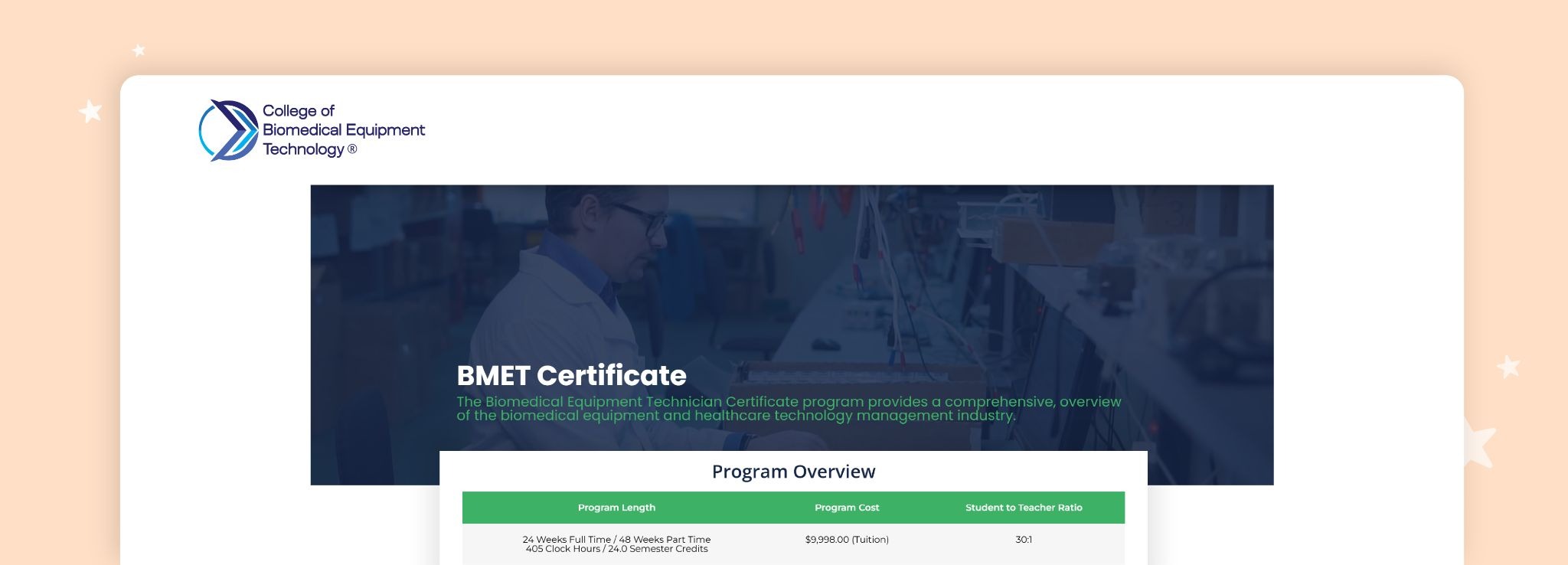
2. College of Biomedical Equipment Technology (CBET)
CBET is a veteran-owned private institution specifically focused on healthcare technology management. Its BMET Certificate is one of the most structured online-friendly private options available.
Format: Online, 100% online delivery with virtual lectures; some hybrid options available in select areas
Credential: Certificate of Completion (credits stackable toward CBET's associate degree)
Prerequisites: Age 18+, high school diploma or GED, valid photo ID
Hands-on: Lecture and lab structure documented; primary delivery is online; verify lab depth directly with CBET before enrolling
Employer connections: Partners include AAMI, Crothall Healthcare, and DoD SkillBridge
What you learn: Basic electronics, schematics, troubleshooting, pneumatics, hydraulics, test and measurement equipment, medical terminology, anatomy, preventive maintenance, calibration, and electrical safety testing.
✅ Pros: Clear admissions process, transparent tuition, online delivery, DoD SkillBridge eligible, career services included
❌ Cons: Significantly more expensive than community college pathways; the school certificate is not the same as professional CBET certification; confirm actual hands-on lab depth before enrolling
Best for: Adults, veterans, and career changers who want a structured private BMET certificate with an online-friendly format and can justify the tuition.
Accelerated Workforce BMET Certificate
Accelerated workforce programs are faster and more hands-on than standard semester-based college pathways, but are usually noncredit and flat-fee. The best fit for learners who want intensive training without a long degree path.
3. MiraCosta College
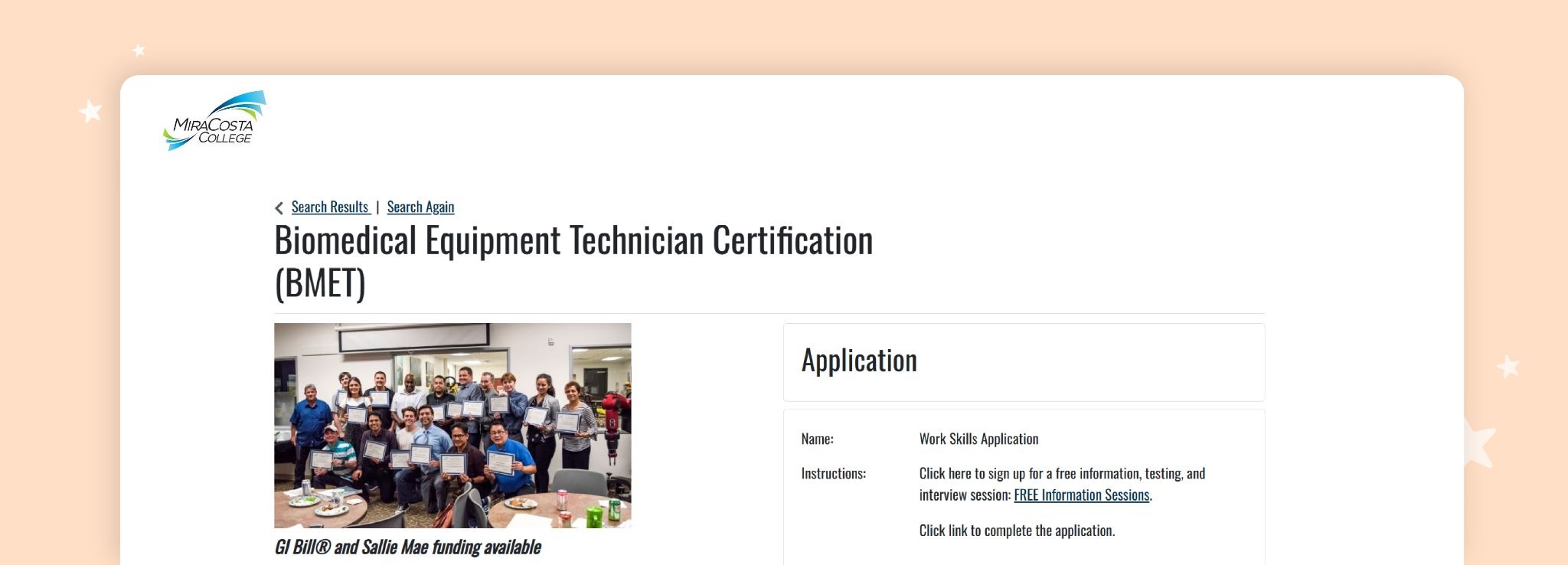
MiraCosta's Biomedical Equipment Technician Certificate Program is the most intensive hands-on option on this list. Delivered through the Technology Career Institute, it is built for learners who want to move fast and gain real lab experience.
Format: In-person, full-time (Monday through Wednesday, 8:00 AM to 4:00 PM)
Length: 440 hours over approximately 4.5 months (Fall 2026 cohort: August 3 to December 9, 2026)
Cost: $6,000 standard; $3,500 for qualified applicants (GI Bill, WIOA funding, and Sallie Mae loans accepted)
Credential: Noncredit BMET certificate through Community Education
Prerequisites: Contact MiraCosta directly; not clearly stated on accessible official pages
Hands-on: Official program listing describes "extensive hands-on application" reinforcing all lecture topics
What you learn: Fundamental electronics, digital electronics, anatomy and physiology, computers and networking, preventive maintenance, troubleshooting, repair, and CBET exam preparation.
✅ Pros: Accelerated intensive format, strong hands-on signal, CBET exam prep included, flat fee with multiple funding options
❌ Cons: Noncredit (no college credit awarded), fixed schedule with limited flexibility, higher flat fee compared to per-credit community college programs
Best for: Learners who want the most hands-on, accelerated BMET training available and can commit to a full-time daytime schedule.
Community College BMET Certificate Programs
Community college BMET certificates offer affordability, college credit, stackability, and structured academic pathways. Most have prerequisites and residency-based tuition, so planning your sequence before you start matters.
4. Community College of Philadelphia (CCP)
CCP's Biomedical Equipment Technology I Proficiency Certificate is a credit-bearing public college pathway with an internship component and a clear route toward an AAS degree.
Format: In-person, Philadelphia campus
Length: 24 credits (up to 28 with advanced anatomy options)
Cost: $174 per credit hour for Philadelphia residents (effective Fall 2026); higher rates for out-of-county and out-of-state students
Credential: Proficiency Certificate, stackable toward the AAS in Biomedical Equipment Technology
Prerequisites: Math placement required; biology/anatomy prerequisites; electronics prerequisite chain; the internship component requires department-head approval and background clearances
Hands-on: BMET 103 Biomedical Equipment Technology Internship is a required component of the program
What you learn: Circuit analysis, computer systems maintenance, biomedical equipment technology I and II, anatomy and physiology, and intermediate algebra.
✅ Pros: Internship included, credit-bearing, stackable toward an AAS degree, rigorous academic structure, public college affordability for local residents
❌ Cons: Prerequisites can delay entry into core BMET coursework; total cost depends heavily on residency; less flexible than online options
Best for: Philadelphia-area students who want an affordable, credit-bearing certificate that includes internship experience and a clear pathway toward an associate degree.
5. Maricopa Community Colleges / Mesa Community College
Mesa Community College, within the Maricopa system, offers a Certificate of Completion in Biomedical Equipment Technology with one of the most forward-looking curricula in this comparison. The program stands out for its coverage of networking and information security.
Format: In-person, Mesa Community College campus
Length: 26 to 36 credits depending on math placement and course selection
Cost: $97 per credit hour for Maricopa County residents; higher for out-of-county and out-of-state students
Credential: Certificate of Completion (CCL)
Prerequisites: Algebra placement required; grade of C or better in ELE111, BIO160, and medical terminology before entering BME101
Employer connection: Banner Health partnership to address a documented local BMET shortage
What you learn: Electronics, networking, information security, anatomy and physiology, healthcare delivery and regulatory systems, technical reporting, and communication with healthcare teams.
✅ Pros: Low in-county tuition, curriculum covers networking and information security, transparent course sequence map, Banner Health industry partnership ❌ Cons: Not offered online; prerequisite sequencing adds meaningful time before entering core BMET courses; total credits vary based on placement
Best for: Arizona residents who want an affordable technical certificate with strong content in networked medical devices, information security, and healthcare regulations.
6. Dakota County Technical College (DCTC)
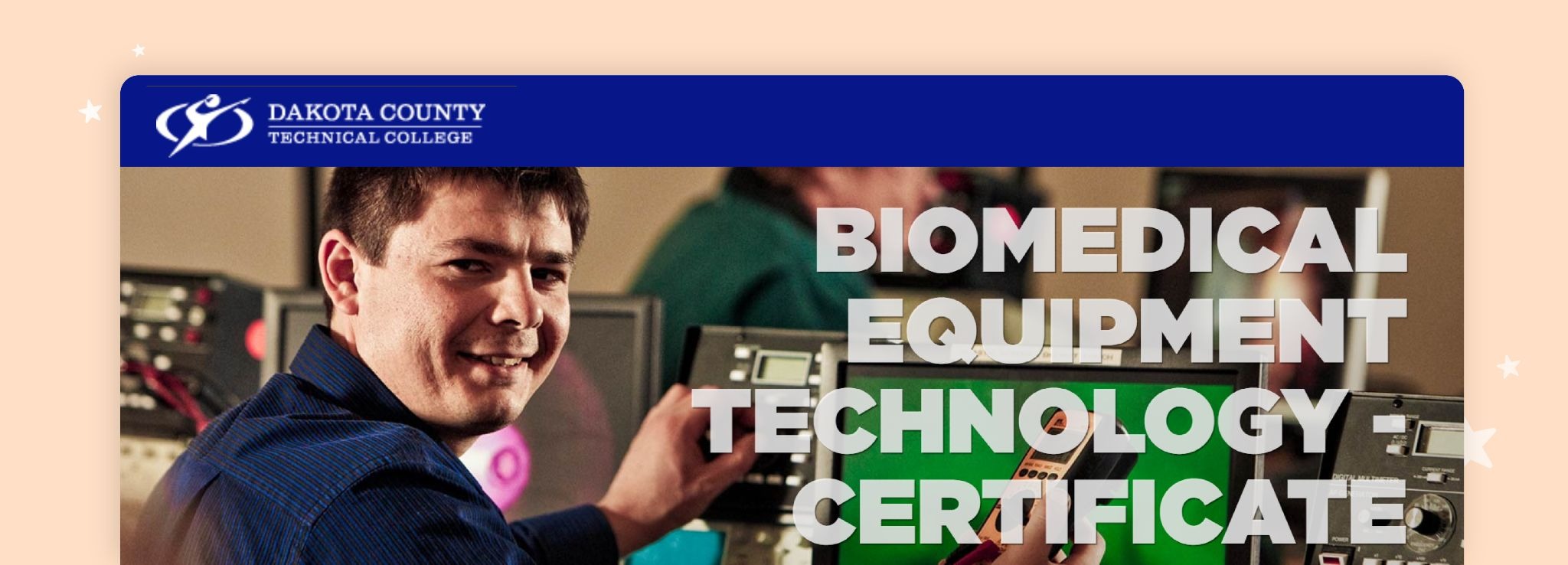
DCTC's Biomedical Equipment Technology Certificate is specifically designed for students who already have an electronics background and want to transition into BMET work without repeating foundational content they already know.
Format: In-person, Rosemount, Minnesota campus
Length: 27 credits
Cost: Approximately $199.65 to $219.33 per credit (rates vary; verify directly with DCTC before applying)
Prerequisites: Electronics-related degree or background required; faculty approval required for admission into the program
Hands-on: Coursework includes applied test equipment use and biomedical instrumentation labs
What you learn: Anatomy and physiology, medical device technology, professional skills, medical terminology, wireless communication, administrative functions, biomedical instrumentation I and II, and preventive maintenance.
❌ Cons: Not a beginner-entry option; faculty approval adds a step to the application process; delivery format and employer connection details should be confirmed directly with DCTC
Best for: Electronics-trained students who want a focused certificate to specialize in biomedical equipment technology without starting from scratch.
Stackable and Employer-Connected BMET Pathways
These programs offer the most direct routes from training to employment, with documented labs, internships, apprenticeships, and real employer partnerships that many certificate programs lack.
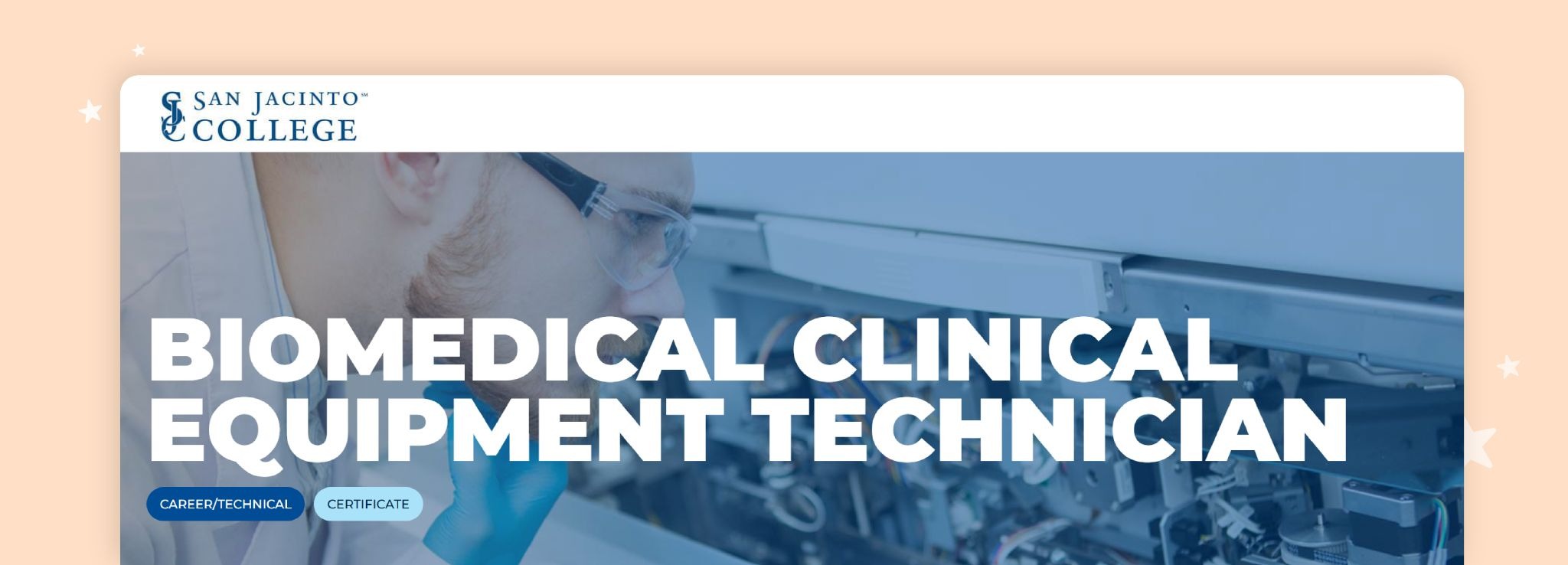
7. San Jacinto College
San Jacinto offers the most flexible stackable BMET pathway on this list. Multiple credential exit points mean you can earn recognized credentials early and keep building without starting over.
Format: In-person, South Campus, Houston, TX
Credential options:
Occupational Certificate: 15 credits / 3 months
Certificate of Technology: 33 credits / 1 year (includes capstone internship)
Level 2 Certificate: 45 credits / 1.5 years
Associate of Applied Science: 60 credits / 2 years
Prerequisites: No additional program-admission requirements beyond standard college enrollment
Hands-on: Significant lab time documented on official program page; capstone internship is required for the Certificate of Technology; external learning experiences require immunization documentation
What you learn: Applied biomedical equipment technology, safety in healthcare facilities, electricity principles, networking technologies, medical device testing, calibration, preventive maintenance, troubleshooting, imaging equipment basics, service manual use, and hospital network troubleshooting.
✅ Pros: Multiple stackable credential exit points, explicit lab and internship components, open admission (no extra application steps), AAS pathway available, transparent in-district tuition
❌ Cons: Campus-based only; immunization requirements may affect externship timing; longer timeline if pursuing Level 2 or AAS credentials
Best for: Students who want a hands-on, stackable BMET pathway with the flexibility to exit and build credentials at multiple stages of their career.
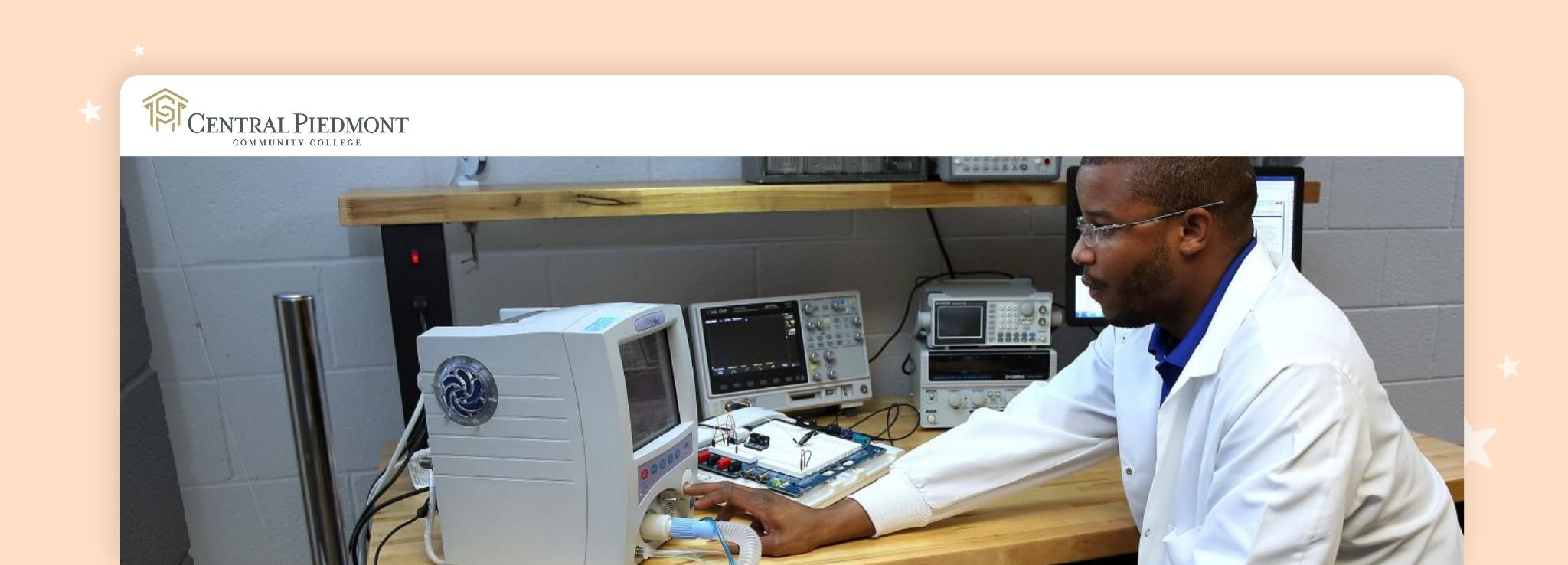
8. Central Piedmont Community College (CPCC)
Central Piedmont stands apart for one clear reason: employer connection. Novant Health actively supports the program because of a documented shortage of trained BMETs in the Charlotte market, and Apprenticeship 2000 provides one of the most direct employment pathways in BMET training available anywhere in the country.
Cost: $76 per credit hour in-state; $268 per credit hour out-of-state
Credential: Certificate specialization(s) in Biomedical Equipment Technology, stackable toward the AAS degree
Prerequisites: High school diploma or equivalent, English and math placement tests, course prerequisites as applicable
Hands-on: State-of-the-art labs; work-based learning embedded in the C2 specialization; Apprenticeship 2000 provides 6,400 hours of paid hands-on training, a scholarship, and a guaranteed job after graduation
Employer connection: Novant Health program support; Apprenticeship 2000 partnership
What you learn: Circuit analysis, hospital safety standards, biomedical instrumentation, imaging techniques, laser fundamentals, anatomy and physiology, records and documentation, equipment setup and repair, and work-based learning.
✅ Pros: Strongest employer connection in this entire list, apprenticeship with a guaranteed job offer, state-of-the-art labs, clear stackable certificate structure
❌ Cons: Localized to Charlotte area; entirely campus-based; out-of-state tuition is significantly higher
Best for: Charlotte-area students who want the most direct employer-connected BMET pathway, access to a paid apprenticeship, and a documented job offer at graduation.
How Much Does Biomedical Equipment Technician Training Cost?
BMET training cost varies widely, and the pricing model matters as much as the number itself.
Flat-fee programs like Unmudl, MiraCosta, and CBET publish a single clear price. Easier to compare, but may not include college credit.
Per-credit community college programs like CCP, Maricopa, DCTC, San Jacinto, and Central Piedmont charge per credit hour. Final cost depends on residency, prerequisite courses, books, and lab fees. For local residents, these are often significantly cheaper than flat-fee private options.
Hidden costs worth checking before enrolling: textbooks, tools, lab fees, immunization documentation, background checks, drug screening, internship travel, and CBET exam fees. Professional certification costs are separate from program tuition at every institution on this list.
There is no single best biomedical equipment technician training program. The right one depends on your goals, location, background, and how fast you need to get moving.
Need online flexibility and a low-cost starting point? Unmudl's self-paced courses with a free trial are your clearest entry point into the field.
Want a structured private online certificate? CBET delivers a comprehensive program if you can justify the tuition.
Prefer hands-on intensive training? MiraCosta's 440-hour program is the most lab-heavy accelerated option available.
Want college credit, an internship, and a degree pathway? CCP, Maricopa/Mesa, San Jacinto, and Central Piedmont all deliver that, with different geographic and cost trade-offs.
Already have an electronics background? DCTC is built specifically for your situation.
Need the strongest employer connection? Central Piedmont's Novant Health partnership and Apprenticeship 2000 are genuinely hard to beat.
What training do you need to become a biomedical equipment technician? Most BMETs need training in electronics, medical equipment maintenance, calibration, safety testing, anatomy, and service documentation. Many employers prefer a certificate or associate degree, though some roles allow entry through apprenticeship or prior relevant experience.
Can you complete biomedical equipment technician training online? Yes, foundational BMET training can be completed online. However, hands-on labs, internships, and apprenticeships are important for most entry-level roles. Online programs work best as a starting point or for employed technicians building foundational knowledge.
How long does biomedical equipment technician training take? It varies widely. Online courses run 40 to 80 hours. Accelerated workforce programs like MiraCosta take approximately 4.5 months. Community college certificates run one to two semesters. Full associate degree pathways take two years.
Is a BMET certificate the same as CBET certification? No. A BMET certificate is awarded by a training provider or college upon program completion. CBET certification is a separate professional credential requiring documented work experience and a passing exam. Always check the program page carefully before assuming certification is included.
How much does biomedical equipment technician training cost? Online courses start at $775. Accelerated noncredit programs can reach $6,000. Private certificates can cost $9,998. Community college programs charge per credit, with final cost depending on residency and the total credits required.
What jobs can you get after BMET training? Common entry-level titles include Biomedical Equipment Technician (BMET I), Medical Equipment Repairer, Clinical Engineering Technician, Biomedical Electronics Technician, Field Service Technician, and Medical Device Service Technician. Employers include hospitals, clinics, medical device manufacturers, independent service organizations, and government healthcare facilities.
What should I look for in a biomedical equipment technician training program? Check the credential type, curriculum coverage (especially electronics, calibration, networking, and documentation), cost model, prerequisites, hands-on training access, internship or apprenticeship availability, and whether credits are stackable toward further credentials.
Are community college BMET programs better than online courses? Community college programs are generally stronger for college credit, lab access, and internships. Online courses are stronger for flexibility and fast exploration of the field. The best choice depends on where you are in your career and what your employer recognizes.
Explore our career-ready "Mechatronics and Robotics Maintenance" designed with employers to help you get hired faster. Train for industrial maintenance in ~10–12 weeks, earn a certificate and get ready to interview for technician roles.


_converted.webp)
.svg)