What is an Air Compressor Technician?
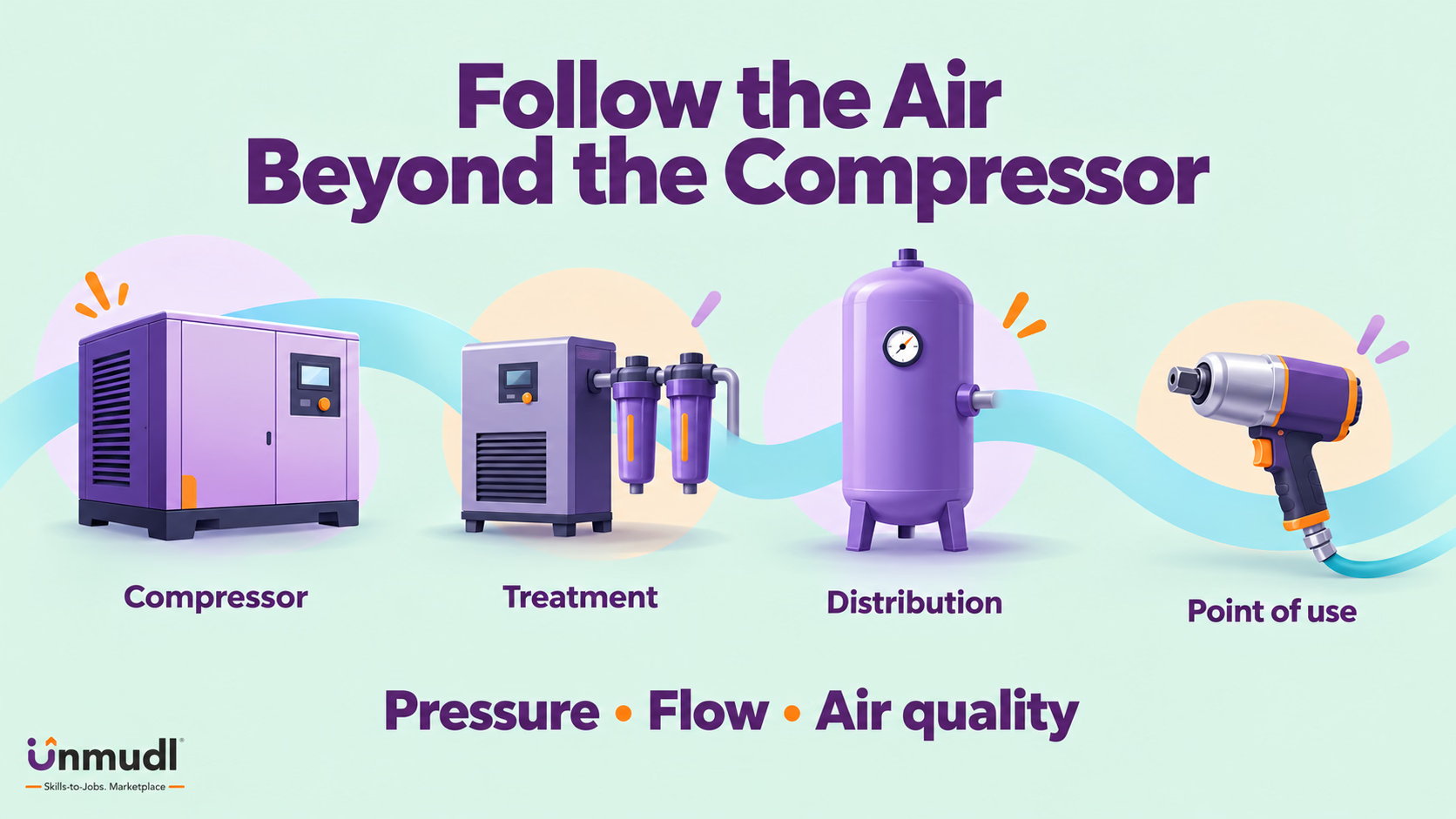
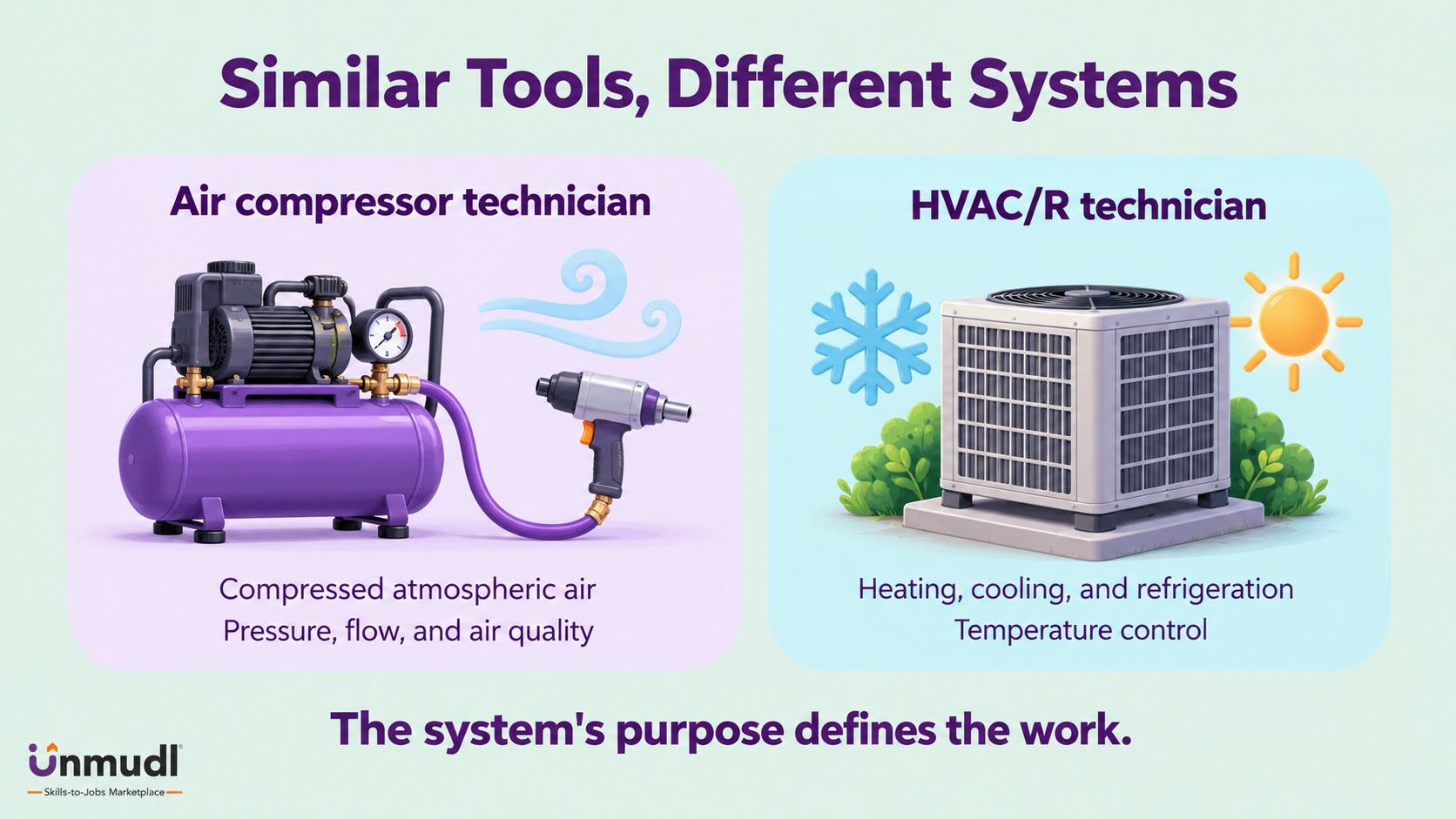
An air compressor technician is an equipment-service specialist whose assigned scope covers the air-producing machine and the connected treatment, control and distribution system. The specialist reads a reported air problem as a system condition rather than a single broken housing. A packaging machine starves for air even while the compressor runs, when the loss sits in a dryer, a drain or a restricted line. A compressor technician and an air compressor service technician hold that same scope under shorter and longer employer titles.
The service scope of the role is set by the employer and the worker's qualifications rather than by a national license. Atlas Copco Group's Quincy Compressor service-technician description, retrieved in October 2026, sets that scope at rotary screw and piston compressors, drying equipment, controls and customer-site service. That description places the daily work of the role inside the complete air system.
What Does an Air Compressor Technician do?
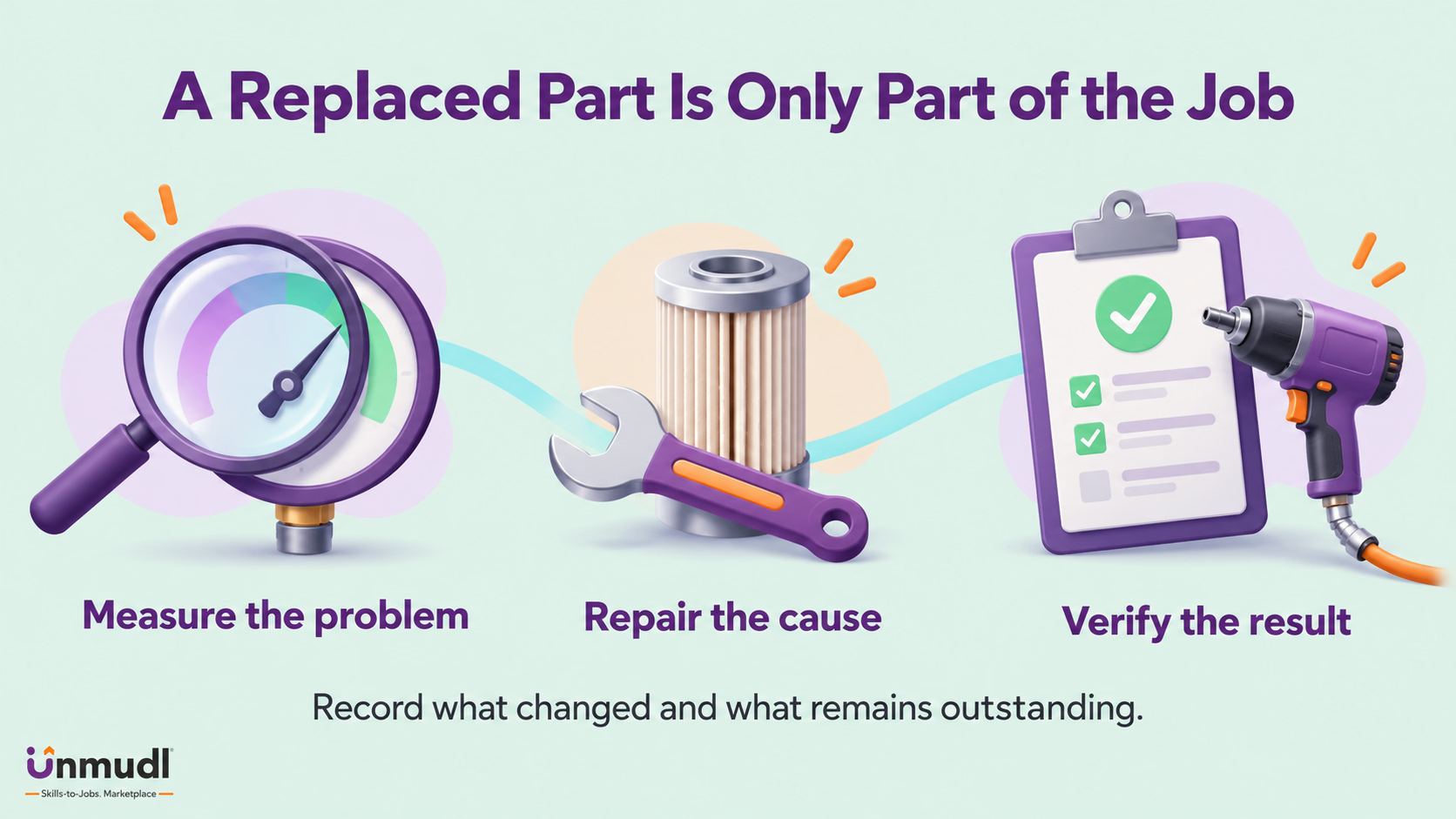
An air compressor technician works by turning a reported air-system complaint or a scheduled service date into a diagnosis, an authorized repair and a documented return-to-service decision. The work begins with the complaint and the operating context of the machine. The operating context leads to measurement of pressure, temperature, electrical load and moisture. The measurements identify the cause, which decides whether the fix is a filter change, a part replacement or a control adjustment. The fix is verified against the original complaint and written into the service record, so a replaced part is never mistaken for a solved production problem. An air compressor mechanic and a compressor service technician perform that same cycle. Performing the cycle on different equipment in different places separates one type of technician from another.
What Are the Types of Air Compressor Technicians?
There are six types of air compressor technicians, divided by the equipment serviced and the place where the service is performed. The first three types are the stationary industrial compressor technician, the portable diesel compressor tech and the air-treatment and controls technician. The last three types are the compressed-air system assessor, the field service compressor technician and the shop repair compressor technician. A natural gas compressor mechanic is not a seventh type, because that mechanic compresses natural gas rather than atmospheric air. The table below places each type beside the equipment it services, the place of service and the fault it isolates.
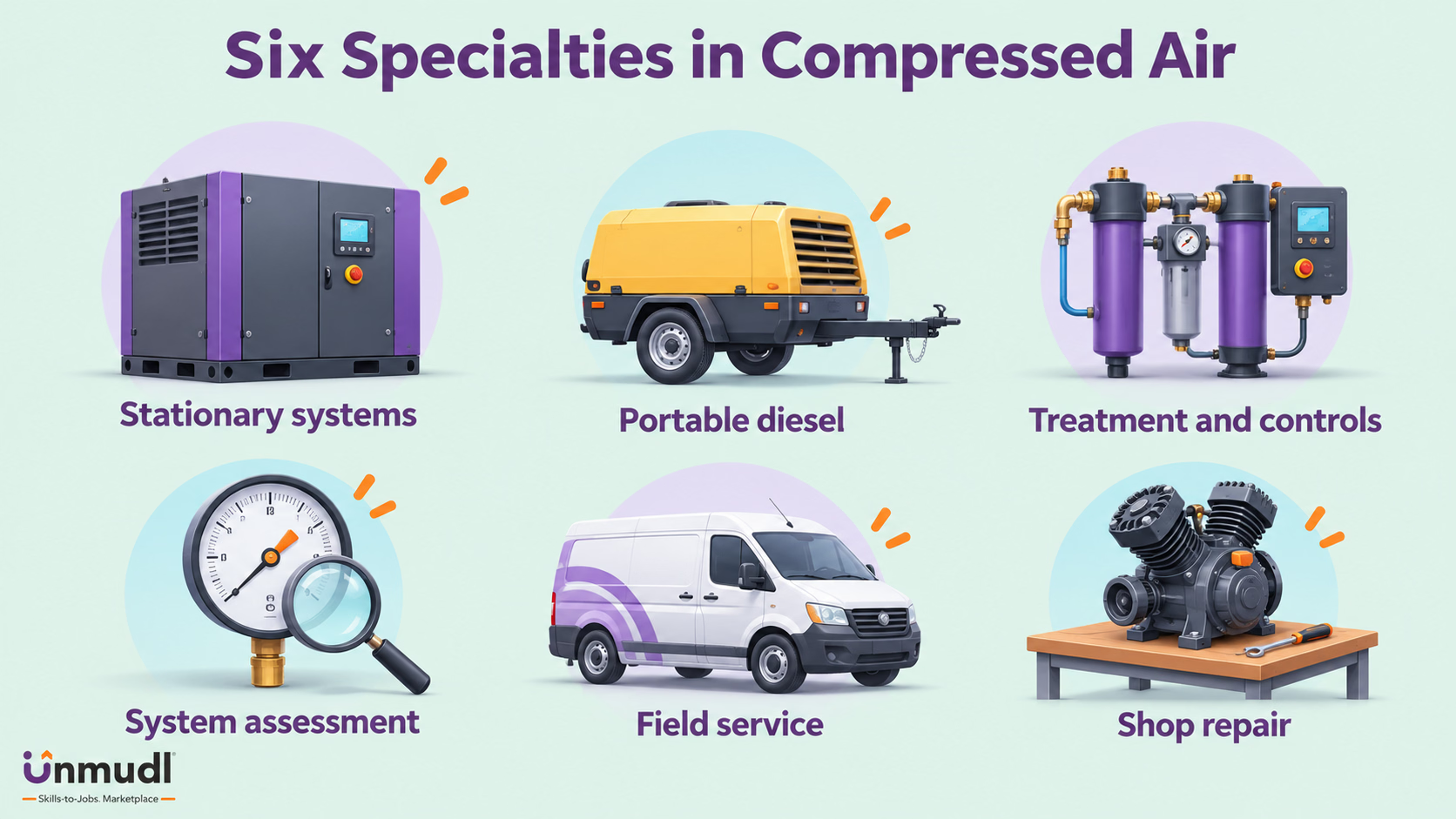
Type | Equipment Serviced | Place of Service | Fault It Isolates |
|---|---|---|---|
Stationary industrial compressor technician | Installed compressor packages | Plant compressor room | Drift in one machine's configuration and history |
Portable diesel compressor tech | Engine-driven air machines | Construction site | Engine fault against compressor fault |
Air-treatment and controls technician | Dryers, filters, drains and controllers | Process plant air-treatment train | Wet or dirty air behind a running motor |
Compressed-air system assessor | Whole-system pressure, demand and control behavior | Customer plant under assessment | Supply-and-demand mismatch, such as a leak load |
Field service compressor technician | Compressed-air systems at customer sites | Customer site, by territory | A different fault on each call, decided on site |
Shop repair compressor technician | Compressor equipment brought in for rebuild | Repair-shop bench | Internal wear found by full disassembly |
Excluded: natural gas compressor mechanic | Gas-compression packages | Gas production, transport and storage sites | Natural gas, not atmospheric air, as the medium |
1. Stationary Industrial Compressor Technician
A stationary industrial compressor technician is a plant-utility specialist who services installed compressor packages supplying a permanent air supply. The installed package serves a fixed production demand, so the specialist records each machine's configuration and history before treating two machines as interchangeable. Employers staff this type inside manufacturing plants.
2. Portable Diesel Compressor Tech
A portable diesel compressor tech is a mobile-equipment specialist who services engine-driven air machines towed to construction sites. The diesel engine supplies the drive while the output stays compressed air, so the tech separates engine faults from compressor faults. Employers place this type with mobile-equipment service operations.
3. Air-Treatment and Controls Technician
An air-treatment and controls technician is an air-quality specialist who focuses on the dryers, filters, drains and controllers that turn raw compressed air into usable air. Usable air means dry, clean air at the pressure the process expects, which a running motor alone never guarantees. Employers pair this type with plants whose processes demand a defined air quality.
4. Compressed-Air System Assessor
A compressed-air system assessor is a performance specialist who evaluates pressure, demand and control behavior across the whole system rather than one component. The assessment finds a supply-and-demand mismatch that a component-only repair misses, such as a leak load that keeps a second compressor running. Employers sell assessment as a separate service.
5. Field Service Compressor Technician
A field service compressor technician is a territory specialist who travels to customer sites to service compressed-air systems. The territory brings a different machine, plant and fault on each call. Each call therefore needs diagnostic tools and the authority to decide a repair on site. Employers organize this type around dispatch, travel and on-call rotation.
6. Shop Repair Compressor Technician
A shop repair compressor technician is a bench specialist who assesses and rebuilds compressor equipment brought into a repair shop. The shop setting allows full disassembly, bench testing and parts replacement. Employers run this type inside distributor service centers.
Reading the six types by equipment and by place lets a candidate match a type to the duties they are ready to perform.
What Are the Duties of an Air Compressor Technician?
There are six core duties of an air compressor technician, ordered from the first step of a service call to the last. The duties are inspecting equipment condition, diagnosing faults, performing preventive maintenance, repairing or replacing components, maintaining treatment and condensate equipment, and verifying results and keeping records. An air compressor tech carries all six on a single visit, and a compressor tech in an in-house team carries them across one site.
1. Inspecting Equipment Condition
Inspection is the examination of the areas the manufacturer and the work order specify before any part is touched. The examination finds belt wear, oil degradation and loose connections while they are still cheap to correct. Technicians follow the equipment's own service requirements rather than one interval for every compressor.
2. Diagnosing Faults
Diagnosis is the separation of a symptom from its cause using manuals and measurements. A pressure drop at the line is a symptom. The cause sits in a worn valve, a failed drain, a tripped motor or a mis-set controller. Technicians keep every electrical measurement inside their authorization.
3. Performing Preventive Maintenance
Preventive maintenance is the scheduled service of filters, lubricants, belts, coolers and drains at the intervals the model and its duty demand. Scheduled service holds the machine at its designed condition so that performance never drifts into a breakdown. Technicians draw the material and the interval from the exact model, never from the job title.
4. Repairing or Replacing Components
Repair is the restoration of an authorized part of the compressor package, from a pump or motor to an alignment or a seal. Restoration follows the diagnosed condition, so a replaced part answers a measured fault rather than a pressure complaint on its own. Technicians treat replacement as a decision rather than a reflex.
5. Maintaining Treatment and Condensate Equipment
Treatment maintenance is the care of dryers, filters and drains that keep moisture and contamination out of the air supply. Moisture that passes a failed drain reaches tools, paint and product downstream, so the duty protects the process as much as the machine. Technicians leave intervention inside a refrigerant circuit to a separately certified trade.
6. Verifying Results and Keeping Records
Verification is the measured confirmation that the original complaint is gone after the work is done. Confirmation is written into a service record that states what was reported, measured, done and left outstanding. Technicians explain those findings to the plant team before leaving the site.
Carrying the six duties in order turns a service call into a documented repair, whichever site the technician reports to.
Where Does an Air Compressor Technician Work?
An air compressor technician works for compressor manufacturers and distributors, independent service businesses and facilities that maintain their own compressed-air equipment. The employer pays the wage, while the customer facility decides the application and the operating environment, so a distributor's technician spends the day inside another company's plant. The physical setting is one of three: a repair shop, a plant compressor room or a customer site. An air compressor mechanic shop is the setting where equipment is rebuilt on a bench. The compressor room is the setting of in-house maintenance, where compressed air is one assignment among wider plant machinery. The customer site is the setting of field service, where a service van, a territory and an on-call rotation shape the week. The setting a worker chooses decides the training route into the occupation.