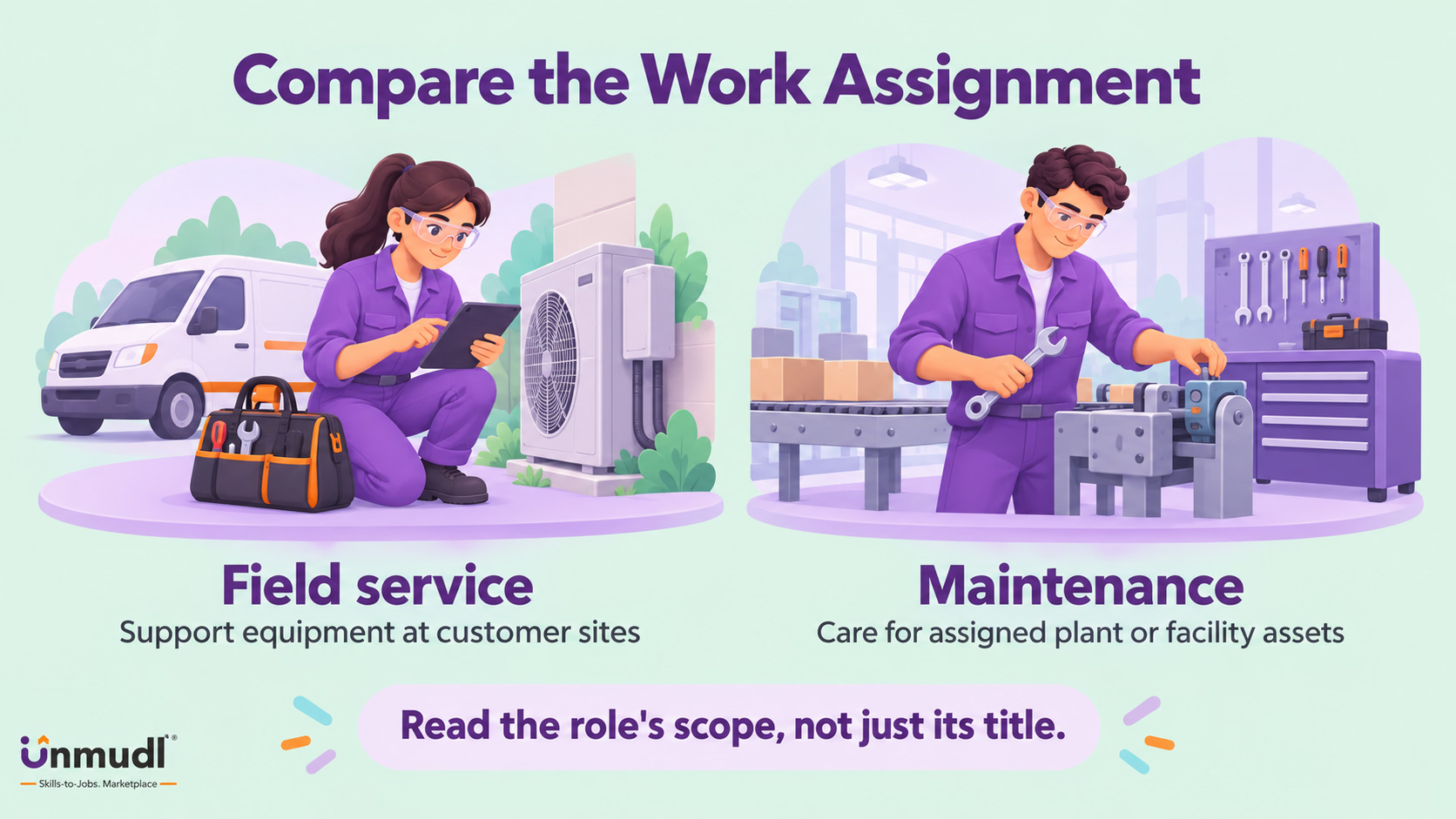
What is a Field Service Technician?
A field service technician is an equipment repairer who installs, diagnoses, maintains and repairs specified machines at a customer or remote worksite instead of at a central repair location. The role involves three parties in every job. The parties are the equipment owner who reports the fault, the employer who holds the service contract, and the worker who carries the authorization to open the machine. The service contract defines the scope of that authorization. The job title alone establishes no engineering degree, no trade license and no competence on every machine.
A reported job title is the label an employer prints on a vacancy, and one label can sit across several classified occupations. The Occupational Information Network (O*NET) lists Field Service Technician, Field Technician, Service Technician and Field Service Engineer among the reported job titles for computer, automated teller and office machine repairers. The same occupational database attaches the field service title to mobile heavy equipment mechanics and to wind turbine service technicians. The answer to what is a field technician therefore depends on the machine in front of the worker. The machine sets the knowledge, while the service request sets the work.
What Does a Field Service Technician Do?
A field service technician works by turning a service request into a documented equipment outcome through six moves: understanding the complaint, inspecting the asset, diagnosing the fault, performing the authorized work, verifying performance and explaining the result. The complaint arrives as a work order with the asset history attached. The asset history names the recurring symptom and the manual for that model. The manual guides the measurements that separate a likely cause from a replaced part. Recorded measurements fix the permitted scope before any component is opened. After the repair, the original symptom is re-tested against the acceptance criteria. The service log then records the parts used and closes with a customer handover that states what is restored, what is limited and what is escalated. A job seeker who asks what does a field technician do meets the same six moves in every specialty. Only the equipment changes between an automated teller machine (ATM), a spindle and a patient monitor.
What Are the Types of Field Service Technicians?
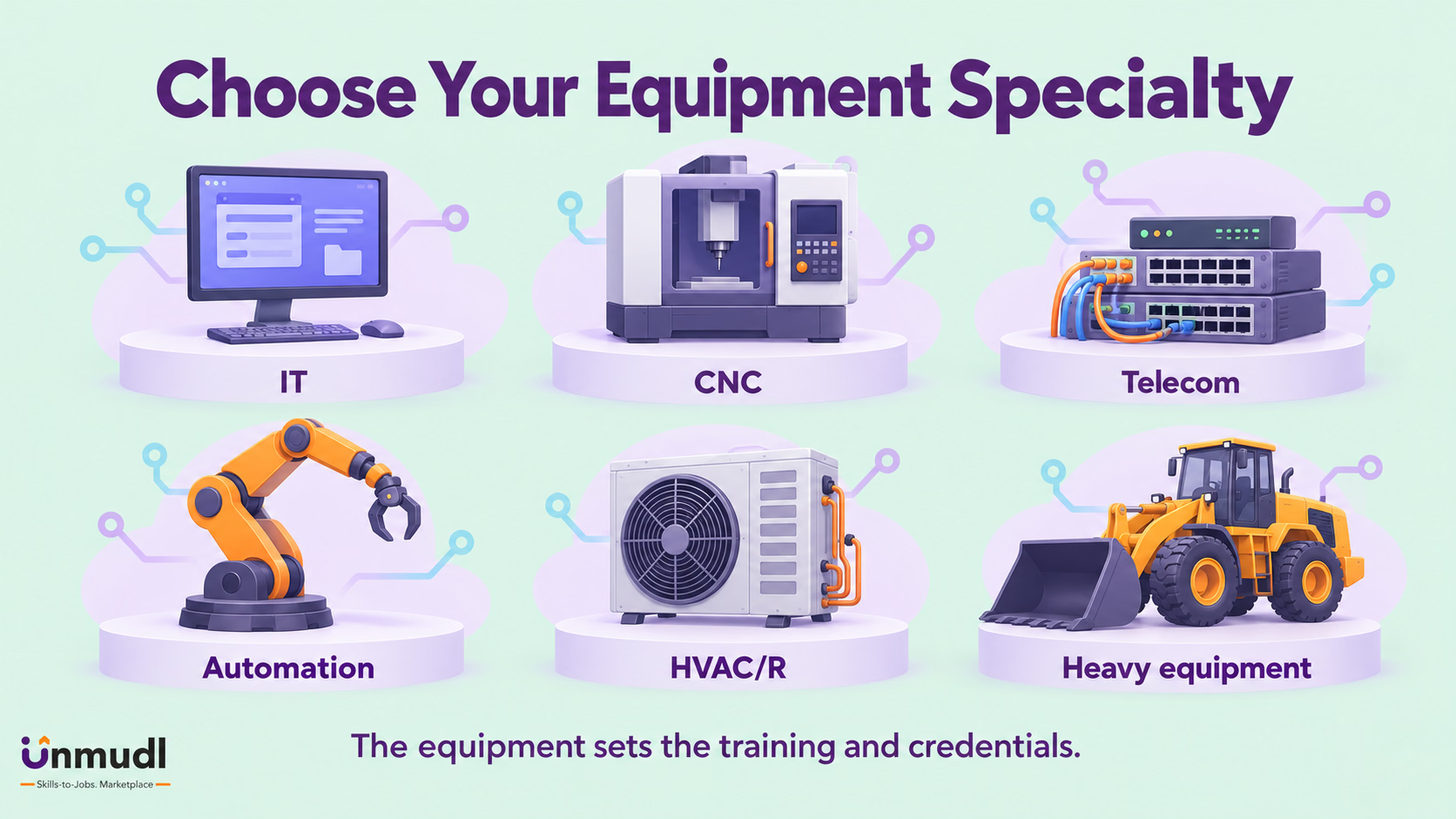
There are six main types of field service technician based on the equipment family that the worker services. The main types are the IT field technician, the CNC field service technician, the telecommunications field technician, the industrial automation field technician, the HVAC/R field technician and the mobile heavy equipment field mechanic. Three other types service medical, solar and oil and gas equipment. The total count is nine types. The table below summarizes the six main types by equipment, typical call and boundary.
Type | Equipment serviced | Typical call | Boundary or credential |
|---|---|---|---|
IT field technician | Computers, peripherals, ATMs, office equipment | Failed printer or faulty workstation component | Authorized data access preserved |
CNC field service technician | Computer-controlled lathes and mills | Recurring tool changer alarm | Operator certification is not service authorization |
Telecommunications field technician | Network equipment and cabling at premises and network sites | Premises equipment and connection check | Tower work under separate fall protection rules |
Industrial automation field technician | Machinery, controls and electromechanical components | Control component in a packaging line | Changes outside authorization escalated |
HVAC/R field technician | Heating, ventilation, air conditioning and refrigeration systems | Commercial cooling system maintenance | EPA Section 608 for refrigerant work |
Mobile heavy equipment field mechanic | Construction, agricultural and similar mobile assets | Excavator hydraulic fault diagnosis | Automotive, heavy equipment and diesel training separate |
Common misreading | "Field technician" names one trade | The short title covers all six types | Equipment family sets the credential |
1. IT Field Technician
An IT field technician is a hardware repairer who services computers, peripherals, ATMs and office equipment on site. A failed printer or a faulty workstation component is the usual call at that site. The call verifies the asset identity, preserves authorized data access and ends with the reported function tested.
2. CNC Field Service Technician
A CNC field service technician is a machine tool repairer who services computer-controlled lathes and mills, including their spindle, tool-changing, coolant and electrical control assemblies. The assemblies are restored to the machine's specified operation. A recurring tool changer alarm in those assemblies is a typical investigation. The investigation follows the troubleshooting guidance for that exact model, because an operator certification is not a factory service authorization.
3. Telecommunications Field Technician
A telecommunications field technician is a connectivity installer who fits and repairs network equipment and cabling at customer premises and network sites. Checking the customer premises equipment and its connection is the standard task. The task separates a premises fault from an upstream network problem. Tower work and premises work remain different assignments with different fall protection rules.
4. Industrial Automation Field Technician
An industrial automation field technician is a production equipment specialist who supports machinery, controls and electromechanical components at customer facilities. Diagnosing a control component in a facility's packaging line is a representative call. The call produces configuration records and test evidence. Any change outside the authorization is escalated, because the robotics label does not mean the worker programs the robot.
5. HVAC/R Field Technician
An HVAC/R field technician is a climate equipment mechanic who services heating, ventilation, air conditioning and refrigeration systems. Some employers label the same work thermal field service. Maintaining a commercial cooling system is a common assignment in that service. The assignment matches the refrigerant credential to the equipment, as covered refrigerant work requires an Environmental Protection Agency (EPA) Section 608 certification.
6. Mobile Heavy Equipment Field Mechanic
A mobile heavy equipment field mechanic is a machinery repairer who fixes large construction, agricultural and similar mobile assets at the worksite. Fault diagnosis on an excavator's hydraulic system at that worksite is the defining example. The example demands confirmed safe access, manufacturer information and work within the mechanic's experience. Automotive, heavy equipment and diesel training remain three separate requirements.
Reading the six types by equipment family lets a career changer choose a machine before choosing a course or interpreting a salary figure. The machine chosen then sets the duties the worker carries on every visit.
What Are the Duties of a Field Service Technician?
There are ten recurring duties of a field service technician, and six of them are the main duties that anchor a field service technician job description. The main duties are reviewing the work order, diagnosing the fault, installing and commissioning the equipment, performing preventive maintenance, repairing or replacing components, and recording the work, time and parts. The four other duties are testing and calibrating, applying safety controls, explaining the outcome to the customer, and escalating to a specialist. Field technician skills such as diagnostic reasoning, careful measurement and plain documentation connect all ten duties.
1. Review the Work Order and Prepare
Reviewing the work order is the preparation duty that establishes the complaint, the equipment identity, the service history and the permitted scope before the visit. Checking a machine serial number before pulling its manual is the simplest example of that preparation. The example matters because the worker verifies the required access, tools and parts in advance.
2. Diagnose the Fault
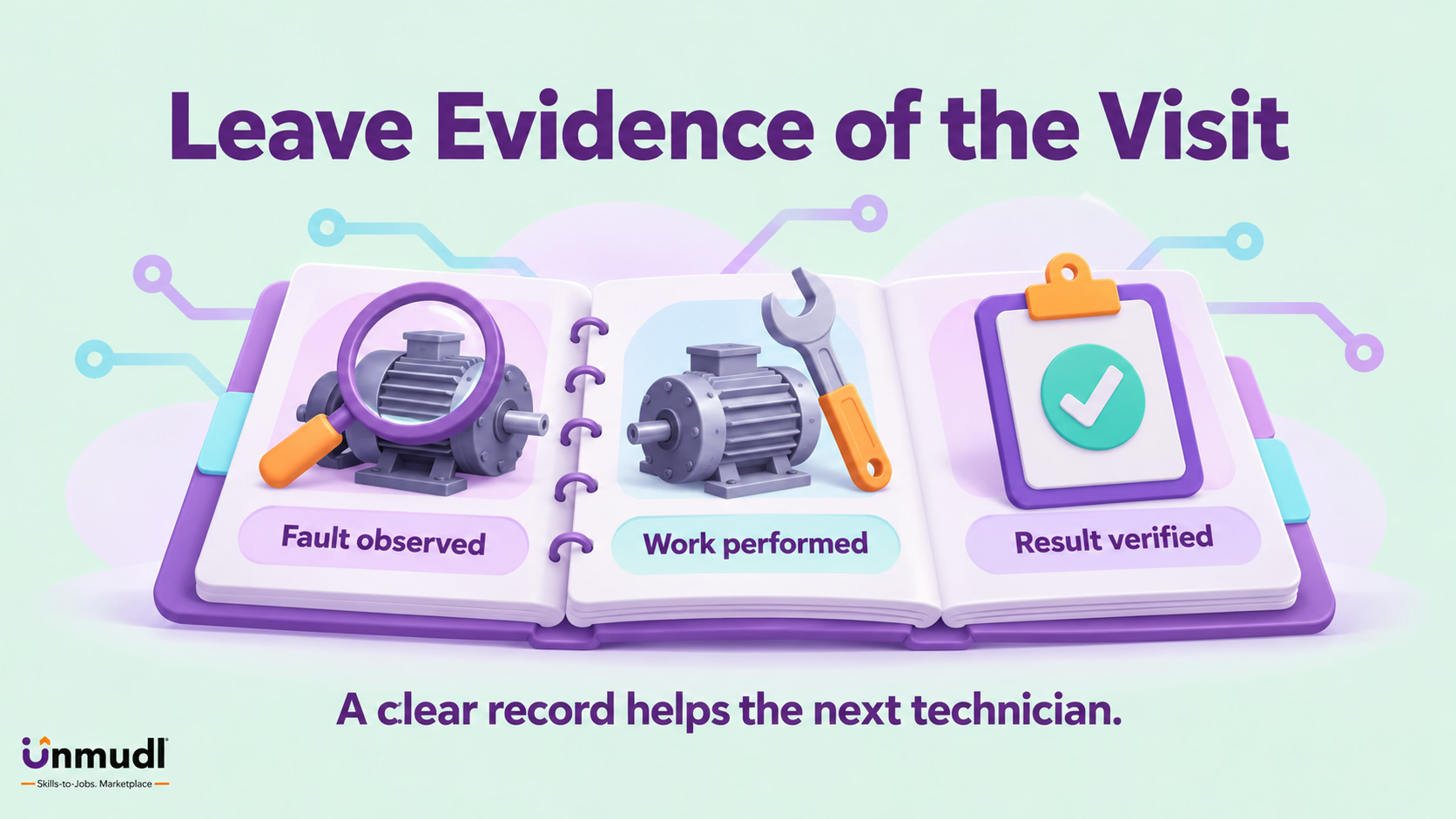
Diagnosing the fault is the evidence duty that gathers symptoms and measurements to separate the likely causes. An electrical test compared with the expected specification separates those causes by confirming or ruling out a suspected component. The suspected component is written down separately from what was observed. The observation record survives the visit even when the repair does not, which lets the next technician start from evidence.
3. Install and Commission Equipment
Installing and commissioning is the setup duty that puts approved equipment into its intended service condition. Installing a medical device under the approved service scope is a clear instance of that duty. The instance requires a recorded configuration and an agreed acceptance result, because the technician executes the installation while the engineer designs it.
4. Perform Preventive Maintenance
Performing preventive maintenance is the scheduled duty that completes inspection and service before a failure is reported. Cleaning or checking the components named in the equipment schedule is the typical scheduled task. The task follows the actual manufacturer interval for that model. No universal interval exists across machines.
5. Repair or Replace Components
Repairing or replacing a component is the corrective duty that fixes a verified defect within the worker's authorization. Swapping a defective part found during diagnosis is the standard case within that authorization. The case ends with a part compatibility check and an escalation of any work beyond competence. An incompatible part turns one fault into two.
6. Record Work, Time and Parts
Recording work, time and parts is the documentation duty that leaves a traceable account of the visit and of the equipment condition. Documenting a replaced assembly together with an unresolved symptom is the model entry in that account. The entry distinguishes installed, consumed, returned and still-needed parts, so the stock count and the invoice both match the visit.
Carrying all ten duties through one visit separates a field technician who fixes a fault from one who merely replaces a part. The fault is fixed wherever the equipment stands.
Where Does a Field Service Technician work?
A field service technician works wherever the supported equipment is installed, which means customer homes and businesses, factories, healthcare sites, outdoor equipment locations and other approved worksites. The approved worksite belongs to the equipment owner, while the employer is a manufacturer, a dealer, a service contractor or the owner itself. Field service workers mix site visits with preparation, remote support and record keeping across one of two arrangements: local route work or overnight territory travel. Local route work in broadband, at an employer such as Spectrum, runs on assigned shifts that include evenings and weekends, with direct travel from home after initial training. Overnight territory travel belongs to the traveling field technician who services heavy equipment, and employers reserve it for experienced staff. No universal travel percentage exists for this title, so a job seeker asks separately about territory, overnight frequency, call rotation, paid travel and vehicle provision. The answers vary by employer, while the route into the title follows one sequence of training, credentials and experience.