EV Technician: Definition, Types, Duties, Training, Certification And Salary

An EV technician refers to a trained automotive service worker who keeps an electric vehicle on the road. An EV technician looks after the electrical propulsion system of the vehicle and its ordinary mechanical parts. An EV technician is also called an EV mechanic, an electric car mechanic, or an electric vehicle technician. The three names describe one service role, and none of the three grants permission to open a high-voltage battery. The permission to open a traction battery comes from training, employer authorization, and the manufacturer's service procedure. The service role therefore sits inside the wider automotive repair occupation rather than beside it.

Electrified vehicle service is the branch of automotive work that joins mechanical repair with electrical measurement and computer-based diagnosis. The benefit of that combination is the ability to tell a mechanical fault from a control, charging, or propulsion fault before any part is replaced. A battery-electric car needs less routine upkeep than a combustion car, yet its brakes, tires, steering, suspension, cooling, and software still need keeping in order. The worker who performs that upkeep is divided into six types, carries six core duties, and reaches the role through training, credentials, and certification. The pay of the role follows the broader automotive occupation, and the definition of the worker opens the pathway into it.

What is EV Technician?

An EV technician is an automotive service specialist who holds the training and task authorization to work on the high-voltage propulsion system of an electric vehicle. An EV mechanic is the same specialist under a workshop name. The occupational parent of the specialist is automotive service, not automotive engineering, battery research, or charging-station electrical installation.

The EV specialization is a narrowing of the automotive occupation to electrified vehicle technologies. The narrowing covers testing, troubleshooting, maintenance, and service records, according to the career page of the New York State Energy Research and Development Authority (NYSERDA). The specialization is a competence rather than a credential, and a certified worker still needs employer authorization for each high-voltage task. Each authorized task is one unit of the work the specialist does.

What Does EV Technician Do?

An EV technician works by turning a reported vehicle problem into an inspection, a supported diagnosis, an authorized repair, and a documented verification. The sequence starts with the customer's complaint and the identification of the affected system. The affected system then receives diagnostic evidence from service information, diagnostic software, and electrical measurement. The evidence points to a cause, and the cause sits in low-voltage power, a cooling circuit, or a connector as readily as in the traction battery or the motor.

An EV service technician is the job title that employers attach to this workflow, and the title includes non-wrench work. The non-wrench work is the service record, so an electric vehicle mechanic documents and communicates the result as part of the job. The same job carries six labels in employer postings.

What Are the Types Of EV Technicians?

There are six types of EV technicians based on the object and the setting of the work. The types are the EV car technician, the EV battery technician, the EV charger technician, the dealership EV technician, the fleet EV technician, and the mobile EV technician. The table below sets the six types against object, setting, and employer boundary.

Type

Object Serviced

Work Setting

Employer Boundary

EV car technician

The whole electric vehicle, mechanical and electrified systems

Workshop bay

EV label read as a scope, not a permit

EV battery technician

Traction-battery condition, faults, and authorized pack removal

Workshop with pack-handling fixtures

No cell-level rebuilding in every shop

EV charger technician

Stationary charging equipment that supplies the vehicle

Charging station site

Electrical license for installation tasks

Dealership EV technician

One manufacturer's electric vehicles

Dealership or brand-owned service center

Staff recruited and trained in-house

Fleet EV technician

One organization's vehicles, from vans to transit buses

Fleet or transit depot

Vehicle-class training paired with the role

Mobile EV technician

Inspection, low-voltage faults, and light mechanical service

Service van at the customer's location

Heavier jobs routed back to a service center

Common misreading

The type label as a high-voltage permit

Any of the six settings

Permission comes from training, authorization, and procedure

1. EV Car Technician

An EV car technician is a vehicle-side worker who services the whole electric vehicle, from its conventional mechanical systems to its electrified systems. The purpose of the vehicle-side role is to restore vehicle function rather than to swap one electrical component. Employers read the EV label as a scope, not as a permit for every high-voltage operation.

2. EV Battery Technician

An EV battery technician is a battery-service specialist who focuses on traction-battery condition, battery faults, and authorized pack removal or replacement. The specialist's advantage is focused handling competence on the heaviest and most hazardous component in the car. Employers do not treat the title as permission for cell-level rebuilding in every shop.

3. EV Charger Technician

An EV charger technician is an infrastructure worker who installs, commissions, maintains, or troubleshoots the stationary charging equipment that supplies the vehicle. The charger role is also written as EV charger repair technician, and both names point at the station rather than at the car. Employers require the electrical license that the installation task demands.

4. Dealership EV Technician

A dealership EV technician is a brand-bound worker who services one manufacturer's electric vehicles inside a dealership or brand-owned service center. The brand boundary gives the worker the manufacturer's diagnosis path, equipment, and training, so the workflow runs deeper on one platform and narrower across platforms. Employers of this type recruit and train their own service-center staff.

5. Fleet EV Technician

A fleet EV technician is a depot-based worker who maintains the electric vehicles that one organization operates, from delivery vans to zero-emission transit buses. The depot setting replaces the retail customer with a vehicle schedule, and bus work adds equipment-specific preparation that light-duty training does not supply. Employers in transit therefore pair the role with vehicle-class training.

6. Mobile EV Technician

A mobile EV technician is a field worker who performs service at the customer's location from a service van rather than in a workshop bay. The mobile setting suits inspection, low-voltage faults, and light mechanical service, while intrusive battery repairs stay in a workshop with lifting equipment. Employers that run mobile fleets route the heavier jobs back to a service center.

Reading the six types by object and by setting lets a learner pick a role by asset and by place. Every role runs the same six duties on each vehicle.
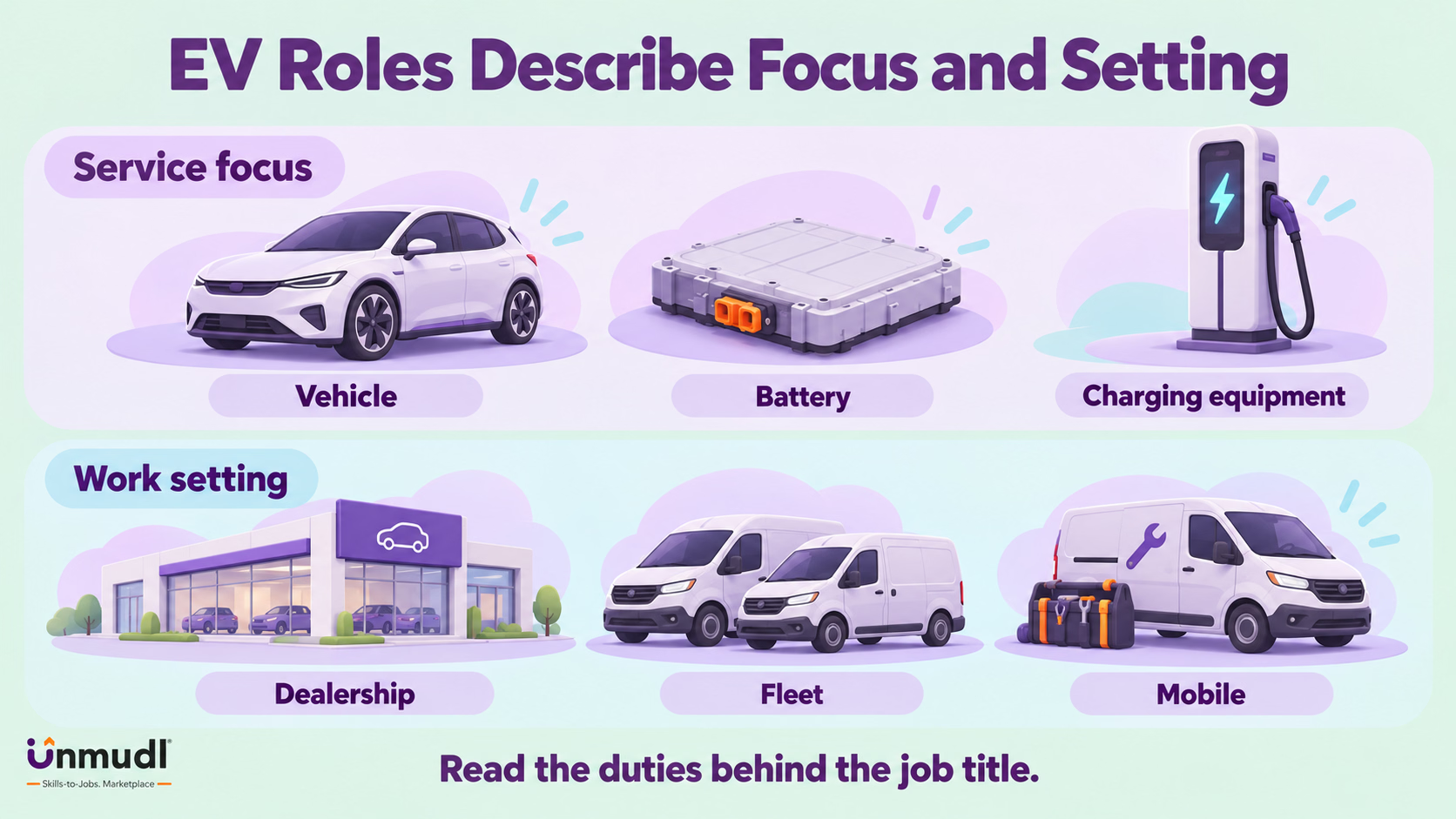
EV role labels describe service focus, including vehicles, batteries and charging equipment, or work setting, including dealerships, fleets and mobile service.

What Are the Duties Of EV Technician?

There are six duties of an EV technician, in the order of a single service job. The duties are recording the concern, preparing the work safely, diagnosing electrical faults, servicing the battery and propulsion, maintaining the conventional systems, and verifying and documenting the work. The sequence answers how to work on electric cars, since working on electric cars is the same six duties repeated on every vehicle.

1. Recording the Concern

Recording the concern is the intake step that turns a customer's symptom into a defined problem. The work order is reviewed, the symptom is confirmed, and the relevant components are inspected before any part is ordered. Supervisors treat a job without a confirmed symptom as a job that has not started.

2. Preparing the Work Safely

Preparing the work safely is the hazard step that identifies the electrical and mechanical dangers of the vehicle before a tool touches it. Work-area controls, protective equipment, and isolation are applied to the high-voltage system, because a switched-off vehicle is not, by itself, safe to touch. Supervisors assign high-voltage preparation only to trained and authorized personnel.

3. Diagnosing Electrical Faults

Diagnosing electrical faults is the evidence step that separates wiring, control, sensor, communication, and component faults from one another. Wiring diagrams, scan tools, and correctly specified measurements supply the evidence that supports the repair decision instead of a guess. Supervisors expect the diagnosis to name the faulty circuit, not only the faulty symptom.

4. Servicing the Battery and Propulsion

Servicing the battery and propulsion is the electrified step that covers the traction battery, the drive unit, and the power electronics. The battery is assessed from its reported condition and fault data, and charging and thermal faults are separated from any station-side problem. Supervisors escalate a pack that shows an abnormal condition rather than opening it in the bay.

5. Maintaining the Conventional Systems

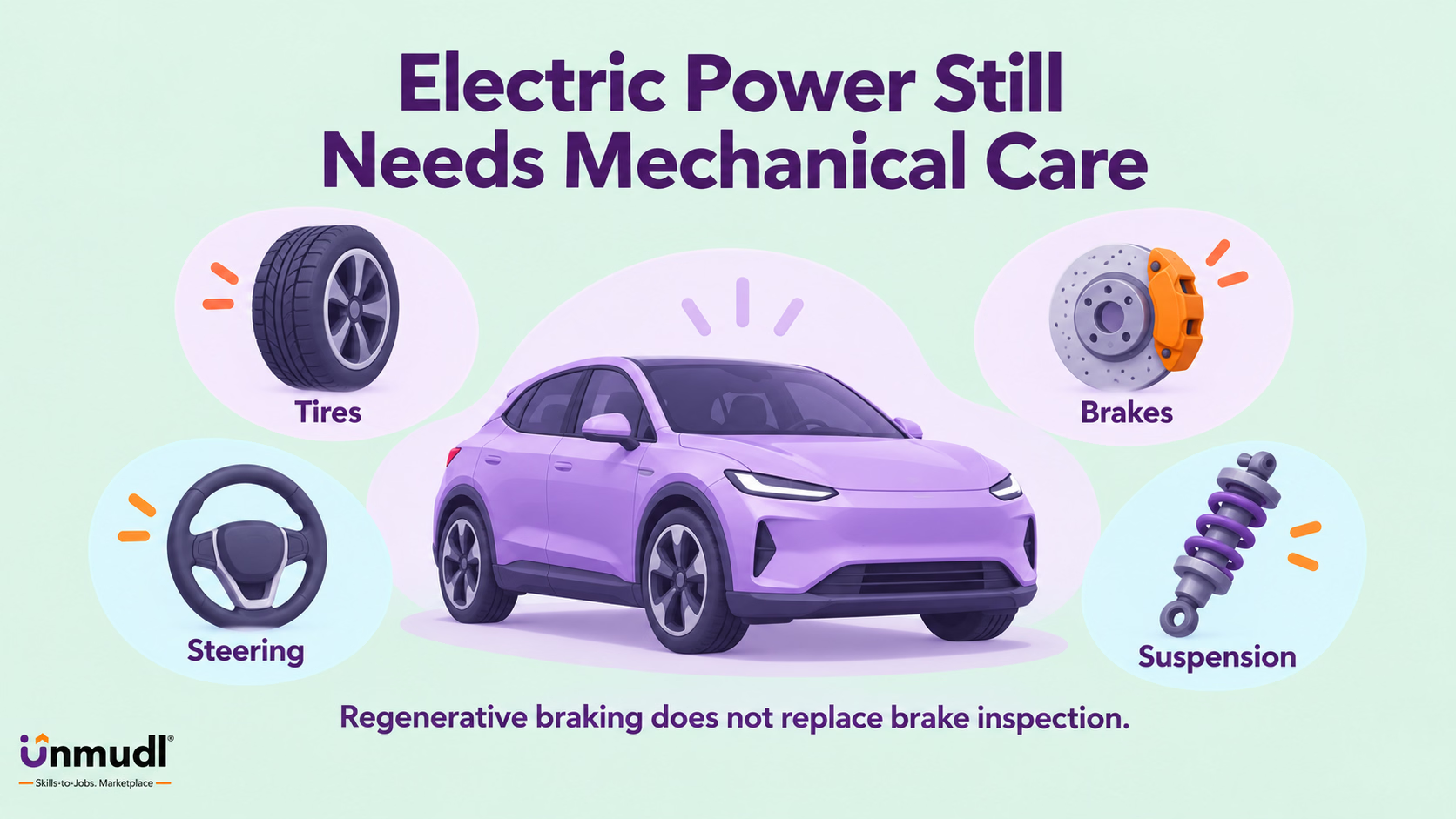
Maintaining the conventional systems is the mechanical step that keeps tires, brakes, steering, and suspension in service. Regenerative braking does not remove friction-brake inspection, and a battery-electric vehicle needs less maintenance, not no maintenance. Supervisors schedule the mechanical checks on the same visit as the electrical work.

6. Verifying and Documenting the Work

Verifying and documenting the work is the closing step that confirms the repair and records it. The permitted road test proves that the first complaint is gone rather than that a warning message has disappeared, and the findings are recorded for the customer. Supervisors read the record as the proof that diagnosis, authorized work, and handover connect.

Running the six duties in order keeps the service evidence-led and keeps the safety boundary explicit on every vehicle. The vehicle itself arrives at one of four workplaces.
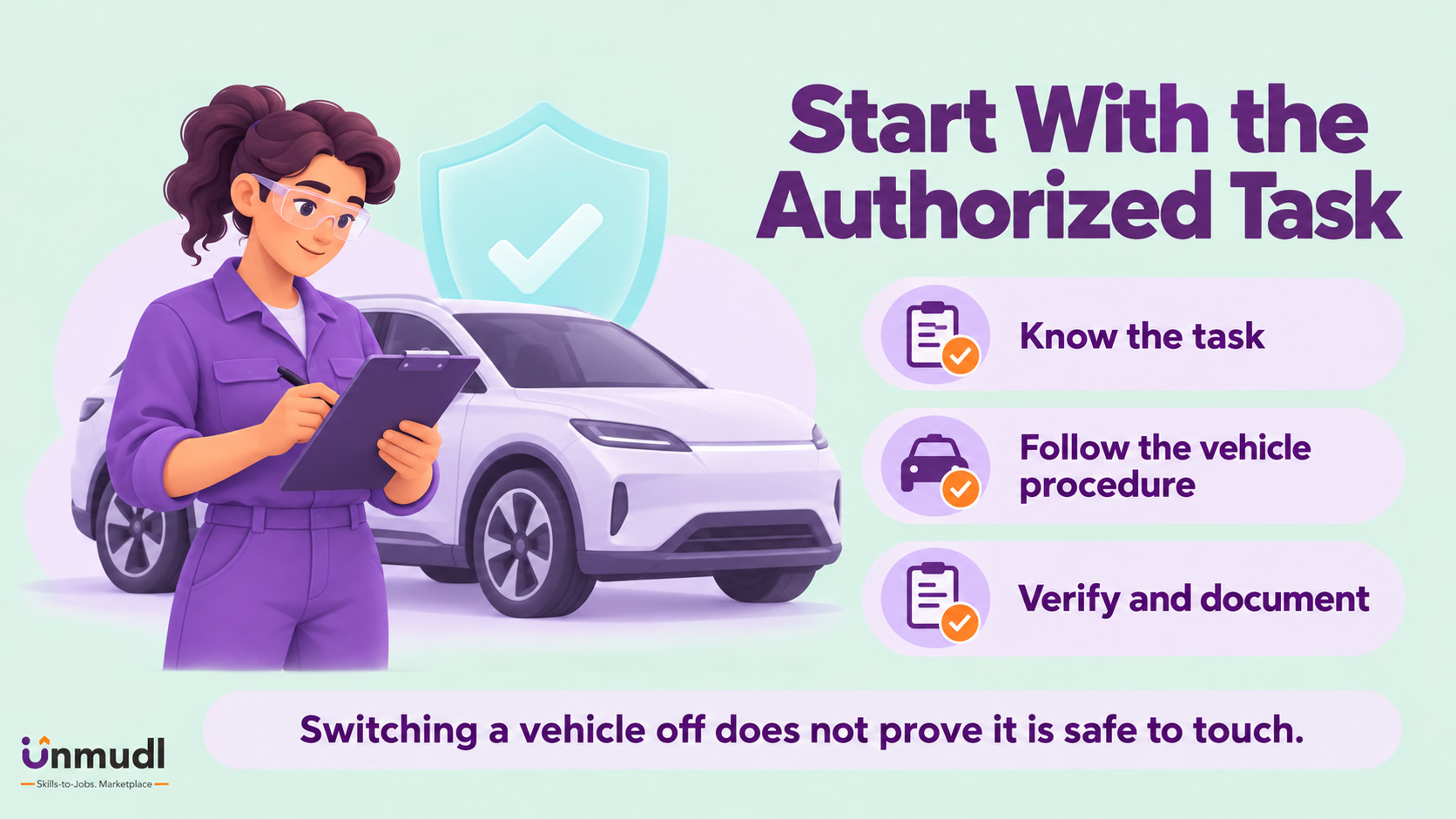
EV work begins with an authorized task and vehicle-specific procedures, followed by verification and documentation.

Where Does EV Technician Work?

An EV technician works in four employer settings, which are the dealership or manufacturer service center, the independent repair shop, the fleet or transit depot, and the mobile service van. The independent shop supplies servicing wherever it holds suitable equipment and task authorization, and the other three settings house the dealership, fleet, and mobile types.

The working conditions of the four settings include physical handling, awkward positions, and safety procedures. The chosen setting therefore decides the brand depth, the vehicle class, and the share of high-voltage work in the job. Reaching that job follows a set sequence of steps.
How To Become EV Technician?

Becoming an EV technician requires six steps. The steps are identifying the target job, establishing the automotive foundation, adding EV safety and systems learning, obtaining supervised work experience, earning the applicable credentials, and continuing vehicle-specific learning. The Bureau of Labor Statistics (BLS) sets the typical entry education for the wider automotive service occupation at a postsecondary nondegree award. The question of how to become an EV technician is therefore answered by a sequence rather than by a single school. The steps are listed below.

  1. Identify the target job before selecting a program. Passenger-vehicle service, fleet maintenance, and charging-station installation ask for different prior experience and tasks.
  2. Establish the automotive foundation through an automotive certificate or diploma. The foundation covers electrical fundamentals, service information, mechanical inspection, and diagnostic reasoning.
  3. Add EV safety and systems learning through a program that covers hazards, the traction battery, propulsion, charging, and thermal management. Supervised competence comes from a separate hands-on phase rather than from a short awareness course.
  4. Obtain supervised work experience in a shop that assesses hands-on tasks. Recording duties, dates, and training completions matters, since professional certification asks for experience evidence at registration.
  5. Earn the applicable credentials and permissions in the order the issuer sets. A safety assessment comes first. An advanced diagnostic certification comes after prerequisite tests, and a task-specific legal credential sits apart from both.
  6. Continue vehicle-specific learning within the employer's task-authorization process, so that credential currency and new-model procedures stay up to date.

The six steps draw on five building blocks, which are training, credentials, certification, work experience, and continuing learning. Training consists of the automotive foundation, the online training, and the hands-on high-voltage training. Credentials cover the educational credential, the refrigerant credential, and the state credential. Certification comprises the National Institute for Automotive Service Excellence (ASE) xEV safety certification and the ASE L3 certification. Work experience includes supervised experience and employer task authorization. Continuing learning spans manufacturer training and the recertification cycle.

1. What is the Training For EV Technician?

EV technician training is instruction that joins an automotive foundation to electrified-vehicle safety, systems, diagnosis, and supervised practical work. Training benefits the learner when its entry level, equipment, and assessment match the intended job rather than only carrying EV in the course title. The foundation stage comes first, the theory stage second, and the practice stage last.

1.1 What is the Automotive Foundation For EV Technician?

The automotive foundation is the certificate or diploma stage that builds the electrical, mechanical, and diagnostic skills a shop expects on day one. Riverland Community College's Electric Vehicle and Hybrid Technician certificate shows where the foundation sits in the sequence. The nine-credit, one-semester program admits current automotive diploma students or working technicians with instructor permission, so the specialist certificate sits on top of the foundation. The theory stage of that certificate runs online.

1.2 What is the Online Training For EV Technician?

Electric vehicle technician online training is the theory stage delivered through the internet before any practical phase. Weber State University's Phase I High-Voltage Safety Training runs approximately seven hours of online content with six months of access. Its Phase II Hybrid and Electric Vehicle Systems runs approximately 21 hours online with Phase I as the prerequisite. Online theory forms part of the route, and no reviewed program offers an online-only route to unrestricted high-voltage work.

1.3 What is the Hands-On High-Voltage Training For EV Technician?

Hands-on high-voltage training is the campus or workshop stage where an instructor assesses the learner's isolation, measurement, and handling tasks on real vehicles. Weber State's Phase III delivers that stage as one full week on campus. The week closes with a training certificate. A training certificate documents program completion, and program completion is a different object from an issuer's assessment. The objects an employer asks to see at hiring are credentials.

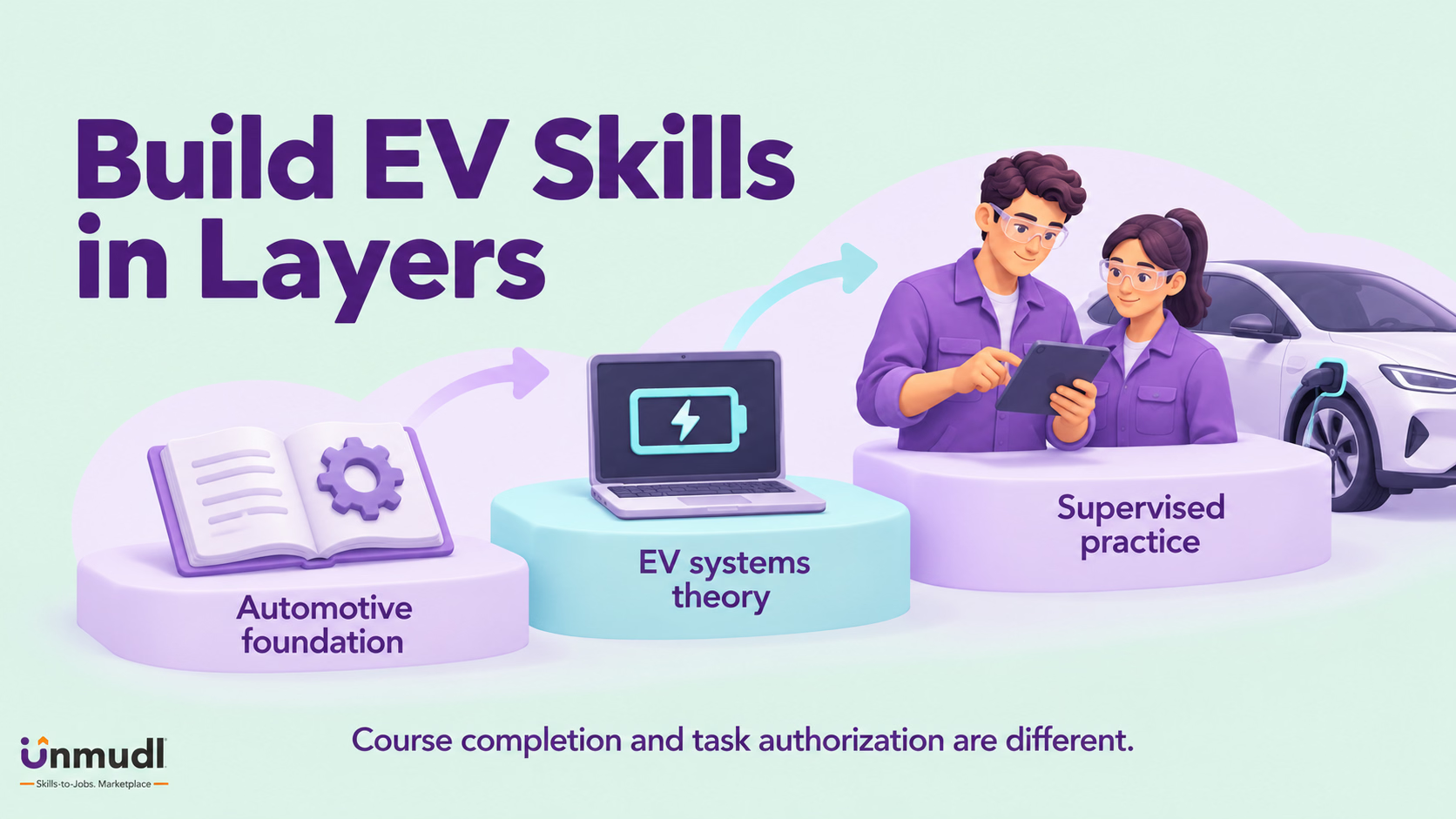
EV skills build on an automotive foundation, EV systems theory, and supervised practice; course completion differs from task authorization.

2. What Are the Credentials Required For EV Technician?

The credentials required for an EV technician are an educational credential, a refrigerant credential where air-conditioning service is performed, and a state credential where the state regulates compensated repair. The requirement is set by the employer, the repair task, and the jurisdiction together, so no single credential covers every U.S. job. The three credentials are briefly discussed below.

2.1 What is the Educational Credential For EV Technician?

The educational credential is the school award an employer reads as proof of entry competence, such as an automotive certificate, a diploma, or an associate degree. The award proves classroom and laboratory completion, and it authorizes no high-voltage task by itself. One task that the award never covers is refrigerant handling.

2.2 What is the Refrigerant Credential For EV Technician?

The refrigerant credential is the Section 609 technician certification that the U.S. Environmental Protection Agency (EPA) requires for compensated motor-vehicle air-conditioning service. The credential is task-specific, since it covers refrigerant handling in the vehicle's climate and thermal systems and nothing else. Section 609 differs from Section 608, which covers stationary air-conditioning equipment and grants no motor-vehicle permission. A federal credential sits beside any credential the state adds.

2.3 What is the State Credential For EV Technician?

The state credential is a government-issued mechanic certification that a state requires before a technician performs covered repairs for pay. Michigan is the concrete example. Its Department of State requires state certification for covered compensated repairs and admits new entrants through a supervised trainee route. An ASE credential does not substitute for the Michigan certificate.

3. What is the Certification For EV Technician?

EV technician certification is an assessment-based credential issued by ASE at two levels, safety and advanced diagnosis. The safety level is the xEV Electrical Safety certification. The advanced level is the L3 Light Duty Hybrid/Electric Vehicle Specialist certification. A training provider's certificate is not interchangeable with either ASE credential, since the provider documents attendance while ASE documents a passed assessment.

3.1 What is the ASE xEV Safety Certification For EV Technician?

The ASE xEV safety certification is a two-level electrical safety credential for personnel who encounter electrified vehicles. Level 1, Electrical Safety Awareness, covers people whose work involves no high-voltage system. Level 2, Technician Electrical Safety, covers trained technicians who work on de-energized high-voltage systems and assess the related hazards. ASE assumes prior high-voltage training for Level 2, so the exam measures safety knowledge and creates no repair authorization. Repair diagnosis is measured by the advanced level instead.

3.2 What is the ASE L3 Certification For EV Technician?

The ASE L3 certification is the advanced diagnostic credential for hybrid and electric light-duty vehicle systems. Registration for L3 requires passed A6 and A8 automobile tests. Certification requires the relevant work experience as well. ASE's work-experience table places L3 in the three-year repair-technician category, with formal education substituting for part of the three years under the issuer's rules. Passing the test before experience approval leaves the candidate uncertified.

4. What is the Work Experience Required For EV Technician?

Work experience is supervised, documented time on vehicle service tasks that an employer or issuer accepts as evidence of competence. Experience serves two purposes, which are supervised skill building and employer task authorization.

4.1 What is the Supervised Experience For EV Technician?

Supervised experience is repair work performed under a qualified technician who signs off each task before the learner performs it alone. Texas State Technical College's Tesla START program shows the employer-supported form of that experience. Its 16-week structure prepares entrants for a brand's service centers, and its admission conditions include prior postsecondary automotive education or equivalent military experience. The sign-off on each task is the seed of employer task authorization.

4.2 What is the Employer Task Authorization For EV Technician?

Employer task authorization is the permission an employer grants a technician for one hazardous task, such as de-energizing a high-voltage system or removing a traction battery. Authorization is a separate condition from training, credentials, and certification, because a job title and a passed exam create no permission on their own. Supervisors grant the authorization task by task after the competence demonstration. Competence demonstrated once still ages with every new model.

5. What is the Continuing Learning For EV Technician?

Continuing learning is the ongoing instruction that keeps vehicle-specific competence and credential validity current after entry. Continuing learning takes two forms, which are brand instruction and credential renewal.

5.1 What is the Manufacturer Training For EV Technician?

Manufacturer training is brand-specific instruction in the service information, diagnostic software, and procedures of one vehicle maker. Tesla's service manual illustrates the content. Its isolation test procedure separates specialized insulation testing from ordinary voltage measurement, and its Toolbox procedure governs software reinstallation. A manufacturer's procedure applies to that manufacturer's vehicles, so a technician who moves between brands repeats the training for each one. The credential renewal runs on a fixed clock regardless of brand.

5.2 What is the Recertification Cycle For EV Technician?

The recertification cycle is the five-year validity period that ASE sets for both its xEV safety certifications and its L3 certification. A technician renews the credential before the five-year period ends. A lapsed credential returns the worker to the uncertified status an employer reads at hiring. Keeping the five building blocks in sequence lets a learner move from the automotive foundation to authorized high-voltage work without buying a credential the intended job never asks for. The job reached pays on the automotive scale.

How Much Does EV Technician Earn?

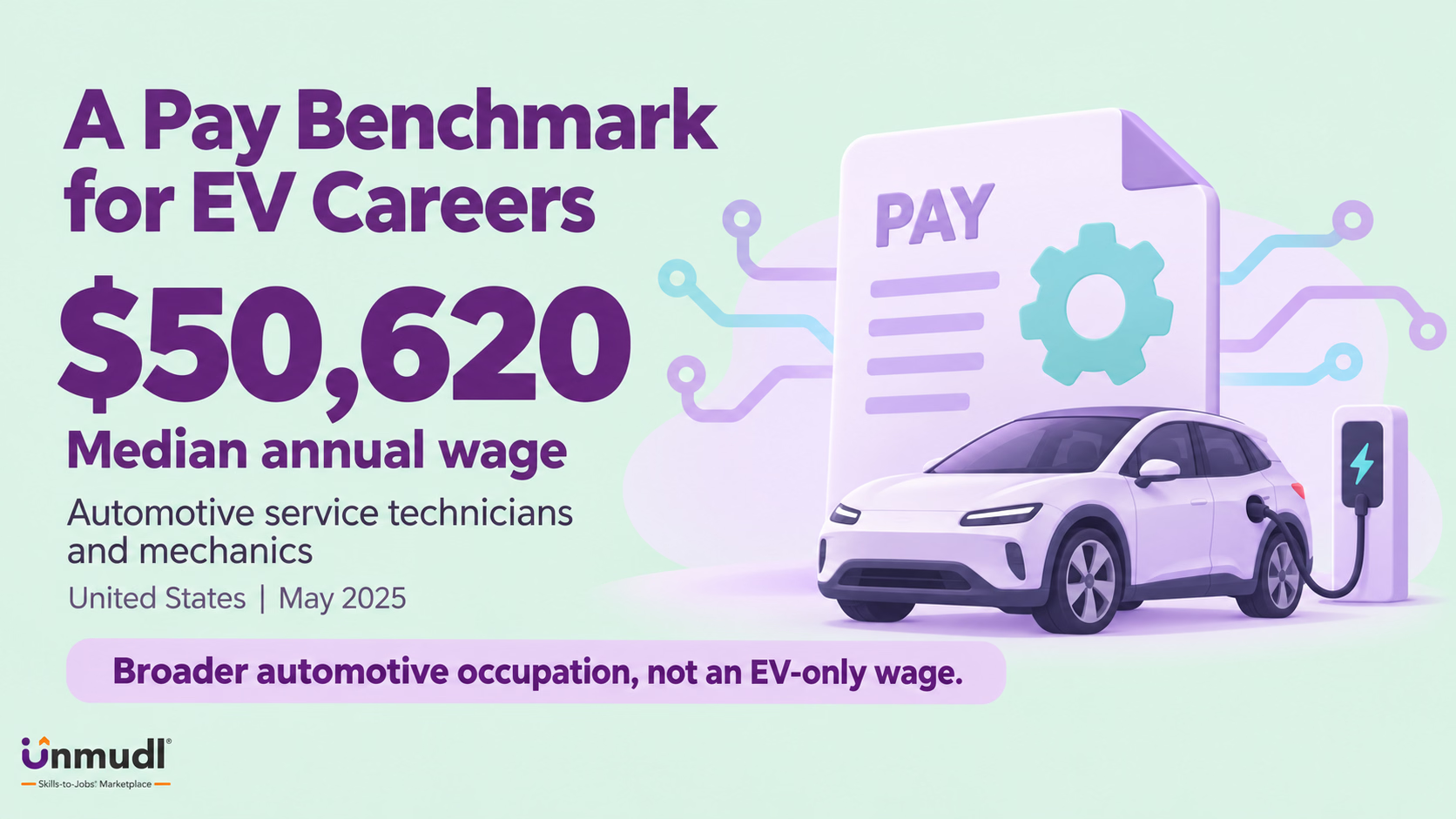
An EV technician earns $27.13 per hour and $56,420 per year at the mean in the May 2025 BLS wage data for the automotive service occupation. The median stands at $24.34 per hour and $50,620 per year. The annual mean divides into $4,701.67 a month and $14,105.00 a quarter as arithmetic equivalents. The annual median works out at $4,218.33 monthly and $12,655.00 quarterly. The average EV technician salary per year is therefore $56,420. An EV mechanic salary carries the same figure, since BLS publishes no separate EV-only wage series and the automotive occupation is the official benchmark. The same benchmark fixes the entry education for the role.

The May 2025 U.S. median annual wage of $50,620 applies to automotive service technicians and mechanics, a broader benchmark rather than an EV-only wage.

Does EV Technician Need Degree?

No, an EV technician does not need a college degree, since the BLS entry benchmark for the automotive service occupation stops at a nondegree award. The nondegree award takes the form of a certificate, employer training, or accepted repair experience. An EV mechanic school or an EV technician school therefore supplies the automotive foundation. School completion does not authorize high-voltage work, because task permission comes from the employer's safety process after the time spent in training.

How Long Does It Take To Become EV Technician?

Becoming an EV technician takes one semester to three semesters, depending on the learner's starting point. A working automotive technician adds the EV specialization in one semester, and a manufacturer-linked program covers it in 16 weeks. A beginner with no automotive background needs three semesters for the automotive foundation and the practical phase. A learner who wants the fastest start as an EV mechanic starts with an online safety introduction of about seven hours. Advanced certification later adds a three-year experience category spent on vehicle systems.

Which Systems Does EV Technician Maintain?

An EV technician maintains eight systems, divided by the function each system performs inside or beside the vehicle. The seven vehicle-side systems are the traction battery and battery management system, the electric motor and drive unit, the inverter and DC-DC power electronics, the onboard charger and charge inlet, the cooling, heating, and refrigerant systems, the low-voltage electronics and vehicle software, and the brakes, tires, steering, and suspension. The eighth system is the external charging station hardware, which belongs to the adjacent charging role. Each system is described below.

Traction Battery And Battery Management System

The traction battery is the energy storage pack that powers the electric drive. The battery management system monitors and protects the pack, so a battery fault reaches the technician as a condition report rather than a visible failure. An EV battery tech assesses the reported condition and determines the manufacturer-authorized next action. The authorized action feeds torque demand to the motor and drive unit.

Electric Motor And Drive Unit

The electric motor and drive unit is the propulsion assembly that transfers torque to the wheels. A technician diagnoses the drive-system components and replaces or repairs the authorized parts. Drive-unit work excludes the engine procedures that a hybrid still needs. The propulsion assembly draws its current through the inverter and DC-DC power electronics.

Inverter And DC-DC Power Electronics

The inverter and DC-DC converter are the power electronics that manage electrical power for propulsion and the low-voltage systems. The inverter converts battery current for the motor, and the DC-DC converter steps high voltage down for the low-voltage circuits. Power that enters these electronics first passes through the onboard charger and charge inlet.

Onboard Charger And Charge Inlet

The onboard charger and charge inlet form the vehicle-side path for receiving energy and coordinating a charging session. The onboard charger converts AC supply for battery charging, and the inlet carries the connector, interlocks, and related controls. A charging fault that stems from heat belongs to the cooling, heating, and refrigerant systems.

Cooling, Heating, And Refrigerant Systems

The cooling, heating, and refrigerant systems are the thermal control circuits that regulate the battery, the power electronics, and the cabin. Thermal control keeps the pack and the drive electronics inside their operating temperature during charging and driving. Thermal sensors report through the low-voltage electronics, vehicle networks, and software.

Low-Voltage Electronics, Vehicle Networks, And Software

The low-voltage electronics, vehicle networks, and software are the control, sensing, communication, and diagnostic functions of the vehicle. Low-voltage faults affect vehicle operation even when the traction battery is fully charged. A technician reads diagnostic data and isolates wiring, sensor, and communication faults before any propulsion part is blamed. The same diagnostic data also covers the brakes, tires, steering, and suspension.

Brakes, Tires, Steering, And Suspension

The brakes, tires, steering, and suspension are the conventional road-going systems that electric propulsion does not remove. A technician services tires, brakes, steering, and suspension on the same inspection schedule as any light-duty vehicle. The vehicle boundary ends at the charge port, where the external charging station hardware begins.

Electric vehicles still need care for tires, brakes, steering, and suspension. Regenerative braking does not replace brake inspection.

External Charging Station Hardware And Network

The external charging station hardware and network are the station-side supply, communication, and serviceability functions of electric vehicle supply equipment (EVSE). A vehicle that fails to charge is split between the car-side investigation and the station-side investigation. Reading the eight systems by function lets a learner see which equipment and tools each system demands.

Which Equipment And Tools Does EV Technician Work With?

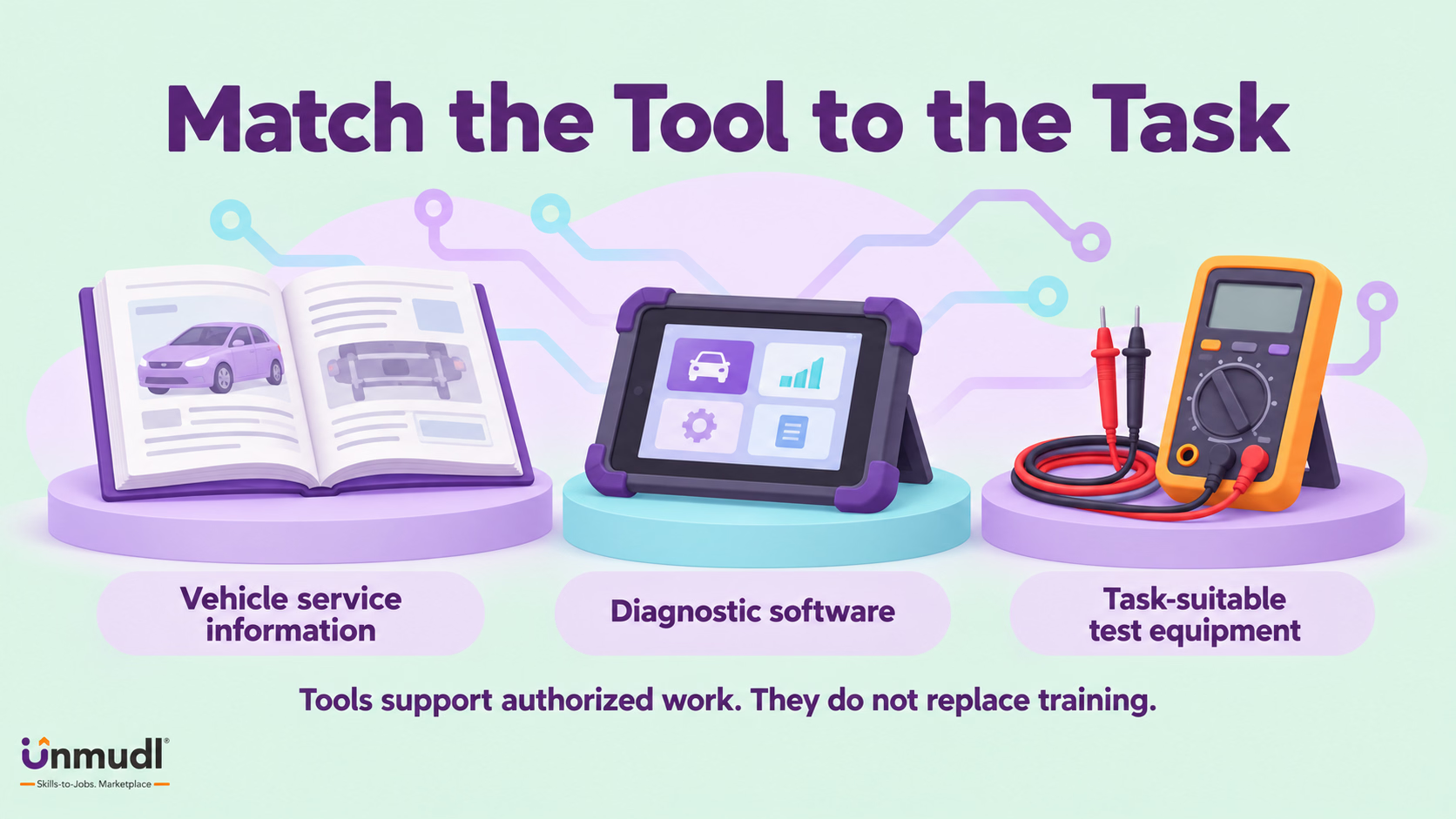
An EV technician works with four classes of equipment and six classes of tools, mapped to the vehicle-side, battery, and charger labels of the role. The equipment classes are vehicle lifting equipment, EV battery lift and support fixtures, coolant and refrigerant service equipment, and high-voltage work-area controls and protective equipment. The tool classes are diagnostic scan tools and original equipment manufacturer (OEM) software, wiring diagrams and service information, hand and torque tools, rated meters and insulation testers, insulated tools and test leads, and the EVSE analyzer and vendor diagnostics. Possessing an item does not authorize its use. Each class is described below.

Vehicle Lifting Equipment

Vehicle lifting equipment is the hoist assembly that raises the whole vehicle for underbody access. A lift rated for the vehicle's weight is the entry condition for every underbody task. Lifting the whole vehicle precedes the separate handling of the pack by the EV battery lift and support fixtures.

EV Battery Lift And Support Fixtures

EV battery lift and support fixtures are the rated lift tables and manufacturer-specified handling adapters that hold a traction pack during authorized removal or replacement. The fixture secures the pack after isolation and before transport. A pack that leaves the vehicle also exposes the coolant lines served by the coolant and refrigerant service equipment.

Coolant And Refrigerant Service Equipment

Coolant and refrigerant service equipment is the recovery, evacuation, and refill apparatus suited to the vehicle's thermal circuits. The vehicle-side worker connects the equipment to battery cooling loops and cabin climate circuits. Opening any thermal circuit near the pack falls under the high-voltage work-area controls and protective equipment.

High-Voltage Work-Area Controls And Protective Equipment

High-voltage work-area controls and protective equipment are the warning barriers, isolation arrangements, and personal protective gear that secure an energized vehicle before work starts. The employer's isolation and protection-against-reactivation arrangement is the control that makes a de-energized state verifiable. Once the work area is controlled, the technician reaches for the diagnostic scan tools and OEM software.

Diagnostic Scan Tools And OEM Software

Diagnostic scan tools and OEM software are the computer-based instruments that read fault data and run manufacturer procedures. OEM software also supports prescribed software reinstallation and configuration operations. Every fault code the scan tool returns is interpreted against the wiring diagrams and service information.

Wiring Diagrams And Service Information

Wiring diagrams and service information are the documents that define circuits, components, and authorized procedures for a given model. Service information states the isolation steps, torque values, and test methods that the task requires. The torque values in the service information are applied with the hand and torque tools.

Hand And Torque Tools

Hand and torque tools are the mechanical instruments that fasten, loosen, and set components to specification. Mechanical tools carry over from combustion service without modification. Electrical verification of the same connection needs the rated meters and insulation testers.

Rated Meters And Insulation Testers

Rated meters and insulation testers are the measuring instruments whose rating and test method match the electrical task. A correctly specified multimeter reads voltage and continuity, and an insulation tester checks the isolation of a high-voltage circuit from the chassis. Specialized insulation testing differs from ordinary voltage measurement, because the tester generates its own test voltage. Each measurement is taken through the insulated tools and test leads.

Insulated Tools And Test Leads

Insulated tools and test leads are the inspected hand tools and probes rated for contact with high-voltage circuits. An inspected lead is the only lead that touches a high-voltage circuit. The station-side counterpart of these leads is the EVSE analyzer and vendor diagnostics.

EVSE Analyzer And Vendor Diagnostics

The EVSE analyzer and vendor diagnostics are the station-testing instruments and product-specific software used by the charger technician. The analyzer checks protective earth, GFCI (ground-fault circuit interrupter) protection, and the control-pilot signal of an AC station. Vendor diagnostics and commissioning tools examine the station's network functions. Matching each equipment and tool class to its role label helps a learner judge which training leads to which EV technician jobs.

Vehicle service information, diagnostic software, and task-suitable test equipment support authorized EV work and do not replace training.

How To Apply For EV Technician Jobs?

EV technician jobs on Unmudl are applied for through six steps that run from the job board to the application form. The steps are listed below.

  1. Open the job board. Click Get Jobs on the Unmudl homepage, which opens the Find Jobs That Match Your Skills page at unmudl.com/search-jobs.
  2. Search the vehicle-service role. Type EV technician, electric vehicle technician, or EV service technician into Search by job title or company, then set Search by location and Select location radius.
  3. Filter the results. Narrow the list with the employment and job-type, employer and compensation, skills, benefits, courses, shift, and location filters.
  4. Review the posting. Read the employer, location, requirements, and application destination, and confirm that the duties describe vehicle repair rather than manufacturing or charger installation.
  5. Sign in or sign up. Enter Email and Password at unmudl.com/signin and click Continue, use Send Magic Link, or create an account at unmudl.com/signup.
  6. Apply Now. Click Apply Now on the posting and attach a resume from the Unmudl resume builder. The builder starts without an account, takes experience, skills, and education, and saves a PDF after account creation.

Following the six steps in order lets a job seeker reach electric vehicle technician jobs with a tailored resume already attached. The resume is strengthened by a completed course that matches the posting's requirements.

What is the Best EV Technician Course?

The best EV technician course is the course whose entry prerequisites, assessed tasks, and training equipment match the vehicle-service job the learner intends to take. Electrical and Electronic Systems for Technicians on Unmudl supplies the electrical and electronic fundamentals that EV mechanic training builds on. The course prepares the circuit reading, measurement, and diagnostic reasoning that an electric vehicle technician course assumes on entry. A learner checks the catalog's Course Type, Subjects, Colleges, Credentials, and Course Duration filters at unmudl.com/search-courses to confirm the fit. Completing a course that matches the job is what turns training into a career.

Is EV Technician Good Career?

Yes, EV technician is a good career, since the role pairs a transferable automotive foundation with an electrification specialty that the labor market keeps adding openings for. BLS projects employment growth of 5% from 2025 to 2035 and counts about 66,200 openings each year. The tradeoffs are physical work, continuing learning, safety discipline, and the employer's pay system. Electric vehicle technician careers are therefore judged by weighing local openings and training access against the national projection for the broader occupation that the EV role grows out of.

What is the Difference Between EV Technician And Automotive Technician?

The difference between an EV technician and an automotive technician is specialization and authorized scope, not technician versus mechanic. An automotive technician is the wider occupation that maintains, diagnoses, and repairs cars and light trucks across every powertrain. An EV technician is the automotive technician who adds electrified-propulsion competence and high-voltage task authorization. The goal of both roles is to restore vehicle operation, and the EV role adds correct handling of EV-specific hazards.

The tools of the two roles overlap in mechanical and diagnostic instruments. The automotive technician adds powertrain-specific instruments for combustion systems, while the EV technician adds rated high-voltage meters, protective equipment, and OEM software for authorized tasks. For example, the automotive technician investigates an engine misfire in a combustion vehicle, whereas the EV technician investigates a vehicle-side charging fault through the prescribed EV diagnostic path. The automotive technician owns the whole light-duty fleet, and the EV technician owns its electrified subset. The electrified subset ends at the vehicle, where the charging station technician begins.

What is the Difference Between EV Technician And EV Charging Station Technician?

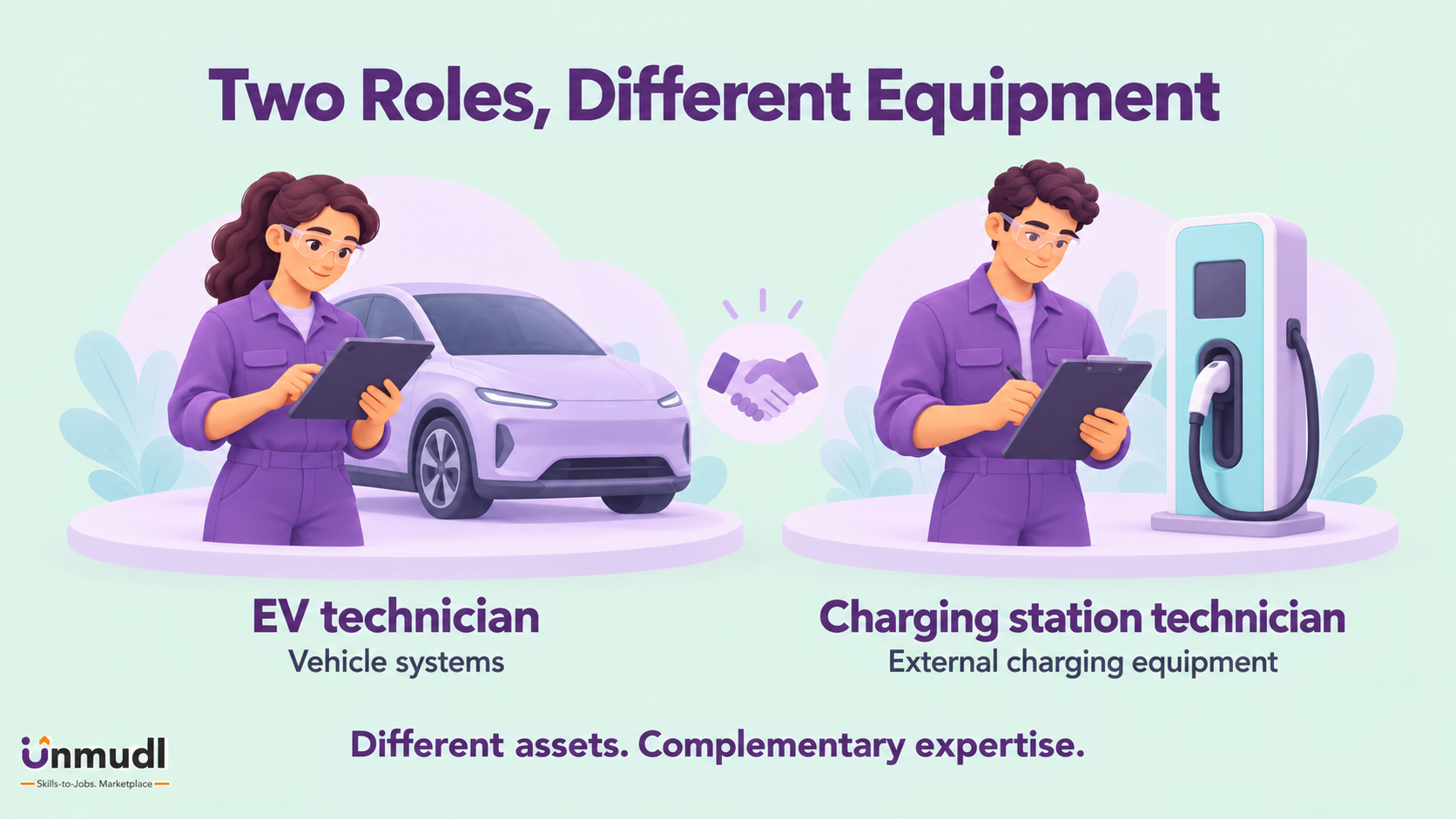
The difference between an EV technician and an EV charging station technician is the asset each one services. The first services the vehicle, and the second services the external charging equipment. An EV charging station technician serves the supply equipment at the station and no system inside the car. The goal of the charging role is to restore a station's ability to supply a charging session, and the goal of the vehicle role is to restore road-going operation. EV charging station technician training is electrician-focused, and EV charger technician training from an equipment vendor is product-specific.

The tools of the two roles diverge at the connector. The vehicle technician uses vehicle diagnostic software and task-suitable high-voltage instruments, while the charging station technician uses an EVSE analyzer, station software, and commissioning information. For example, the vehicle technician diagnoses a vehicle-side charging or battery fault and carries out an authorized repair. The charging station technician, in contrast, diagnoses a station that fails to start a session and repairs or escalates the station-side cause. The same charging failure calls for cooperation across both roles, and neither role substitutes for the other.

EV technicians service vehicle systems, while charging station technicians service external charging equipment. The roles bring complementary expertise.
Last updated on:
November 2, 2026
No items found.