Automotive Technician: Definition, Types, Training, and Salary

Automotive technicians are skilled trade workers who inspect, diagnose, maintain, and repair cars and light trucks. Automotive technicians combine mechanical service, electrical testing, and electronic diagnosis on the same vehicle. The combination of those three skills turns a reported concern into a verified repair. The auto technician title is the shortened form of the same occupation, and employers use both titles for one role.

The importance of the role rests on the size of the vehicle fleet that needs service. The United States Bureau of Labor Statistics (BLS) counted 825,800 automotive service jobs in 2025 and projects 5% growth in those jobs by 2035. The growth comes from older vehicles that need service and advanced safety systems that need calibration. Calibration and diagnosis are the reason the trade now rewards training in electronics as much as skill with hand tools. The reward is measured in pay, and the national median pay for the occupation reached $50,620 per year in May 2025. Pay, training, types, and duties are the four facets of the trade, and each facet starts from one definition of the occupation.

What is an Automotive Technician?

An automotive technician is a service and repair worker who diagnoses, adjusts, repairs, and overhauls passenger cars and light-duty trucks. The federal occupation carries the title automotive service technicians and mechanics. The occupation is therefore one role that holds mechanical, electrical, and electronic work together. The National Institute for Automotive Service Excellence (ASE) recognizes the same scope through its certification tests. The boundary of that scope excludes vehicle design, body restoration, glazing, and heavy diesel service. The daily work of the role begins inside the boundary.

What Does an Automotive Technician Do?

An automotive technician works by turning a reported vehicle concern or a scheduled-service need into an inspected, tested, and documented outcome. The outcome follows six moves in a fixed order. First, the technician reviews the work order and records the symptom. Second, the technician inspects the vehicle and establishes a baseline. Third, the technician diagnoses the cause by combining scan data with circuit tests. Fourth, the technician carries out the authorized repair with the specified parts. Fifth, the technician verifies the result against the manufacturer's specifications. Finally, the technician records the work, the parts, and the time and explains the repair to the customer. The specialization a technician holds decides which part the sequence ends on.

What Are the Types of Automotive Technicians?

There are six main types of automotive technicians based on the vehicle system or the service scope each type owns. The types are general service technician, diagnostic technician, brake technician, front-end technician, transmission technician, and automotive air-conditioning technician. The table below compares the eight types by system, typical job, and credential.

Type

System or Scope Owned

Typical Job

Credential or Basis

General service technician

Every system, upkeep and light repair

Oil service with a tire-wear inspection

Vehicle-specific service schedule

Diagnostic technician

Engine controls, fuel, ignition, electrical

Misfire traced by scan data and a circuit test

Defensible fault cause before a part is ordered

Brake technician

Braking components and electronic controls

Rotors and pads replaced, pedal response verified

Controlled brake-dust handling

Front-end technician

Steering, suspension, alignment, tire wear

Worn ball joint replaced before alignment

Measured wheel geometry

Transmission technician

Gear trains, couplings, pumps, controls

Delayed shift traced to a pressure fault

Measured evidence before a gearbox replacement

Automotive air-conditioning technician

Compressors, condensers, refrigerant circuits

Weak cooling diagnosed by pressure readings

Environmental Protection Agency (EPA) Section 609 credential

Hybrid-vehicle specialist (further type)

High-voltage battery and power electronics

De-energized high-voltage part service

ASE xEV high-voltage certificate

Driver-assistance specialist (further type)

Cameras, radar, safety electronics

Camera and radar calibration after repair

Prescribed calibration procedure

Common misreading

Auto body and auto glass technician

Collision repair and glazing replacement

Adjacent trades, not types

1. General Service Technician

A general service technician is a maintenance and light-repair specialist who performs common upkeep across every vehicle system. The upkeep covers scheduled maintenance, condition checks, and limited repairs, such as an oil service paired with a tire-wear inspection.

2. Diagnostic Technician

A diagnostic technician is a drivability specialist who investigates performance and emissions faults in engine controls, fuel, ignition, and electrical systems. The investigation establishes a defensible fault cause before a part is ordered.

3. Brake Technician

A brake technician is a stopping-system specialist who inspects, adjusts, and services braking components and their electronic controls. The service restores correct deceleration after pads, rotors, or hydraulic parts wear.

4. Front-End Technician

A front-end technician is a steering and suspension specialist who diagnoses ride, handling, alignment, and tire-wear problems. The diagnosis measures wheel geometry and assesses the condition of each worn component.

5. Transmission Technician

A transmission technician is a drivetrain specialist who diagnoses and repairs gear trains, couplings, hydraulic pumps, and their controls. The repair addresses mechanical, hydraulic, and electronic causes of a shift complaint.

6. Automotive Air-Conditioning Technician

An automotive air-conditioning technician is a cabin-climate specialist who installs and repairs compressors, condensers, controls, and refrigerant circuits. The work includes regulated refrigerant recovery, recycling, and recharging. Refrigerant service requires the EPA Section 609 credential.

Hybrid-vehicle specialists and driver-assistance specialists form two further types with their own high-voltage and calibration scope, which brings the total to eight types. An auto body technician and an auto glass technician are two adjacent automotive trades rather than members of those eight. Reading the eight types by system lets a learner match a specialization to the duties it carries.
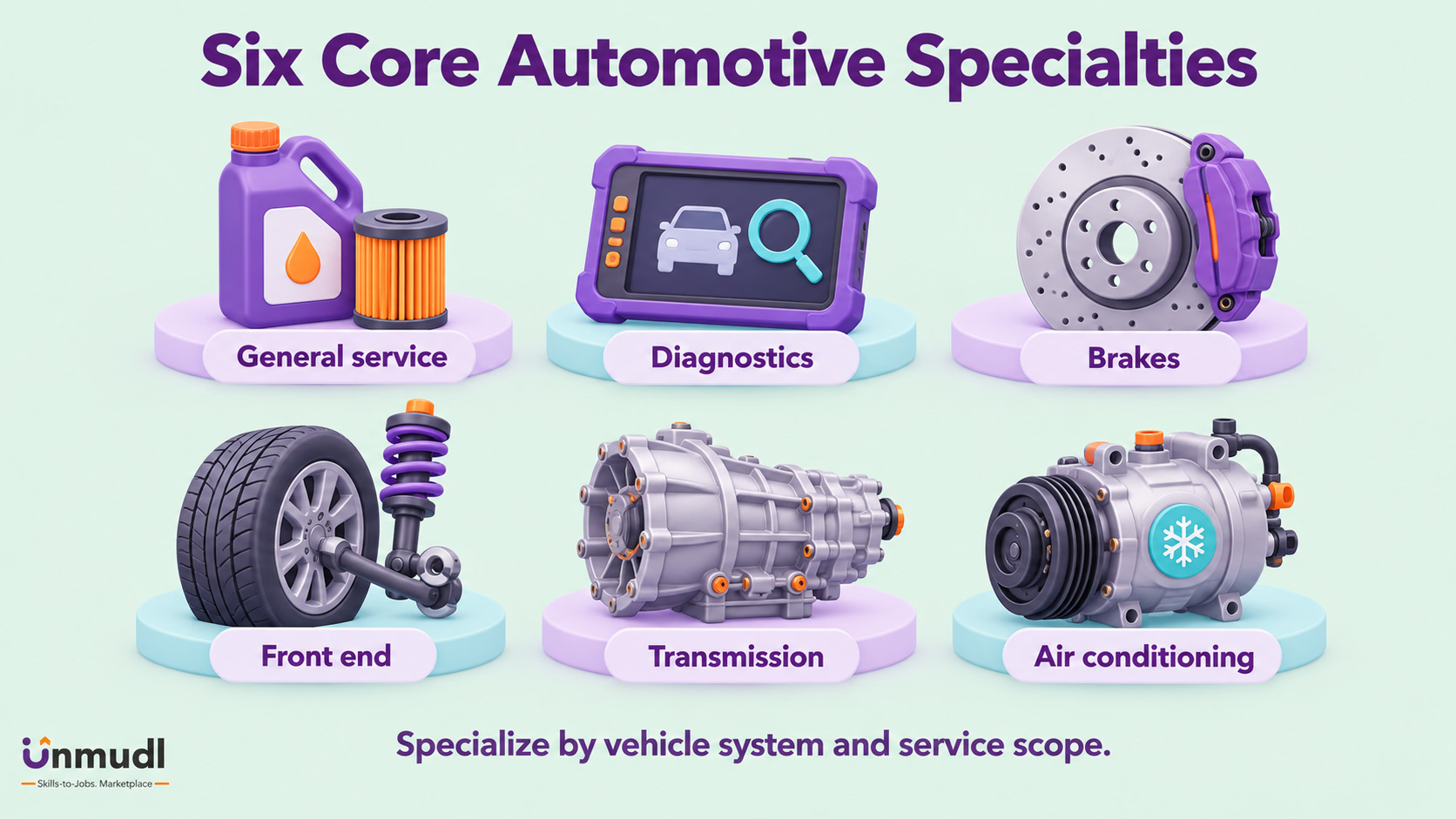
Six core automotive specialties illustrated through equipment: general service, diagnostics, brakes, front end, transmission, and air conditioning.

What Are the Duties of an Automotive Technician?

The automotive technician job description lists six main duties. The duties are inspecting vehicle condition, diagnosing faults, completing scheduled maintenance, repairing or replacing components, testing completed work, and documenting work and time.

1. Inspecting Vehicle Condition

Inspecting vehicle condition is the examination of components and the recording of observable findings. The examination supplies the baseline that every later test is measured against. A consistent checklist separates measured wear from a reported symptom, such as a tread-depth reading logged beside a road-noise complaint.

2. Diagnosing Faults

Diagnosing faults is the testing of possible causes with scan information, gauges, electrical instruments, and service procedures. The testing retains each measurement so a suspected fault is confirmed before a component is recommended. A voltage-drop test across a starter circuit is one such measurement.

3. Completing Scheduled Maintenance

Completing scheduled maintenance is the performance of fluid, filter, and other routine services at the interval the manufacturer specifies. A transmission fluid service, for example, is set by mileage and by fluid grade.

4. Repairing or Replacing Components

Repairing or replacing components is the restoration of a confirmed fault within the authorized scope of the shop. The restoration follows the correct procedure and verifies the assembly after installation. A starting-system component replaced after a measured circuit fault is the clearest case.

5. Testing Completed Work

Testing completed work is the static, functional, or road check that proves the original concern has been addressed. A road test that reproduces an intermittent fault is the most demanding form of the check.

6. Documenting Work and Time

Documenting work and time is the recording of findings, labor, parts, and completed checks on the repair order. The record makes the repair traceable.

Adjusting systems, communicating with customers, and maintaining a safe work area are three further duties, which brings the full inventory to nine. Automotive technician skills map onto that inventory: troubleshooting skills support fault correction, and measurement skills support verification. Matching each skill to its duty shows which capability a job posting is testing, and the posting depends on where the technician is employed.

Automotive repair verification: confirm the cause, test the repair, and record the result.

Where Does an Automotive Technician Work?

An automotive technician works mainly in vehicle service businesses, which are dealership service departments, independent repair shops, and parts and tire retailers, with self-employment as the fourth setting. Automobile dealers employed 32% of the occupation in 2025. Independent mechanical and electrical repair shops employed 25%, self-employed workers made up 15%, and tire and parts retailers employed 6%. An auto repair technician at an independent shop and a technician at a dealership perform the same occupation under different pay plans. The automotive service market is the combined demand of those settings for inspection, maintenance, and repair of the vehicle fleet. Technician-owned hand tools and employer-owned lifts are separated in the pay plan, so a learner asks about both before accepting a job. The job itself is reached through a defined route into the trade.
How to Become an Automotive Technician?

Becoming a certified automotive technician follows four ordered stages. The stages are the training, the credentials, the apprenticeship route, and the levels. BLS records two entry routes for the occupation, a postsecondary nondegree award and a high school diploma with on-the-job learning.

1. What is the training for an Automotive Technician?

Automotive technician training is classroom instruction combined with hands-on shop practice that builds the mechanical, electrical and diagnostic skills needed to inspect, maintain and repair vehicles. The training route splits into three actions, which are explained below.

1.1 Build the academic and safety foundation

Start the foundation with automotive, mathematics, electronics and computer coursework in high school or at a community college. Record the coursework and the supervised repairs from the first week, because ASE experience verification later depends on dated records.

1.2 Compare automotive technician school programs by award and delivery

Compare each automotive technician school by the award it grants, the credit count and the delivery model. The University of Hawai'i Maui College awards an Associate in Applied Science for 68 to 71 credits of classroom and shop work. UTI Sacramento awards an Associate of Occupational Studies in Automotive and EV Technology for 61 semester credit hours. Western Wyoming Community College states that the complete automotive degree cannot be taken online.

1.3 Verify the lab access and the total cost before enrolling

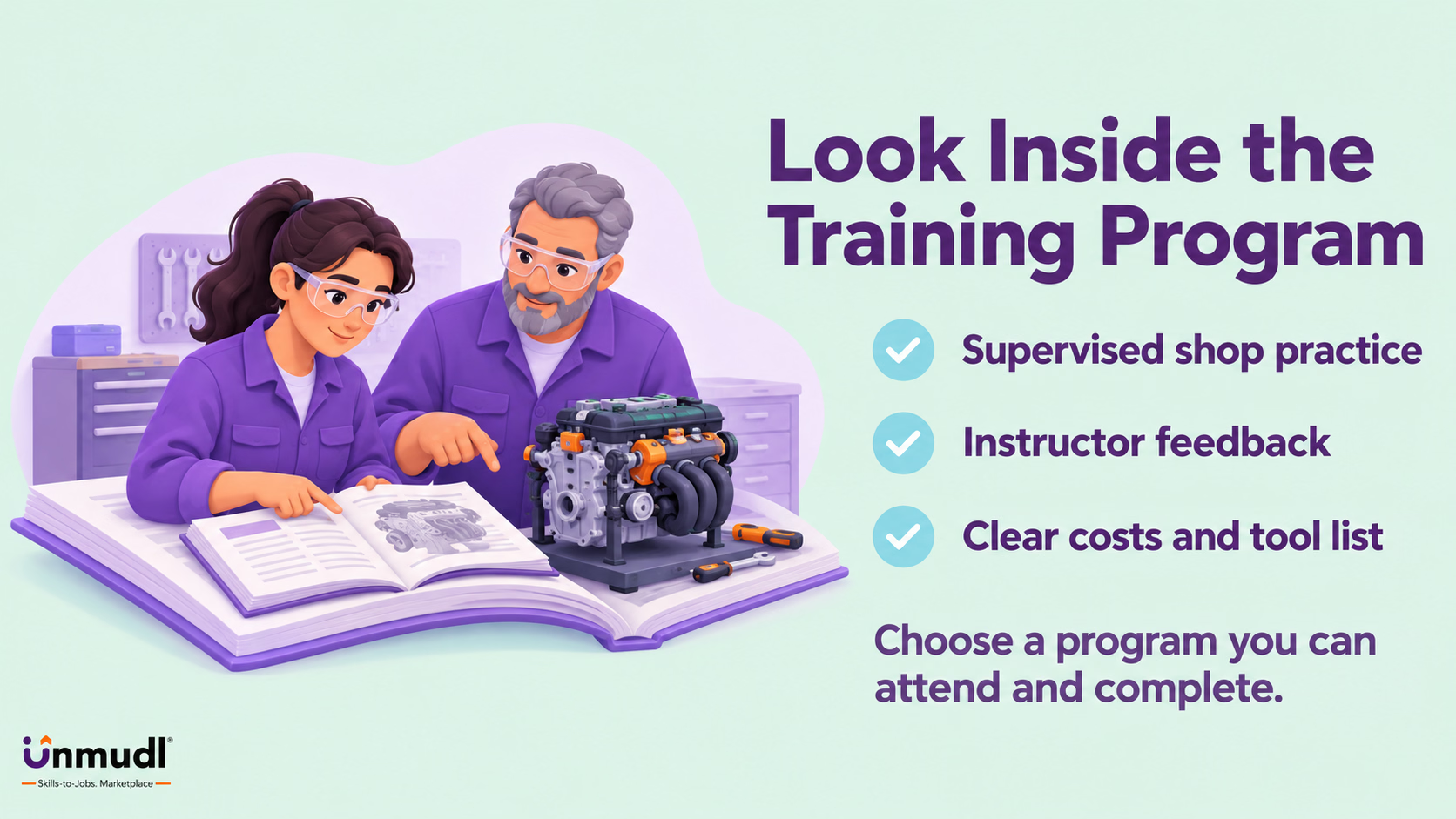
Ask the school to show the lab tasks, the instructor feedback method, the safe equipment access and the current ASE accreditation of the program. Request the full cost of attendance, the student tool list, the schedule and the withdrawal terms in writing.

A learner and mentor illustrate supervised shop practice, instructor feedback, and checking costs and tool requirements.

2. What are the Credentials Required for an Automotive Technician?

The credentials required for an automotive technician are the educational award, the professional ASE certification and the legal qualifications that match the employer, the state and the work performed. A legal qualification, such as the EPA Section 609 certificate, grants authority for regulated work. The three credential actions are listed below.

2.1 Earn the ASE Entry-Level certificate during school

Take the ASE Entry-Level test while enrolled, since the test carries no work-experience requirement. The certificate stays valid for two years and has no recertification option. List it as a student credential and never as professional certification, because employers read the two credentials as different scopes.

2.2 Qualify for professional automotive technician certification

Pursue professional automotive technician certification once the experience condition is met. The G1 Maintenance and Light Repair certification requires one year of relevant full-time experience plus a passed test. The nine Automobile and Light Truck tests, A1 to A9, each require two years of relevant experience plus the applicable test. The Master Automobile Technician status requires current certification in A1 through A8, and A9 sits outside that rule. Professional certifications renew on a five-year cycle.

2.3 Hold the legal and specialist qualifications for the assigned work

Obtain the Section 609 certificate before servicing motor-vehicle air conditioning for payment, because federal rule requires an EPA-approved program for that work. Check the state repair rules next, since Michigan requires state certification for major repairs performed for compensation and issues a trainee permit for supervised work. Add the ASE xEV high-voltage certificate, valid for five years, before working on electric-vehicle battery systems.

3. What is the Apprenticeship Route for an Automotive Technician?

The apprenticeship route for an automotive technician is a Registered Apprenticeship that combines paid shop work, mentoring, related instruction, progressive wage increases and a recognized completion credential. The United States Department of Labor or a State Apprenticeship Agency approves each registered program. An internship is not a registered apprenticeship, because it carries no approved progression. Three actions complete the route, and each action is given below.

3.1 Find a registered sponsor through Apprenticeship.gov

Search Apprenticeship.gov for a registered automotive sponsor that accepts candidates in the intended location. The NAPA apprenticeship program is a competency-based route with nine stages and a normal length of two years or less. The NAPA model ends in a Department of Labor journeyman credential and pairs the G1, A4 and A5 certifications with the federal refrigerant certificate.

3.2 Review the written conditions before accepting the placement

Read the written apprenticeship agreement before signing it. Check the starting wage, the wage progression, the schedule, the mentor assignment, the related instruction hours, the tool policy, any fees and the assessment method. A sponsor that states each condition in writing gives the apprentice a measurable progression.

3.3 Complete the competencies and keep the completion certificate

Track each competency under the sponsor's system and obtain the mentor sign-off at every stage. Retain the apprenticeship completion certificate as a separate award from professional ASE certification, since the two credentials prove different things. The ASE Education Foundation received a Department of Labor grant on July 8, 2026 to expand registered apprenticeship across automotive, collision and truck service.

4. What are the Levels of an Automotive Technician?

The levels of an automotive technician are employer-defined grades that mark growing competence and responsibility, and no single nationwide grading ladder exists. Employers use five common labels. The labels are entry-level technician, general service or B-level technician, advanced diagnostic or A-level technician, ASE Master Technician, and lead technician or shop foreman. The progression through the levels follows three actions, described below.

4.1 Start at the entry level with supervised maintenance

Begin as an entry-level or quick-service technician performing supervised maintenance, inspections and lubrication services. Build shop habits such as service-information use, torque verification and clean documentation during the first year, because a supervisor checks those habits before assigning repairs.

4.2 Progress from B-level repair to A-level diagnosis

Move to the B-level once general repairs, brakes, steering and suspension work and assisted diagnostics are completed with increasing independence. Advance to the A-level once advanced drivability and electrical diagnosis and the mentoring of junior staff are assigned. Mankato Motor Company, one employer, requires two or more years for its B-level applicants and five or more years for its A-level applicants.

4.3 Move up through credentials, verified repairs and mentoring

Request the employer's task and competency matrix and identify the diagnostic or system gaps. Seek supervised exposure to those gaps and document every successful verification and every rework lesson. Maintain the certifications that the next level names, and develop the mentoring skills that a lead technician position demands.

Working through the training, the credentials, the apprenticeship route and the levels in that order lets a learner turn a course completion into a hired, certified and promotable technician. The hired technician then earns the wage the occupation records.

How much does an Automotive Technician earn?

An automotive technician earns a national median of $24.34 per hour and $50,620 per year in the May 2025 wage estimates for the occupation. The median converts to $4,218 per month and $12,655 per quarter as derived figures rather than payroll periods. The automotive technician salary at automobile dealers reaches a median of $59,920, while the median in other automotive repair and maintenance falls to $35,730. The average rate per year is $56,420, which equals an arithmetic mean of $27.13 per hour. Those gross figures show how much automotive technicians make before overtime premiums or benefits, and the figures belong to the occupation rather than to any college award.

U.S. automotive service technicians and mechanics earned a median annual wage of $50,620 in May 2025.

Does an Automotive Technician Need a Degree?

No, an automotive technician does not need a college degree, since the typical entry-level education for the occupation is a postsecondary nondegree award. An automotive technician degree at associate level is one route among several. An accredited degree program earns approved credit toward the ASE work-experience requirement. A learner who asks whether school is required to be a mechanic receives the same answer. The route chosen then sets the length of preparation.

How Long Does It Take to Become an Automotive Technician?

It takes between 51 weeks and two years to become an automotive technician through a formal route. The verified lengths are a 51-week accelerated degree program, a two-year associate degree and a nine-stage apprenticeship finished in two years or less. The length of automotive technician school therefore follows the award selected. The difficulty of becoming a certified auto technician lies in combining measurement, electrical diagnosis and documentation. That combination spans every vehicle system the technician maintains.

Which Systems Does an Automotive Technician Maintain?

An automotive technician maintains nine interconnected vehicle systems. The first five systems are the engine, the fuel and emissions group, the electrical network, the brakes and the chassis. The remaining four are the drivetrain, the cabin climate system, the safety electronics and the hybrid and electric interface. The upkeep side of this work belongs to an automotive maintenance technician, who follows the vehicle-specific service schedule. Automotive repair is the correction of a verified fault or damage inside one of these systems. Repair therefore differs from scheduled upkeep, and each system is described below.

Engine Mechanical, Lubrication and Cooling System

The engine mechanical, lubrication and cooling system is the power-producing assembly that burns fuel, circulates oil and holds operating temperature within range. The technician checks its condition, services its fluids and diagnoses its faults against the vehicle-specific procedure. Measured evidence therefore decides the repair before the fuel charge is examined.

Fuel, Air, Ignition and Emissions System

The fuel, air, ignition and emissions system is the combustion-control group that meters the air-fuel charge, ignites it and limits the exhaust products the vehicle releases. The technician's responsibility in this group is drivability diagnosis and component testing for running and emissions concerns. Scan codes alone never settle the cause, so circuit testing follows.

Starting, Charging, Electrical and Electronic Network

The starting, charging, electrical and electronic network is the circuitry that supplies, distributes and controls power and signals throughout the vehicle. The technician performs circuit tests and component diagnosis across this network to isolate power, connection or control faults. Those tests include the ones that reach the brake controls.

Brakes and Electronic Brake Controls

Brakes and electronic brake controls are the deceleration system that converts wheel motion into controlled stopping and modulates that stopping electronically. The technician inspects friction components, repairs worn or defective parts and tests the finished assembly. Brake dust requires controlled handling rather than compressed-air cleaning, a precaution that also applies when chassis parts are serviced.

Steering, Suspension, Tires and Alignment

Steering, suspension, tires and alignment form the chassis system that controls direction, ride quality and wheel geometry. The technician inspects component condition, measures alignment angles and services tires and related wear parts. Adjustment cannot compensate for a defective joint or bushing. The worn part is therefore replaced before the geometry is set, and the same measured approach carries into the drivetrain.

Transmission, Axles and Drivetrain

The transmission, axles and drivetrain are the power-transfer system that carries engine output to the wheels through automatic or manual gearing. The technician's role covers fluid and service checks, shift-concern diagnosis and component repair within the assigned specialization. Tasks differ by design, since a shift complaint has mechanical, hydraulic or electronic causes. The cabin climate system holds a similar mix of causes.

Heating, Ventilation and Air Conditioning System

The heating, ventilation and air conditioning system is the cabin thermal system that regulates temperature and clears the glass for visibility. The technician diagnoses performance concerns and performs regulated refrigerant service on this system. Refrigerant work requires EPA Section 609 certification and equipment matched to the refrigerant. That task-specific authorization pattern repeats in the safety electronics.

Restraints, Safety Electronics and ADAS

Restraints, safety electronics and advanced driver assistance systems (ADAS) are the occupant-protection network of airbags, sensors, cameras and radar that detects hazards and restrains occupants. The technician diagnoses these components and calibrates them where the procedure specifies. Completing the prescribed calibration is the payoff, because clearing a warning code establishes nothing about safety. Camera and radar calibration remains a specialist domain. The high-voltage interface that follows is a specialist domain of the same kind.

Hybrid and Electric Vehicle Interface

The hybrid and electric vehicle interface is the electrified propulsion system of battery, power electronics and supporting components that a technician services within authorization. Maintenance unrelated to high voltage differs from work on de-energized high-voltage parts. Servicing each of these nine systems depends on the equipment and tools the technician works with.

A conceptual vehicle illustration connects mechanical, electrical, and electronic systems.

Which Equipment and Tools Does an Automotive Technician Work With?

An automotive technician works with five categories of equipment and five categories of tools. The equipment categories are vehicle lifts and supports, brake, tire and alignment machines, refrigerant service machines, EV insulated gear and repair-order software, which the employer owns. The tool categories are hand and torque tools, scan tools, multimeters and oscilloscopes, pressure and compression testers and borescopes, which the technician commonly owns.

Vehicle Lifts, Jacks and Supports

Vehicle lifts, jacks and supports are the access equipment that raises and holds a vehicle for underbody work. The technician prepares the bay, positions the vehicle on its lift points and checks stability before raising or lowering. The raised vehicle is where brake and tire machines take over.

Brake, Tire and Alignment Equipment

Brake, tire and alignment equipment is the service machinery that resurfaces or measures brake components, mounts and balances tires and measures wheel geometry. The technician selects the machine that fits the service operation and reads its output against the specified value. A machine readout is not a complete diagnosis, because condition checks confirm what the numbers suggest. The same rule governs refrigerant machines.

Refrigerant Recovery, Recycling and Recharging Machine

A refrigerant recovery, recycling and recharging machine is the air-conditioning service equipment that captures, cleans and refills refrigerant in a closed process. The technician matches the machine to the refrigerant, such as an R-1234yf unit for vehicles charged with that gas. Mixing refrigerants or applying stationary-building equipment to a vehicle is excluded. Exclusion by rating also governs EV gear.

EV Insulated Equipment and Protective Gear

EV insulated equipment and personal protective equipment (PPE) are the high-voltage safety gear of insulated instruments, insulated hand tools and rated gloves. The technician uses this gear only for the specifically authorized electrical task on a hybrid or electric vehicle. The authorization record for such work lives in the shop's software.

Repair-Order and Time-Tracking Software

Repair-order and time-tracking software is the administrative system that records job activity and supports shop workflow. Automotive technician time tracking inside this software runs on a job clock. The job clock logs time against a repair-order job with play and pause controls. The physical work those recorded hours describe starts with hand tools.

Hand and Torque Tools

Hand and torque tools are the manual instruments of wrenches, sockets and torque wrenches that disassemble, assemble and tighten components to a specified value. The required torque specification comes from the service procedure, never from an assumed universal setting. The same procedure feeds the scan tool.

Scan Tools and Service Information

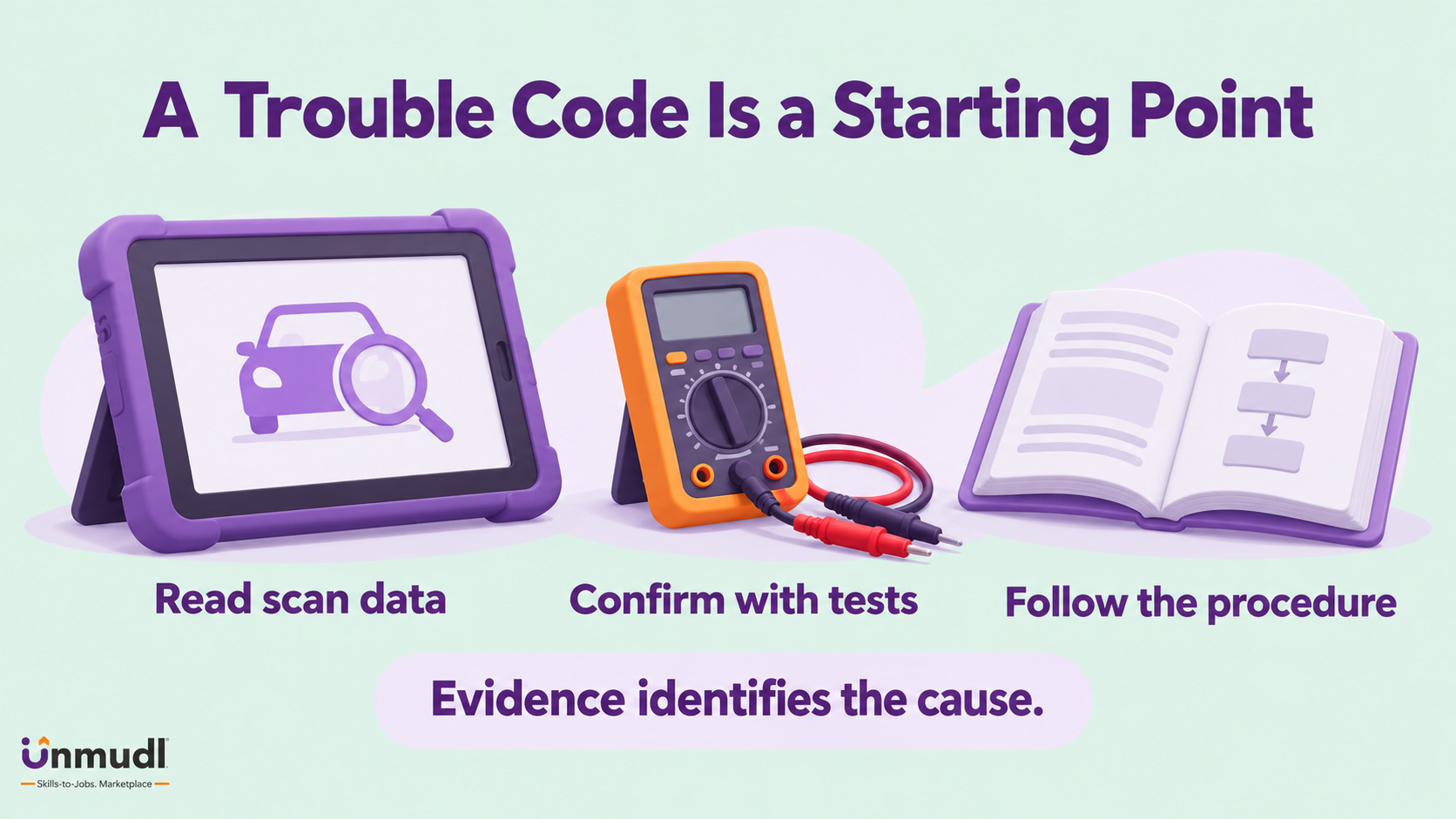
A scan tool is the diagnostic computer that reads trouble codes, displays live data and runs available tests on vehicle modules. The technician treats a code as a lead and confirms it with physical or circuit tests. Coverage varies by vehicle, software and subscription, so the tool never proves the faulty part on its own. Meters enter at that point.

Multimeters and Oscilloscopes

Multimeters and oscilloscopes are the electrical measuring instruments that quantify voltage, current and resistance and display changing signals as waveforms. The technician selects instrument and lead ratings appropriate to the circuit under test. A meter reads a static value and a scope shows a signal over time. Physical behavior that neither instrument resolves is measured by pressure testers.

Pressure, Leak and Compression Testers

Pressure, leak and compression testers are the physical-test instruments that measure cylinder, intake, exhaust, fuel-supply, cooling and lubrication pressures. Scan data cannot reveal those pressures. The technician reads the gauge value or pressure waveform against the relevant procedure. Internal areas that pressure cannot characterize are viewed with a borescope.

Borescopes

A borescope is the inspection camera that views difficult-to-see internal areas without full disassembly. The Milwaukee auto technician borescope is sold as the M12 Auto Technician Borescope, model 3150-20. The model carries a 5 mm camera head with front and side viewing and image and video capture. The inspection experience they produce is the kind of evidence a resume presents.

Scan data, confirmatory testing, and service procedures work together to identify an automotive fault.

How to Build a Resume for an Automotive Technician?

Building an automotive technician resume on Unmudl takes seven steps. The steps are opening the Free Resume Builder, starting the builder, entering experience, entering education and credentials, entering skills, saving with a free account and tailoring the document at application. A resume for automotive technician work is read by employers for three signals. The signals are the systems serviced, the tools and equipment used and the credentials held,. The steps are listed below.

  • Open the Free Resume Builder from the Unmudl homepage, which opens the landing page at unmudl.com/resume-builder.
  • Start the builder by selecting Build My Resume, which opens the editor at unmudl.com/create-resume without an account.
  • Enter work experience as dated entries that name the employer, the vehicle systems serviced and the diagnostic tasks completed under supervision.
  • Enter education and credentials as separate lines, listing the program award and the ASE or EPA credential with its status.
  • Enter skills that match the job description, naming the scan tools, meters, lifts and service equipment handled.
  • Save the resume by creating a free Unmudl account, which also unlocks the PDF download.
  • Tailor the saved resume when applying to a listing through Unmudl.

Completing these seven steps gives a job seeker a document that an employer reads in the same order it screens applicants. The finished resume is the attachment every application needs.

How to Apply for Automotive Technician Jobs?

Applying for automotive technician jobs on Unmudl takes six steps. The steps are reaching the job search, searching by title and location, checking occupational fit, reading the offer conditions, submitting the application and following up while learning continues. Automotive technician jobs near a chosen city come from the location step, since a title search without a location returns openings nationwide. Each step is described below.

  • Reach the job search by selecting Get Jobs on the Unmudl homepage, which opens the search page at unmudl.com/search-jobs.
  • Search by entering automotive technician, automotive service technician or auto technician as the title and setting the location to the intended city or distance.
  • Check occupational fit by reading the duties in the listing for inspection, diagnosis, maintenance and repair of cars and light trucks.
  • Read the offer conditions in the posting, including the pay arrangement, supplied tools, required personal tools, schedule and supervision.
  • Submit the application through the listing's application control with the saved Unmudl resume attached.
  • Follow up on each submitted application and continue skills learning through Unmudl courses while responses arrive.

Running these six steps in order turns a search into a shortlist of openings that match the occupation. The course chosen for continued learning is the next decision.

What is the Best Automotive Technician Course?

The best automotive technician course is the automotive technician program that pairs vehicle-system coverage with supervised shop practice, a recognized credential outcome and a schedule the learner can keep. On Unmudl, the Unmudl Short: Electrical Systems 1 course supplies the electrical foundation of that preparation. The course covers circuit measurement and basic electrical components and prepares the learner for a SACA micro-credential examination. This automotive technician course is therefore a supporting step before hands-on vehicle training rather than a replacement for it. A learner who completes that preparation then weighs the career itself.

Is Automotive Technician a Good Career?

Yes, automotive technician is a good career, but only when the learner meets the physical, scheduling and continuing-learning demands of the work. The occupation records 66,200 openings a year between 2025 and 2035, including replacement needs. The automotive technician shortage stands at a 29% training-supply gap, according to the TechForce Foundation's May 2026 report Supply, Demand & Opportunity: 2026 Technician Workforce Report. The job title on the offer, technician or mechanic, changes none of those conditions.

What is the difference between Automotive Technician and Mechanic?

An automotive technician differs from a mechanic in job title only, not in occupation, since both titles sit inside the single national occupation of automotive service technicians and mechanics. A mechanic diagnoses, services and repairs vehicle systems exactly as a technician does. Both share the goal of restored vehicle function and the tool set of hand tools, scan tools and meters. For example, a technician diagnoses an intermittent starting fault while a mechanic repairs a brake concern. The comparison therefore turns on competence, and the choice between the two words is set by the employer. A diesel technician, by contrast, is a separate occupation.

What is the difference between Automotive Technician and Diesel Technician?

An automotive technician and a diesel technician differ in vehicle scope. A diesel technician diagnoses, repairs and overhauls diesel-powered buses, trucks and engines, whereas the automotive worker services cars and light trucks. Both pursue the goal of restored specified function with hand tools, diagnostic software, meters and lifts. For example, the automotive side verifies a passenger-car starting repair while the diesel side verifies a truck engine-performance repair. The diesel vs auto mechanic boundary blurs at light-duty diesel vehicles, which the ASE A9 test covers. Scope separates the body trade in the same way.

What is the difference between Automotive Technician and Auto Body Technician?

What separates an automotive technician from an auto body technician is the object of repair, vehicle function against vehicle structure. An auto body repair technician restores collision-damaged panels, structure, fit and finish, whereas the automotive worker corrects mechanical and electrical faults. Body measuring and pulling equipment, welders and refinishing gear sit on the body side. Scan tools and meters sit on the service side. For example, one replaces a damaged panel while the other repairs a brake fault. The split between auto body and mechanic work is settled by the damage, not by rank, and both trades work on the same vehicle after a collision.

Automotive service focuses on mechanical and electrical function; auto body work focuses on panels, structure, fit, and finish.
Last updated on:
November 2, 2026
No items found.