What is a Welder?
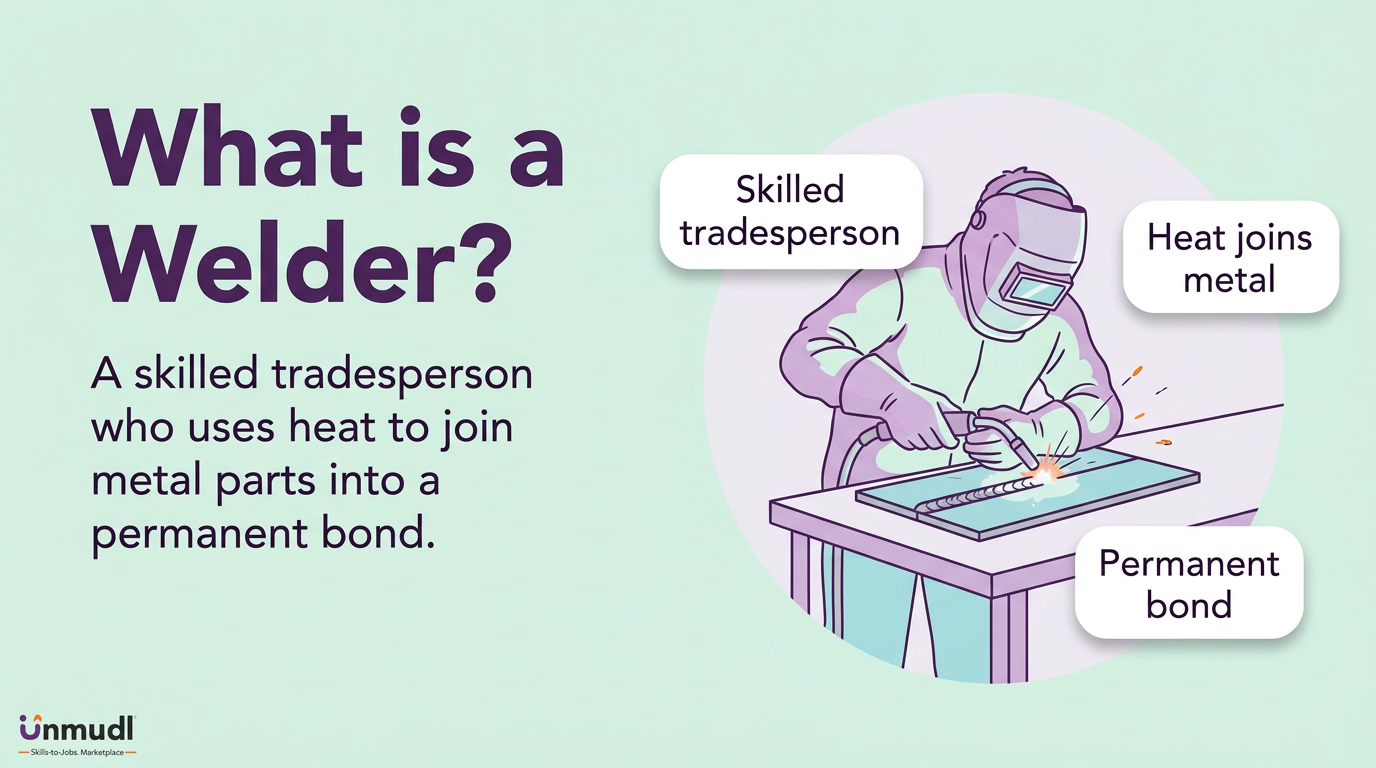
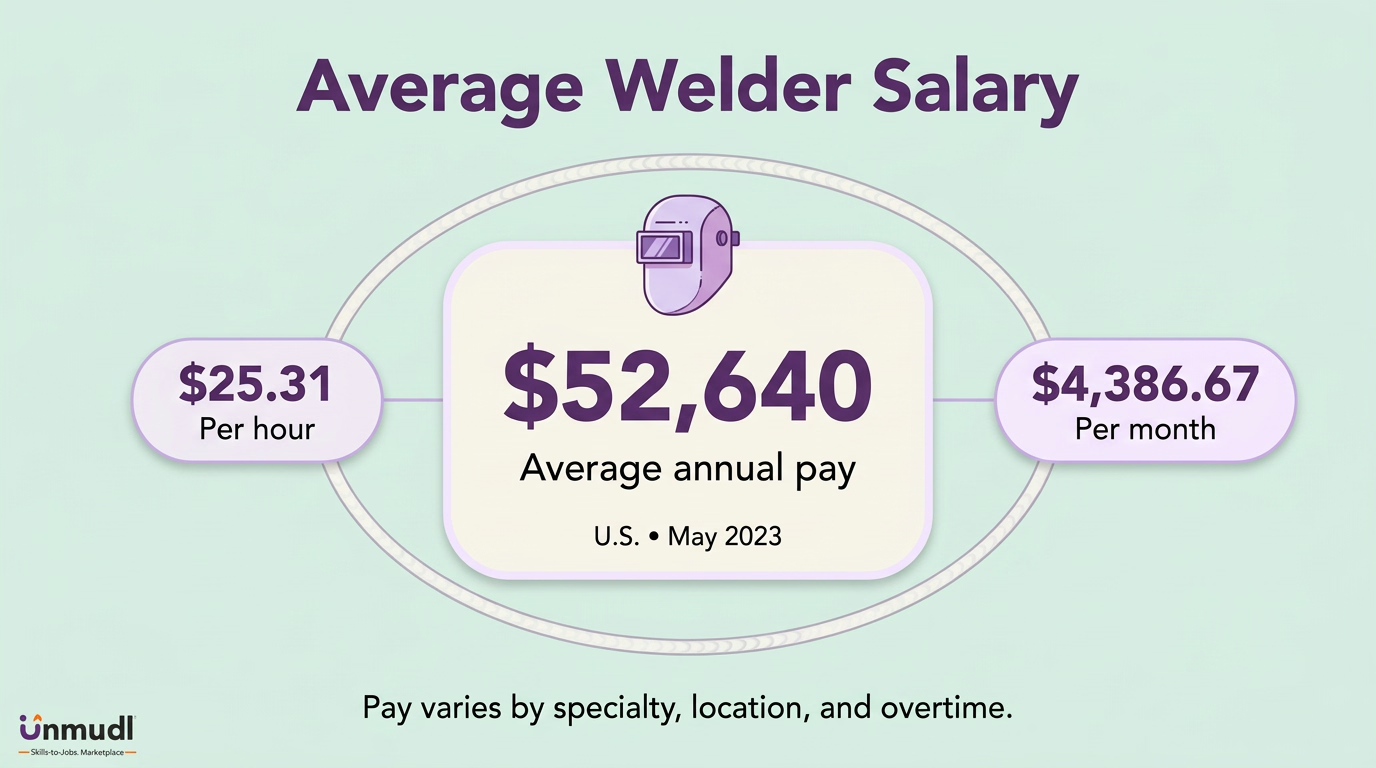
A welder is a production worker who uses hand-held or remotely controlled welding, flame-cutting, soldering, or brazing equipment to join fabricated metal components. The production worker melts a joint with heat and adds filler metal, which cools with the two components into a single piece. The word welder names the person and not the machine, because the machine that supplies the arc is called a welding machine. The occupation sits in a statistical group with cutters, solderers, and brazers. The United States Bureau of Labor Statistics (BLS) records 457,300 jobs in that group for 2024. BLS projects growth in welding jobs of 2 percent between 2024 and 2034, a rate slower than the average for all occupations. Slow growth describes the job count and not the daily work.
What does a Welder do?
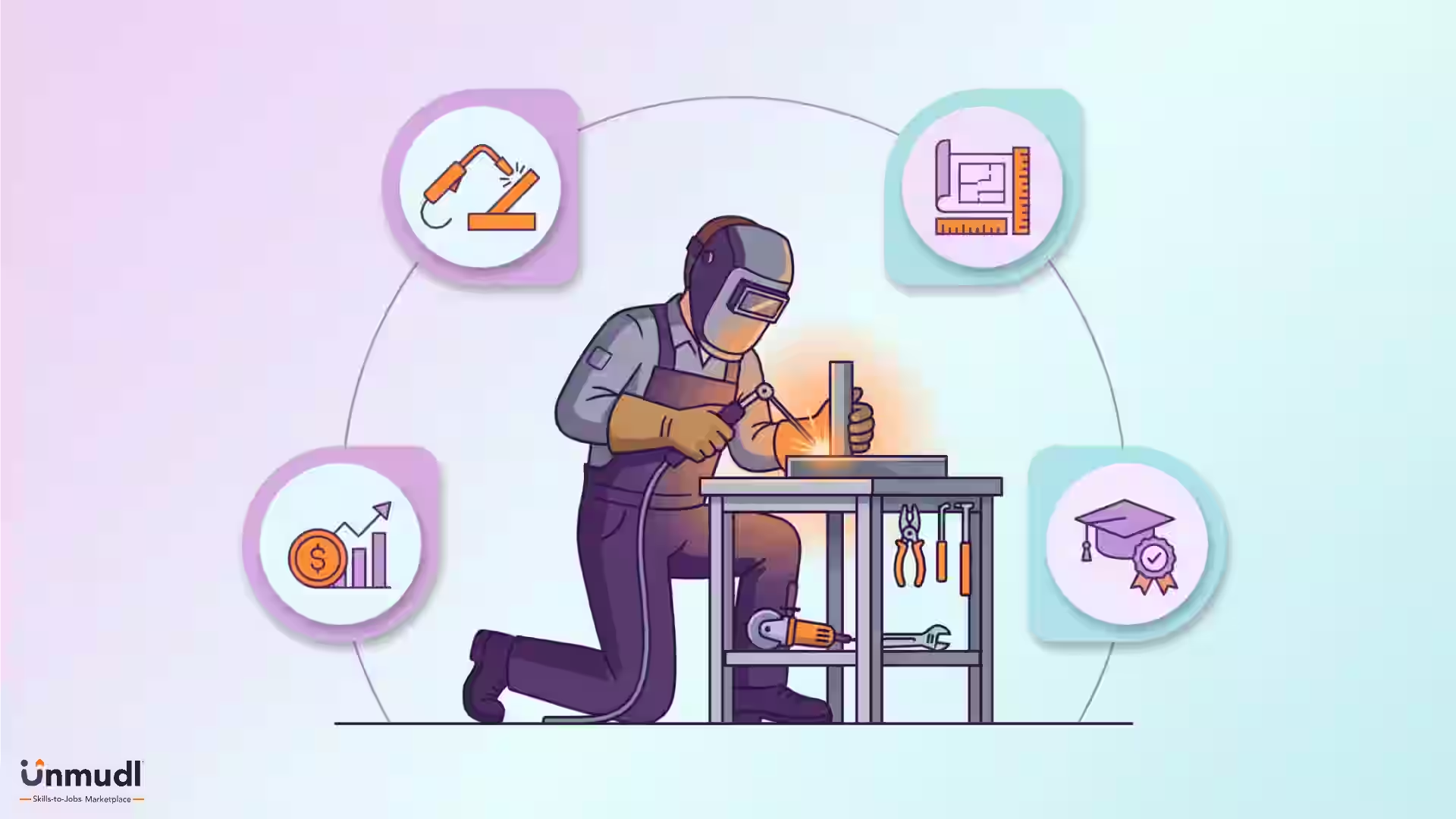
A welder works by aligning prepared metal parts and fusing them to blueprint specifications. The blueprint tells the tradesperson where each seam sits and which dimensions the assembly must meet. Those dimensions govern the preparation stage. In the preparation stage the operator cleans the surfaces, clamps the workpieces, and sets the heat. Heat then travels through a torch or an electrode into the joint. The operator fills the joint with molten metal in a flat, vertical, or overhead position. A sagging weld pool in the overhead position weakens the seam. A weak seam is caught at the finishing stage, where the worker grinds the edges until the parts fit. Some tradespeople specialize in gas welding or robotic welding alone, while others combine welding, cutting, and soldering. The work of a welder in every specialization reduces to applying heat and filler metal until a strong bond forms. The process behind that bond defines the type.
What are the Types of Welder?
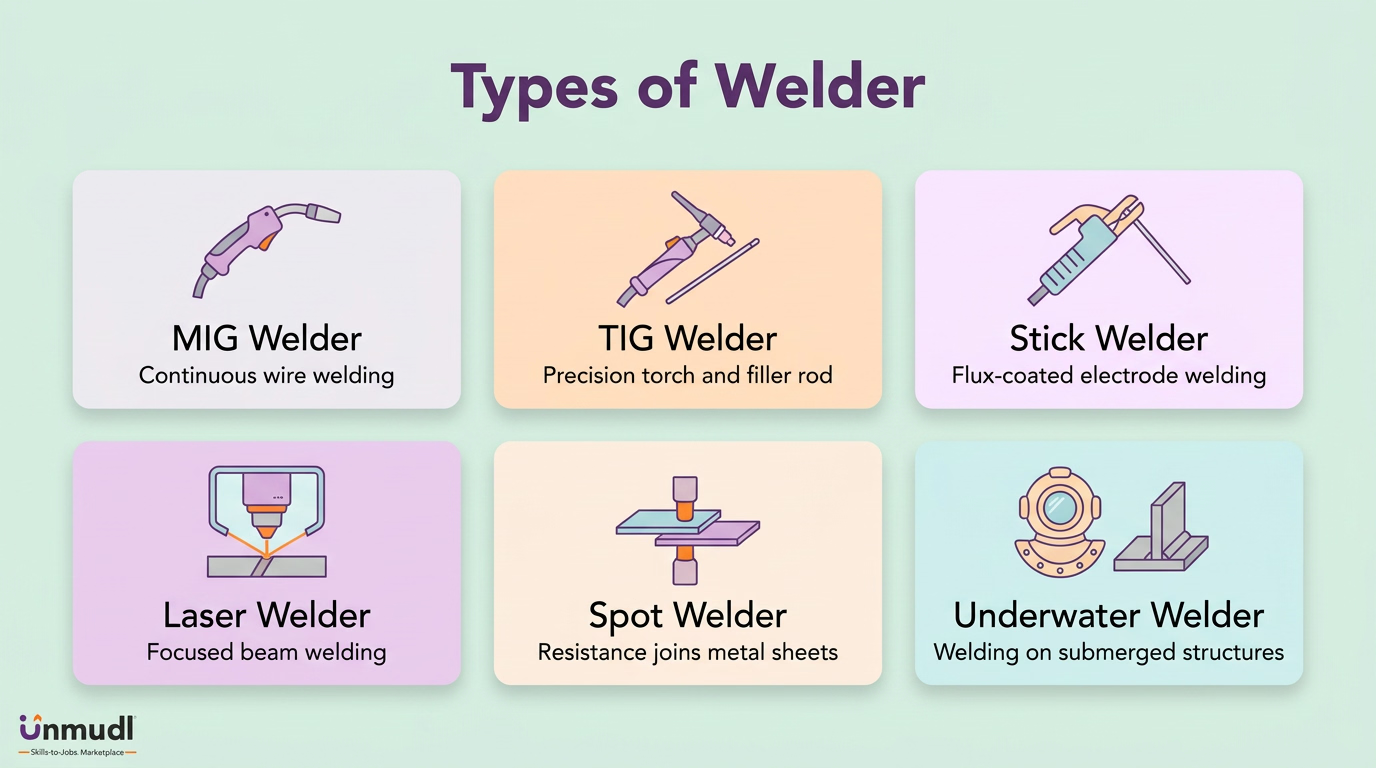
There are six main types of welder based on the process the worker runs and the setting the worker welds in, and they are listed below. The types of welding jobs are the MIG welder, the TIG welder, the stick welder, the laser welder, the spot welder, and the underwater welder.
1. MIG Welder
A MIG welder is a metal inert gas operator who feeds a continuous wire electrode through a gun under a shielding gas. The continuous wire melts into the joint at a steady rate, which gives a fast and even bead on steel or aluminum sheet. Employers place the MIG operator on assembly lines where speed outweighs fine finish.
2. TIG Welder
A TIG welder is a tungsten inert gas operator who holds a non-consumable tungsten electrode over the seam and feeds filler rod by hand. The hand-fed rod gives full control of the weld pool on thin or reactive metal, which makes the TIG welder the aluminum welder of choice. Employers assign the TIG operator to aerospace and stainless steel joints.
3. Stick Welder
A stick welder is an arc welder who strikes an electric arc between a flux-coated consumable electrode and the workpiece. The flux coating burns into a protective slag, which lets the arc welder work outdoors in wind and on rusty steel. Employers send the stick operator to structural steel, pipeline, and repair sites.
4. Laser Welder
A laser welder is a beam operator who directs a focused laser along the seam to melt a narrow, deep joint. The narrow beam puts little heat into the surrounding metal, which keeps thin parts from warping. A seam that never warps needs little finishing. Employers pair the beam operator with automated cells in precision manufacturing.
5. Spot Welder
A spot welder is a resistance operator who presses two overlapping sheets between electrodes and passes current through the contact point. The current heats the contact point into a small fused spot, which joins the sheets without filler metal. Employers station the resistance operator on automotive and appliance assembly lines.
6. Underwater Welder
An underwater welder is a commercial diver who welds and cuts submerged steel on offshore rigs, pipelines, and ship hulls. The submerged work combines diving skill with wet or hyperbaric welding, which raises the hazard level and the pay level above shop work. Employers recruit a diver who holds both a diving and a welding qualification.
The table below compares the six types of welder on the heat source, the joint formed, the metal or site, and the employer placement.
Type | Heat Source | Joint Formed | Metal or Site | Employer Placement |
|---|---|---|---|---|
MIG Welder | Arc from a continuous wire electrode under a shielding gas | Fast, even bead fed by the melting wire | Steel or aluminum sheet | Assembly lines where speed outweighs fine finish |
TIG Welder | Arc from a non-consumable tungsten electrode | Controlled weld pool fed by a hand-held filler rod | Thin or reactive metal, including aluminum and stainless steel | Aerospace and stainless steel joints |
Stick Welder | Arc from a flux-coated consumable electrode | Bead laid under a protective slag from the burning flux | Rusty steel outdoors in wind | Structural steel, pipeline, and repair sites |
Laser Welder | Focused laser beam directed along the seam | Narrow, deep joint with little heat in the surrounding metal | Thin parts that warp under wider heat | Automated cells in precision manufacturing |
Spot Welder | Electric current passed through the contact point between electrodes | Small fused spot joined without filler metal | Two overlapping sheets | Automotive and appliance assembly lines |
Underwater Welder | Wet or hyperbaric welding arc on submerged steel | Weld or cut made under water at a raised hazard level | Offshore rigs, pipelines, and ship hulls | Employers that require both a diving and a welding qualification |
Choosing among the MIG, TIG, stick, laser, spot, and underwater types lets a candidate match a process to the metal, the site, and the pay they want. Miller welder, Lincoln welder, and YesWelder name the machine brands the trade operates and not a type of worker. A brand names the equipment, while a type names the work, and the work is fixed by the duties that every type shares.
What are the Duties of Welder?
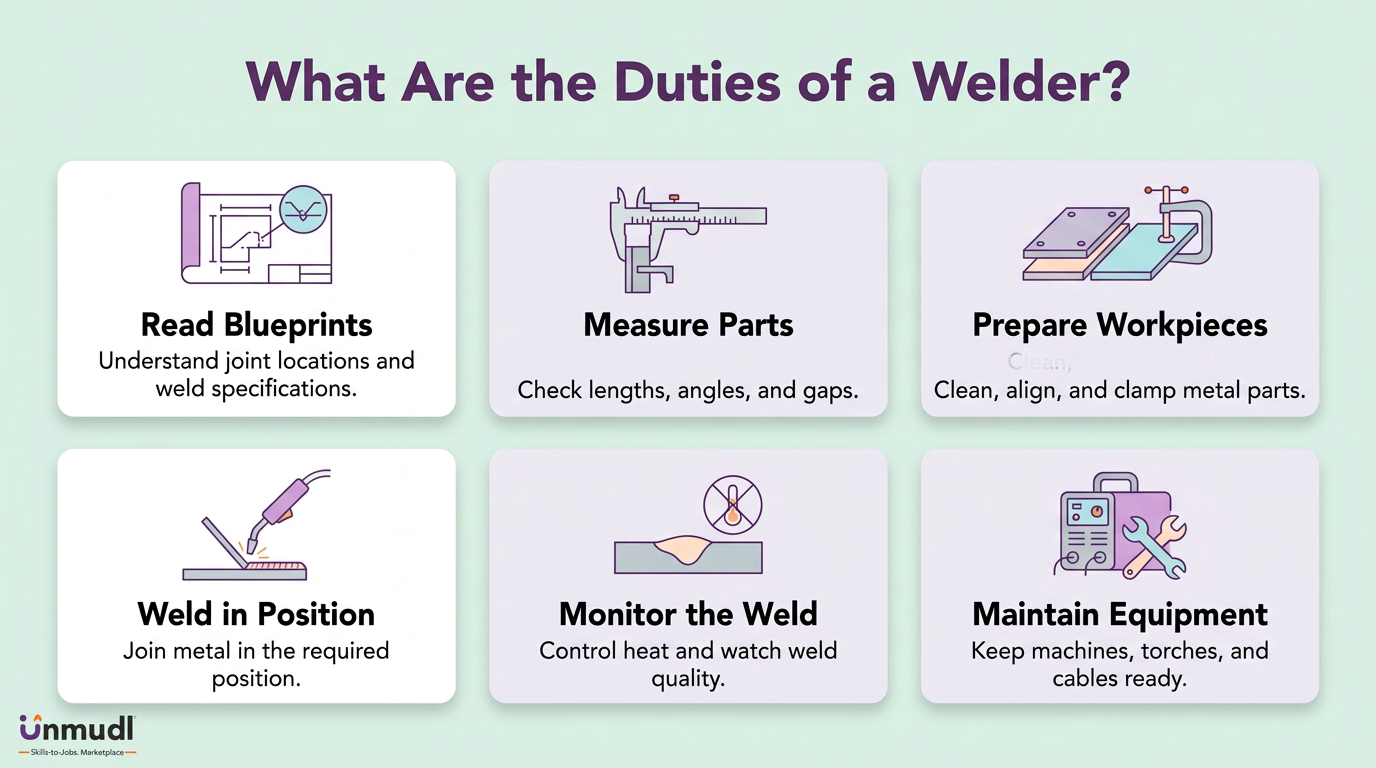
The main duties of a welder are reading blueprints, measuring parts, preparing workpieces, welding joints in position, monitoring the weld, and maintaining equipment, and they are listed below. The six duties appear in every welding job description because each one protects the strength of the finished joint.
1. Reading Blueprints
Reading blueprints is the duty of interpreting the drawings, symbols, and sketches that specify where and how each joint is welded. The drawing gives the operator the joint type, the weld size, and the sequence of seams. A correct sequence prevents distortion, since heat applied in the wrong order pulls the parts out of line. Supervisors treat blueprint reading as the first of the welder responsibilities on any job.
2. Measuring Parts
Measuring parts is the duty of calculating and checking the dimensions of the components to be welded before the arc is struck. The check confirms that cut lengths, angles, and gaps match the drawing within tolerance. A gap outside tolerance starves the joint of filler or burns through the base metal. Supervisors expect the operator to measure twice and weld once.
3. Preparing Workpieces
Preparing workpieces is the duty of cleaning the material surfaces and aligning and clamping the parts so the seam stays fixed. Clean surfaces keep rust, oil, and paint out of the weld pool, where contamination creates porosity. Firm clamping holds the alignment while the metal expands and contracts. Supervisors judge a weld by the fit-up that preceded it.
4. Welding Joints in Position
Welding joints in position is the duty of fusing components in flat, vertical, horizontal, or overhead positions with the process the job specifies. Each position changes how gravity acts on the molten pool, so the operator adjusts travel speed and angle to keep the bead uniform. Supervisors qualify an operator position by position rather than once for all.
5. Monitoring the Weld
Monitoring the weld is the duty of watching the fitting, burning, and welding processes and adjusting heat to avoid overheating, warping, or expansion. Excess heat distorts the assembly and weakens the metal beside the seam. A watched arc reveals cracks and incomplete fusion while the joint is still open for repair. Supervisors rely on the operator's eye as the first inspection of every weld.
6. Maintaining Equipment
Maintaining equipment is the duty of keeping welding machines, torches, cables, and consumables in working order. A clean torch and a sound cable deliver a stable arc, and a stable arc delivers a consistent bead. Supervisors hold the operator accountable for the condition of the tools at the end of a shift.
Carrying out the blueprint, measuring, preparation, positional welding, monitoring, and maintenance duties together lets the tradesperson produce joints that pass inspection at any site where the trade is practiced.
Where does a Welder Work?
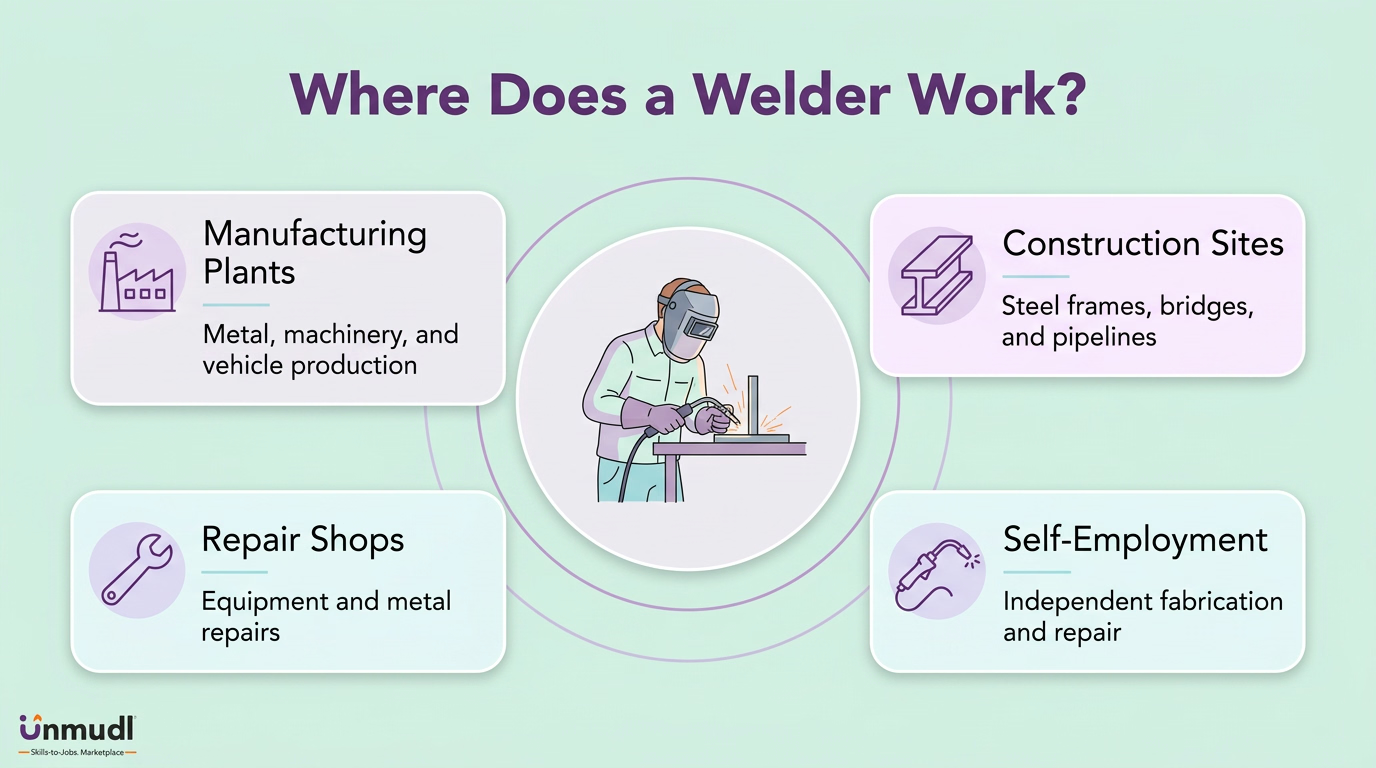
A welder works in manufacturing plants for the most part, with construction sites, repair shops, and self-employment absorbing the remainder. Manufacturing places the tradesperson in fabricated metal, machinery, and vehicle body plants, where parts move along a production line. Construction places the worker on steel frames, bridges, and pipelines, where the parts stay fixed and the worker moves. The site decides the welding work environment. A pipeline site puts the operator outdoors in all types of weather. A factory floor keeps the operator indoors in a confined area designed to contain sparks and glare. Sparks and glare explain the protective helmet and gloves worn in every setting. BLS lists scaffold work, heavy lifting, and overhead welding among the physical conditions of the trade. BLS puts the share of the combined group employed in manufacturing at 61 percent for 2024. Those manufacturing settings open to a candidate through training.