CNC Machinist: Types, Duties, Training, Certification and Salary

CNC machinists are skilled production workers who set up, program, and operate computer numerical control (CNC) machine tools to manufacture precision metal and plastic parts. CNC machinists convert engineering drawings into programmed tool paths. The programmed tool paths steer lathes, mills, grinders and routers through every cut. Every cut must land inside tight tolerances, since a single error in a program or a setup renders a part unusable. The same numerical control divides the trade into specialisations, from milling and turning to programming and toolmaking.

The importance of the CNC machinist lies in the manufacturing sectors that depend on the trade, including fabricated metal products, machinery, transportation equipment, aerospace, and medical devices. Each of these sectors rewards the trade with wages above the national median and with steady replacement hiring as older machinists retire. Retirement openings favour candidates who enter through a high school diploma, an apprenticeship or a machining certificate rather than a four-year degree. The certificate route pairs with a CNC certification from the National Institute for Metalworking Skills (NIMS). A CNC machinist certification of this kind validates skill in mill operations, lathe programming and precision measurement to employers. Validated skill is the reason the trade pays well for a non-degree occupation. The same skill is the ground on which its duties, training, credentials and pay rest.

What is a CNC Machinist?
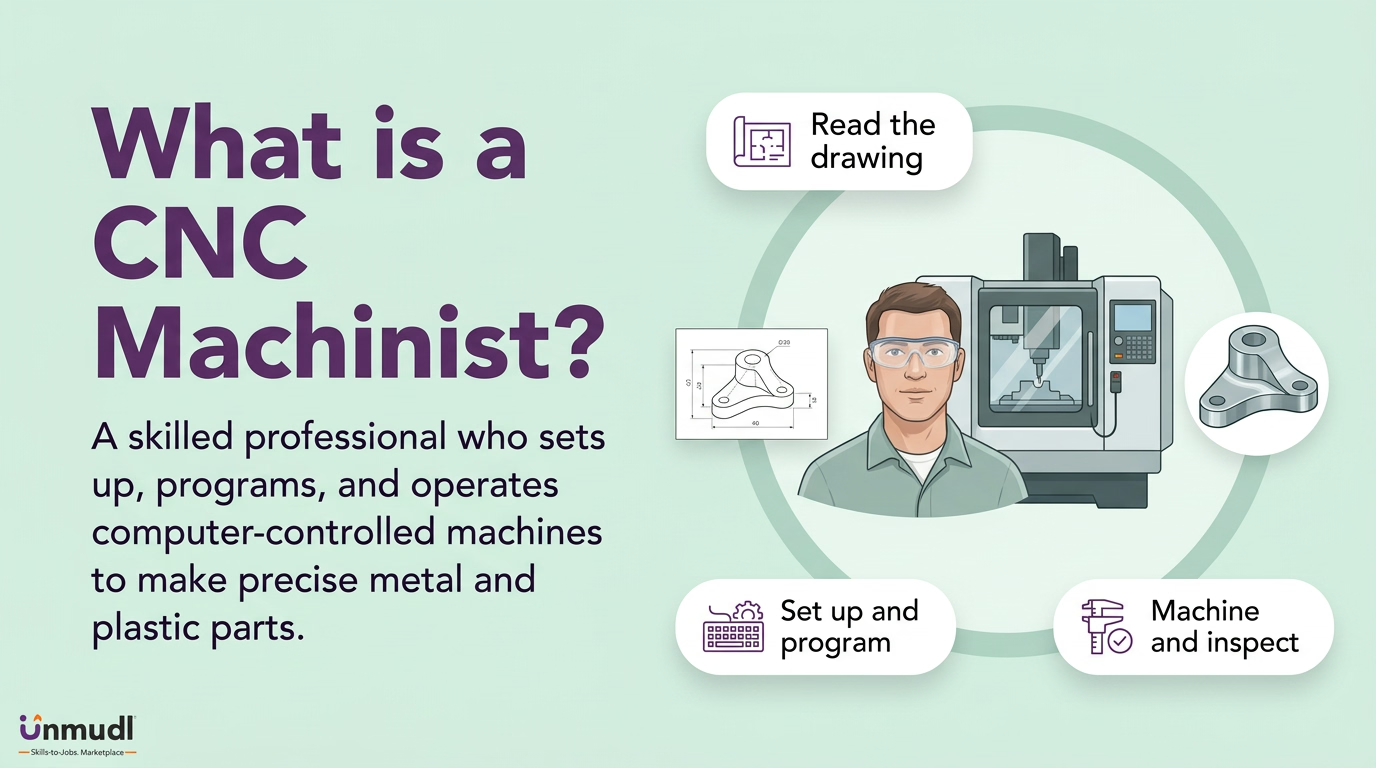
CNC machinist reading a drawing, setting up and programming a machine, then machining and inspecting a part

A CNC machinist is a machinist who fabricates components to exact specifications on computer-controlled cutting equipment such as milling machines, lathes and grinders. A CNC machinist blends the traditional machining trade with computer programming. The programming side covers reading blueprints, selecting cutting tools, and generating machine instructions through CAM (computer-aided manufacturing) software. The machine instructions convert a digital design into tool paths that the equipment follows without manual guidance. Guidance by program rather than by hand is what the alias CNC mechanic obscures. The alias misleads, because a CNC mechanic repairs machines while a CNC machinist produces parts on them. The Bureau of Labor Statistics (BLS) groups CNC machinists under Machinists and Tool and Die Makers in its Occupational Outlook Handbook. The 2025 handbook counts about 288,300 machinist jobs in the United States. Each of those jobs runs the same working sequence.

What does a CNC Machinist do?

A CNC machinist works by turning a technical drawing into a finished part through a fixed sequence of setup, cutting and inspection. The sequence begins when the machinist loads a CNC program into a lathe or mill. The loaded program needs the correct cutting tool installed and touched off to zero the setup. The zeroed setup then runs a first piece, which passes under precision gauges such as a micrometer or a bore gauge before the full run is released. A dimension that drifts from the drawing sends the machinist back to the offsets. The offsets are adjusted until the part conforms. A CNC certificate awarded by a training programme attests to these setup, cutting and inspection skills. The certificate is a qualification the machinist holds rather than a task the machinist performs. The tasks performed vary with the machine and with the production stage, and that variation sorts the trade into types.

What are the Types of CNC Machinist?
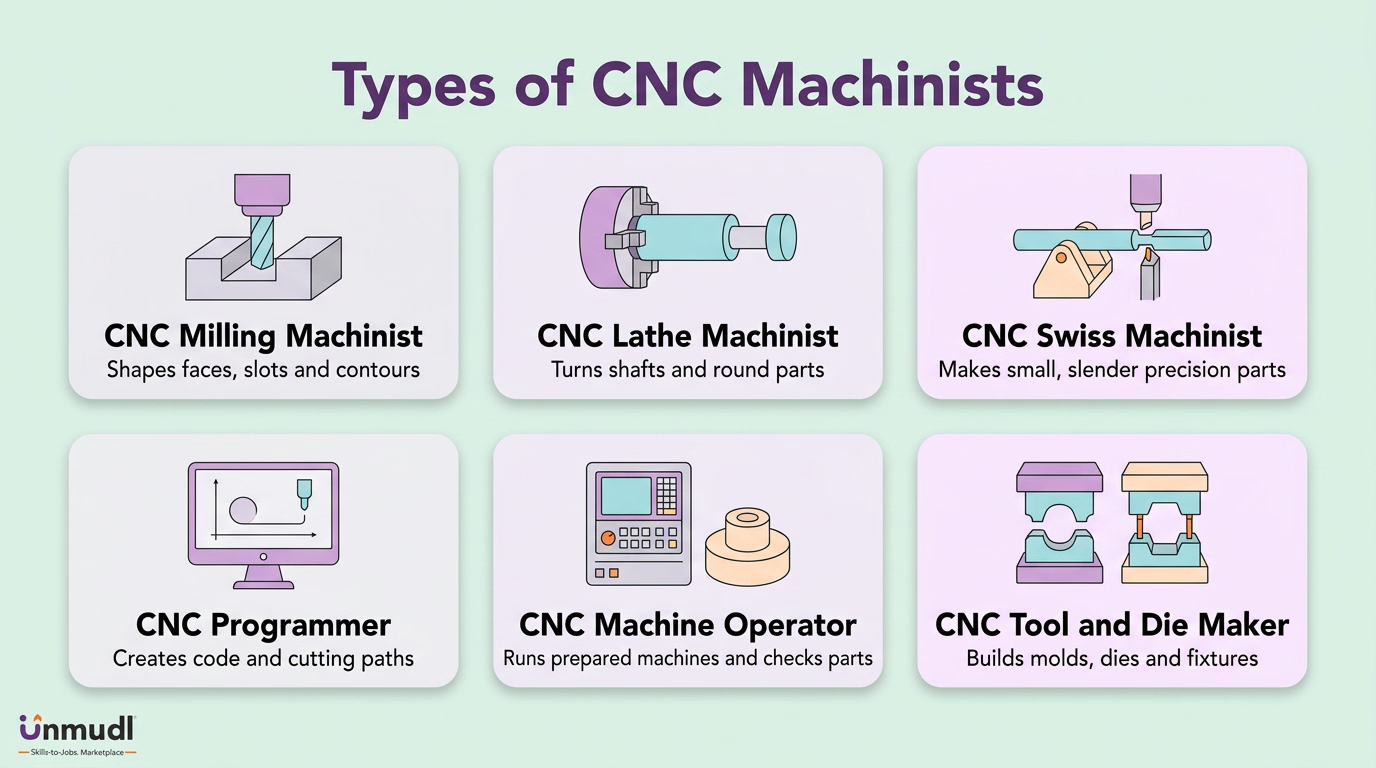
Six CNC machinist types: milling, lathe, Swiss, programmer, machine operator, and tool and die maker

There are six main types of CNC machinist based on the machine the worker runs and the production stage the worker owns. The types are the CNC milling machinist, the CNC lathe machinist, the CNC Swiss machinist, the CNC programmer, the CNC machine operator, and the CNC tool and die maker.

1. CNC Milling Machinist

A CNC milling machinist is a machinist who shapes parts on a machining centre. The machining centre spins a cutter against a fixed workpiece. The fixed workpiece yields flat faces, pockets, slots and contoured surfaces from a single fixture. Fixture design therefore decides the accuracy of a milled part. Employers assign milling machinists to housings, brackets and mould components.

2. CNC Lathe Machinist

A CNC lathe machinist is the turning specialist who produces round parts on a lathe where the workpiece rotates against a stationary tool. The rotating workpiece yields shafts, bushings, pins and threaded fittings. Each fitting must hold its diameter across the full length. Holding a diameter depends on tool offsets corrected after each measured piece. Employers rely on lathe machinists for high-volume cylindrical work.

3. CNC Swiss Machinist

A CNC Swiss machinist is a lathe machinist who runs a sliding-headstock machine. The sliding headstock feeds bar stock through a guide bushing close to the cutting tool. The guide bushing supports the material at the point of cut, which keeps slender parts from deflecting. Deflection control suits small medical, electronic and watch components. Employers value Swiss machinists for parts measured in fractions of a millimetre.

4. CNC Programmer

A CNC programmer is the machinist who writes and edits the G-code that directs a machine tool along its cutting path. The cutting path originates in a CAD (computer-aided design) model, which CAM software converts into tool selections, feeds, speeds and sequences. Sequences proven at the computer shorten setup time at the machine. Employers position programmers above operators in the production chain.

5. CNC Machine Operator

A CNC machine operator is the worker who runs equipment that a programmer and a setup machinist have already prepared. The prepared machine receives raw stock from the operator. The operator starts the cycle, watches the run and unloads the finished part. Finished parts pass through basic gauges such as calipers. Employers treat the operator role as the entry point into the trade.

6. CNC Tool and Die Maker

A CNC tool and die maker is the toolmaker who builds the jigs, fixtures, dies and moulds that form production parts on other machines. Production parts inherit their accuracy from these tools. The inheritance forces the toolmaker to hold tolerances tighter than the parts themselves. Employers regard tool and die makers as the most senior machinists on the floor.

The table below sets the six machinist types side by side on the machine run, the parts produced and the position held in the production chain.

TypeMachine RunParts ProducedPosition in the Production Chain
CNC milling machinistMachining centre, cutter spinning against a fixed workpieceHousings, brackets and mould componentsAssigned to faces, pockets, slots and contours cut from a single fixture
CNC lathe machinistLathe, workpiece rotating against a stationary toolShafts, bushings, pins and threaded fittingsRelied on for high-volume cylindrical work
CNC Swiss machinistSliding-headstock lathe with a guide bushingSmall medical, electronic and watch componentsValued for parts measured in fractions of a millimetre
CNC programmerCAM software converting a CAD model into G-codeProven tool paths, feeds, speeds and sequencesPositioned above operators
CNC machine operatorPrepared machine loaded with raw stockFinished parts checked with calipersTreated as the entry point into the trade
CNC tool and die makerMachines that build jigs, fixtures, dies and mouldsTooling that forms production parts on other machinesRegarded as the most senior machinists on the floor
Common misreadingAn operator and a machinist hold the same postThe operator runs a prepared machineThe machinist prepares the machine the operator runs

Reading the six types across machine families and production stages lets a candidate choose between running a machine, programming it, and building the tools it uses. Every one of those types, whichever the candidate picks, carries the same set of duties.

What are the Duties of CNC Machinist?
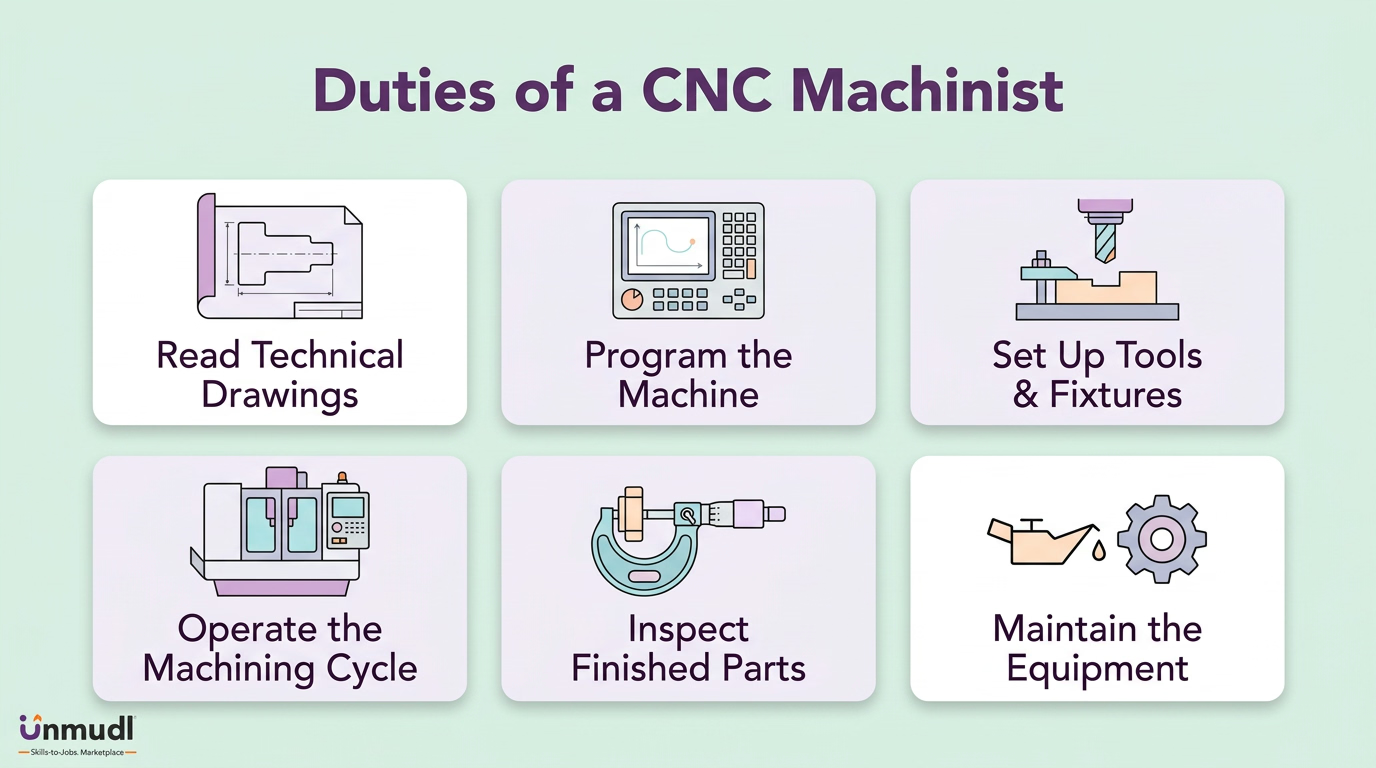
CNC duties: read technical drawings, program the machine, set up tools, operate the cycle, inspect parts and maintain equipment

There are six main duties of a CNC machinist, and each duty follows the part from drawing to inspection. The duties are reading technical drawings, programming the machine, setting up tools and fixtures, operating the machining cycle, inspecting finished parts, and maintaining the equipment.

1. Reading Technical Drawings

Reading technical drawings is the duty of converting a blueprint's dimensions, tolerances and geometric symbols into a machining plan. The machining plan fixes which surface is cut first and which datum the measurements reference. The datum tells the machinist where a thousandth of an inch matters. Supervisors expect a machinist to read the drawing before touching the machine.

2. Programming the Machine

Programming the machine covers loading, writing or editing the numerical code that a CNC control executes. The control executes tool changes, spindle speeds, feed rates and coordinate moves exactly as coded. Coded errors reproduce themselves in every part, so dry runs and single-block execution precede the full cycle. Supervisors hold the machinist responsible for the program that reaches the spindle.

3. Setting Up Tools and Fixtures

Setting up tools and fixtures means mounting the workpiece, installing the cutting tools and establishing the zero point from which the program measures. The zero point ties the digital coordinates to the physical stock. A zero set wrong offsets every feature by the same error. Each tool is touched off and recorded in the control. Supervisors judge a setup by the first piece it produces.

4. Operating the Machining Cycle

Operating the machining cycle consists of running the program while watching the cut for sound, chip formation, coolant flow and surface finish. Surface finish deteriorates when a tool dulls. A dulled tool is replaced before the finish drifts out of specification. Drift also appears as chatter, which the machinist corrects by adjusting speeds and feeds mid-run. Supervisors measure operating skill by scrap rate per shift.

5. Inspecting Finished Parts

Inspecting finished parts involves measuring machined features against the drawing with micrometers, calipers, bore gauges and coordinate measuring machines. Coordinate measuring machines report deviations to the micron. The deviations feed back into the offsets for the next piece. The next piece therefore carries the correction. Supervisors sign off a batch only on an inspection record.

6. Maintaining the Equipment

Maintaining the equipment refers to cleaning chips, checking coolant concentration, lubricating ways and spindles, and logging machine hours between runs. Logged hours schedule preventive service before a bearing or a ball screw fails during a cycle. A failed component mid-cycle scraps the part and idles the machine. Supervisors treat a clean, calibrated machine as the machinist's signature.

Carrying the six duties in the order of drawing, program, setup, cycle, inspection and maintenance keeps a part traceable from print to finished batch. The finished batch leaves a shop floor, and that floor is where the trade is practised.

Where does a CNC Machinist Work?

A CNC machinist works in machine shops and factory production floors where metal and plastic components are manufactured. The production floors belong to fabricated metal product plants, machinery makers, motor vehicle parts plants, aerospace manufacturers and medical device firms. Aerospace and medical device manufacturers demand the tightest tolerances and pay the highest wages.

The CNC work behind those wages takes place in well-lit, climate-controlled shops, since temperature stability protects the precision of the machining technology on the floor. The machinist on that floor stands for long hours amid metal chips, cutting fluid and machine noise, with ear and eye protection worn throughout the shift. Factories that run around the clock schedule evening and weekend shifts, with extra pay for second and third shifts. Shift patterns of this kind set the conditions under which a newcomer trains to enter the trade.
How to Become a CNC Machinist?

Becoming a CNC machinist requires five stages of preparation that run from secondary school to independent shop work. The stages are training, credentials, skills, duration, and work experience. Training starts with a high school diploma, continues in a certificate or associate degree program, or runs through a CNC machinist apprenticeship. Credentials come from NIMS Level I modules and employer-preferred certificates. Skills cover blueprint reading, CNC programming, and metal cutting on real machines. Duration sets three clocks for the certificate, the apprenticeship, and independent competence. Work experience moves a graduate from operator to programmer. The BLS Occupational Outlook Handbook sets the typical entry education for machinists at the high school diploma, and every later stage builds on that diploma.

1. What is the Training for a CNC Machinist?

CNC machinist training is technical instruction that teaches machine setup, CNC operation, and part inspection on mills and lathes. The instruction arrives through three routes. The routes are a high school diploma, a certificate or degree program, and a registered apprenticeship. A CNC school delivers the classroom and shop portions, while an employer delivers the supervised portion on production equipment. The three routes are explained below in the order a candidate follows them.

1.1 Complete a High School Diploma with Math and Shop Courses

Complete a high school diploma or its equivalent before any CNC coursework begins. The diploma is the minimum award that machinist training accepts. Mathematics and physics classes prepare a student for tolerance calculations and cutting principles. Shop classes introduce hand tools and the safety habits that a machinist program later assumes.

1.2 Enroll in a CNC Machining Certificate or Associate Degree Program

Enroll in a CNC machining certificate or an associate degree in machining technology at a community college or trade school. The coursework covers blueprint reading, precision measuring, manual machining, CAD/CAM software, and CNC programming. Department of Labor workforce data shows that 33% of machinists hold a postsecondary certificate and 17% completed some college. A machine tool technology degree therefore places a candidate inside the largest credentialed share of the workforce.

1.3 Join a Registered CNC Machinist Apprenticeship

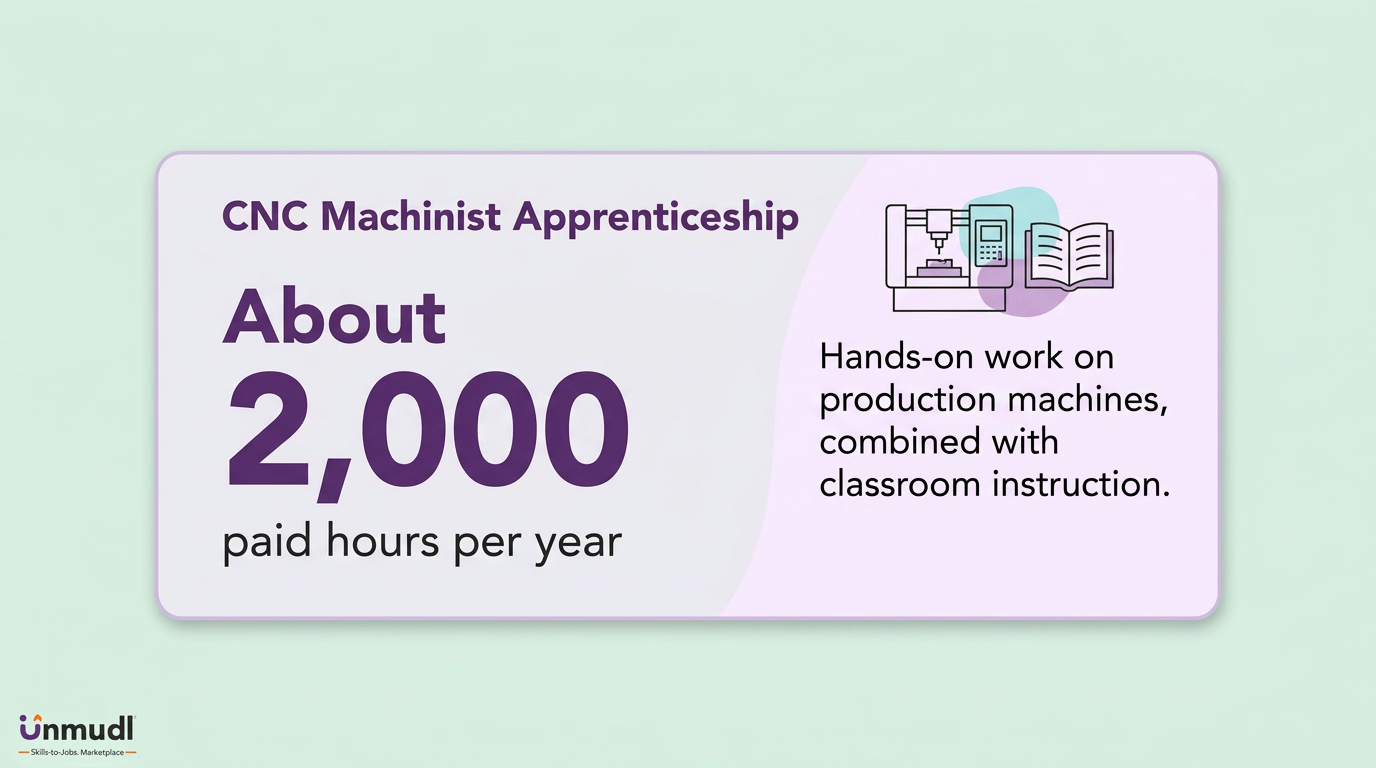
CNC apprenticeship combining about 2,000 paid work hours per year with hands-on machine training and classroom instruction

Join a registered CNC machinist apprenticeship as the alternative to full-time schooling. A CNC machinist apprentice combines about 2,000 paid hours per year on production machines with classroom instruction. The apprenticeship places the learner beside experienced machinists who supervise machine running and gauge use on live jobs. Union shops and manufacturing companies sponsor these programs, and several align their curriculum with NIMS standards.

2. What are the Credentials Required for a CNC Machinist?

CNC machinist credentials are voluntary industry certifications that verify competence in a defined machining task. No national license exists for machinists in the United States, so no single credential is legally mandated. Two credential groups matter to employers. The groups are NIMS machining credentials and employer-preferred certificates. NIMS lists 52 skill certifications across 24 machining skill areas, and the two groups are described below.

2.1 Earn NIMS Machining Level I Credentials

Earn NIMS Machining Level I credentials in the CNC modules first. The Level I modules include CNC Mill Operations, CNC Turning Operations, and CNC Lathe Programming. Each module tests setup, programming, and operation on the named machine class. Some machinist programs require every Level I CNC credential before graduation. Holding these modules evidences competence to employers who otherwise rely on an interview alone.

2.2 Add Employer-Preferred Certificates in Measurement and Safety

Add employer-preferred certificates after the NIMS core, since individual shops set their own hiring filters. Precision measurement certificates cover the micrometers, bore gauges, and calipers used in first-piece inspection. Safety certificates cover guarding and coolant handling on the shop floor. BLS notes that CNC programmers usually need coursework beyond high school, so a programming certificate moves a machinist toward that role. Stacking these certificates on the NIMS base completes the qualification set. Every certificate in that set attests to a skill.

3. What Skills Does a CNC Machinist Need?

CNC machinist skills are the technical abilities that turn a drawing into a finished part within tolerance. The skill set has three parts. The parts are blueprint reading with precision measurement, programming with CAD/CAM software, and hands-on cutting on real equipment. Training programs teach the first two parts in the classroom, and the shop floor teaches the third. The three parts are described below.

3.1 Learn Blueprint Reading and Precision Measurement

Learn blueprint reading and precision measurement before touching a control panel. Blueprint reading converts engineering drawings and geometric tolerances into machine offsets and tool choices. Precision measurement checks the first piece with a micrometer or bore gauge before a production run continues. A slight error in either skill makes a part unusable, since CNC work holds tolerances that a visual check cannot verify.

3.2 Practice CNC Programming and CAD/CAM Software

Practice CNC programming and CAD/CAM software until a program runs without manual correction. CAD software holds the part geometry. CAM software converts that geometry into G-code instructions for the machine. CNC programming classes teach the machinist to edit offsets and re-run a corrected program. Programming ability separates a machinist from an operator who only loads a proven program.

3.3 Cut Metal on Real Equipment

Cut metal on real CNC mills and lathes during training, because software simulation alone cannot teach chip formation or tool wear. Experienced machinists advise against entirely online CNC courses for this reason and recommend community college workshops where students run actual equipment. Shop practice teaches touching off a tool, zeroing a setup, and monitoring surface finish. Experience with cutting metal is the skill that employers test first. Acquiring that skill set takes a measured span of time.

4. How Long Does It Take to Become a CNC Machinist?

CNC machinist training timelines: two to four years for independent skills, six to twelve months for a certificate, and three to five years for apprenticeship

The time to become a CNC machinist ranges from 2 to 4 years of combined education and experience. The duration depends on the training route, and each route sets its own clock. The clocks are the certificate clock, the apprenticeship clock, and the run-up to independent competence. A certificate finishes fastest and an apprenticeship takes longest. The three clocks are explained below.

4.1 Allow 6 to 12 Months for a Certificate Program

Allow 6 to 12 months for a short CNC machining certificate at a career college or community college. A full associate degree extends the classroom clock to 1 to 2 years. Accelerated year-round tracks finish in 17 to 18 months. Classroom routes therefore span from 6 months to 36 months for the longest full vocational program. The certificate clock ends at graduation.

4.2 Plan 3 to 5 Years for an Apprenticeship

Plan 3 to 5 years for a CNC machinist apprenticeship, since the apprentice earns wages while learning. Each apprenticeship year holds about 2,000 paid hours on production machines plus related classroom instruction. The longer clock produces a machinist who has already run live jobs under supervision, so no separate experience period follows completion. Apprentices who pass NIMS credentials during the program finish with both the time served and the certification.

4.3 Reach Independent Competence Within 2 to 4 Years

Reach independent competence within 2 to 4 years of entering the field, whichever route the machinist takes. Independent competence means setting up a new job, proving the first piece, and correcting offsets without a supervisor checking each step. A certificate graduate spends additional months on the job to reach that point, while an apprentice reaches it inside the program. Full competence marks the point at which the entry role ends.

5. How to Gain Work Experience as a CNC Machinist?

Work experience for a CNC machinist is supervised production time that converts training into independent machining. The experience path runs through three stages. The stages are an operator or set-up entry role, advancement into programming and multi-axis machining, and continuing education on evolving CNC technology. Each stage adds responsibility over the machine, and the three stages are described below.

5.1 Start as a CNC Operator or Set-Up Person

Start as a CNC operator or set-up person, which is the entry role most shops offer a new graduate. The operator half of that entry role runs a proven program. A set-up person aligns the machine for a new job before the operator runs it. Entry-level CNC machinists earn about $40,000 to $50,000 per year, and the role becomes a machinist position once setup and programming duties are added.

5.2 Advance to CNC Programming and Multi-Axis Work

Advance to CNC programming and multi-axis work once setup duties are routine. A programmer writes G-code from CAD designs rather than editing a program written by others. Aerospace and medical device shops hold the tightest tolerances that demand this programming depth. Mid-career machinists earn $55,000 to $72,000 per year, and senior machinists in specialized sectors earn $70,000 to $90,000. Advancement therefore tracks programming responsibility rather than years alone.

5.3 Keep Skills Current with Evolving CNC Technology

Keep skills current, because CNC technology changes faster than the credential that first certified them. Multi-axis machining, CAM software updates, and hybrid additive processes each add a control layer that older training did not cover. Manufacturers report difficulty filling CNC roles as experienced machinists retire. Keeping every skill current protects the wage a CNC machinist commands.

What is the Average Pay For a CNC Machinist?

CNC machinist salary snapshot showing a $58,750 annual median and $28.24 hourly wage

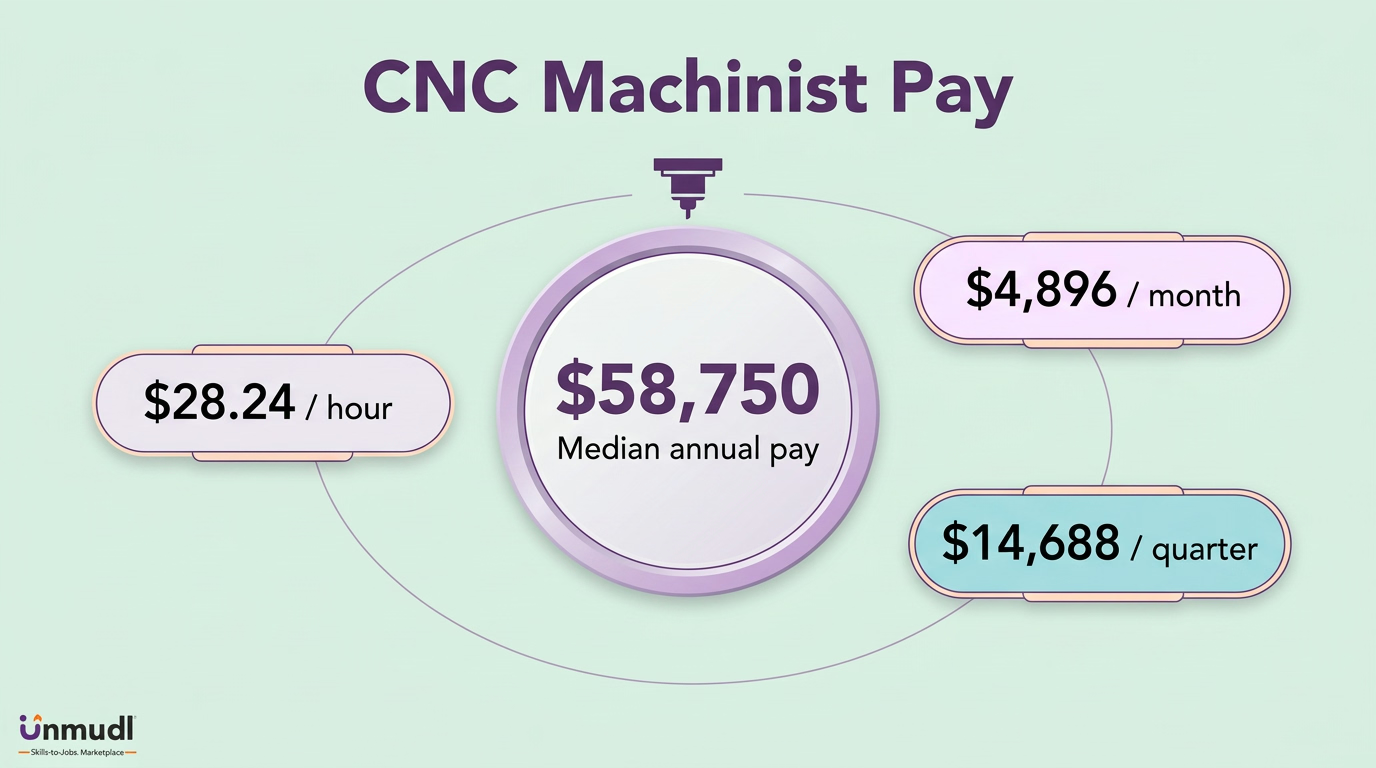
A CNC machinist salary is $58,750 per year at the median, which BLS reported for machinists in May 2025. The hourly rate is $28.24 at the same median. The monthly rate is $4,896, derived as one twelfth of the annual figure. The quarterly rate is $14,688, calculated as one quarter of the same figure. After all conversions, the average rate for a CNC machinist stands at $58,750 per year. A wage at that level draws the question of whether a degree is needed to earn it.

Does a CNC Machinist Need a Degree?

No, a CNC machinist does not need a college degree, since the entry requirement for the trade is a high school diploma or its equivalent. Training then continues on the shop floor. A CNC machining degree, such as an associate degree in machining technology, stays an optional qualification that shortens that training period. Employers read a machining certificate or an apprenticeship record as equal preparation for a machinist post. The machinist post itself is reached through a job application.

How to Apply for CNC Machinist Job?

Applying for a CNC machinist job on Unmudl takes four steps, which are account creation, account verification, profile completion, and the application click. The steps are listed below.

  1. Create an Unmudl account on Unmudl.com, or sign in to an existing one.
  2. Verify the account through the email confirmation the platform sends.
  3. Complete the profile with CNC skills, work experience, and an uploaded resume.
  4. Click Apply Now on the CNC machinist job listing to reach the employer's application portal.

Each CNC machinist job description on a listing states the machine family, the shift pattern, and the tolerance standard the employer expects. The CNC machinist wages posted beside that description let an applicant weigh the post before the application leaves the platform. Completing the four steps in sequence moves a candidate from a blank account to a submitted application in one session. The resume attached at the profile step is the document the employer opens first.

How to Build a CNC Machinist Resume?

A CNC machinist resume is built from five components, which are the resume builder, the education section, the skills section, the experience section, and the tailored wording. The components are listed below.

  1. Use the free Unmudl resume builder, which formats an ATS (applicant tracking system)-friendly resume without an account.
  2. List the CNC machinist education requirements met, including a machining certificate, an associate degree, or an apprenticeship record.
  3. Highlight machining skills such as G-code programming, lathe and mill operation, blueprint reading, precision measurement, and CAD/CAM software.
  4. Showcase shop experience with measured results, for example a reduced scrap rate or a completed production run.
  5. Tailor the wording to the listing with terms such as CNC lathe and GD&T (geometric dimensioning and tolerancing), then proofread the final document.

Assembling the five components in that order gives an employer the qualification, the skill set, and the proof of output on one page. The qualification line is where a completed training course earns its place.

What is the Best CNC Machinist Online Courses?

The best CNC machinist online courses on Unmudl are Introduction to CNC Machinist, Smart CNC Machinist, and Accelerator: Smart CNC Machinist. No single course fits every learner, since each one serves a different starting level. Introduction to CNC Machinist opens the trade to a newcomer. Smart CNC Machinist gives a learner with prior shop exposure the applied machining processes. Accelerator: Smart CNC Machinist covers the full CNC skill path in one enrollment. These CNC machinist programs sit on the same skills-to-jobs marketplace as the job listings. A finished entry from the CNC machinist courses list therefore appears on the profile an employer reviews. The employer reviewing that profile is reached directly or through a recruitment agency.

What are the Top CNC Machinist Recruitment Agencies?

Unmudl lists no CNC machinist recruitment agencies for Savannah, Georgia, or Houston, so the marketplace connects a candidate to an employer directly. The staffing firms that place machinists in those locations operate outside the platform. Trillium Staffing fills CNC machinist jobs in Savannah. Trillium Staffing and Aerotek cover CNC machinist jobs across Georgia, and a CNC lathe machinist in Georgia reaches openings through the same two firms. KP Staffing recruits for CNC machinist jobs in Houston. A candidate in any of the three locations lands a machinist post through an external agency or through a direct listing. The worth of that post is the next question.

Is CNC Machinist a Good Career?

Yes, CNC machinist is a good career, since the trade pays above most non-degree occupations and keeps hiring to replace retiring workers. The BLS Occupational Outlook Handbook projects a 1 percent decline in employment from 2025 to 2035 and about 30,400 openings each year. A machinist program built on shop practice, not a college track, is what advancement in the trade rewards. The first rung of that advancement is the operator post.

What is the difference between CNC machinist and CNC operator?

The difference between a CNC machinist and a CNC operator lies in ownership of the machine setup, not in the machine each one stands beside. A CNC operator is a production worker who loads stock, starts a pre-programmed cycle, and checks parts with calipers. The machinist sets the tooling, edits the G-code, and proves the first sample. The validated program then passes from the machinist to the operator.

The goal of the machinist is a process that holds tolerance across the whole batch. The goal of the operator is steady output at the expected rate under that process. On one job, the machinist fixtures a new part on a mill and approves the first piece. The operator runs the approved program for the rest of the shift. A CNC operator school teaches the loading and gauging side of that division, which is why the operator post is the entry rung. The technician post sits on a separate ladder.

What is the difference between CNC machinist and Technician ?

A CNC machinist and a technician differ in the output each role is measured on. A CNC machinist produces parts, so the shift is measured in components that match a drawing. A technician, in the industrial sense of a maintenance or engineering technician, keeps equipment running, so the shift is measured in machine uptime.

The tools of the machinist are the mill, the lathe, the micrometer, and the CAD/CAM file that drives the cut. The tools of the technician are the multimeter, the hand and power tool set, and the diagnostic instrument that finds the fault. On one shop floor, the machinist cuts an aircraft bracket on a CNC mill while the technician troubleshoots the hydraulic press beside it. Both roles keep the same factory producing.

Learn In Demand Skills Employers Are Hiring For

Explore our career-ready "Mechatronics and Robotics Maintenance" designed with employers to help you get hired faster. Train for industrial maintenance in ~10–12 weeks, earn a certificate and get ready to interview for technician roles.
No items found.
No items found.
Last updated on:
October 19, 2026
No items found.