What is a Multicraft Technician?
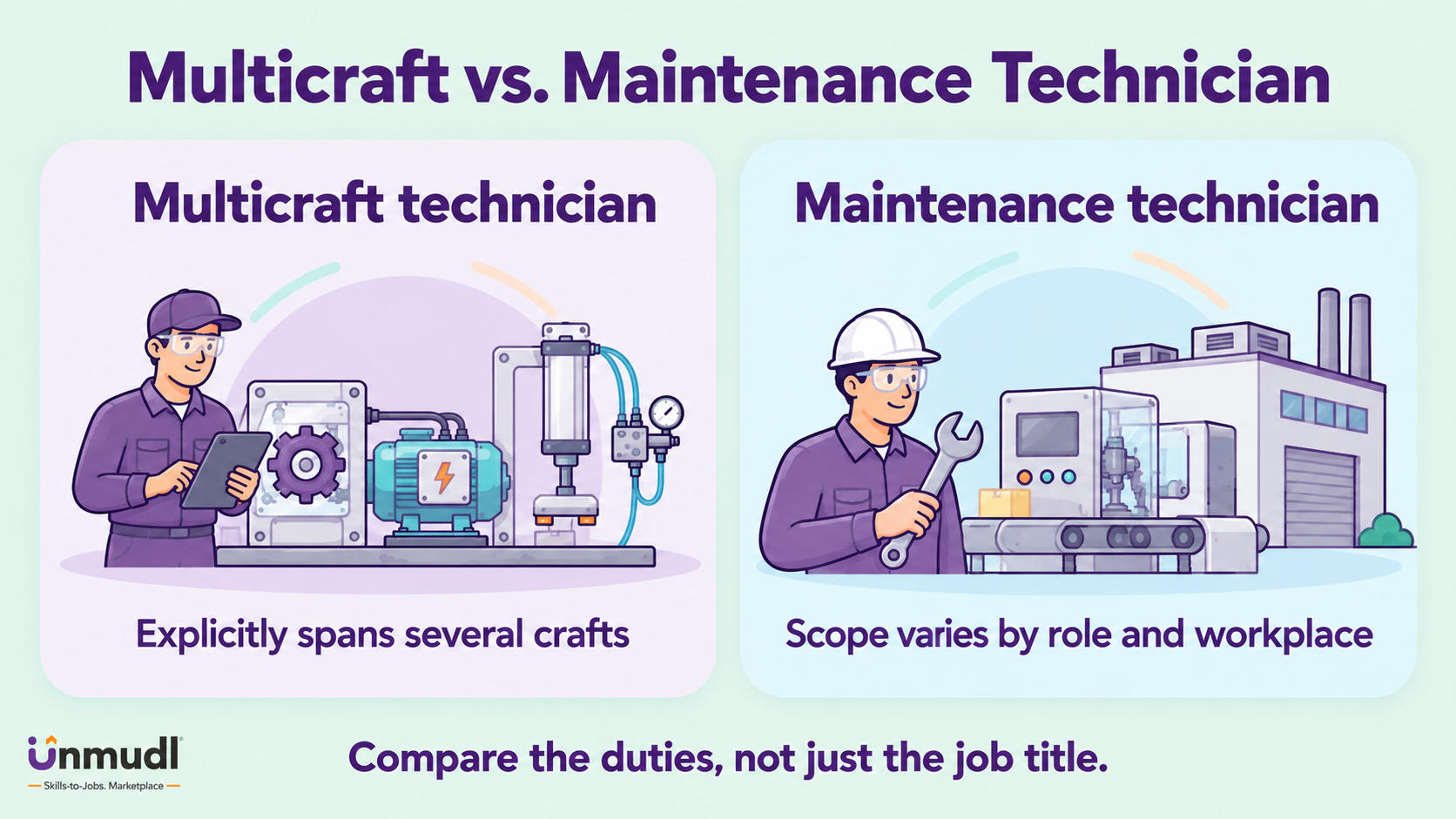
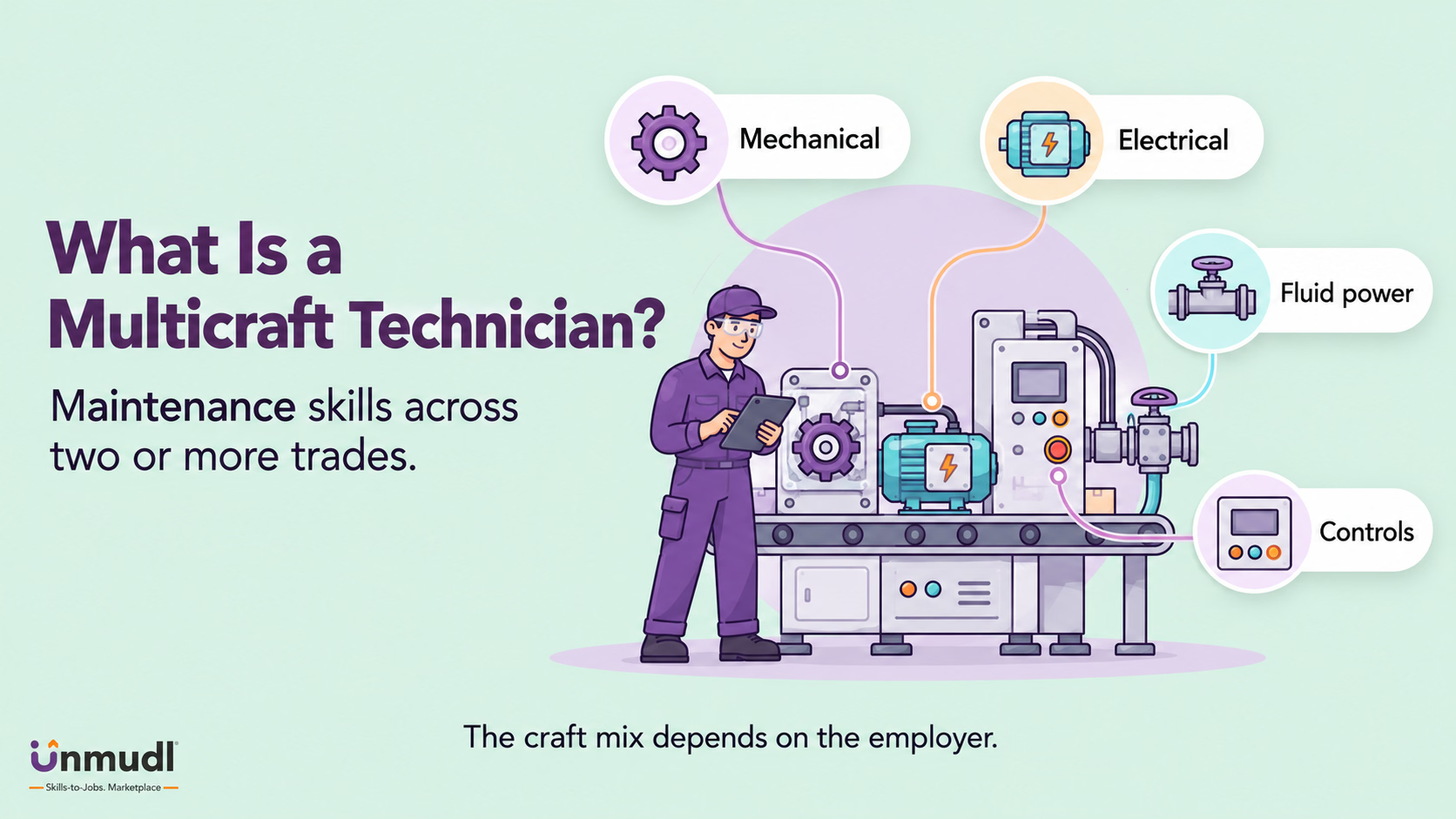
A Multicraft Technician is a cross-craft plant maintenance worker whose job scope bundles mechanical, electrical, fluid-power, and fabrication competence into one employer-defined position. The job scope shifts from plant to plant, so Printpack's version stresses mechanics, hydraulics, and pneumatics, while Kimberly-Clark's version leans toward programmable logic controller (PLC) and control systems. The shift signals breadth rather than one standardized skill matrix. Breadth of this kind stops at the boundary of licensed trades, because tasks above the worker's skill level pass to electricians or heating, ventilation, and air-conditioning (HVAC) technicians. A multicraft maintenance technician is the maintenance-explicit variant of the same title, used by Bridgestone, Saint-Gobain, and Mercedes-Benz for the same cross-system work. The available evidence establishes no separate occupation behind the variant. Both titles rest on the baseline that the Occupational Information Network (O*NET) sets in its 2026 profile of general maintenance and repair workers for work spanning two or more crafts. That cross-craft work is the daily task set of the role.
What does a Multicraft Technician do?
A Multicraft Technician works by diagnosing an equipment fault first and then correcting it inside whichever craft domain holds the cause. Diagnosis starts with inspecting, operating, or testing the machine against schematics, manuals, and machine error messages. The error message points to the failed domain, which is a gearbox, a drive, a PLC signal, or a hydraulic actuator. Correction then runs inside that domain through component replacement, wiring work, alignment, or balancing with hand tools and electrical test instruments. Planned servicing continues alongside the corrective work and covers drives, motors, belts, fluids, and filters on a manufacturer-set interval. Scheduled servicing is linked by Kimberly-Clark's Warren, Ohio posting to machine uptime and failure elimination. Technicians perform each task only within their training, their employer's authorization, and the applicable hazardous-energy procedure. The employer's authorization also fixes which title the role carries.
What are the Types of Multicraft Technician?
There are six employer-used types of Multicraft Technician, divided by the title attached to the same cross-craft maintenance role. The types are Multicraft Technician, Multicraft Maintenance Technician, Multi-Craft Industrial Maintenance Technician, Multicraft Partner, Multi-Skilled Technician, and General Maintenance and Repair Worker. No federal classification publishes a taxonomy of these types, so each one is a naming pattern rather than a standardized occupation. The table below compares the six types by setting, craft emphasis, and named source.
1. Multicraft Technician
The Multicraft Technician is the unqualified core title for cross-craft plant and equipment maintenance. The core title covers general plant upkeep through mechanics, machine-shop practice, hydraulics, pneumatics, fabrication, and equipment installation or modification. Installation and modification work hands the employer one position for conditions that span more than one craft. Candidates match their preparation to the system mix a posting names.
2. Multicraft Maintenance Technician
The Multicraft Maintenance Technician is the title that adds the word maintenance to the same breadth applied to production or facility equipment. The maintenance purpose spans preventive servicing, fault correction, and restoration of equipment operation across mechanical, electrical, PLC, hydraulic, and pneumatic systems. Restoration supports process reliability and daily production requirements. Technicians who hold the title compare each job's craft domains instead of searching for one universal curriculum.
3. Multi-Craft Industrial Maintenance Technician
The Multi-Craft Industrial Maintenance Technician adds an industrial qualifier to the maintenance-explicit title. The qualifier narrows the setting to production machinery inside a plant and away from building-oriented upkeep. Production machinery runs around the clock, so the qualified title carries rotating shifts across nights, weekends, and holidays. Employers use the qualifier as their own taxonomy, not as a national third category.
4. Multicraft Partner
The Multicraft Partner is the internal title Kimberly-Clark gives to the position it advertises publicly as Multicraft Technician. The partner title places the worker inside a self-directed manufacturing work system rather than a conventional maintenance department. A self-directed system assigns asset troubleshooting, preventive maintenance, and daily performance records to the same worker. Partners log that work in the plant's maintenance-management software.
5. Multi-Skilled Technician
The Multi-Skilled Technician is a related title that facility-services employers such as CBRE use for maintenance and repair across mechanical, electrical, and other building systems. The building-system scope reaches from inspection and diagnosis into installation work, work-order estimation, and compliance checks. Compliance work makes the title relevant background without making the two titles identical. Readers treat such a listing as a related example rather than an exact match.
6. General Maintenance and Repair Worker
The General Maintenance and Repair Worker is the federal occupational title whose definition matches the multicraft concept most closely. The federal definition keeps machinery, mechanical equipment, or buildings in repair through combined craft skills. Buildings widen the setting past manufacturing into hotels, hospitals, offices, and campuses. Classification agencies apply this title where employers apply the multicraft label.
Reading the six titles together lets a candidate separate the shared breadth from the setting, craft mix, and duties each employer attaches to it.
What are the Duties of Multicraft Technician?
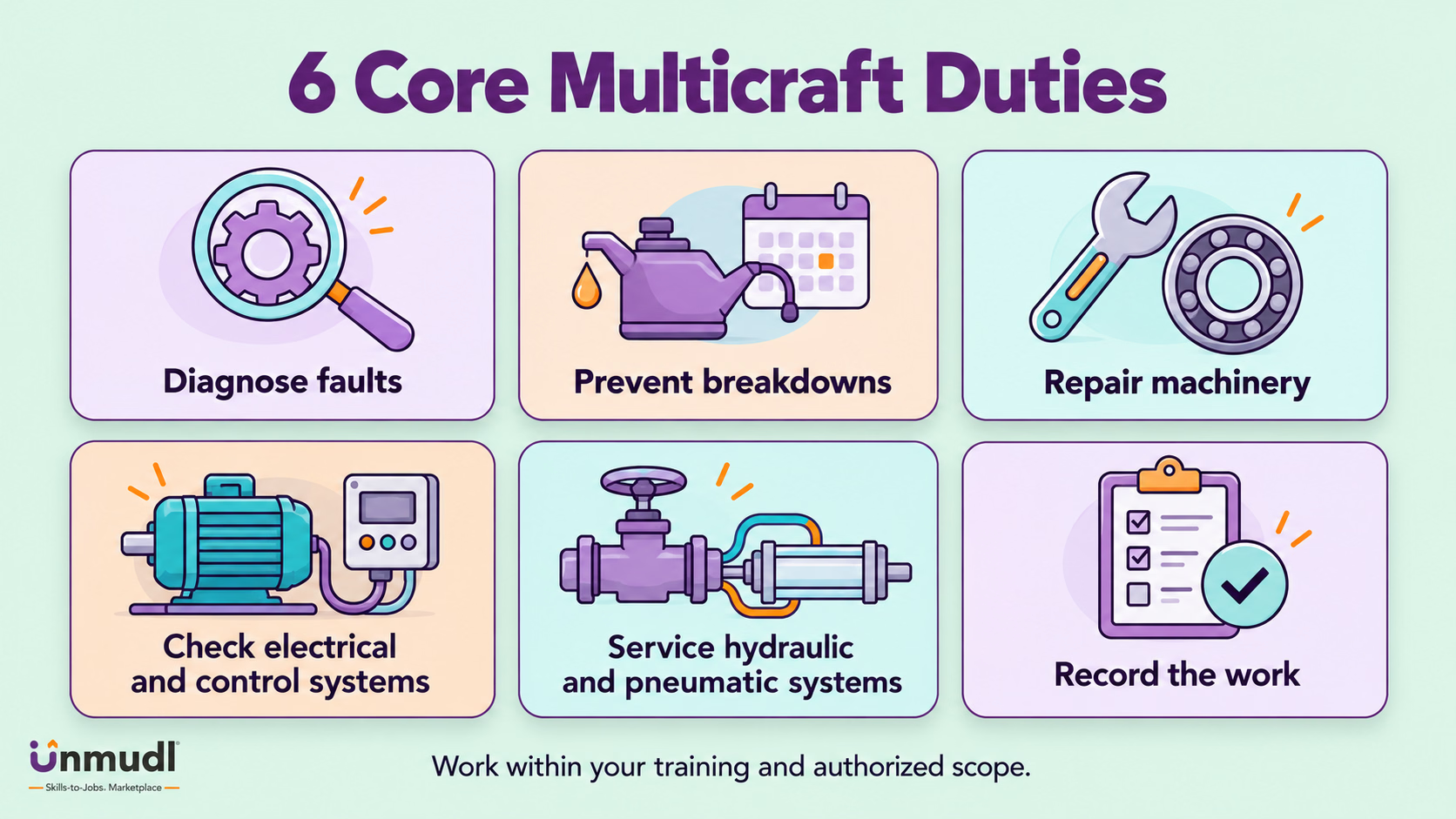
There are six main duties of a Multicraft Technician, grouped by the stage of the maintenance cycle each duty serves. The duties are inspecting and diagnosing equipment faults, performing preventive maintenance, repairing mechanical equipment, troubleshooting electrical and control systems, maintaining hydraulic and pneumatic systems, and documenting maintenance work. Installing and fabricating equipment forms a seventh employer-specific duty, so the total number of duty groups is seven.
1. Inspecting and Diagnosing Equipment Faults
Inspecting and diagnosing is the duty that identifies the failed or degraded component before any repair begins. The identification draws on observed symptoms, test results, schematics, and manuals rather than on guesswork. Symptom-based identification separates the mechanical, electrical, or fluid-power domain that holds the fault. Technicians escalate any fault that sits outside their competence.
2. Performing Preventive Maintenance
Preventive maintenance consists of planned inspection and servicing that keeps equipment within its required operating condition. The planned work covers drives, motors, belts, fluid levels, filters, and calibration of flow, pressure, and temperature devices. Calibration follows the schedule the equipment manufacturer specifies and the work order the employer approves. Technicians record each completed check and every abnormal finding.
3. Repairing Mechanical Equipment and Components
Mechanical repair restores worn, misaligned, or failed physical components to their specified condition. The restoration moves through adjustment, disassembly, replacement, reassembly, and lubrication of bearings, pumps, gearboxes, conveyors, and belts. Reassembly follows the drawings and tolerances the manual specifies. Technicians apply the energy-control procedure before touching any part that holds stored energy.
4. Troubleshooting Electrical, Electronic, and Control Systems
Electrical and control troubleshooting corrects faults in wiring, motors, drives, sensors, and PLCs within the worker's authorized scope. The authorized scope depends on qualification, because specified testing and verification on energized circuits belong to a qualified person. Qualification therefore bounds how deep the control work goes at each employer. Technicians learn the plant's voltage and control environment before accepting that scope.
5. Maintaining Hydraulic and Pneumatic Systems
Hydraulic and pneumatic maintenance keeps power and motion moving through pressurized fluid and compressed air. The pressurized systems include pumps, valves, hoses, and actuators that interact with mechanical and electrical parts. That interaction is the clearest reason an employer bundles several crafts into one role. Technicians treat stored pressure as hazardous energy and service it under a controlled procedure.
6. Documenting Maintenance Work
Maintenance documentation records what was inspected, diagnosed, repaired, or serviced in the plant's maintenance history. The history enters a computerized maintenance management system (CMMS) and carries equipment status, parts used, and outstanding conditions to the next shift. Status handoffs close the maintenance cycle that diagnosis opened. Technicians use the employer's system and terminology rather than verbal handoffs.
Carrying out the six duties in sequence shows how diagnosis selects the craft, servicing and repair apply it, and documentation hands the equipment condition forward on the plant floor.
Where Does a Multicraft Technician Work?
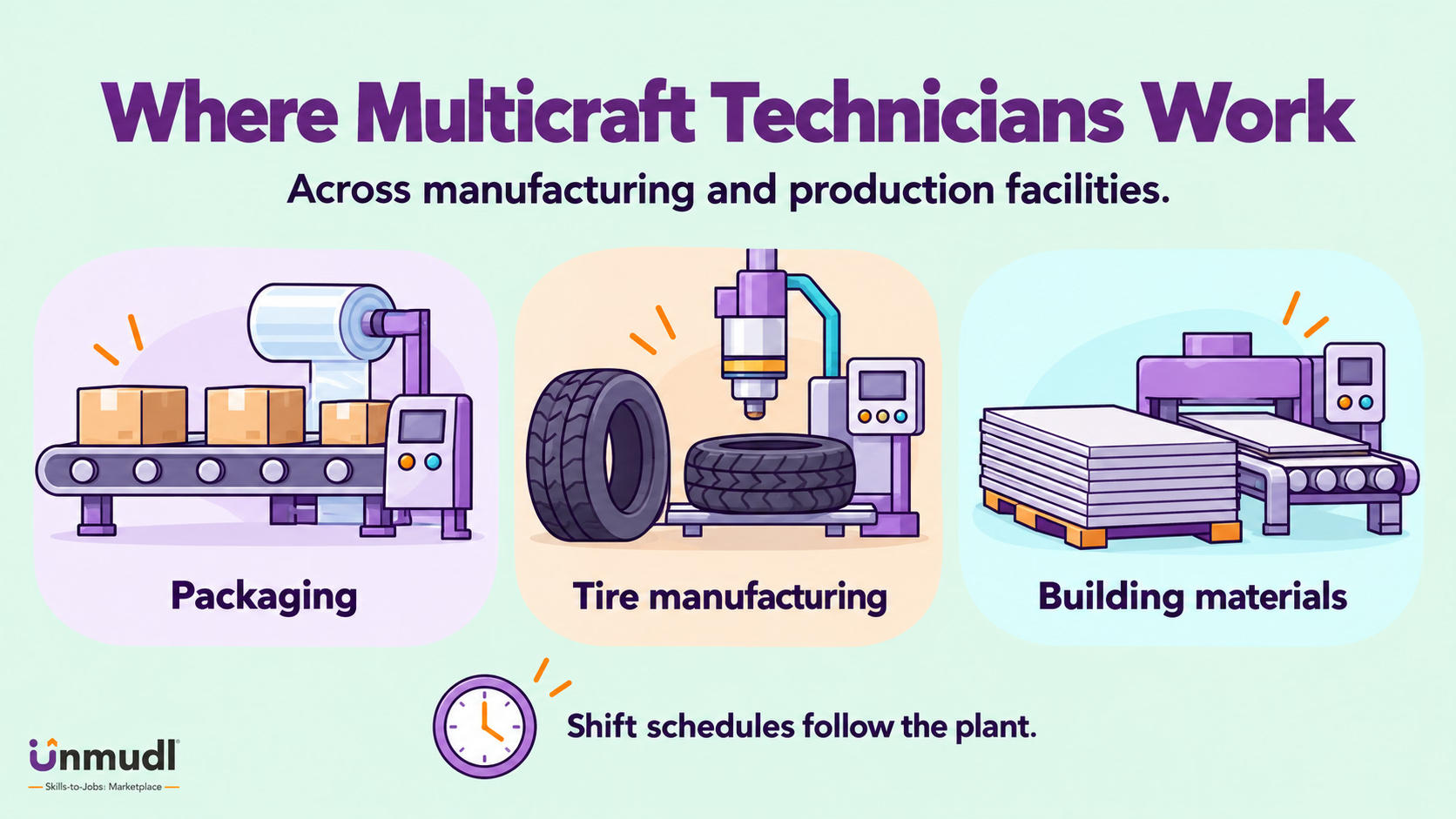
A Multicraft Technician works on site in manufacturing and industrial production facilities, where every exact-title posting reviewed places the role. The facilities span flexible packaging at Printpack in Villa Rica, Georgia, tire manufacturing at Bridgestone in Graniteville, South Carolina, and building-material production at Saint-Gobain in Huntsville, Alabama. Inside those plants the immediate work environment holds production machinery, conveyors, drives, PLC cabinets, hydraulic and pneumatic lines, and utilities such as compressed air. The work schedule follows the plant, so the postings specify 12-hour night shifts, rotating coverage, and overtime. The broader federal occupation reaches far past manufacturing. The Bureau of Labor Statistics (BLS) counted about 1.6 million general maintenance and repair worker jobs in 2025 and placed 20% of them in real estate against 13% in manufacturing. Employers attach the multicraft label wherever the technician must cross several craft domains inside that particular plant. Crossing those domains is the competence a candidate builds before entering the plant.