Industrial Technician: Types, Duties, Work Settings, and Credentials

Industrial technicians are skilled trades workers who keep production machinery, automated equipment, and plant processes running. Industrial technicians perform industrial maintenance on conveyors, robotic cells, hydraulic presses, and motor-control panels so that a production line meets its output, quality, and safety targets. The job title belongs to a family of adjacent occupations rather than to one fixed trade. The family covers industrial machinery mechanics, maintenance technicians, mechatronics technicians, and industrial engineering technicians. A maintenance technician in this family restores a stopped machine. An automation specialist tunes the controls that run the machine. An engineering technician measures how well the line performs. The common thread across the family is the industrial asset, whose availability decides whether a plant produces or stands idle.

Industrial technicians earn their importance from downtime, which is the period in which production equipment stops and revenue stops with it. Downtime is prevented by preventive maintenance, shortened by fast diagnosis, and ended by a verified repair. Automated manufacturing machinery deepens that dependence, since every added robot, sensor, and drive is one more asset that needs service. The benefits of the occupation for the worker are a high school entry route, paid on-the-job training, and steady demand from plants that keep adding automated machinery. Those attributes are set out below through the definition, the six types, the six duties, the work settings, and the credentials of an industrial technician.

What is Industrial Technician?
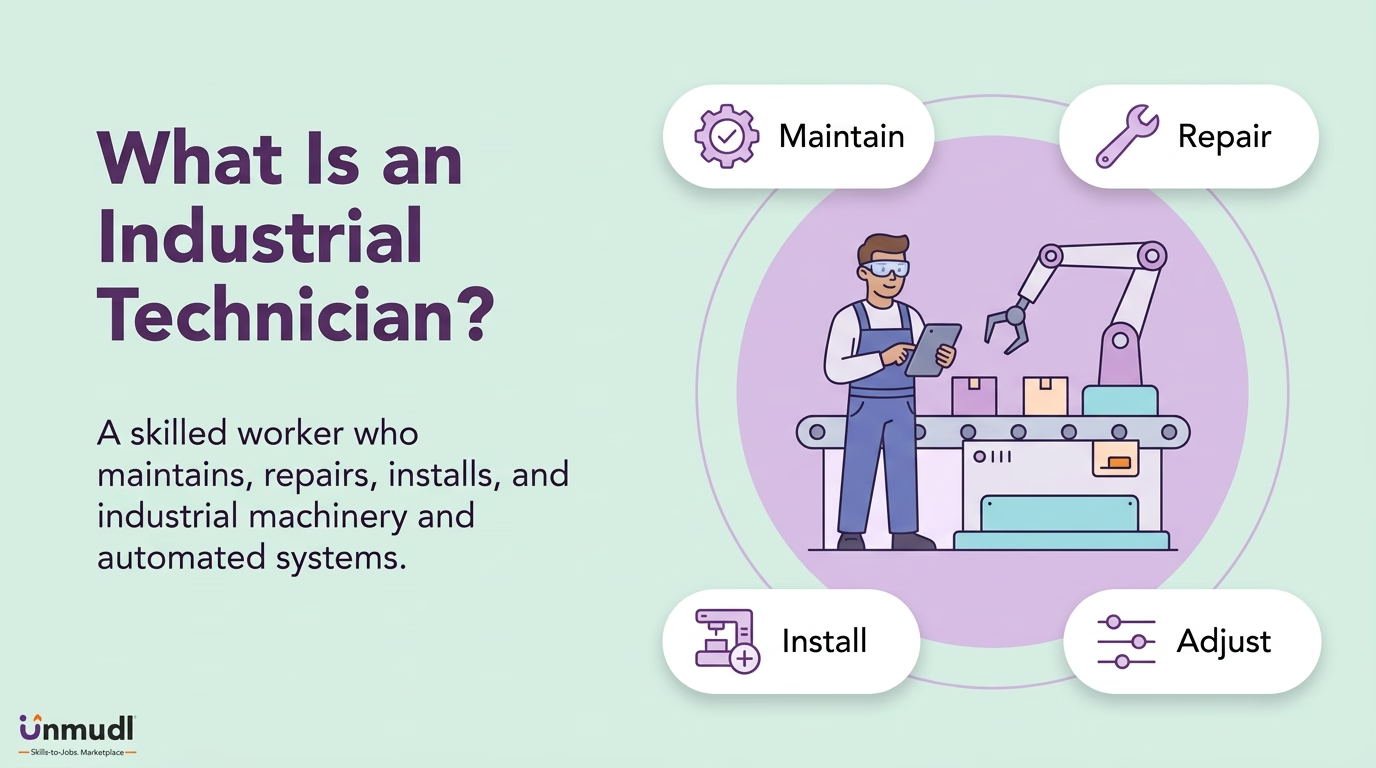
Industrial technician maintaining, repairing, installing and adjusting industrial machinery and automated systems

An industrial technician is a technician who maintains, repairs, installs, and adjusts the machinery and automated systems used in industrial production. An industrial technician holds a job title that employers assign. The title maps onto several classified occupations depending on the work performed. The classified occupations behind the title are industrial machinery mechanic, machinery maintenance worker, electro-mechanical technician, industrial controls repairer, and industrial engineering technician. A maintenance mechanic is the closest overlapping title, since the mechanic's work centers on machinery upkeep rather than on production analysis. A warehouse maintenance technician is the same role placed in a distribution center, where the maintained assets are conveyors and dock equipment. The U.S. Bureau of Labor Statistics (BLS) Occupational Outlook Handbook, last modified August 27, 2026, counts 547,300 jobs in 2025 across industrial machinery mechanics, machinery maintenance workers, and millwrights combined. Each of those jobs is defined by the work the technician performs on the machinery.

What Does an Industrial Technican do?

An industrial technician keeps industrial equipment operating to specification by inspecting, diagnosing, repairing, calibrating, and testing it. The technician detects a fault through observation, machine error data, or a diagnostic instrument. The cause of the fault is removed by repairing or replacing the failed component. The repaired machine is tested before it returns to production. Preventive work runs alongside the corrective work, so the technician also lubricates, adjusts, and inspects equipment on a fixed schedule. Hazardous energy control frames every one of those tasks, because a machine under service stores electrical, hydraulic, pneumatic, and thermal energy. A maintenance degree is not a precondition for that work.  The precondition is an entry route. The entry route changes with the type of industrial technician the worker becomes.

What are the Types of Industrial Technician?
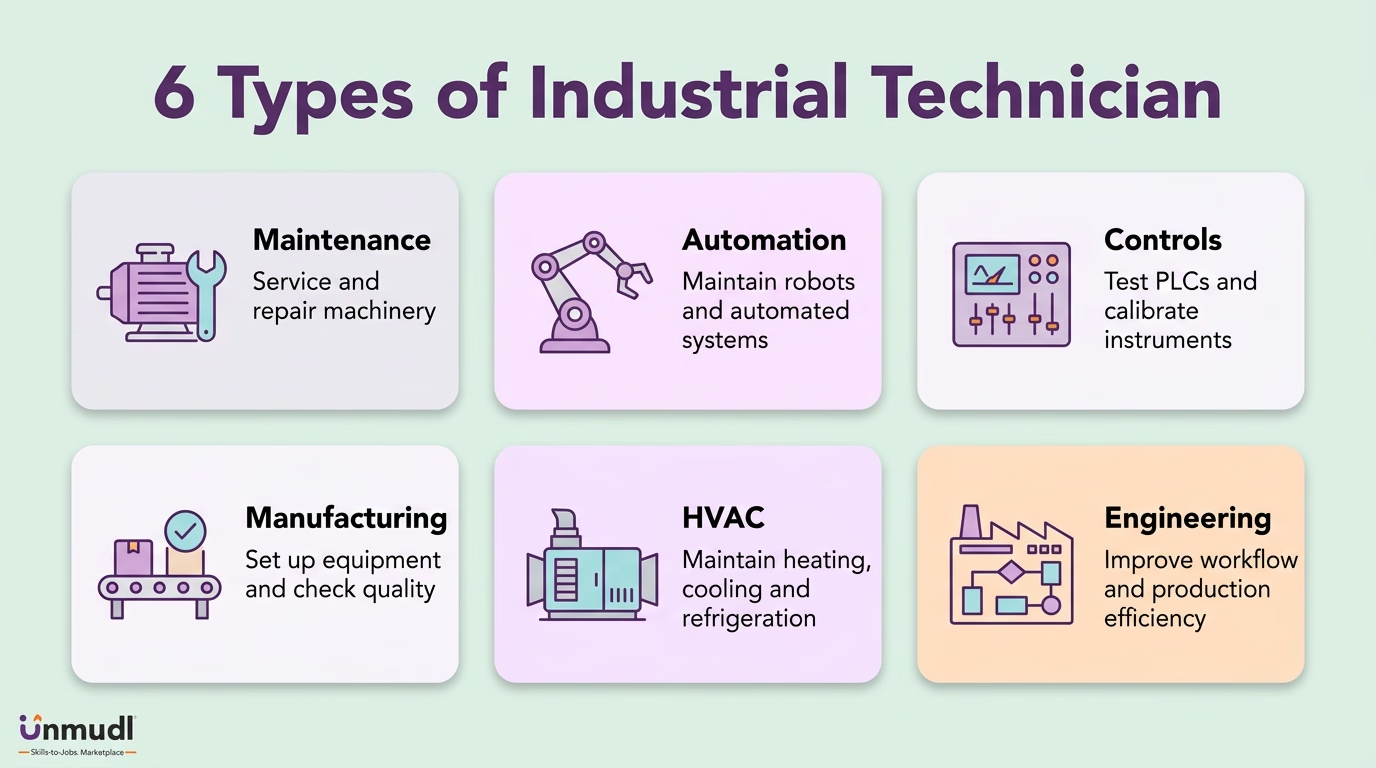
Six industrial technician types: maintenance, automation, controls, manufacturing, HVAC and engineering

There are six main types of industrial technician based on the system the technician is responsible for keeping in service. The types are industrial maintenance technician, industrial automation technician, industrial controls technician, industrial manufacturing technician, industrial HVAC (heating, ventilation, and air conditioning) technician, and industrial engineering technician. These types of technician are described below. The table below sets each type against the system it keeps in service, the task that defines it, and the team that relies on it.

TypeSystem kept in serviceDefining taskWho relies on it
Industrial maintenance technicianProduction equipment: bearings, belts, drives, and motorsScheduled service and corrective repairPlants
Industrial automation technicianRobots, servo drives, and computer-controlled machinesTesting an automated cell and adjusting its sensorsManufacturers with automated cells
Industrial controls technicianPLCs, motor controls, transmitters, and instrumentationReading a schematic and calibrating a transmitterPlants, at the panel-to-machine boundary
Industrial manufacturing technicianThe production line between service visitsEquipment setup, process monitoring, and quality checksProduction managers
Industrial HVAC technicianCompressors, chillers, and air handlersHolding a plant or cold store at its required temperatureFacilities
Industrial engineering technicianManufacturing layout, workflow, and production efficiencyCollecting production and quality data and studying time and motionEngineering teams
Common misreadingOne title covers all six typesThe system a posting names decides the typeCandidates

Industrial Maintenance Technician

An industrial maintenance technician is a machinery specialist who keeps production equipment available through scheduled service and corrective repair. The maintenance technician inspects bearings, belts, drives, and motors. Worn components are replaced before they fail. A failure that does occur is traced to its cause and cleared. Plants value this type for the downtime the role removes.

Industrial Automation Technician

An industrial automation technician is a robotics specialist who services the robots, servo drives, and computer-controlled machines that run a process without manual operation. The automation technician tests an automated cell and adjusts the actuators and sensors that guide it. A robotic arm that has lost its position is restored. Manufacturers assign the automation technician wherever automated cells outnumber hand-operated stations.

Industrial Controls Technician

An industrial controls technician is an electrical specialist who maintains the programmable logic controllers (PLCs), motor controls, transmitters, and instrumentation that command industrial equipment. The controls technician reads a control schematic and tests a circuit with an electronic instrument. A transmitter is calibrated until its signal stays within range. Plants place this type at the boundary between the electrical panel and the machine it drives.

Industrial Manufacturing Technician

An industrial manufacturing technician is a production-floor technician who supports production operations through equipment setup, process monitoring, and quality checks. The manufacturing technician sets up a machine for a run and monitors its output against specification. Basic preventive maintenance sits inside the role, and deeper repair sits outside it. Production managers rely on this type to keep a shift running between service visits.

Industrial HVAC Technician

An industrial HVAC technician is a building-systems specialist who maintains the heating, ventilation, air conditioning, and refrigeration systems that condition industrial buildings and processes. The HVAC technician services the compressors, chillers, and air handlers that hold a plant or a cold store at its required temperature. Facilities count on the HVAC technician when the conditioned space is itself part of production.

Industrial Engineering Technician

An industrial engineering technician is an engineering-support technician who helps engineers improve manufacturing layout, workflow, and production efficiency. The engineering technician observes a process, collects production and quality data, and studies time and motion. Those studies become recommendations for process changes. Engineering teams use this type as the link between the drawing office and the production floor.

Reading the six types by the system each one serves lets a candidate match maintenance technician jobs to the machinery, controls, or process a posting names beside its duties.

What are the Duties of Industrial Technician?
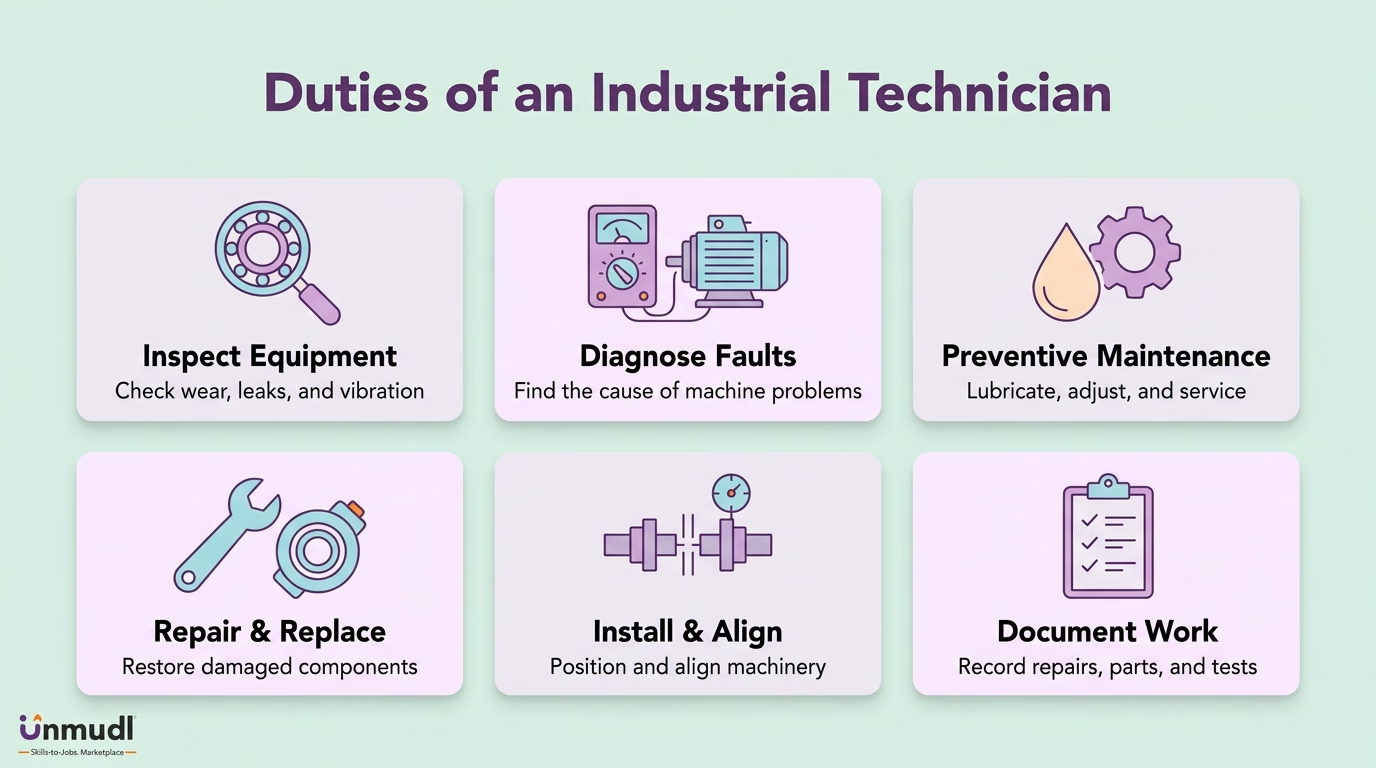
Six industrial technician duties from equipment inspection and fault diagnosis to repair, installation and documentation

The main duties of an industrial technician are inspecting equipment, diagnosing faults, performing preventive maintenance, repairing and replacing components, installing and aligning machinery, and documenting maintenance work. The six duties are listed below in the order a maintenance cycle runs them. The maintenance technician skills behind the duties are mechanical, electrical, and fluid-power troubleshooting. An industrial technician salary follows the range of duties the worker performs, since each occupation in the family sets its own median wage.

1. Inspecting Equipment

Inspecting equipment is the routine examination of machinery for wear, leaks, vibration, heat, and noise before a failure occurs. The industrial technician walks a production line on a fixed schedule and checks belts, bearings, seals, and fluid levels. A reading outside its acceptable range becomes a work order. Supervisors treat the inspection log as the earliest warning the plant receives.

2. Diagnosing Faults

Diagnosing faults is the tracing of a machine problem to its cause through observation, error data, and test instruments. The technician reads the machine's error information and measures voltage and vibration at the suspected point. Diagnosis ends when the failed bearing, drive, sensor, or circuit is named, not when the symptom stops. Maintenance teams order the replacement part only after that diagnosis is complete.

3. Performing Preventive Maintenance

Performing preventive maintenance is the scheduled lubrication, adjustment, and parts replacement that stops a failure before it begins. The technician follows a maintenance plan that sets the interval for each machine. Drives are greased, belts are tensioned, and consumable parts are swapped at the end of their rated life. Planners slot this duty around production so that the line loses no running hours.

4. Repairing and Replacing Components

Repairing and replacing components is the corrective work that restores a failed machine to operation. The technician disassembles the affected unit, repairs or replaces the damaged part, and reassembles the unit for a test run. Fabrication tools such as lathes, grinders, and welding equipment allow a worn part to be reconditioned. Production crews measure this duty in the minutes between breakdown and restart.

5. Installing and Aligning Machinery

Installing and aligning machinery is the positioning, leveling, and connection of new or relocated equipment so that it runs true from its first cycle. The technician reads the installation drawing, moves the machine with hoists or jacks, and aligns shafts and couplings with precision instruments. Alignment error left at installation is the vibration the technician later diagnoses. Plant engineers sign off on this duty before a machine is commissioned.

6. Documenting Maintenance Work

Documenting maintenance work is the recording of every inspection, repair, part, and test in a maintenance log or a computerized maintenance management system (CMMS). The technician enters the fault found, the action taken, the parts consumed, and the hours spent, so the record shows the machine's history at the next inspection. Auditors read the maintenance record as proof that safety and service intervals were kept.

Running the six duties as one cycle keeps equipment inspected, repaired, and recorded before the next scheduled service at the site where the equipment is installed.

Where does a Industrial Technicians Work?

Industrial technicians work primarily in manufacturing facilities, where the production machinery, conveyors, and automated equipment they maintain are installed. The work setting follows the equipment, so the same technician also appears in wholesale trade establishments, machinery repair shops, construction sites, and automated distribution centers. Industry maintenance work at those sites runs around the production schedule, which places machinery mechanics on call, on night shifts, and on overtime when a machine stops without warning. A maintenance worker in a hotel or a hospital holds a related title but a different workplace, because the general maintenance role covers buildings and plumbing rather than industrial equipment. BLS employment data for 2025 places 51% of the three machinery-maintenance occupations in manufacturing, 13% in wholesale trade, 11% in machinery repair and maintenance services, and 5% in construction. The table below pairs each industry share with its reading.

IndustryShare of the three machinery-maintenance occupations, 2025Reading
Manufacturing51%Dominant industry, holding just over half of the group
Wholesale trade13%Second-largest industry, through wholesale trade establishments
Machinery repair and maintenance services11%Field service work outside a single plant
Construction5%Smallest of the four named industries, through construction sites
All other industries20%Derived by subtraction, not a published share

Entry into those plants runs through one preparation pathway.

How to become an Industrial Technician?

Becoming an industrial technician requires industrial technician training, role-specific credentials, a chosen occupational track, foundational education, and practical competence on industrial systems. The pathway is built for the industrial machinery mechanic occupation, where BLS records the preparation as loaded after hiring rather than before it. How to become a repair technician is a broader question, since repair technicians service vehicles, HVAC systems, medical equipment, or electronics under separate entry rules. The five sections below follow the industrial pathway in order. Section 1 explains the training, section 2 sets out the credentials, section 3 chooses the track, section 4 completes the education, and section 5 builds competence on live systems.

1. What is the Training for an Industrial Technician?

The training for an industrial technician is employer-supervised preparation that develops maintenance competence after the diploma is earned. The preparation runs for more than one year for a machinery mechanic. There are three main training routes. The routes are employer on-the-job training, Registered Apprenticeship, and the National Center for Construction Education and Research (NCCER) industrial maintenance curriculum, which are described below.

1.1 Employer On-the-Job Training

Employer on-the-job training is instruction delivered inside the plant by employer trainers or equipment-manufacturer representatives. The instruction begins with routine setup, cleaning, lubrication, and machine starting, then widens to shop mathematics, blueprint reading, hand-tool use, welding, electronics, and computer programming. This route is the baseline for a machinery mechanic because the diploma covers none of those subjects. Employers treat the first year as supervised learning rather than independent repair work.

1.2 Registered Apprenticeship

A Registered Apprenticeship is paid occupational training with supervised learning and related instruction under a federal framework. The U.S. Department of Labor approved a National Occupational Framework for Industrial Maintenance Mechanic on July 29, 2025. The framework spans installation, maintenance, troubleshooting, and repair across mechanical, hydraulic, pneumatic, electrical, and piping systems. The framework's three program designs run 6,000 hours time-based, 6,000 to 8,000 hours hybrid, or 3 years competency-based. Sponsors certify completion against hours in the first two designs and against demonstrated competencies in the third.

1.3 NCCER Industrial Maintenance Curriculum

The NCCER Industrial Maintenance Mechanic curriculum is structured technical instruction organised in four levels totalling 830 recommended hours. The 2025 fourth edition complies with Department of Labor apprenticeship standards. The four levels progress from maintenance tools and mechanical drawings through pumps, valves, bearings, fluid power, electrical test equipment, alignment, and conveyors to preventive and predictive maintenance. Training providers use the curriculum as the classroom half of an apprenticeship. The completed curriculum is then evidenced by a credential.

2. What are the Credentials Required for an Industrial Technician?

The credentials required for an industrial technician are role-specific awards that document completion, assessed knowledge, or a technology specialty rather than one mandatory license. No single certification is required of every industrial technician in the United States. There are three relevant credentials. The credentials are the Certified Maintenance & Reliability Technician, the PMMI (Association for Packaging and Processing Technologies) Programmable Logic Controllers 1 test, and the NCCER Journey Level Assessment.

2.1 Certified Maintenance & Reliability Technician (CMRT)

The Certified Maintenance & Reliability Technician (CMRT) is a professional certification issued by the Society for Maintenance & Reliability Professionals (SMRP) for multi-skilled maintenance work. The examination covers four domains. The domains are maintenance practices, preventive and predictive maintenance, troubleshooting and analysis, and corrective maintenance. Eligibility carries no stated education or experience prerequisite. The certification runs on a three-year cycle, and recertification requires 50 course hours from at least two qualifying activity categories. Plants accept the certification as third-party evidence rather than as a licence to perform work.

2.2 PMMI Programmable Logic Controllers 1 Test

The PMMI Programmable Logic Controllers 1 test is a specialty technical credential for entry-level technicians who maintain PLC-controlled packaging equipment. The test runs approximately 2 hours, contains 100 questions, and requires a 70% passing score. Technicians add this credential only when the plant runs PLC-controlled machinery.

2.3 NCCER Journey Level Assessment

The NCCER Journey Level Assessment for Industrial Maintenance Mechanic is a craft assessment that measures knowledge against the NCCER curriculum. The assessment sits at the end of the four-level pathway and verifies the 830 curriculum hours. The credential is craft evidence, not a professional certification of the CMRT type. Employers read the assessment as proof that a candidate completed the structured curriculum. Which credential an employer reads depends on the track the candidate works in.

3. Choose the Industrial Technician Track That Matches the Work

Choose the track by matching the occupation to the work performed rather than to the job title. Federal classification sorts industrial technician jobs by their tasks, so the title alone settles nothing. There are three tracks under the industrial technician label. The tracks are the industrial machinery maintenance track, the mechatronics track, and the engineering-support track.

3.1 Industrial Machinery Maintenance Track

Projected industrial machinery maintenance employment growth from 2025 to 2035

The industrial machinery maintenance track is the occupational route for repairing, installing, adjusting, and maintaining production and processing machinery. The route carries the Maintenance Technician job title and a federal Bright Outlook label. Employment in the route grows from 446,900 jobs in 2025 to 526,600 jobs in 2035, with about 44,400 openings per year. Choose this track for hands-on machinery repair.

3.2 Mechatronics Track

The mechatronics track is the automation route covering robotic, electronic, and computer-controlled mechanical equipment. The route belongs to electro-mechanical and mechatronics technologists and technicians, who install, test, repair, upgrade, and maintain automated systems. The route held 15,700 jobs in 2025 with 3% projected growth to 2035. Pick this track when the plant runs robots and computer-controlled lines rather than purely mechanical machinery.

3.3 Engineering-Support Track

The engineering-support track is the production-analysis route covering manufacturing layout, workflow, production study, and process improvement under engineering staff. The route belongs to industrial engineering technologists and technicians and holds the exact reported title Industrial Technician. The occupation counted 76,700 jobs in 2025 and grows 3% by 2035. Select this track when the work measures production rather than repairs it. Each track then sets its own foundational education.

4. Complete the Foundational Education for the Chosen Track

Complete the foundational education that the chosen track sets as its minimum award before structured training begins. The award rises from the maintenance track to the two technical tracks. There are two education levels to complete. The levels are the high school diploma and the postsecondary award.

4.1 High School Diploma or Equivalent

A high school diploma or equivalent is the typical entry-level education for a machinery mechanic. The diploma is also the baseline prerequisite named in the 2025 apprenticeship framework. Employer respondents in the Occupational Information Network (O*NET) profile report the diploma as sufficient for 39% of new hires. The same respondents name a postsecondary certificate for 47% and an associate degree for 14%. Complete the diploma first, since every later stage assumes it.

4.2 Associate Degree or Postsecondary Certificate

An associate degree or postsecondary certificate is the typical entry award for the mechatronics and engineering-support tracks. Machinery mechanics also complete a two-year associate degree in industrial maintenance covering welding, mathematics, hydraulics, and pneumatics as one preparation route rather than a universal requirement. Complete the postsecondary award when the chosen track or the target employer names it. The award admits the candidate to supervised work on industrial systems, where practical competence is built.

5. Build Practical Competence on Industrial Systems

Build practical competence by working under supervision on the systems the plant actually runs. Competence is demonstrated ability on live equipment that no diploma or credential replaces. There are three system groups to master. The groups are mechanical and fluid-power systems, electrical and piping systems, and hazardous-energy control.

5.1 Mechanical and Fluid-Power Systems

Mechanical and fluid-power systems are the pumps, valves, bearings, power-transmission assemblies, and hydraulic and pneumatic circuits that move production machinery. Competence on them means aligning shafts, replacing bearings, and calibrating hydraulic assemblies, then testing the machine after the repair. Apprentices log those tasks under a journeyworker before performing them alone.

5.2 Electrical and Piping Systems

Electrical and piping systems are the motor controls, circuits, transmitters, and process lines that power and feed industrial machinery. Electrical competence is verified with voltmeters and electrical test equipment. Piping competence covers the installation and repair of the lines that carry fluids between machines. The 2025 apprenticeship framework names both systems as required progressive learning. Sponsors verify both competences before an apprentice services a line unsupervised.

5.3 Hazardous-Energy Control

Hazardous-energy control is the lockout/tagout procedure that isolates electrical, mechanical, hydraulic, pneumatic, chemical, and thermal energy before servicing begins. The Occupational Safety and Health Administration (OSHA) requires the procedure for servicing and maintenance of machines and equipment. Every diagnostic or repair task exposes the worker to stored energy unless the employer's energy-control procedure is followed. Technicians learn the procedure before the first supervised repair.

Following the five stages in order lets a candidate reach industrial technician work with the training, credentials, track, education, and competence aligned to one occupation. Unmudl lists vacancies in that occupation, including a Kia Georgia maintenance team member role posted on September 1, 2026. Each vacancy in that occupation pays against one published wage.

How much an Industrial Technician earn?

An industrial technician earns $32.91 per hour, $5,705 per month, $17,115 per quarter, and $68,460 per year as the national mean for a machinery mechanic in May 2025. The monthly and quarterly values are derived by dividing the annual mean published by BLS by 12 and by 4. Industrial technician salary figures of this type count straight-time gross pay and exclude overtime, shift differentials, and bonuses. Industrial maintenance technician salary at the median stands at $64,520. The average industrial technician salary is that published mean, and the median sits below it. That wage is reached from the entry education the occupation sets, not from a degree.

Does an Industrial Technician Need a Degree?

No, an industrial technician does not need a college degree, since entry education on the industrial machinery mechanic track stops at secondary school. Technical preparation on that track arrives after hiring, inside the plant. An industrial maintenance technician degree at the associate level is one route. An industrial maintenance degree therefore works as an employer preference, named last among the three awards that O*NET respondents report for new hires. The preference follows the systems the employer's plant runs.

Which Systems Do Industrial Technicians Maintain?

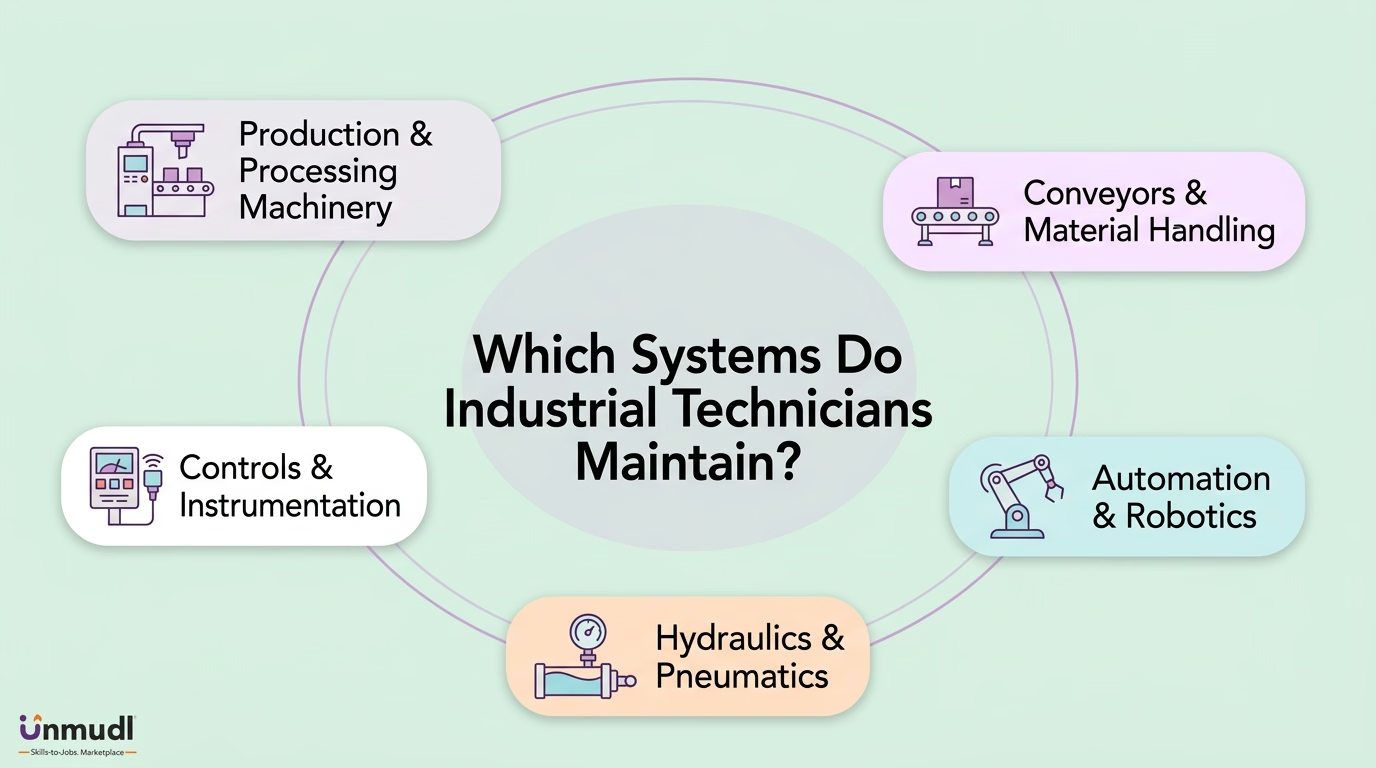
Five systems maintained by industrial technicians, including machinery, conveyors, robotics, fluid power and instrumentation

Industrial technicians maintain five principal systems. The systems are production and processing machinery, conveyor and material-handling systems, automated and electromechanical systems, hydraulic and pneumatic systems, and industrial control and instrumentation systems. The five systems share one dimension, because each is an integrated industrial system whose adjustment, repair, or calibration falls inside a technician's specialty. The systems are listed below.

Production and Processing Machinery

Production and processing machinery is the machine base that turns raw material into finished product along a manufacturing line. Maintenance of this machinery covers diagnosis, disassembly, component replacement, adjustment, lubrication, and post-repair testing. The same occupation extends its scope to refinery and pipeline distribution systems. Process machinery therefore includes continuous-flow infrastructure wherever an employer operates it.

Conveyor and Material-Handling Systems

A conveyor system is an integrated assembly of belts, rollers, motors, drives, sensors, and controls that moves materials between production stations. Belts, motors, and rollers wear under continuous load. That wear makes automated conveyors a recurring maintenance demand inside factories. Fulfillment and distribution centers run the same material-handling systems, so the conveyor specialty reaches warehouses as well as plants.

Automated, Robotic, and Electromechanical Systems

Automated and electromechanical systems combine computer control, servomechanisms, and robotic equipment into one machine that runs with limited human input. Mechatronics and automation technicians operate, test, maintain, and adjust these servomechanical and unmanned systems. A purely mechanical maintenance position rarely owns them. The control element sets such a system apart, because a fault surfaces in a sensor or an actuator rather than in a gear.

Hydraulic and Pneumatic Systems

Hydraulic and pneumatic systems convert fluid pressure or air pressure into controlled mechanical motion. Production and material-handling equipment integrate these fluid-power circuits to lift, clamp, press, and position loads. Electro-mechanical technicians repair and calibrate hydraulic and pneumatic assemblies. Machinery-maintenance roles troubleshoot the same hydraulic equipment when a pressure loss stops a machine.

Industrial Control and Instrumentation Systems

Control and instrumentation systems are the electronic layer of controllers, transmitters, motor controls, and data-acquisition devices that regulates the machinery beneath it. An industrial controls technician repairs, tests, adjusts, and installs these controls. The specialization spans electrical repair, production engineering support, and mechatronics rather than one occupation. Reading the five systems by their energy source lets a technician match each fault to its diagnostic method and to the tool that performs it.

Which Equipment and Tools Does an Industrial Technicians Work with?

Industrial technicians work with two groups of physical assets. The groups are the equipment that is inspected, maintained, or repaired and the tools that diagnose, measure, move, fabricate, or program that equipment. The equipment group holds three main asset classes and the tool group holds six. An equipment maintenance technician takes the title from the first group, because the title maps to the machinery kept in service. Both groups are listed below.

Robotic Welding Arms, Assembly Conveyors, and Hydraulic Lifts

Robotic welding arms, automobile-assembly conveyor systems, and hydraulic lifts are the representative production assets that an industrial machinery mechanic services. Service on these assets runs from inspection and troubleshooting to adjustment and repair. Verification closes each job. A machine returns to the line only after a test confirms correct operation.

Computer-Controlled Mechanical Equipment

Computer-controlled mechanical equipment is the automated and robotic asset class whose motion is directed by software rather than by an operator. Mechatronics technicians install, upgrade, test, operate, and maintain this equipment. The asset therefore belongs to automation-oriented technician roles. An upgrade differs from a repair here, since it changes the control program instead of restoring a failed part.

Industrial Controls and Transmitters

Industrial controls and transmitters are electronic assets that sense a process value and switch or signal the machinery in response. Controls and instrumentation specialists diagnose these assets with test equipment or software. Diagnosis is followed by preventive maintenance, calibration, installation, and repair. Calibration matters most on a transmitter, because a drifted signal misreports the process before any mechanical part fails.

Voltmeters and Computerized Diagnostic Systems

Voltmeters, electronic test instruments, and computerized diagnostic systems are the fault-finding tools that read a machine's electrical values and error information. Vibration analysis joins the same class. It locates a failing bearing or drive from its vibration signature before the failure halts production. A technician reads these instruments first, because diagnosis precedes every repair.

Micrometers, Calipers, and Height Gauges

Micrometers, calipers, height gauges, protractors, ring gauges, measuring tapes, and lasers are the precision measurement tools that verify a dimension, a clearance, or an alignment. Industrial engineering technicians calibrate equipment with the gauges. Millwrights align installations with the tapes and lasers. Mechatronics technicians check clearances with the same instruments.

Screwdrivers, Socket Wrenches, and Power Drills

Screwdrivers, socket wrenches, hammers, levels, drills, and wrenches are the hand and power tools that fasten, loosen, and align mechanical parts. Machinery maintenance workers align motors with screwdrivers and socket wrenches. The exact hand-tool set changes with the asset and the specialty.

Lathes, Grinders, and Welding Equipment

Lathes, grinders, drill presses, and welding, brazing, cutting, and soldering equipment are the fabrication tools that modify, join, or remake a component instead of inspecting it. Industrial machinery mechanics run the lathes and grinders, and the BLS handbook lists welding among their tasks. Millwrights braze and cut. Mechatronics technicians solder electronic parts.

Hoists, Cranes, and Forklifts

Hoists, jacks, cranes, winches, chain falls, dollies, and forklifts are the lifting and rigging tools that move a machine component whose mass prevents manual handling. Machinery maintenance workers and millwrights dismantle, position, and align heavy components with this equipment. Rigging skill therefore sits beside mechanical skill in both occupations.

PLC, SCADA, and CAD/CAM Software

PLC software and supervisory control and data acquisition (SCADA) software are the industrial software tools that program and monitor the equipment. Computer-aided design and manufacturing (CAD/CAM) software designs it. Machinery mechanics use PLC and SCADA software. Industrial engineering technicians use CAD/CAM. Matching each tool class to a specialty shows which toolkit a mechanical, controls, or engineering technician carries. A training course teaches that toolkit before the first shift.

What is the Best Training Course for Industrial Technician?

The best training course for an industrial technician is Introduction to Mechatronics on Unmudl, a beginner-level course built for learners with little to no experience in advanced manufacturing maintenance. The course covers safety, electrical systems, automation, mechanical systems, and fluid systems. Unmudl places it first in the mechatronics and robotics maintenance skill path on a live industrial machinery mechanic vacancy. A school for maintenance technicians is a different institution, since Unmudl is a skills-to-jobs marketplace rather than a college. The same marketplace lists the jobs a trained candidate applies for.

How to Apply for Industrial Technician jobs?

Applying for industrial technician jobs on Unmudl takes six steps. The steps are searching the jobs page, opening the job result, signing in, verifying the account, completing the profile, and selecting Apply Now. The steps are listed below.

  1. Open the Unmudl Jobs page and search the target role by job title, company, or location.
    Searching for industrial technician opportunities on Unmudl
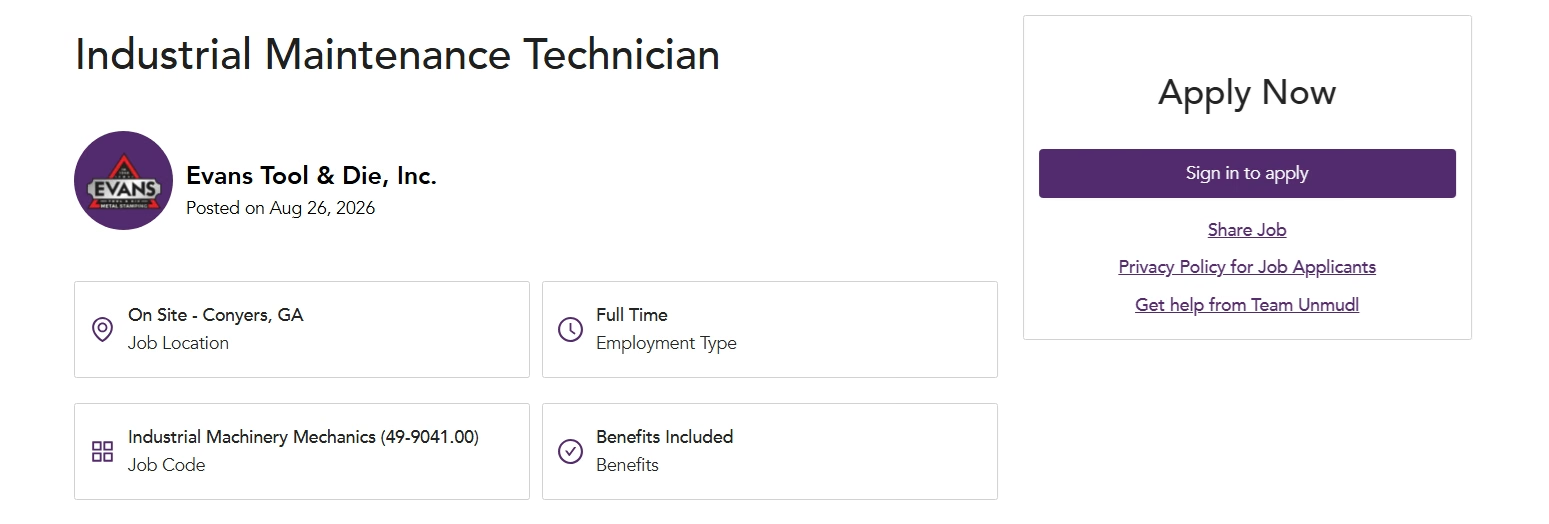
  2. Open the job result and verify the employer, location, job code, and qualifications.
    Industrial technician job search results on Unmudl
  3. Sign in or sign up when the job page displays "Sign in to apply".
  4. Verify the Unmudl account before the candidate profile opens.
  5. Complete the profile with skills, experience, and a resume.
  6. Select Apply Now on the job page, which redirects the candidate to the employer's application system.
    Industrial maintenance technician job details and Apply Now section on Unmudl

Industrial engineering technician certification programs appear nowhere in a listing such as the Kia Georgia vacancy, since it asks for a diploma or GED (General Educational Development) plus manufacturing experience. Following the six steps carries a candidate from the marketplace to the employer's own form. An application submitted on that form starts a career that pay and demand data measure.

Is Industrial Technician a Good Career?

Yes, an industrial technician is a good career for a worker who wants hands-on machinery maintenance, since pay sits above the all-occupation median of $50,980 and demand is projected to grow. The fit assumes shift or overtime schedules. Maintenance careers differ by occupation, because machinery maintenance workers face a 2% decline. BLS projects the industrial machinery mechanic occupation to add 79,700 jobs between 2025 and 2035, an 18% rise against 3% across all occupations. Those added jobs are filled by entrants with and without prior experience.

Can one become an industrial technician without experience?

Yes, one can become an industrial technician without prior paid experience, since the industrial machinery mechanic occupation lists no related work experience for entry. Competence is built through long-term on-the-job training. Getting a maintenance job without experience therefore runs through a training route, such as a Registered Apprenticeship in Industrial Maintenance Mechanic. Unsupervised safety-critical maintenance waits until the employer judges the entrant competent. The title that entrant holds then depends on whether the employer advertises industrial or maintenance work.

What is the difference between Industrial technician and Maintenance Technician?

The difference between an industrial technician and a maintenance technician is scope, since the industrial title anchors the work to manufacturing while the maintenance title centers on keeping equipment operational. A maintenance technician is a reported title across machinery mechanics and general maintenance workers, so the title reaches buildings, HVAC, and plumbing-related repair. The industrial goal is productivity and quality, and the maintenance goal is reliability. The tools follow the goal, with production-measurement instruments against hand tools, test devices, and hoists. For example, an industrial technician calibrates production equipment to a specification, whereas a maintenance technician isolates a conveyor bearing fault before restart. A conveyor fault inside a factory is where the industrial and maintenance titles merge into one industrial maintenance role.

What is the difference between Industrial technician and Industrial maintenance technician?

The difference between an industrial technician and an industrial maintenance technician is outcome ownership, since the first owns production performance and the second owns equipment availability. An industrial maintenance technician is the narrower concept, defined by inspecting, lubricating, diagnosing, and repairing industrial machinery. One pursues a process change that lifts efficiency with engineering software. The other pursues prevented downtime with vibration analysis and maintenance records. Controls work blurs the border, because PLC, process control, and control technician titles sit in three occupations. A female industrial maintenance technician holds the same occupation with the same duties, since federal classification follows the work performed and not the worker's sex.

Learn In Demand Skills Employers Are Hiring For

Explore our career-ready "Mechatronics and Robotics Maintenance" designed with employers to help you get hired faster. Train for industrial maintenance in ~10–12 weeks, earn a certificate and get ready to interview for technician roles.
No items found.
No items found.
Last updated on:
October 19, 2026
No items found.