Electrician : Types, Duties, Training, Certification and Salary

An electrician is a trained tradesperson who installs, maintains, and repairs the electrical wiring, equipment, and fixtures that carry power through a building. An electrician handles every point of that path, from the service panel to the outlets and control devices on each circuit. The path stays safe when every connection conforms to building and safety codes. Electricians therefore deliver usable power and deliver it without hazard, and the second of those duties is what the codes exist to enforce.

The importance of the trade follows from the reach of the systems it serves. Home circuits, intercoms, street lights, and control systems all depend on a correctly wired supply. The benefit to a homeowner is an installation that passes inspection, and the benefit to a factory is a line that keeps running. Both benefits flow from one skill set, so the trade divides by setting rather than by skill. Residential, commercial, industrial, emergency, maintenance, and solar work are the six settings that shape the types of electrician. Installation, repair, wiring, lighting, panel, and generator work are the six duties that fill the working day. The training route, the certification ladder, and the electrician salary grow out of those duties. Each license level widens the scope of work a tradesperson is allowed to take on.

What is an Electrician?

An electrician is a skilled trades worker who assembles, installs, tests, and maintains electrical wiring, equipment, appliances, and fixtures with hand and power tools. The same occupation carries the alternative titles electrical technician and wireman, which mark a difference in employer wording rather than in work. The work spans home lighting circuits at one end and street lights and electrical control systems at the other. Every task on that span ends in conformance to the National Electrical Code (NEC), the standard that makes an installation lawful.

Electrical repairs and emergency call-outs sit inside the occupation rather than beside it. An emergency electrician is not a separate job classification, since the term describes a tradesperson who answers urgent outages or hazards outside normal hours. The urgency changes the schedule and nothing about the wiring standard applied to the repair. Customers read the emergency label as an availability promise and not as a distinct trade.

What does an Electrician do?
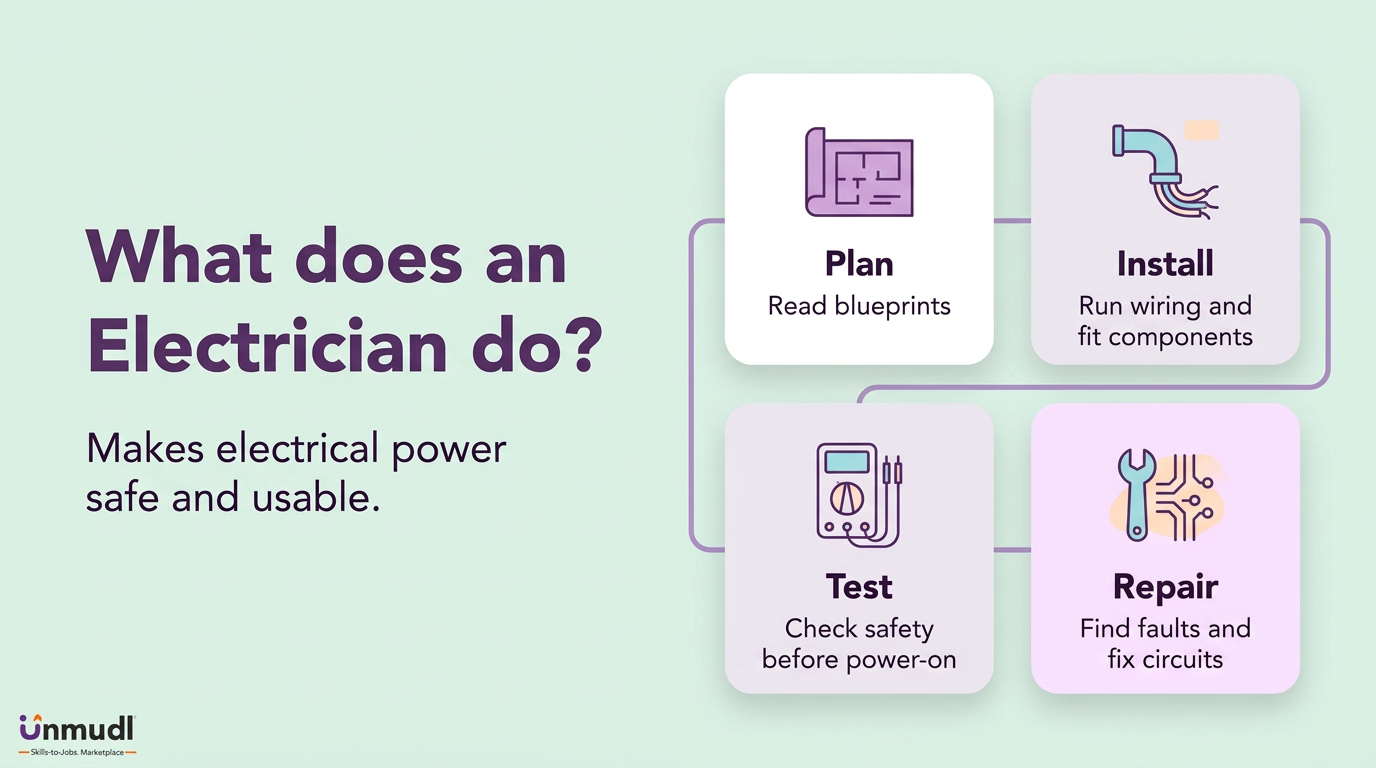
Electrician workflow: plan from blueprints, install wiring, test safety and repair faults

An electrician works by making electrical power safe and usable in buildings and equipment. The worker first reads the blueprints, then installs the components and runs conduit and cable to each load. The wiring system is inspected and tested before it is energized. The energized system is troubleshot whenever a fault appears, and the faulty circuitry is repaired or upgraded. Home electrical services show the full sequence inside one dwelling. Wiring a new kitchen, upgrading a breaker panel, and fixing a dead outlet all follow the order of plan, install, test, and repair. The same order holds on a construction site, where an office's power and data network is run from the drawings. The outcome in every setting is functional electrical service that meets code.

What are the Types of Electrician?
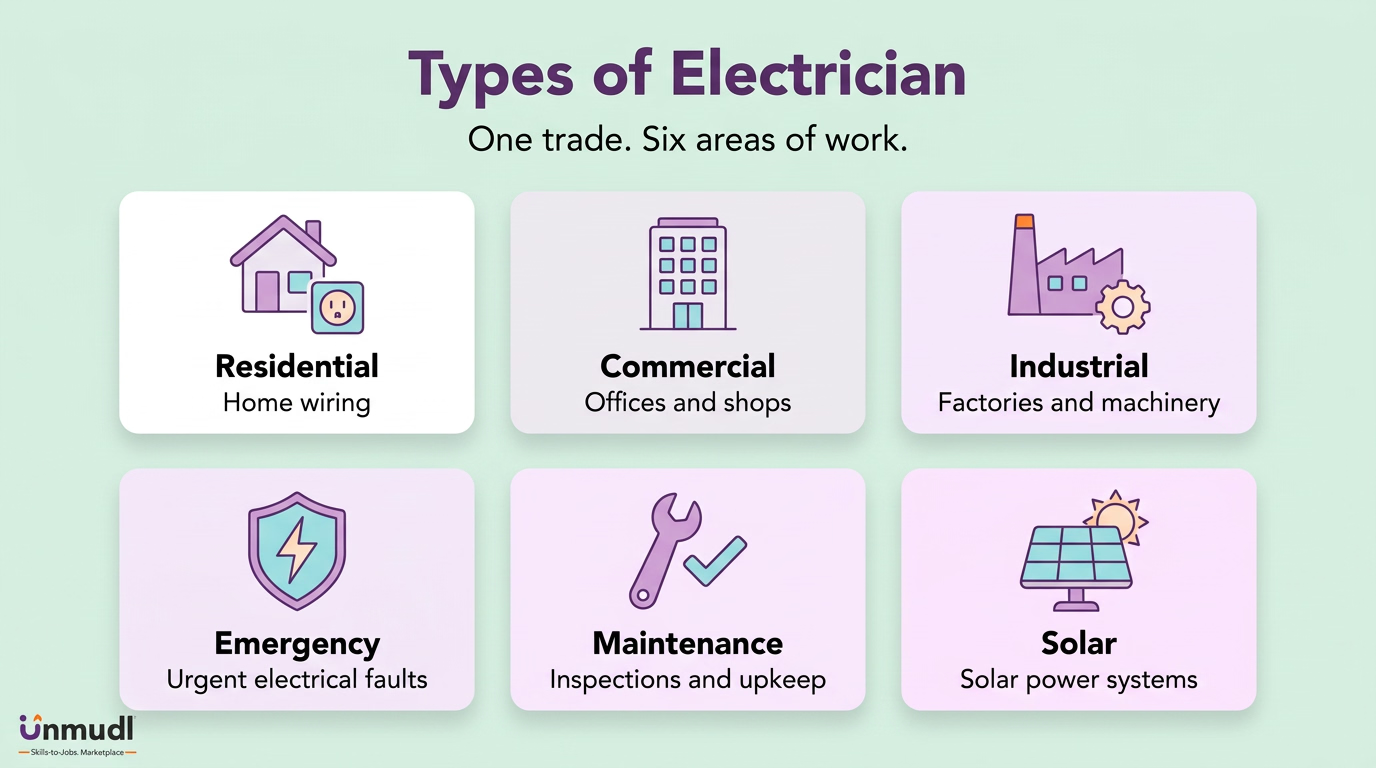
Six electrician specialties: residential, commercial, industrial, emergency, maintenance and solar

There are six main types of electrician based on the setting and the scope of the systems they wire. The types are residential electrician, commercial electrician, industrial electrician, emergency electrician, maintenance electrician, and solar electrician, which are briefly discussed below.

The table below compares the six types by the setting they serve, the supply they wire, and the party that hires them.

Type of Electrician

Setting

Supply and Wiring

Who Hires the Type

Residential electrician

Individual homes

Single-phase 120/240 V household panelboards and flexible cable

Homeowners, for every dwelling task that must pass inspection

Commercial electrician

Offices, shops, and other large spaces

Three-phase 208/240/480 V power through rigid conduit and heavy-duty panels

Building owners, when a space changes tenant or use

Industrial electrician

Factories, plants, and warehouses

Three-phase 480 V lines and industrial panelboards feeding heavy machinery

Plant managers, because machine downtime is lost output

Emergency electrician

Any building with an urgent outage or hazard after hours

The faulted circuit, isolated and made safe before power returns

Customers, for speed of response

Maintenance electrician

Existing electrical systems in occupied buildings

Aging installations with worn contacts, loose terminations, and overloaded circuits

Facility teams, to find faults before they stop a building

Solar electrician

Buildings with on-site generation

Photovoltaic arrays whose direct current an inverter converts before it joins the supply

Property owners, for on-site generation

Common misreading

The six types are six separate trades

One trade divided by setting, not by skill

The customer chooses by setting, not by credential

1. Residential Electrician

A residential electrician is a tradesperson who wires and services individual homes. The home runs on 120/240 V single-phase circuits fed through household panelboards and flexible cable. The residential electrician installs the lighting circuits of a new house or replaces an aging breaker panel. Homeowners hire this type for every dwelling task that must pass inspection.

2. Commercial Electrician

A commercial electrician is a trades worker who fits out offices, shops, and other large spaces. The large space draws 208/240/480 V three-phase power through rigid conduit and heavy-duty panels. The commercial electrician runs that conduit from the building drawings, and connects the fire alarm and lighting systems. Building owners engage this type when a space changes tenant or use.

3. Industrial Electrician

An industrial electrician is a specialist who keeps factories, plants, and warehouses energized. The plant runs heavy machinery on 480 V three-phase lines and industrial panelboards. The industrial electrician installs the machine circuits, repairs motor and control wiring, and restores a stopped line. Plant managers depend on this type because every hour of machine downtime is lost output.

4. Emergency Electrician

An emergency electrician is a practitioner who answers urgent outages and hazards after hours. The outage arrives as a dead panel, a burning smell, or a tripped main that will not reset. The emergency electrician isolates the fault, makes the circuit safe, and restores power. Customers call this type for speed of response rather than for a different skill.

5. Maintenance Electrician

A maintenance electrician is the worker who keeps an existing electrical system in working order. The existing system ages through worn contacts, loose terminations, and overloaded circuits. The maintenance electrician inspects the installation, tests the protection, and upgrades the parts that no longer meet the load. Facility teams keep this type on staff so that faults are found before they stop a building.

6. Solar Electrician

A solar electrician is an installer who connects photovoltaic (PV) generating systems to a building supply. The PV array produces direct current, and an inverter converts it before it joins the supply. The solar electrician mounts the array, wires the inverter to the panel, and proves the interconnection safe. Property owners choose this type for on-site generation.

Reading the six types by setting lets a customer match the job to the electrician whose systems, voltages, and hours fit it.

What are the Duties of Electrician?
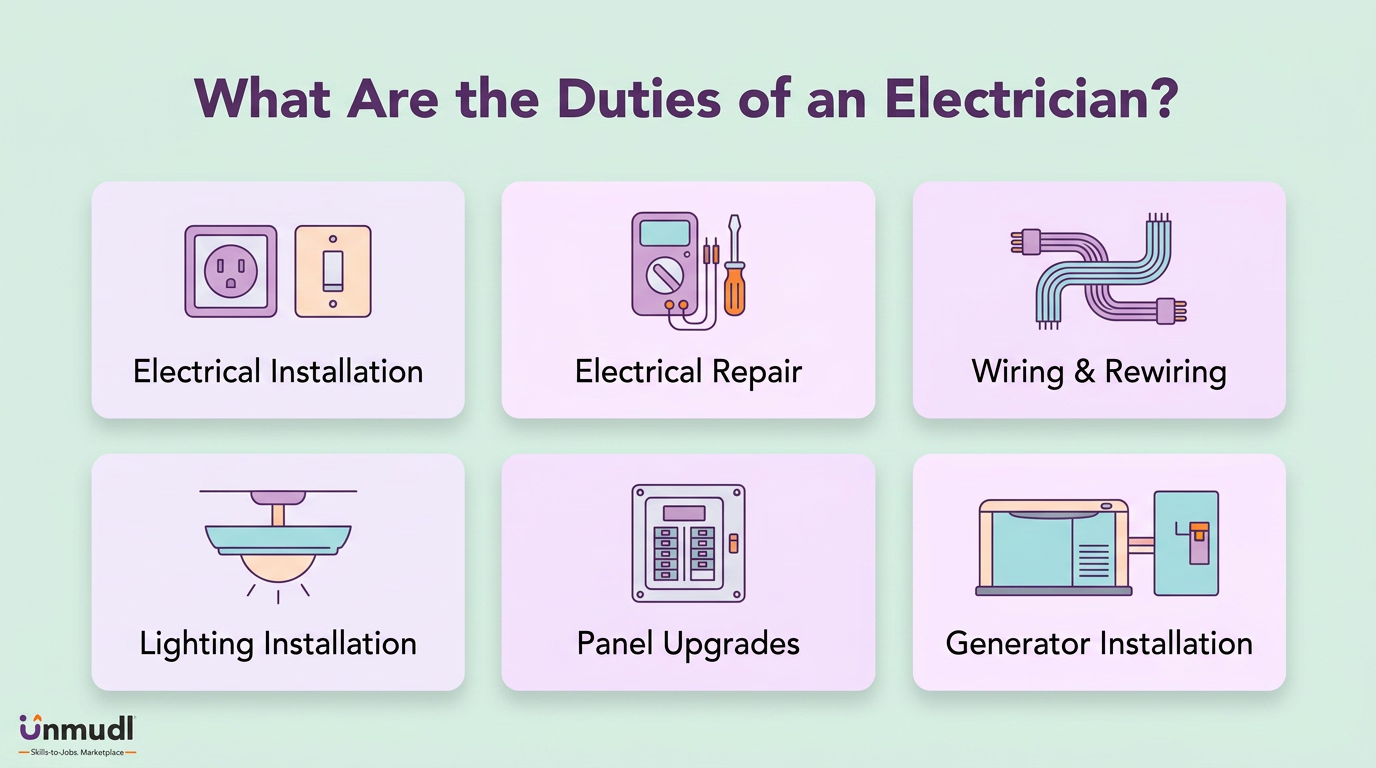
Electrician duties covering installation, repair, rewiring, lighting, panel upgrades and generator installation

There are six main duties of an electrician that turn a design into a safe, working supply. The duties are electrical installation, electrical repair, electrical wiring and rewiring, lighting installation, electrical panel upgrade, and generator installation, which are set out one by one below.

1. Electrical Installation

Electrical installation is the duty of fitting new components into a building supply. The components include outlets, switches, fixtures, and control devices. The installer positions each component from the plan, connects it to its circuit, and tests the circuit before handover. Installers follow this sequence so that a new component never energizes an unsafe path.

2. Electrical Repair

Electrical repair is the task of finding and correcting a fault in an energized system. The fault shows as a dead outlet, a tripping breaker, or a flickering light. The tradesperson diagnoses the cause with testing equipment, isolates the affected circuit, and replaces the failed part. Repair crews restore power only after the corrected circuit passes a fresh test.

3. Electrical Wiring and Rewiring

Electrical wiring and rewiring is the work of running conductors through a structure. The conductors carry power from the panel to every load, and rewiring replaces conductors that are aged, undersized, or damaged. The worker sizes the wire to the load, routes it through walls and conduit, and terminates it to code. Wiring crews treat a whole-home rewire as the largest residential job.

4. Lighting Installation

Lighting installation is the job of mounting and connecting lighting systems. The lighting system ranges from a single ceiling fixture to a commercial lighting layout. The lighting electrician selects the fixture for the space, wires it to a switched circuit, and sets the controls. Lighting electricians take on this duty most in new construction.

5. Electrical Panel Upgrade

Electrical panel upgrade is the duty of replacing or enlarging a building's main distribution board. The distribution board becomes undersized when new appliances, chargers, or machinery raise the load. The tradesperson installs the higher-capacity panel, transfers every circuit to a new breaker, and re-labels the board. Service crews schedule this upgrade before a load increase rather than after a nuisance trip.

6. Generator Installation

Generator installation is the task of connecting a standby power source to a building's supply. The standby source takes over when the utility supply fails. The installer mounts the generator, wires the transfer switch, and tests the changeover under load. Installation crews finish only when the building switches over without back-feeding the grid.

Grouping the six duties by purpose shows that every one of them serves the safe delivery of power at the site where the work is done.

Where does a Electrician Work?
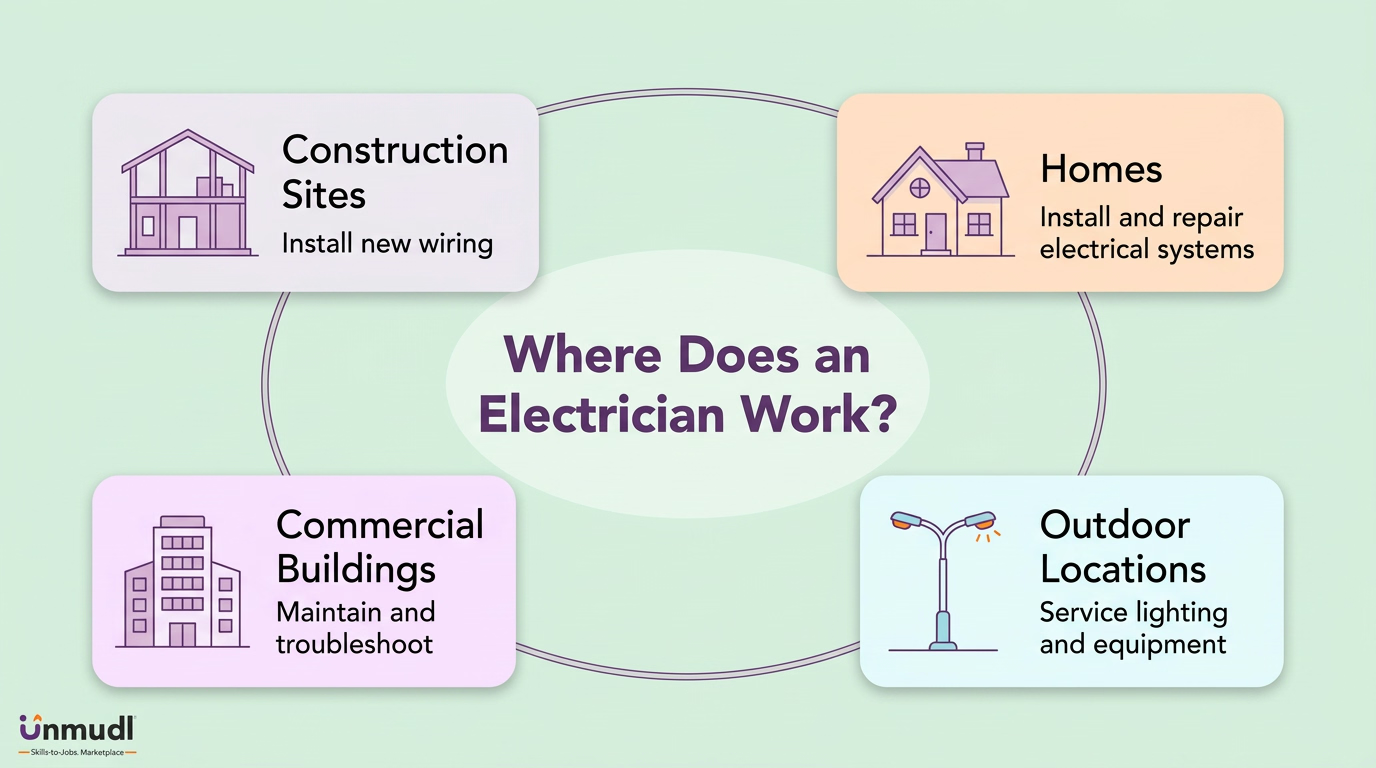
Electrician work settings: construction sites, homes, commercial buildings and outdoor locations

An electrician works primarily on construction sites, in residential and commercial buildings, and occasionally outdoors. The construction site calls for a wholly new wiring system installed from the plan. The occupied building calls instead for maintenance and troubleshooting of equipment already in place. The outdoor assignment adds weather and public safety to the task. The employer side of the setting is concentrated in one industry. The Bureau of Labor Statistics (BLS) recorded 455,910 of 631,080 electricians, about 72%, employed by building equipment contractors in 2017. Manufacturing, utilities, local government maintenance, and employment services make up the remaining employers. Each employer places the electrician in the setting its own equipment demands. Each of those employers hires only a worker who has entered the training and licensing route of the trade.
How to Become an Electrician?

Becoming an electrician requires finishing supervised training, earning the required credentials, advancing to a higher license, adding certifications, and meeting the state requirements that govern the trade. The path has five stages, and the stages are training, credentials, advanced licenses, certifications, and state requirements. Training covers the high-school diploma, the registered apprenticeship, and the trade-school or community college route. Credentials cover the journeyman exam and the journeyman license. Advanced licenses cover the master license and the contractor license. Certifications cover the Occupational Safety and Health Administration (OSHA) safety card and the specialty credentials for solar and electric vehicle (EV) charging work. State requirements cover apprentice registration and the hour and exam rules of each state board. BLS records that electricians enter the field through lengthy supervised training rather than a college degree. That supervised training is the first of the five stages described below.

1. What is the Training for an Electrician?

The training for an electrician is supervised instruction that pairs paid on-the-job hours with classroom study of theory and code. The training stage has three steps. The steps are earning a secondary diploma, entering a registered apprenticeship, and completing a program at a trade school or a community college. Supervised hands-on experience stays essential in all three steps. Only logged hours and finished coursework lead to licensure. The diploma opens the sequence.

1.1 Earn a High-School Diploma or GED

Earn a high-school diploma or a General Educational Development (GED) certificate before applying to any electrician training program. The diploma or GED is the minimum education an apprenticeship or a trade program accepts. Basic math skills accompany the diploma as a second admission requirement. Apprenticeship programs set a minimum age of 18 years as the third admission requirement. A registered apprenticeship gates admission further with an aptitude test or a physical requirement. The registered apprenticeship is the program most applicants enter next.

1.2 Enter a Registered Apprenticeship

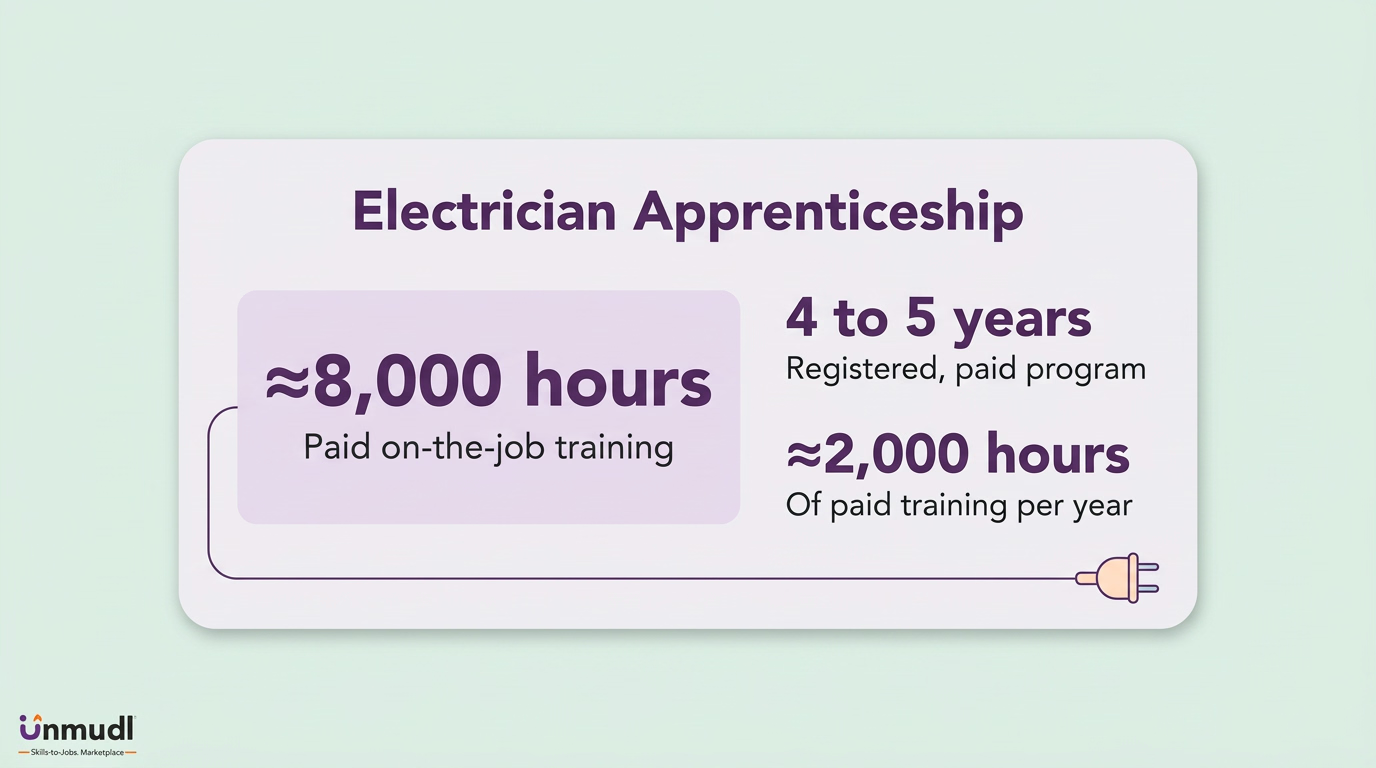
Electrician apprenticeship showing about 8,000 paid training hours across four to five years

Enter a registered apprenticeship through a union Joint Apprenticeship and Training Committee (JATC) or a non-union program. A registered apprenticeship is a paid program recognized by the U.S. Department of Labor that lasts 4 to 5 years. Apprentices accumulate roughly 8,000 hours of paid on-the-job training at about 2,000 hours per year. Apprentices also finish hundreds of classroom or lab hours in electrical theory, codes, and safety. The apprenticeship pays progressive wages, and technical-school graduates shorten it through credit.

1.3 Complete a Trade-School or Community College Program

Complete a trade-school certificate or a community college program as the alternate route into the trade. A trade-school certificate is a 1 to 2 year course of classroom and lab instruction in electrical trades. A community college program is an associate degree in electrical technology that covers theory. Graduates of both programs receive credit toward the apprenticeship experience requirement. The completer then enters an apprenticeship or sits a trainee exam with that credit. Neither program substitutes for the required work hours, and those logged hours unlock the credentials stage.

2. What are the Credentials Required for an Electrician?

The credentials required for an electrician are a passed journeyman exam and a journeyman license issued by a state electrical board or a municipal authority. Two steps make up the credentials stage. Those steps are passing the journeyman electrician exam and obtaining the journeyman electrician license. State or local law requires the license before a tradesperson practices independently. The journeyman license is therefore the primary credential of the trade. The exam precedes the license.

2.1 Pass the Journeyman Electrician Exam

Pass the journeyman electrician exam after finishing the required training and hours. The journeyman electrician exam is a state or local licensing test of the NEC, wiring practices, electrical calculations, and regulations. Candidates sit the exam only after the apprenticeship hours and the coursework are complete. The state board demands proof of both. A passing score turns the candidate into an applicant for the journeyman license.

2.2 Obtain the Journeyman Electrician License

Obtain the journeyman electrician license from the state electrical board or the municipal authority after the exam. The journeyman electrician license is the legal credential that authorizes independent work on standard electrical projects within the scope of the license. A licensed journeyman pulls permits and performs most electrical work legally. A Residential Specialty license for limited home tasks sits beside the journeyman license in the jurisdictions that issue one. The journeyman license is also the base for the advanced licenses.

3. What are the Advanced Licenses for an Electrician?

An electrician's advanced licenses are the master electrician license and the electrical contractor license, which sit above the journeyman license. The advanced stage holds two steps, namely earning the master license and securing the contractor license. Both licenses are optional for daily electrical work. Both licenses become mandatory for supervising other electricians or for owning an electrical contracting business. The master license is the earlier of the two.

3.1 Earn the Master Electrician License

Earn the master electrician license after 2 to 4 additional years of journey-level experience. The master electrician license is an advanced state credential that requires a journeyman license, the added years of experience, and a rigorous master's exam. A master electrician supervises other electricians and designs complex electrical systems. Master status also qualifies a worker to operate as an electrical contractor under a contractor license.

3.2 Secure an Electrical Contractor License

Secure an electrical contractor license where the state requires one for owning or operating an electrical contracting business. An electrical contractor license is a business credential tied to master electrician status and to proof of insurance or a bond. The contractor license lets a business bid on and contract for electrical work in the states that mandate it. Contract work on construction sites also calls for the safety certification that site owners demand before entry.

4. What are the Certifications for an Electrician?

An electrician's certifications are voluntary credentials that employers, governments, or project owners require for specific sites or specialized work. The certification stage runs two steps. The steps are holding an OSHA safety card of either length and adding specialty certifications. No state board issues a certification. A certification still serves as a prerequisite for certain projects or company qualifications. The safety card is the more common of the two.

4.1 Hold an OSHA 10-Hour or 30-Hour Safety Card

Hold an OSHA 10-hour or 30-hour safety card before reporting to a construction site. An OSHA safety card is a federal OSHA credential that employers and governments set as an entry condition on construction sites. The two cards differ in the length of the safety training behind them. The site rules decide which card the worker carries. Specialty certifications follow the safety card.

4.2 Add Specialty Certifications

Add specialty certifications in solar photovoltaics or EV charging once the core credentials are in place. Specialty certifications are industry credentials that qualify a tradesperson for one specific system type. The solar example is the PV Installation Professional (PVIP) credential from the North American Board of Certified Energy Practitioners (NABCEP). The charging example is the Electric Vehicle Infrastructure Training Program (EVITP) credential for EV charger installation. Both certifications are voluntary. Both become gate requirements on the projects that name them. The state sets the remaining requirements.

5. What are the State Requirements for an Electrician?

The state requirements for an electrician are the licensing rules that a state Board of Electrical Examiners or Department of Professional Regulation sets as the legal prerequisites for practice. The state stage consists of two steps. Those steps are registering with the state board as an apprentice and confirming the hour count and exam format with that board. Requirements vary by state. The registration step applies where a state mandates it and the confirmation step applies everywhere. Registration comes during training.

5.1 Register as an Electrical Apprentice With the State Board

Register as an electrical apprentice with the state board in states that mandate registration during training. Electrical apprentice registration is a state record that tracks the hours of a worker who is still in training. The registering states mandate that apprentices register with the board and track hours. The remaining states simply require employer verification of the hours. Either record feeds the hour rule that the state electrical board confirms.

5.2 Confirm the Hour and Exam Rules With the State Electrical Board

Confirm the exact hour and exam rules with the specific state's electrical board before applying for any license. The state electrical board is the authority that establishes the legal prerequisites for licensure in its jurisdiction. The hour count and the exam format differ from one board to the next. National occupational data anchors basic licensure. The actual state regulations supplement that anchor. Following the five stages in order carries a candidate from a high-school diploma to a licensed electrician.

Does Electrician Require A Degree?

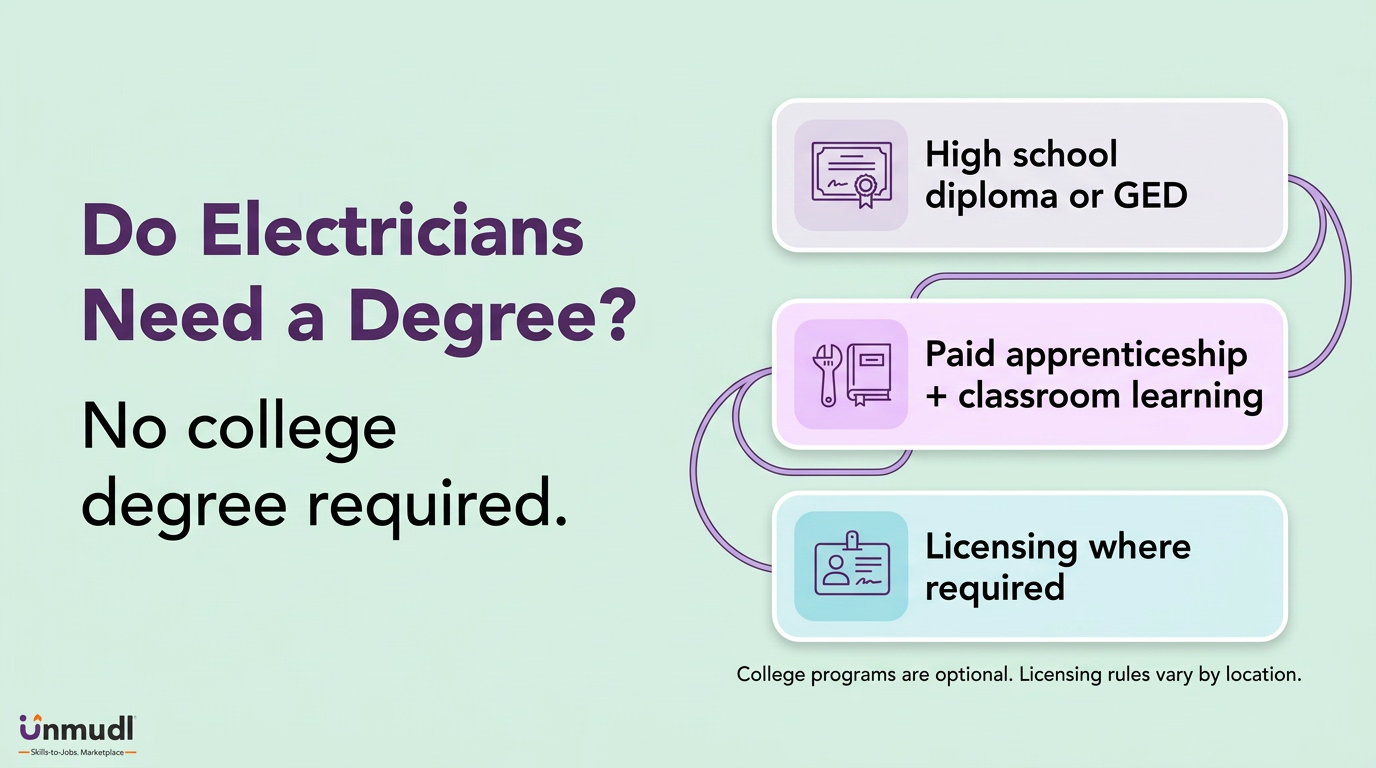
Electrician entry route showing a high school diploma or GED, paid apprenticeship, classroom learning and licensing where required

No, an electrician does not require a college degree, since the trade sets a high-school diploma or GED plus an approved apprenticeship as its entry education. Electrical work is classified as a skilled trade, so vocational training and licensure replace the four-year degree. The licensing boards of nearly all states require applicants to hold that diploma and complete technical instruction. No state requires a bachelor's degree. The diploma, the logged hours, and the license are therefore the credentials an electrician resume carries into a job search.

How to Build Resume for Electrician?

An electrician resume is built on Unmudl through the free Resume Builder, a tool that arranges work history, education, and trade credentials into a single-column layout. The single-column layout is the format an applicant tracking system (ATS) parses correctly. The Resume Builder asks for no account and no payment at the start. The five steps for building an electrician resume on Unmudl are listed below.

  1. Open the Resume Builder at unmudl.com/create-resume without creating an account or paying a fee.
    Unmudl resume builder opening screen with the Build My Resume button
  2. Enter the work history, the education, and the skills, including trade licenses and safety certifications, into the guided fields.
    Selecting basic information and profile details in the Unmudl resume builder
  3. Add trade-specific accomplishments, such as troubleshooting industrial circuits, installing motor-control systems, and holding NEC compliance on every project.
  4. Create a free Unmudl account once the resume is complete, then save and download the file as an ATS-compliant PDF.
  5. Reuse the saved resume for every later application, since the tool highlights keywords automatically and tailors the resume to each Unmudl job posting.

Completing these five steps leaves a candidate with one saved, keyword-matched resume that is ready for job applications on the Unmudl board.

How to Apply for Electrician Job?

Applying for an electrician job on Unmudl runs through the Unmudl Job Board. A free account, a keyword search, and an employer link lead from the board to the employer's own career site. The Job Board links to more than 50 employers hiring technicians. One saved resume therefore serves several electrician jobs across that employer network. Unmudl never processes the application itself. The six steps for applying to electrician jobs through Unmudl are listed below.

  1. Register or log in to a free Unmudl account, and keep the saved resume ready for upload.
  2. Search the Unmudl Jobs page by entering electrician, electrical, or maintenance together with a location in the search fields.
    Searching for electrician jobs on the Unmudl job board
  3. Filter the listings by industry and job type, then open any relevant posting to review its details.
  4. Click the Apply Now button on the listing, which redirects to the employer's official career site, as the Georgia-Pacific listing for an electrical maintenance technician shows.
  5. Submit the application on the employer's portal by signing in or creating an account there and uploading the Unmudl resume.
  6. Check the final submission against the posting, so that a stated requirement such as industrial wiring experience appears clearly on the resume.

Working through these six steps takes a candidate from a Unmudl listing to a completed application with a hiring employer. Those employers are manufacturers and facility operators rather than electrical service providers.

What are Top Electrician Service Providers in the US?

There is no verified list of top electrician service providers in the US on Unmudl, because Unmudl is a skills-to-jobs marketplace rather than a directory of electrical companies. Electrical services reach homes and businesses through electrical contractors. Electrical contractors are the companies that employ electricians for installation, electrical repairs, and maintenance work. A national ranking of the top electrical companies needs an industry source outside Unmudl, and no Unmudl page rates or lists a contractor business. The employers on the Unmudl Job Board hire tradespeople for their own facilities instead of selling electrical services to the public. Course selection, by contrast, is a choice Unmudl answers from its own catalogue.

What is the Best Online Electrician Course?

The best online electrician course on Unmudl is Electrical Systems 1, a 15-hour online Unmudl Short that teaches the electrical fundamentals used in industry. The fundamentals include circuits, measurements, inductance, and transformers. Electrical Systems 1 runs on industry-standard Amatrol modules and prepares learners for the Smart Automation Certification Alliance (SACA) Electrical Systems micro-credential. The syllabus moves from reading schematics and safety rules to basic components, which are the tasks a tradesperson performs on a job site. The Technicians of America career guide names Electrical Systems 1 as the course covering foundational concepts for the electrician track. Completing the course builds skill without conferring a license. That skill travels to any employer, whether a national contractor or a local electrician serving one town.

What is the difference between Electrician and Local Electrician?

A local electrician is an electrician who serves one nearby community, so the two titles name one occupation. No license carries the title local electrician. The goal differs in emphasis alone, since a local electrician prioritizes same-day response and regional building-code knowledge. A contractor's electrician instead travels between cities on a project schedule. Both use the same wire strippers, conduit benders, and voltmeters under the NEC. For example, a panel installation in a shopping mall and a same-day breaker rewire in a home are identical trade work in different service areas. Neither service area changes the license the work requires.

What is the difference between Electrician and Licensed Electrician?

A licensed electrician is a credential holder who has completed approved training and passed the state licensing exam, whereas the bare title electrician guarantees no credential. The goal of safe, code-compliant electrical systems is shared. Only the licensed electrician is obligated to certify that compliance and sign off on a project. Tools stay identical, from multimeters to code manuals, because licensing changes authority and scope rather than equipment. For example, a licensed electrician upgrades a home's electrical panel independently and pulls the permit. An unlicensed worker wires that same home only under supervision.

What is the difference between Electrician and Residential Electrician?

A residential electrician is an electrician who specializes in home wiring and house projects, while the bare title covers residential, commercial, and industrial settings alike. Federal classification lists no separate occupation. Iowa, however, issues a residential electrician license as a specialty category that a fully licensed electrician does not need for home work. The goal inside a dwelling is a functional, code-compliant system for lighting, kitchen appliances, and heating, ventilation, and air conditioning (HVAC). Tools overlap, but materials differ by supply. Residential work runs single-phase household circuits in plastic-sheathed cable, whereas commercial work runs three-phase systems in rigid conduit. A residential electrician, for example, adds a stove circuit in a house, while a warehouse electrician installs the three-phase machine circuits of a production line.

Learn In Demand Skills Employers Are Hiring For

Explore our career-ready "Mechatronics and Robotics Maintenance" designed with employers to help you get hired faster. Train for industrial maintenance in ~10–12 weeks, earn a certificate and get ready to interview for technician roles.
No items found.
No items found.
Last updated on:
October 19, 2026
No items found.