Electrical Technician: Types, Duties, Training, Certification and Salary

An electrical technician is a skilled worker who applies electrical and electronic theory to build, test, install and maintain equipment that runs on electric current. An electrical technician works under the direction of engineers. That direction separates the role from an electrician, who wires buildings to code, and from an engineer, who designs the system on paper. The equipment side of that boundary covers circuit boards, motor controls, control panels and test instruments. Each of these devices reaches the technician as a fault to trace, a prototype to adjust or an instrument to calibrate. The Bureau of Labor Statistics (BLS) counts 96,900 such positions across the United States in 2025. Electrical technician jobs from that count sit inside government, engineering services, manufacturing and utilities.

The importance of the occupation rests on the dependence of every automated plant, laboratory and power site on hardware that keeps conducting current safely. Safe current flow is verified by the technician rather than assumed by the operator, since a drifting sensor halts a production line before anyone reads the fault. Reading the fault, isolating the component and restoring the system are the three outcomes an employer buys with this hire. Electrical technician training delivers those outcomes through an associate degree in electrical or electronic engineering technology, which BLS records as the typical entry-level education. The entry route is shorter than the four-year path of an engineer and carries no state licence of the kind an electrician holds. A two-year investment therefore opens a technical career whose definition, types, duties, workplaces, training, credentials, salary and neighbouring trades follow in that order.

What is an Electrical Technician?

An electrical technician is a technical occupation in the applied engineering hierarchy whose holder assembles, calibrates, repairs and modifies electrical components, circuitry, controls and machinery under an engineer's supervision. The supervision of an engineer places the occupation at the middle of the hierarchy. The middle of the hierarchy is where a drawing becomes working hardware. Working hardware includes alternating current (AC) and direct current (DC) circuits, motor controls and instrumentation. BLS files the occupation under electrical and electronic engineering technologists and technicians, and the electrical engineering technician title belongs to that same file. The same file excludes trades that join metal rather than conduct current. Metal inert gas (MIG) welding is one such trade.

What does an Electrical Technician do?

An electrical technician does the hands-on work of assembling, installing, testing, troubleshooting and maintaining electrical hardware until the hardware meets its specification. Meeting the specification starts with the basics of electricity, since voltage, current and resistance decide how a schematic reads and where a fault hides. The fault is located with a multimeter or an oscilloscope. The faulty relay, contactor or sensor is then replaced. The repaired circuit is run again to prove the repair. Proof of repair is the point where the technician's task ends and the operator's shift resumes. Resumed production is the reason an electrical maintenance technician is the commonest form of the role inside a factory. BLS describes the duties as installing and maintaining electrical control systems and equipment, and adjusting electrical prototypes, parts and assemblies to correct problems. How those duties are shared out depends on the type of electrical technician.

What are the Types of Electrical Technician?
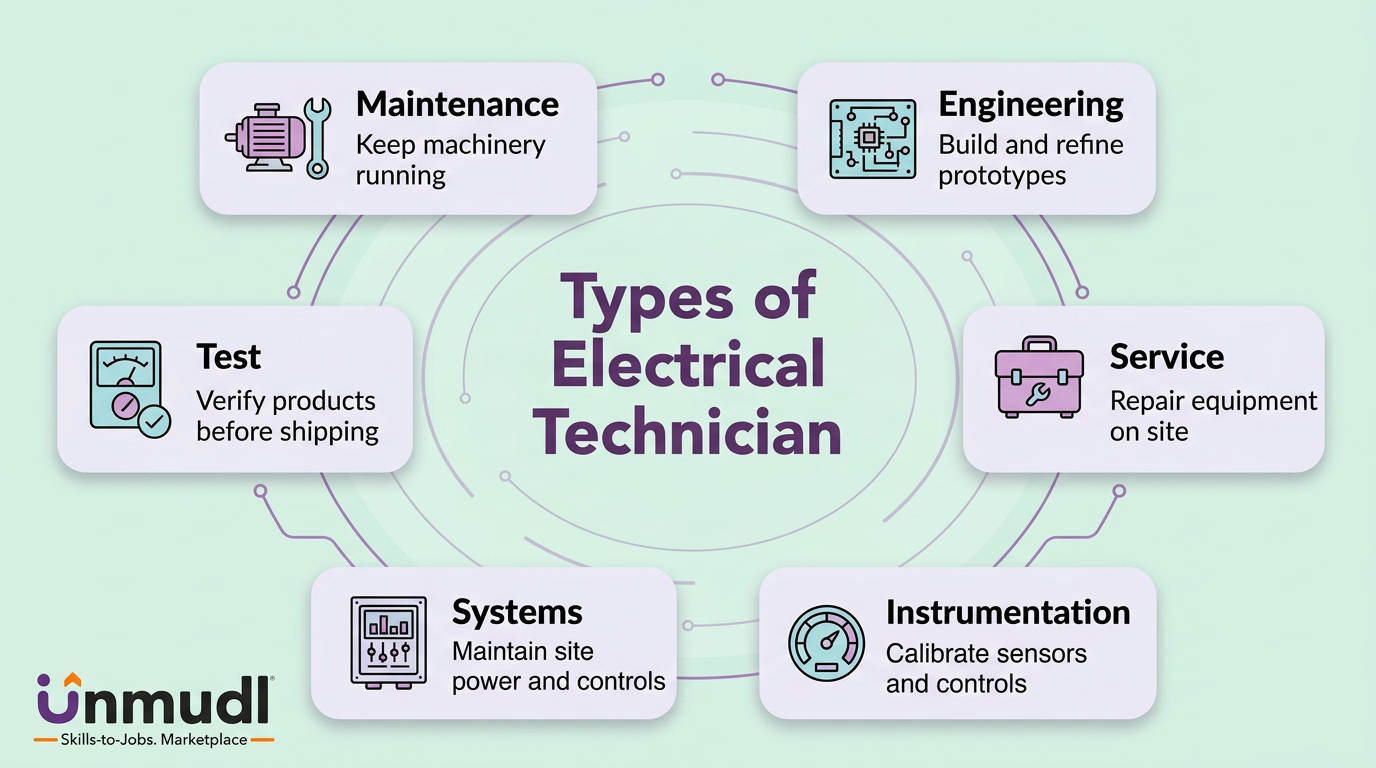
Six electrical technician specialties: maintenance, engineering, service, instrumentation, systems and testing

There are six main types of electrical technician based on the system the worker services and the stage of the equipment's life at which the worker meets it. The types are the electrical maintenance technician, the electrical engineering technician, the electrical service technician, the electrical and instrumentation technician, the electrical systems technician and the electrical test technician.

1. Electrical Maintenance Technician

An electrical maintenance technician is a plant-based worker who keeps production machinery running by servicing its motor controls, relays and wiring. The servicing follows a preventive schedule and an emergency call-out. Both routes end in a restored line, which is what the employer measures. Fast diagnosis therefore counts for more than fresh design in this type. Employers staff this type most heavily in manufacturing.

2. Electrical Engineering Technician

An electrical engineering technician is a laboratory-based worker who turns an engineer's drawing into a working prototype and then tests it. The testing of a prototype feeds design changes back to the engineer. Faster feedback shortens development, which is what a design firm pays for. Logging every result against the drawing revision it verified keeps the feedback usable. Employers place this type in engineering services and instrument manufacturing.

3. Electrical Service Technician

An electrical service technician is a field-based worker who travels to a customer's site to repair installed equipment. Repair on site removes the cost of shipping a machine back to its maker. That saving is what a service contract sells. Carrying the spares a fault history predicts protects the saving, since a second visit doubles the downtime. Employers assign this type to equipment makers and service companies.

4. Electrical and Instrumentation Technician

An electrical and instrumentation technician is a process-plant worker who calibrates the sensors, transmitters and protection relays that measure and guard a process. Calibration keeps a reading true to the quantity it reports. A true reading lets an operator trust the control room screen. A documented calibration interval for every instrument tag guards that trust. Employers post this type in utilities and process industries.

5. Electrical Systems Technician

An electrical systems technician is a facility-based worker who maintains the power distribution and control systems of a site as one connected whole. Treating the site as a whole locates a fault upstream of the symptom. Upstream location stops a repeated trip on the same breaker. A current single-line diagram of the site makes that location possible. Employers hire this type for campuses, data centres and government sites.

6. Electrical Test Technician

An electrical test technician is a bench-based worker who runs the electrical inspection a product passes before it ships. The inspection catches a defective board before the customer does. Early detection is counted by a manufacturer in returns avoided. A written procedure with fixed pass and fail limits for every measurement keeps detection early. Employers concentrate this type in semiconductor and electronic component manufacturing.

Maintenance, engineering, service, instrumentation, systems and test work all draw on one body of electrical theory. Choosing among the six by the equipment served lets a candidate match a title to the duties they want to perform.

What are the Duties of Electrical Technician?
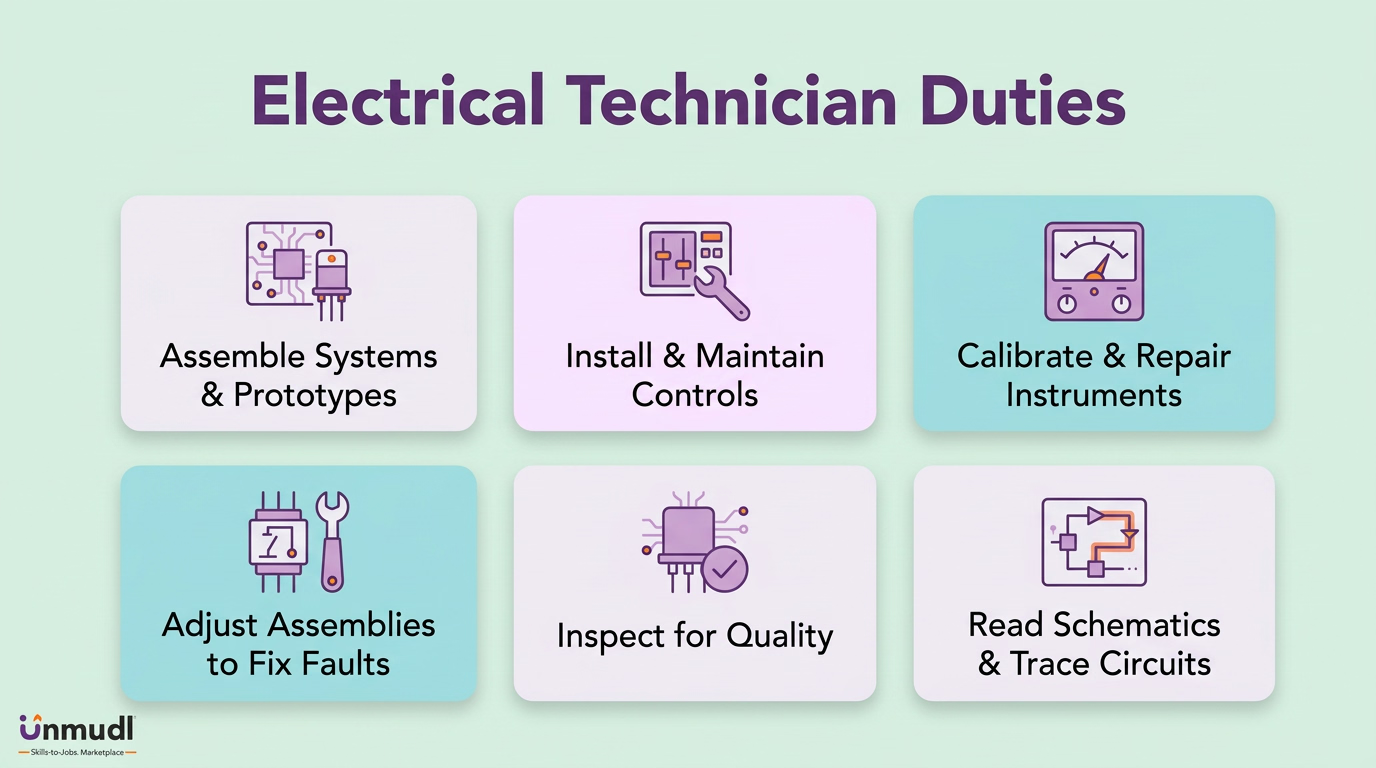
Electrical technician duties: assemble systems, maintain controls, calibrate instruments, correct faults, inspect quality and trace circuits

There are six core duties of an electrical technician. The duties are assembling electrical systems and prototypes, installing and maintaining control systems, calibrating and repairing instruments, adjusting assemblies to correct faults, inspecting designs for quality control and reading schematics to trace circuits.

1. Assembling Electrical Systems and Prototypes

Assembling is the duty of building a circuit, panel or prototype from a drawing and a parts list. The build follows the drawing wire by wire. Wire-by-wire fidelity makes the finished unit testable against the design. Marking each completed connection on the drawing guards that fidelity. Supervisors judge this duty by the first-pass test result.

2. Installing and Maintaining Control Systems

Fitting programmable controllers, motor control centres and relays and then keeping them in service is the second duty. Keeping a controller in service means replacing a failed module and confirming the programme still runs. A running programme is what the production manager sees. A spare-module stock matched to the installed base keeps it running. Supervisors track this duty through unplanned stoppage hours.

3. Calibrating and Repairing Instruments

Calibrating is the duty of comparing an instrument's reading against a reference and adjusting it until the two agree. Agreement with the reference lets a test result stand. A standing result is what a laboratory sells. A calibration record with a due date for every meter and oscilloscope protects the result. Supervisors read this duty from that record.

4. Adjusting Assemblies to Correct Faults

Adjusting is the duty of changing a part, a setting or a connection until a failed unit passes its test. The change is made one variable at a time. Changing one variable shows which change cleared the fault. Retesting after every single adjustment confirms the clearance. Supervisors value this duty for the faults it clears without a redesign.

5. Inspecting Designs for Quality Control

Inspecting is the duty of checking a drawing or a built unit against the specification before approval. Checking before approval catches an error while it is still cheap. A cheap correction is what quality control returns to the firm. A checklist drawn from the specification itself keeps the check complete. Supervisors sign off this duty on the inspection sheet.

6. Reading Schematics to Trace Circuits

Reading schematics is the duty of following a circuit on paper to the component that carries the fault. Following the paper first narrows the search on the hardware. A narrow search turns an hour of probing into ten minutes. Keeping the drawing set current after every modification keeps the search narrow. Supervisors rely on this duty whenever a machine stops without a stated cause.

Assembling, installing, calibrating, adjusting, inspecting and reading form one workflow from drawing to running equipment. Performing all six in that sequence lets a technician hand a system back in a proven state at any work site.

Where does an Electrical Technician Work?
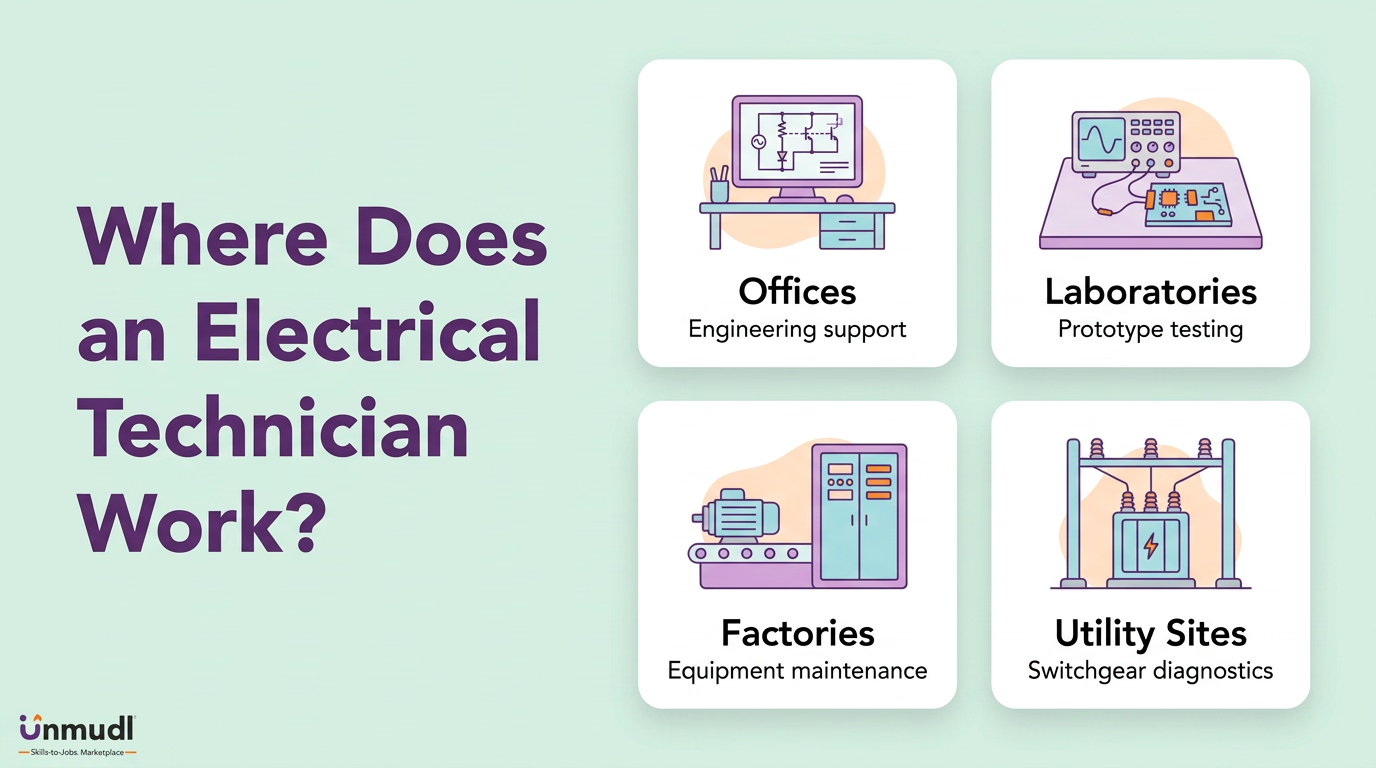
Electrical technician work settings: offices, laboratories, factories and utility sites

An electrical technician works in offices, laboratories and factories, and the site decides which duties fill the day. A laboratory day is spent at a bench with test instruments on prototypes. A factory day is spent on the production floor with conveyor motor controls and control panels. A utility day is spent at a substation running diagnostics on switchgear. Each of these sites belongs to an industry, and the industries divide the workforce unevenly. Serious hazards at these sites are rare where safety procedures are followed, according to the BLS Occupational Outlook Handbook, and exposure to those hazards ranges by site. A semiconductor cleanroom sits at the controlled end of that range and an outdoor utility site at the exposed end. BLS records the largest employing sectors as government at 12 percent, engineering services at 11 percent, semiconductor and electronic component manufacturing at 10 percent, measurement and instrument manufacturing at 8 percent and utilities at 7 percent. The table below sets out those sector shares.

Employing Sector

Share of Electrical Technician Workforce

Government

12 percent

Engineering services

11 percent

Semiconductor and electronic component manufacturing

10 percent

Measurement and instrument manufacturing

8 percent

Utilities

7 percent

Smaller industries combined

52 percent, derived as the remaining share

Every one of those industries hires the technician through the same entry route.
How to Become an Electrical Technician?

Becoming an electrical technician requires completing postsecondary training, earning recognised credentials, building supervised experience, preparing a competitive job application, and keeping skills current. There are five stages on this route. The stages are training, credentials, practical experience, job application readiness, and skill maintenance. The five stages are completed in the order listed below.

1. What is the Training for an Electrical Technician?

Training for an electrical technician is classroom instruction in electrical theory combined with laboratory practice on circuits and control equipment. The instruction covers DC and AC circuitry, digital electronics, circuit analysis, and safety procedures. Community colleges and vocational schools deliver the instruction through three formats. The formats are the associate degree program, the certificate course, and hands-on laboratory work. Each format is completed in the order given below.

1.1 Complete an Associate Degree Program

Enrol in an accredited associate degree program in the field. The program runs about 60 credits over 2 years. Coursework in the program includes circuit analysis, digital electronics, industrial controls, and microcontrollers. Students in the program learn to read schematics, operate test instruments, and apply troubleshooting techniques.

1.2 Take a Certificate Course as a Shorter Route

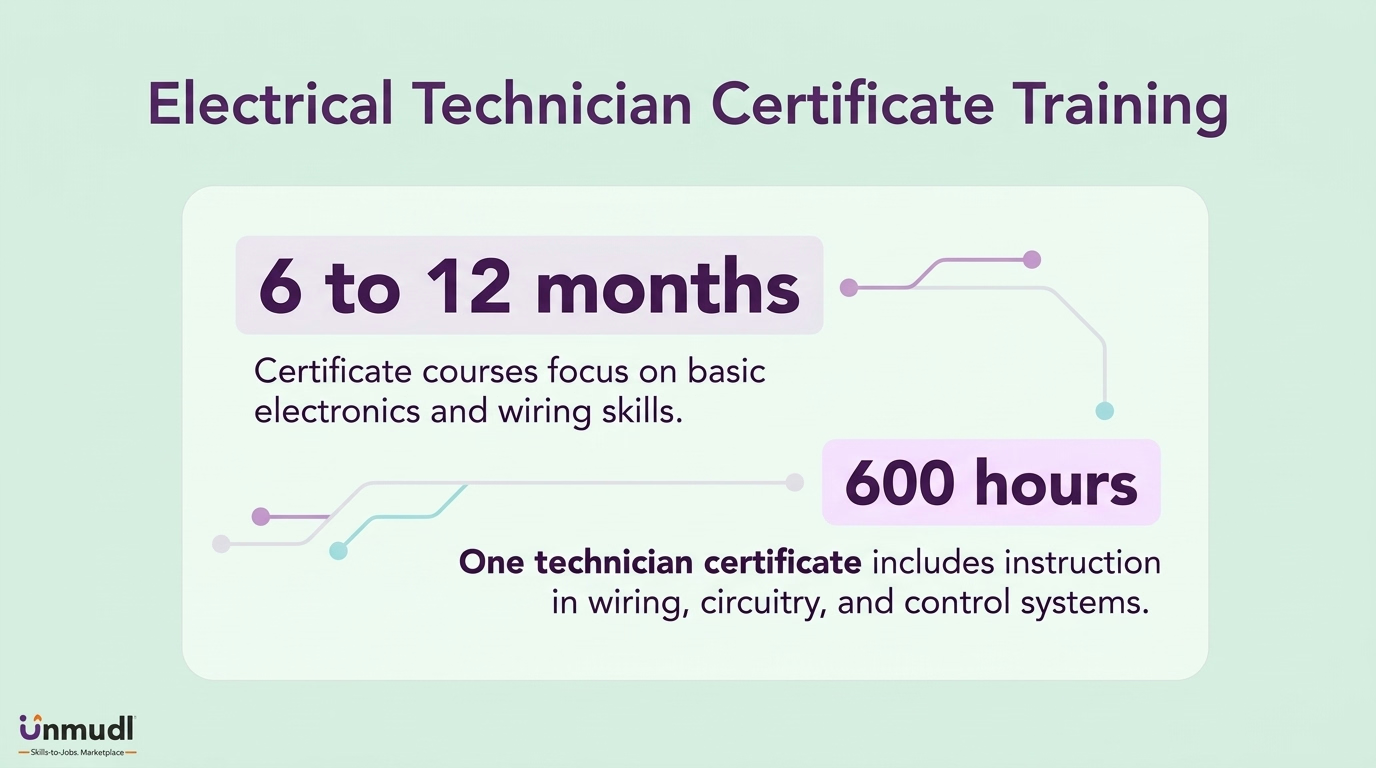
Electrical technician certificate training showing a six-to-twelve-month route and a 600-hour program example

Choose a certificate course when the two-year degree does not fit the timeline. A certificate course runs 6 to 12 months and concentrates on basic electronics and wiring skills. One technician certificate contains 600 hours of instruction in wiring, circuitry, and control systems. Admission to a certificate course needs only a high school diploma, with algebra and physics as recommended background. Graduates of a certificate course enter junior technician roles after in-house training.

1.3 Practise in Laboratories and Apprenticeships

Build circuits, program programmable logic controllers (PLCs), and wire motors inside the program laboratory. Laboratory projects turn circuit theory into working equipment. Apprenticeship frameworks add about 2,000 hours of on-the-job training alongside classroom study. Formal apprenticeships are common for electricians and rare for technicians, so manufacturers and government agencies sponsor most technician programs. The trained candidate then documents the training with credentials.

2. What are the Credentials Required for an Electrical Technician?

The credentials required for an electrical technician are an educational award, a voluntary certification, and a conditional state license. No single national license governs the occupation. Certification instead signals competence to employers on a voluntary basis. The three credential classes are listed below, from mandatory to conditional.

2.1 Earn the Educational Credential

Hold an associate degree or diploma in electrical technology as the base credential. Completion of the program awards an Associate of Applied Science degree or a certificate. Employers list the award as required or preferred in most job postings.

2.2 Obtain an Electrical Technician Certification

Sit for an industry certification once employment begins. ETA International awards the Associate Certified Electronics Technician (CETa) at entry level, the Journeyman CET, and the Senior CET. The International Society of Certified Electronics Technicians (ISCET) awards a parallel CET. The National Institute for Certification in Engineering Technologies (NICET) awards Electrical Power Testing certification at Levels I to IV. Level I demands 6 months of experience, a supervisor's recommendation, and a passed exam. The International Society of Automation (ISA) awards the Certified Control Systems Technician (CCST) for instrumentation work. Siemens and Allen-Bradley add vendor certificates for PLC programming.

2.3 Check the State License Requirement

Verify the licensing rule of the state before accepting installation duties. A technician who works only on equipment and control panels needs no electrician's license. A technician who alters permanent wiring in Texas or California needs a state license. California requires the C-10 General Electrical license for work on electric vehicle charging infrastructure. A limited low-voltage license covers alarm and communication systems where a state regulates them. Licensed or not, the candidate proves the credentials through practice.

3. What Practical Experience Does an Electrical Technician Need?

The practical experience an electrical technician needs is supervised work with test instruments, control equipment, and safety procedures on real machinery. Experience turns the credential into demonstrated skill. There are three sources of that experience. The sources are internships and co-op positions, on-the-job training, and safety training.

3.1 Secure an Internship or Co-op Position

Apply for internships in electrical laboratories, manufacturing plants, or utilities while still enrolled. An internship places the student beside senior technicians and engineers. Practice on the placement includes multimeters, oscilloscopes, soldering irons, and programmable controllers. Manufacturing companies also run paid technician-level apprenticeships.

3.2 Learn Company Equipment Through On-the-Job Training

Expect on-the-job training after formal schooling. BLS records no formal on-the-job training requirement for the occupation, since education carries most of the skill. Employers still train new hires on company-specific equipment and procedures.

3.3 Finish Safety Training

Complete Occupational Safety and Health Administration (OSHA) 10-hour or 30-hour electrical safety training before working on industrial sites. Lockout and tagout procedures isolate machinery from its power source before repair. Insulated gloves and arc-flash protective equipment guard against shock and burn hazards. Employers on factory and construction sites treat the OSHA card as effectively mandatory. The experienced candidate then converts the record into an application.

4. How Does an Electrical Technician Prepare a Job Application?

An electrical technician prepares a job application by presenting technical education, laboratory projects, and tool proficiency as evidence of competence. The application has three components. The components are the resume, the references, and the interview. Each component is built below.

4.1 Write a Technical Resume

List the degree, the certifications, and every hands-on project on the resume. Include laboratory experience, cooperative education, and mastered software such as Multisim and AutoCAD Electrical. Name the tools operated, from oscilloscopes to PLC interfaces.

4.2 Collect References and Rehearse the Interview

Request letters of recommendation from instructors and internship supervisors. Rehearse the interview by explaining technical tasks already performed, such as tracing a motor control circuit. Demonstrate familiarity with electrical systems through those examples. Recruiters weigh a described repair more heavily than a listed course. The hired technician then keeps the skill set current.

5. How Does an Electrical Technician Keep Skills Current?

An electrical technician keeps skills current by renewing certifications, tracking code revisions, and pursuing advanced credentials. Electrical systems, standards, and safety rules change over time. Skill maintenance has two parts. The parts are renewal and advancement. Both parts are described below.

5.1 Renew Certifications and Standards Knowledge

Renew NICET and ETA certifications on their cycles through continuing education or retesting. Renew the OSHA safety card annually where the employer requires it. Track the National Electrical Code (NEC) and relevant Institute of Electrical and Electronics Engineers (IEEE) standards as revisions appear.

5.2 Pursue Advanced Credentials

Progress from the CETa to the Senior CET as experience accumulates. Add short courses in industrial automation or renewable energy systems. Complete a bachelor's degree in engineering technology for advancement into engineering-support roles. Following the five stages in sequence takes a candidate from first coursework to a certified, current electrical technician. A certified, current technician commands the salary that the occupation reports.

What is the Electrical Technician Salary?

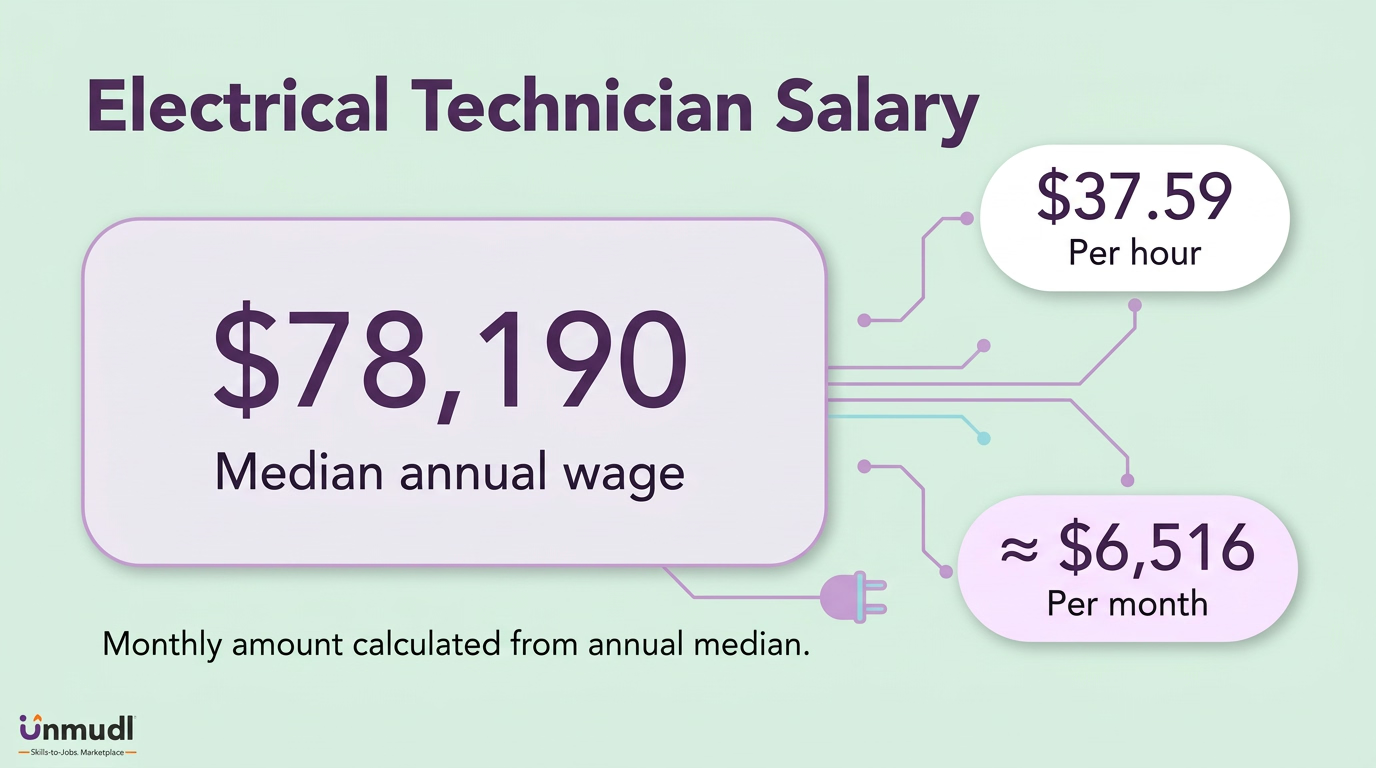
Electrical technician pay infographic showing a $78,190 median annual wage, $37.59 hourly and about $6,516 monthly

The electrical technician salary is $37.59 per hour, which builds into a median annual wage of $78,190. BLS reports both figures for electrical and electronic engineering technologists and technicians in its 2025 wage data. The hourly rate of $37.59 converts to $6,516 per month. The same rate converts to $19,548 per quarter. Both the monthly and the quarterly figures are arithmetic divisions of the annual wage and not separate BLS estimates.

The related question of how much electricians make receives a lower answer. Electricians form a separate occupation with a median wage of $62,350 in the May 2024 BLS data. The wage gap of $15,840 places the technician role higher on the pay scale of the electrical career field.

Is Electrical Technician a Good Career?

Yes, an electrical technician is a good career, since the occupation pairs above-average pay with steady replacement demand. BLS projects employment in the technician group to grow 2 percent from 2025 to 2035. That growth rate matches the average for all occupations. The modest growth still opens about 8,100 positions each year. The openings are driven by workers who retire or transfer to other roles. The openings spread across several industries, and the industry a technician joins decides which electrical systems the technician maintains.

What Electrical System Does Electrical Technician Maintain?

An electrical technician maintains four categories of electrical system, which are power distribution systems, control and automation systems, electronic instrumentation systems, and equipment lighting and low-voltage systems. Each category moves electricity through a different kind of hardware. Each kind of hardware demands a different maintenance task from the technician. The four system categories are described below.

Power Distribution Systems

A power distribution system is the network of transformers, switchgear, circuit breakers and panelboards in a facility. The network carries electricity from the supply point to every load. The electrical technician keeps the network live by inspecting breakers, replacing blown fuses and calibrating protection relays. Voltage checks at the panelboard expose a failing transformer before the load loses power. High-voltage transmission lines sit outside this network and belong to utility crews.

Control and Automation Systems

A control and automation system is the set of PLCs, motor control centers and relay circuits that commands machinery. The electrical technician services the set by loading controller programs and swapping electronic modules. The sensors and actuators that feed each controller are calibrated in the same visit. A conveyor that stalls is traced back to a faulty relay inside its control panel. Design of new control logic remains an engineering task.

Electronic Instrumentation Systems

An electronic instrumentation system is the group of printed circuit boards (PCBs), meters, sensors and embedded devices inside a machine. The group measures and reports what the machine is doing. The electrical technician maintains the group by testing boards and replacing failed resistors or chips. Every instrument is then verified to read within its specification. A medical monitoring device with a burned board receives a replacement board and a signal verification before it returns to service.

Equipment Lighting and Low-Voltage Systems

An equipment lighting and low-voltage system is the internal wiring, emergency lighting and small circuits housed inside a machine or a control cabinet. The electrical technician repairs an emergency light in a cabinet or restores a machine's internal lighting circuit. The repaired circuit keeps the enclosure safe to open and operate. Complete rewiring of a building is excluded from this system, because facility wiring is licensed work. Every system category runs on physical equipment, and that equipment is handled with a set of tools.

Which Equipment and Tools Does an Electrical Technician Work With?

An electrical technician works with two classes of hardware, which are the equipment that the technician services and the tools that the technician services it with. Equipment is the powered apparatus that belongs to a system, including motors, control panels and prototype assemblies. Tools are the hand-held and bench instruments that measure, join or image, including multimeters, oscilloscopes and soldering stations. The equipment items are described first and the tool items follow.

Electric Motors and Contactors

An electric motor is the powered machine that turns electrical energy into rotation on a pump, a conveyor or a robotic arm. A contactor is the heavy-duty switch that starts and stops the motor. The electrical technician tests the motor windings and traces the motor's control circuit. A worn contactor is replaced when the motor fails to reach its rated speed. A restored motor returns the line to full output.

Control Panels and PLCs

A control panel is the enclosure that houses the relays, terminal blocks and the PLC for one machine. The PLC is the industrial computer that runs the machine's operating sequence. The electrical technician sets up the panel for a new automated assembly line. A PLC program is adjusted and a faulty relay is swapped, so the machinery follows its designed sequence. A reprogrammed PLC is the fastest repair for a line that runs out of step.

Generators and Power Supplies

A generator is the machine that produces electricity when the main supply drops. A power supply is the module that converts incoming power to the voltage a device needs. The electrical technician inspects a backup generator and calibrates its voltage regulator. The output voltage of a power supply module inside an industrial robot is adjusted the same way. A stable output voltage keeps the robot's motor at its correct speed.

Prototype Assemblies

A prototype assembly is the first working build of a circuit or a device that an engineer has designed. The electrical technician solders components onto the prototype board and wires a harness for it. The assembly is then modified to correct functional deviations before production starts. The finished prototype is inspected for quality control against the engineer's drawings. Every adjustment on the assembly is made and checked with tools.

Multimeter

A multimeter is the hand-held meter that reads voltage, current and resistance on one dial. The electrical technician relies on the multimeter to check motor windings and to confirm a dead circuit before touching it. A live reading is compared with the value on the schematic. Voltage, current and resistance are the three quantities in Ohm's law, so the multimeter is the first tool picked up on every fault.

Oscilloscope

An oscilloscope is the bench instrument that draws an electrical signal as a waveform against time. The electrical technician turns to the oscilloscope to verify a circuit board's signal and to tune an electronic signal inside manufacturing equipment. Electrical noise that a multimeter cannot display shows up on the oscilloscope screen. A clean waveform on the screen is the pass mark for a repaired board.

Signal Generator and Calibrator

A signal generator is the bench source that injects a known test signal into a circuit. A calibrator is the reference instrument that checks a meter or a sensor against a known value. The electrical technician pairs the two instruments to calibrate a new control panel before installation. A drifting sensor is brought back within its specification with the same pair. A calibrated sensor feeds the controller a true reading.

Soldering Station

A soldering station is the temperature-controlled iron that joins components to a circuit board. The electrical technician works the station to fix parts onto a prototype board. A failed resistor or chip on a repaired board is removed and replaced at the same station. A sound solder joint is the difference between a board that passes verification and a board that fails it.

Thermal Camera and Cable Tester

A thermal camera is the imaging tool that shows heat as colour on a screen. A cable tester is the device that confirms continuity along a run of wire. The electrical technician scans a panel with the thermal camera to find an overheating breaker. The cable tester then locates a break in a control cable before the cable is replaced. Handling this equipment with these tools carries a technician from a fault report to a working machine. The same skill set is what an employer screens for in a job application.

How to Apply For Electrical Technician Job?

Applying for an electrical technician job on Unmudl takes five actions. The actions are creating an account, completing a profile, searching the job hub, reviewing a listing and pressing Apply Now. Unmudl is a skills-to-jobs marketplace that lists employer postings beside the courses that prepare for them. The five actions are listed below.

  1. Create a Unmudl account and verify the email address, since a signed-in and email-verified account is required before any application is accepted.
  2. Complete the profile with skills, work experience and an uploaded resume, because the Apply Now function reads the profile as the application.
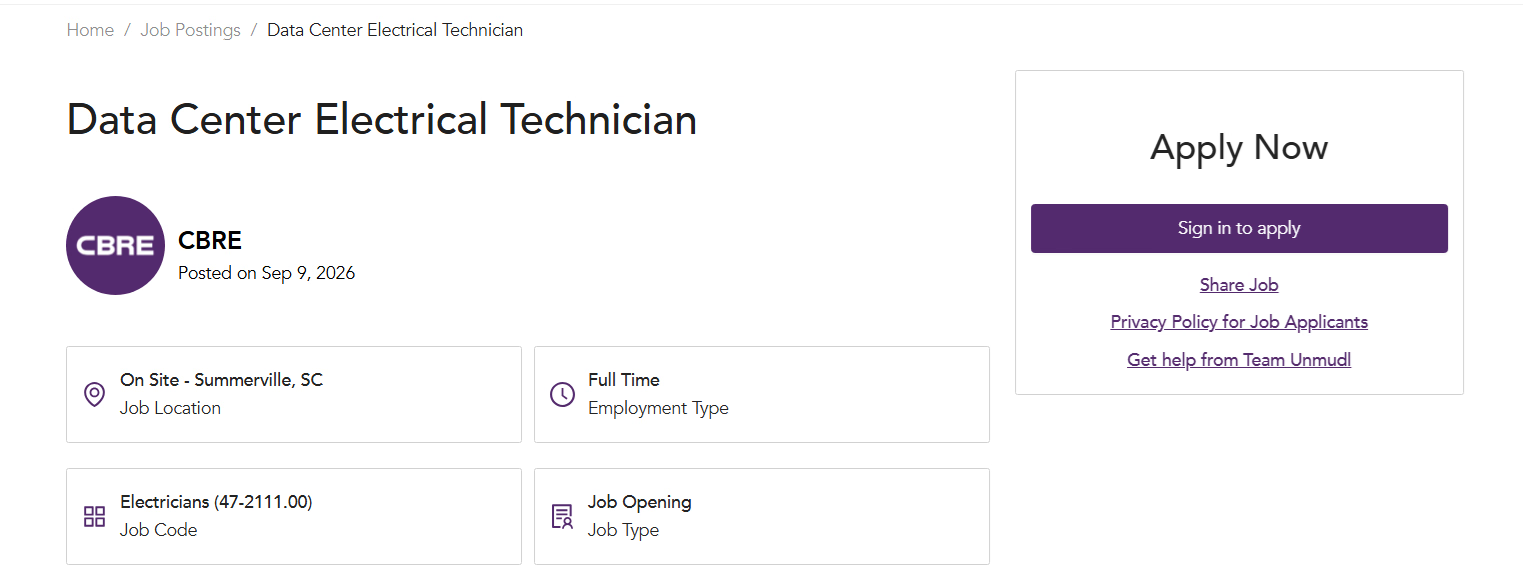
  3. Search the job hub by the title Electrical Technician and by location, which returns live postings. One such posting is the JLL electrical technician position in Colorado Springs, Colorado, posted on September 9, 2026.
    Electrical technician search results on Unmudl showing a Data Center Electrical Technician listing
  4. Review the listing for the employer name, the posting date, the location and the duty statement. The duty statement on the JLL posting covers planned preventive and emergency maintenance of building electrical systems.
  5. Press Apply Now on the job page, which submits the application directly on Unmudl. Some listings redirect the applicant to the employer's own portal to finish the submission.
    Data Center Electrical Technician listing with the Apply Now panel on Unmudl

Following the five actions in order places a complete application in front of the employer. The strongest profile on that application carries a course certificate in electrical systems.

What is Best Electrical Technician Course?

The best electrical technician course is Electrical and Electronic Systems for Technicians, offered on Unmudl by All Unmudl Originals. The course is an online, self-paced program in industrial electrical and electronic fundamentals. The fundamentals include circuit analysis, motor control and electronic systems. The curriculum aligns with a Smart Automation Certification Alliance (SACA) microcredential. The course page also carries an endorsement from the Advanced Robotics for Manufacturing (ARM) Institute. Completion awards a Unmudl certificate, which a learner adds to the Unmudl profile as evidence of electrical skill. The course is built for learners with some prior experience who are moving toward industrial maintenance. That maintenance scope is also what separates an electrical technician from an electrician.

What is the Difference Between Electrical Technician and Electrician?

The difference between an electrical technician and an electrician is the object of the work. The technician services electrical equipment and control circuitry, while the electrician installs and repairs the fixed wiring of buildings. An electrician is a licensed tradesperson who installs, maintains and repairs the wiring, fixtures and panels in homes, commercial buildings and industrial facilities. That wiring is governed by the NEC. BLS files electricians under Standard Occupational Classification (SOC) 47-2111, a separate occupation code from the technician's.

The goal of the electrician is code-compliant and safe power for a structure, which is why a state journeyman or master license gates the trade. The technician's objective is equipment that performs to engineering specification, and that objective needs no electrician's license. The electrician's tools are wire strippers, conduit benders and drills for pulling cable to a store's new lighting circuit. The technician's tools are the oscilloscope and the calibrator for tuning a power supply inside an industrial robot. Electrical technician vs electrician therefore comes down to wiring a facility against tuning the machines inside it. A third occupation shares the machine side with the technician.

What is the Difference Between Electrical Technician and Electro-mechanical technician?

An electrical technician differs from an electro-mechanical technician in the skill mix. The electrical technician works on purely electrical and electronic circuits, while the electro-mechanical technician works on machines that combine electrical and mechanical parts. An electro-mechanical technician, also known as a mechatronics technician, is a worker who operates, calibrates and repairs machinery with integrated electrical and mechanical systems. Such machinery includes robots, automated machines and pumps. BLS separates the mechatronics role under SOC 17-3024.

The aim of the electro-mechanical technician is a whole machine that moves correctly. That aim has the worker aligning gears and lubricating bearings as well as testing the sensors on the same device. The aim of the electrical technician stops at the circuit, so the worker adjusts a speed controller and leaves the mechanical alignment to the mechatronics side. The mechatronics toolkit adds torque wrenches, calipers and bearing pullers to the shared multimeter. On a conveyor, the electrical technician wires the control panel. The electro-mechanical technician clears the jam and realigns the motor.

Learn In Demand Skills Employers Are Hiring For

Explore our career-ready "Mechatronics and Robotics Maintenance" designed with employers to help you get hired faster. Train for industrial maintenance in ~10–12 weeks, earn a certificate and get ready to interview for technician roles.
No items found.
No items found.
Last updated on:
October 19, 2026
No items found.