Aviation Technician: Types, Duties, Training, And Salary

Aviation technician refers to a skilled worker who keeps aircraft and aircraft equipment in a condition fit for service. Aviation technician is the short form of aviation maintenance technician. The Federal Aviation Administration (FAA) treats the longer title as equivalent to aviation mechanic. This equivalence places the occupation inside aircraft maintenance rather than inside flying or design. The maintenance of each airframe covers its structure, engines, electronics and ground equipment, and each of these work objects produces its own technician type.

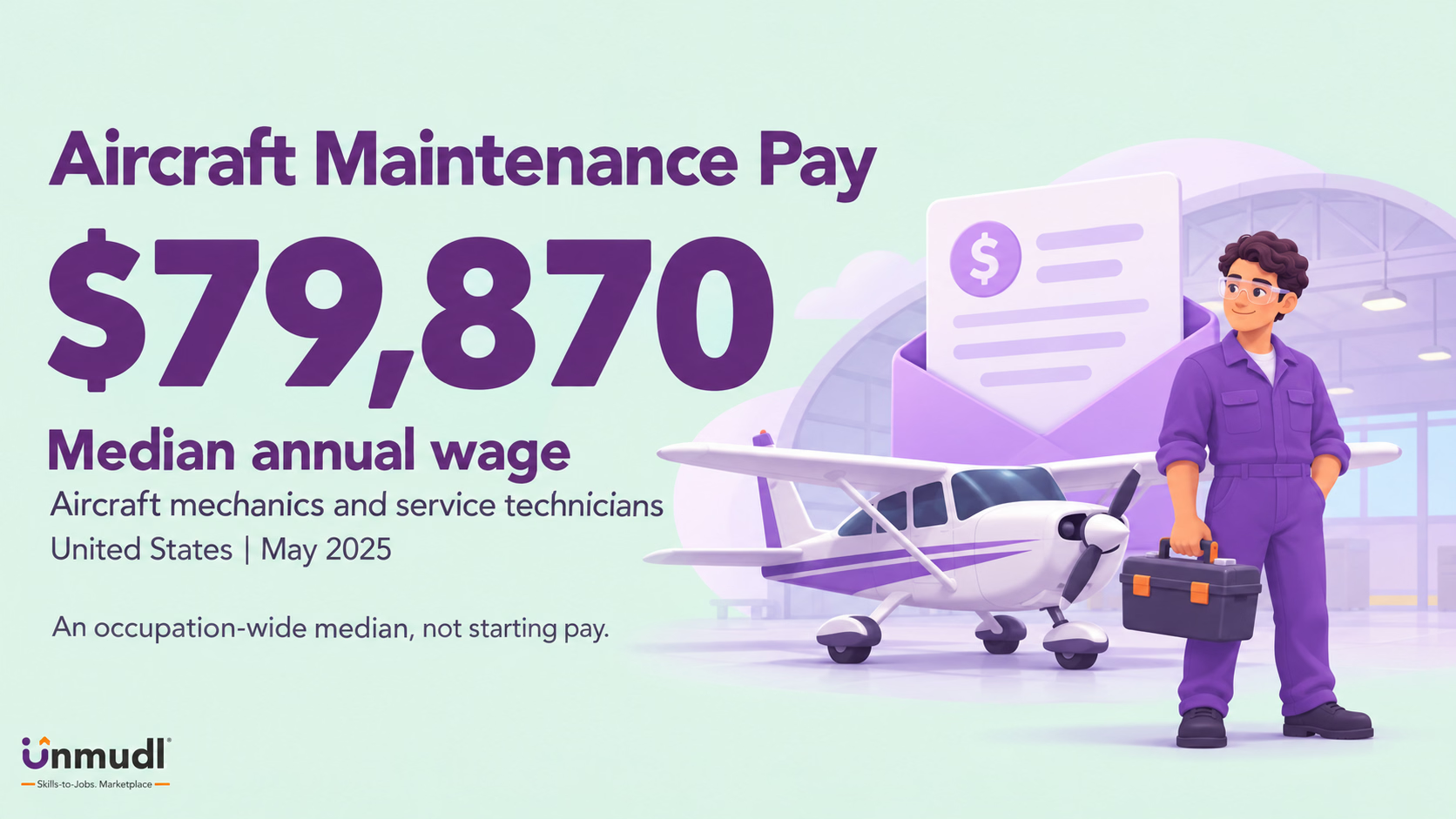
The importance of an aviation maintenance technician lies in airworthiness, which is the documented condition that keeps an aircraft safe to operate. Airworthiness depends on three things: a finding about condition, a correction of any defect and a record naming who performed the work. The record gives the role its weight, since a signature on a maintenance entry carries responsibility for the task it describes. The aircraft mechanic salary reached a median of $79,870 per year, or $38.40 per hour, in May 2025. The figure is from the Occupational Employment and Wage Statistics of the Bureau of Labor Statistics (BLS). The median closes a path that runs through the types of the work, the duties of a shift and the training that leads to an FAA certificate.

What is Aviation Technician?

An aviation technician is a maintenance worker who inspects, diagnoses, services and repairs aircraft and aircraft equipment within the limits of a personal competence and a maintenance authorization. An aviation technician handles the aircraft itself. This work object separates the role from an aerospace engineering technician, who handles designs, and from an aviation survival technician, who performs rescue work. Employer postings name the same worker as an aircraft technician, so the aviation technician job spans airline hangars, repair stations and military flight lines.

Maintenance authorization is the permission that fixes which tasks a worker performs alone and which tasks call for supervision. A worker with the title and no certificate performs permitted work under a certificated mechanic who is readily available in person. Required inspections and the approval for return to service stay with the certificate holder.

What Does Aviation Technician Do?

An aviation technician works by moving a reported defect through technical data, diagnosis, corrective work, verification and a written release. The defect arrives as a discrepancy from a pilot report or a scheduled check. The discrepancy is matched against the applicable technical data, the manufacturer instruction that states the limits for that configuration. The limits guide the diagnosis, so a hydraulic leak is traced by comparing a measured value with a published one. The corrective work repairs or replaces the component, and a functional check verifies that the system performs. The verified work is recorded with the date, the description and the name of the approver.

Learners who ask "what does an aviation technician do" receive this six-step cycle as the answer. The last step depends on an A&P license, the common name for an FAA mechanic certificate that carries both the Airframe rating and the Powerplant rating. The A&P holder approves return to service on the structure and the engine alike.

What Are the Types Of Aviation Technicians?

There are six main types of aviation technicians based on the work object each one maintains. The types are airframe technician, powerplant technician, A&P mechanic, avionics technician, helicopter mechanic and aviation support equipment technician. There are two other types, aircraft interior technician and aircraft composite technician, so the total number of types is eight. The six main types are listed below.

1. Airframe Technician

An airframe technician is a structures specialist who restores the metallic and nonmetallic structure of an aircraft to its approved configuration. A representative task is a structural repair performed to the applicable drawing with the specified fasteners. Employers assign the airframe technician to hangar work where structural condition decides a return to the line.

2. Powerplant Technician

A powerplant technician is an engine specialist who keeps propulsion systems and their lubrication, ignition and cooling systems in operating condition. The engine model sets the instructions, so competence on one engine establishes nothing about another. Employers post the powerplant technician to engine shops and to engine-related defects on the line.

3. A&P Mechanic

An A&P mechanic is a generalist who holds both ratings, Airframe and Powerplant, on one FAA mechanic certificate. The two ratings allow authorized work on the structure and on the engine of one aircraft during one visit. Employers place the A&P mechanic on work that crosses the airframe and engine boundary.

4. Avionics Technician

An avionics technician is an electronics specialist who installs, tests and repairs the communication, navigation and display equipment of an aircraft. The work object is a circuit rather than a structure, so the schematic and the test method replace the drawing and the fastener. Employers send the avionics technician to faults that a cockpit indication reports and a meter confirms.

5. Helicopter Mechanic

A helicopter mechanic is a rotorcraft specialist who applies maintenance skill to rotor systems and drive systems. The rotor system transmits lift and control. The specialization rests on aircraft-specific procedures and exists without a separate FAA helicopter rating. Employers station the helicopter mechanic with operators whose fleet is rotary-wing.

6. Aviation Support Equipment Technician

An aviation support equipment technician is a ground-equipment specialist who maintains the electrical, hydraulic, pneumatic and engine-driven units that serve an aircraft on the ramp. The work object never leaves the ground, which separates this type from the five aircraft-centered types. Employers deploy this specialist to flight lines and, in the Navy, to ships and shore stations.

The table below sets the six main types side by side on their work object and the assignment employers give them.

Type

Work object

Employer assignment

Airframe technician

Metallic and nonmetallic structure

Hangar structural work

Powerplant technician

Propulsion system and its support systems

Engine shops and line engine defects

A&P mechanic

Structure and engine of one aircraft

Tasks spanning airframe and engine

Avionics technician

Communication, navigation and display circuit

Cockpit-reported, meter-confirmed faults

Helicopter mechanic

Rotor system and drive system

Rotary-wing fleet operators

Aviation support equipment technician

Ground units on the ramp

Flight lines, Navy ships and shore stations

Common misreading

A type name read as an FAA license class

Ratings belong to the person, not the type

Reading the six types by their work objects lets a learner pick a specialty by the structure, engine, circuit, rotor or ground unit they want to handle. That matching starts with the duties that every type shares.

Airframe, powerplant, and avionics are three aviation specialties distinguished by the systems maintained.

What Are the Duties Of Aviation Technician?

There are six main duties of an aviation technician in the order of one maintenance cycle. The duties are reviewing technical data, inspecting condition, diagnosing faults, replacing components, testing completed work and documenting the work. There are four other duties, which are servicing systems, repairing structural defects, working on electrical equipment and controlling tools and hazards, so the total number of duties is ten. An aircraft maintenance technician job description and an aviation maintenance technician job description both list the same ten duties. The six main duties are listed below.

1. Reviewing Technical Data

Reviewing technical data connects a reported symptom to the correct instruction for the exact aircraft configuration. The instruction changes with the serial number and the modification state, so an inapplicable procedure is the first risk the review removes. Supervisors treat a task begun without the current data as a task begun wrong.

2. Inspecting Condition

Inspecting condition is the examination of an aircraft for damage, wear, leaks and deterioration by the prescribed method. A visual check and a borescope check reveal different defects in the same part. The inspection produces a discrepancy, and the discrepancy produces the rest of the shift. Supervisors keep the required inspections with the certificate holder who signs them.

3. Diagnosing Faults

Diagnosing faults narrows a mechanical or electrical problem to one cause through measurement. The measurement is compared with a published limit, so a reading outside the limit confirms the fault and a reading inside it clears the component. The comparison replaces the parts swap. Supervisors read an unexplained swap as a missing diagnosis.

4. Replacing Components

Replacing components is the corrective work that fits an eligible part while checking part identity, configuration and task limits. A part that fits physically is not a part that is eligible, since eligibility comes from the parts data and not from the shape. Supervisors gate the installation on the part number, not on the fit.

5. Testing Completed Work

Testing completed work verifies operation through the prescribed functional check. The check closes the gap between a component in position and a system in service, because an installation is complete only when the function returns. The result of the check is the value the record will carry. Supervisors release nothing that has not been tested.

6. Documenting the Work

Documenting the work is the maintenance entry that records the description, the completion date, the performer and the approval for every task. The entry is the only evidence that survives the shift, and it tells the next technician what remains open. Supervisors treat an undocumented task as a task not done.

Carrying the six duties in this order turns a reported defect into an aircraft released with a traceable record. That sequence is carried out in a range of workplaces rather than in a single hangar.
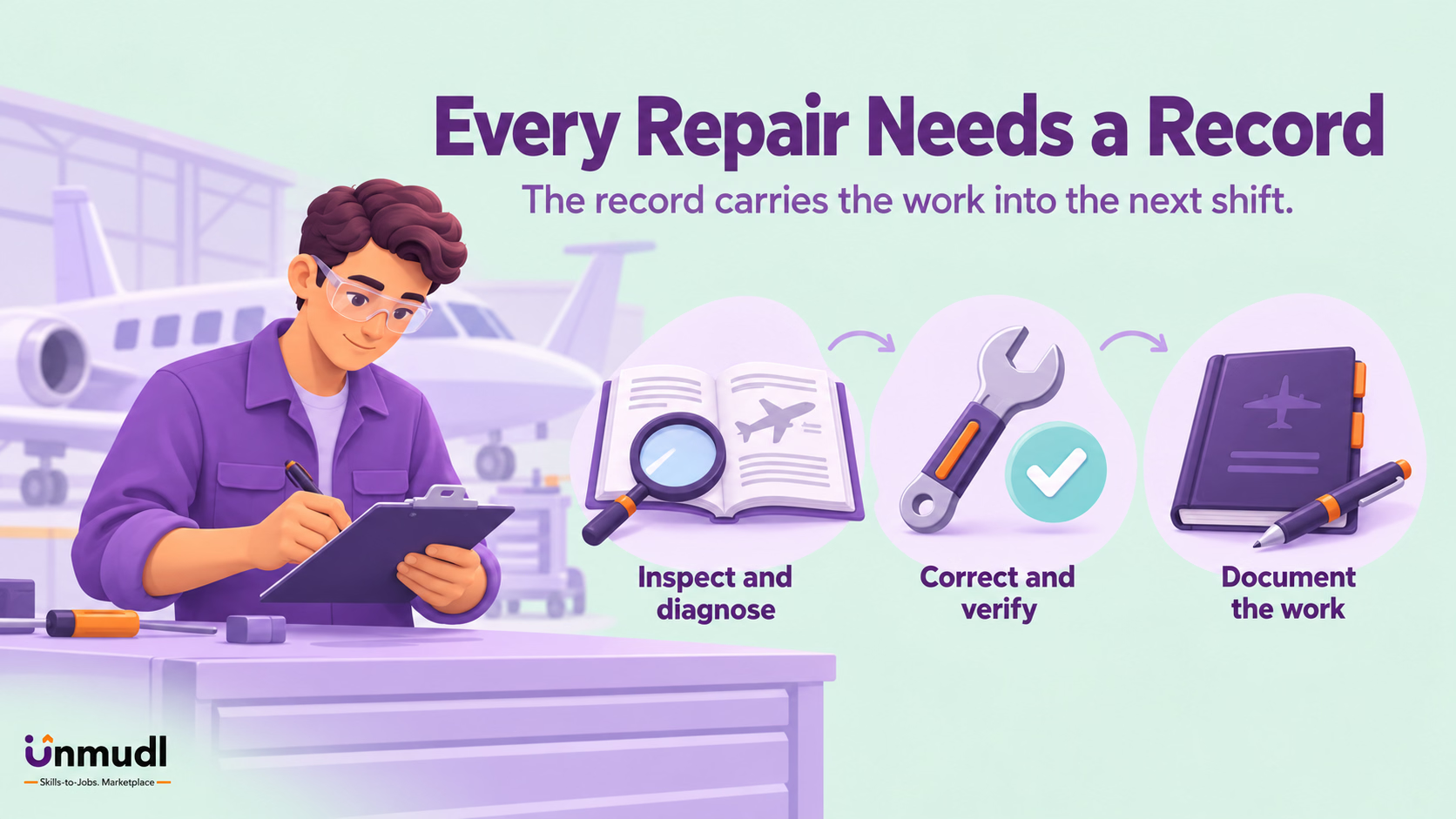
Aviation maintenance connects inspection and diagnosis, corrective work and verification, and a documented maintenance record.

Where Does Aviation Technician Work?

An aviation technician is employed in five settings: airline maintenance, independent repair stations, general and business aviation, aircraft manufacturing and military aviation. Airline maintenance divides into line maintenance on the ramp between flights and hangar maintenance for scheduled work indoors. An independent repair station, or maintenance, repair and overhaul (MRO) provider, serves several operators. General and business aviation adds smaller fleets and rotorcraft, and manufacturing adds assembly and flight-test support at Gulfstream and Boeing. Military aviation supplies the fifth setting. The aviation technician navy route places ground-equipment work afloat and ashore. An air force mechanic works on a flight line or in a back shop. Neither service title confers an FAA certificate, since military qualification is evaluated separately from civilian eligibility. Noise, awkward positions, elevated work and night or weekend schedules repeat across all five settings. Those conditions are the first facts a learner weighs before choosing the route into the occupation.
How To Become Aviation Technician?

Becoming an aviation technician requires five stages: qualifying training, required credentials, the FAA mechanic license, the certification tests, and the additional authorizations. The stages run in a fixed order because each stage supplies the evidence that the next stage checks. Learners asking how to become an aircraft technician follow the same five stages. The five stages are explained below.

1. What is the Training For Aviation Technician?

Aviation technician training is structured instruction that combines technical knowledge with supervised practical work on aircraft structures, propulsion, and systems. The instruction covers diagnosis, technical-document interpretation, testing, and record keeping beside manual skill. Avionics training narrows the same instruction to electronic equipment. Three attributes define the training: its curriculum, its routes, and its cost. The three attributes are listed below.

1.1 What is the Curriculum of Aviation Technician Training?

The curriculum of the training is the subject set that an FAA-certificated school ties to the mechanic certification standards under 14 CFR Part 147. The general subjects include mathematics, physics, electricity, drawings, weight and balance, materials and processes, records, regulations, and human factors. Airframe subjects address aircraft structures and their systems. Powerplant subjects address engines and their associated systems. Curriculum completion and FAA testing remain separate steps.

1.2 What Are the Routes of Aviation Technician Training?

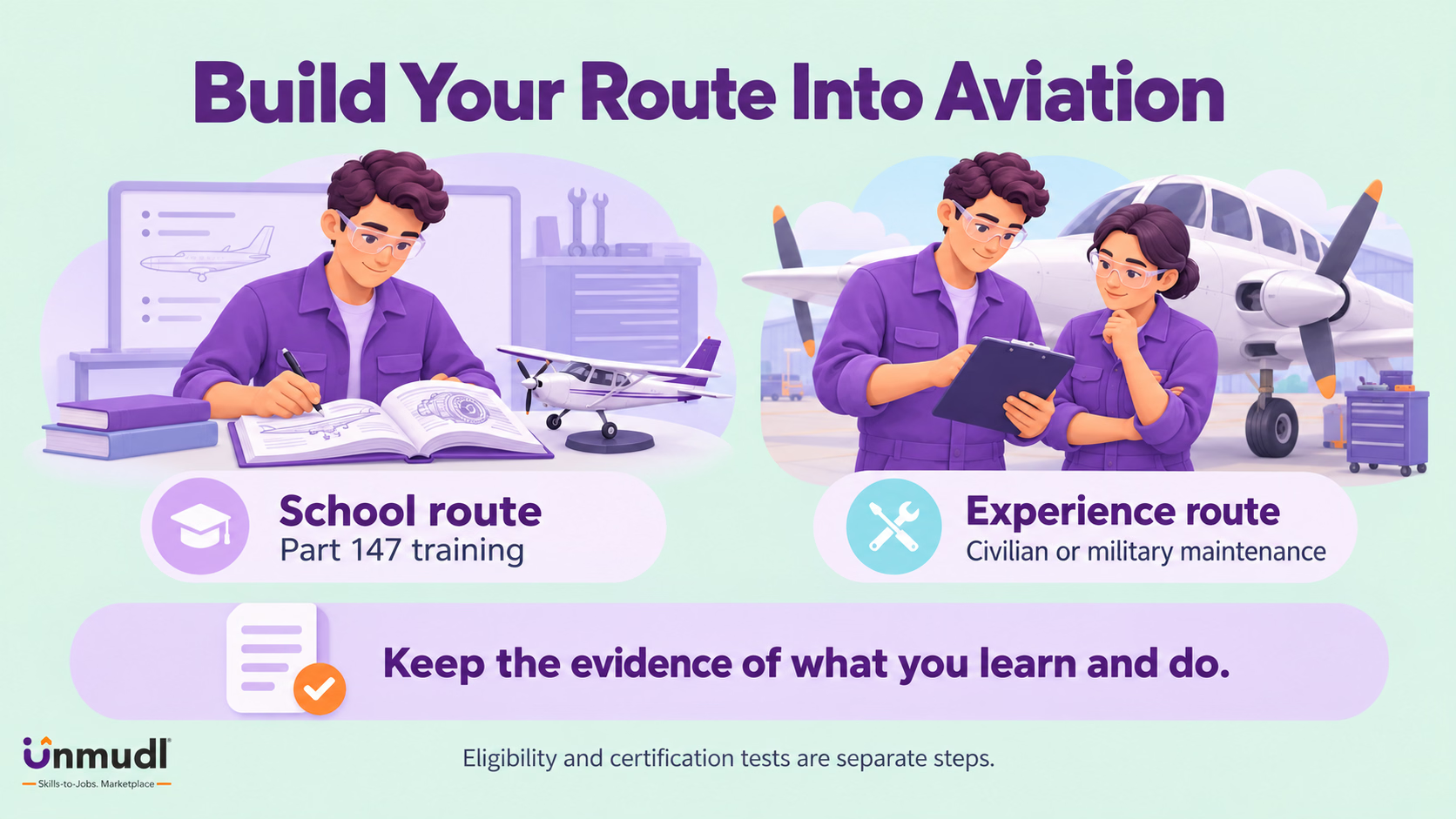
The routes of the training are three qualifying paths: a Part 147 school, supervised employment, and military maintenance. A Part 147 school supplies a defined curriculum, workshop equipment, and authenticated completion documents. Supervised employment or apprenticeship builds practical experience while the learner earns wages. The risk of that route is task exposure too narrow for the rating sought. Military maintenance supports civilian eligibility through preserved training and task records.

Aviation training can follow a Part 147 school route or a practical-experience route through civilian or military maintenance, with documented evidence and separate certification tests.

1.3 What is the Cost of Aviation Technician Training?

The cost of the training is a provider-specific figure with no universal FAA license price. Pima Community College's 2026-2027 in-state full-time associate degree table lists $20,269.50. The listed figure includes a $1,725 credential cost that the college reimburses upon successful completion. The published figure excludes tools, exam retests, transport, housing, and forgone earnings.

2. What Are the Credentials Required For Aviation Technician?

The credentials required for an aviation technician are documents that establish academic completion, occupational knowledge, or legal authority. The three functions are not interchangeable, so the necessary credential depends on the job and its approval responsibility. The credential types are the academic credential, the repairman certificate, and the avionics credential. The three credential types are explained below.

2.1 What is the Academic Credential For Aviation Technician?

The academic credential is a college certificate or an associate degree defined by the institution that awards it. A Part 147 school completion document sits beside the academic award and supports testing eligibility. Pima Community College awards both an A&P certificate and an Aviation Technology associate degree from the same program hub. An academic award alone grants no mechanic privileges.

2.2 What is the Repairman Certificate For Aviation Technician?

The repairman certificate is an FAA-issued credential for an employer-recommended person qualified for specific duties. The FAA criteria include the age and English conditions, an employer recommendation, qualification for the specific work, and appropriate practical experience or acceptable training. The employer recommends and the FAA issues. The authority stays limited to the task and the employment, so a repairman certificate substitutes for no A&P privilege outside that scope.

2.3 What is the Avionics Credential For Aviation Technician?

The avionics credential is an industry knowledge credential in aircraft electronics. ASTM International's NCATT program issues the Aircraft Electronics Technician (AET) credential. The Aircraft Electronics Association (AEA) issues the Certified Aircraft Electronics Technician (CAET) credential, with CAET-Advanced as the current upper tier and CAET-Pro as a tier planned for 2027. The electronics credential documents relevant knowledge and confers no FAA mechanic privilege.

3. What is the License Required For Aviation Technician?

The license required for an aviation technician is an FAA mechanic certificate with the Airframe rating, the Powerplant rating, or both. No single federal license covers every aviation specialty. License is the informal word, while certificate and rating are the regulatory terms under Part 65. The license carries three attributes: the A&P certification itself, its eligibility requirements, and its privileges. Each attribute is defined below.

3.1 What is the A&P Certification For Aviation Technician?

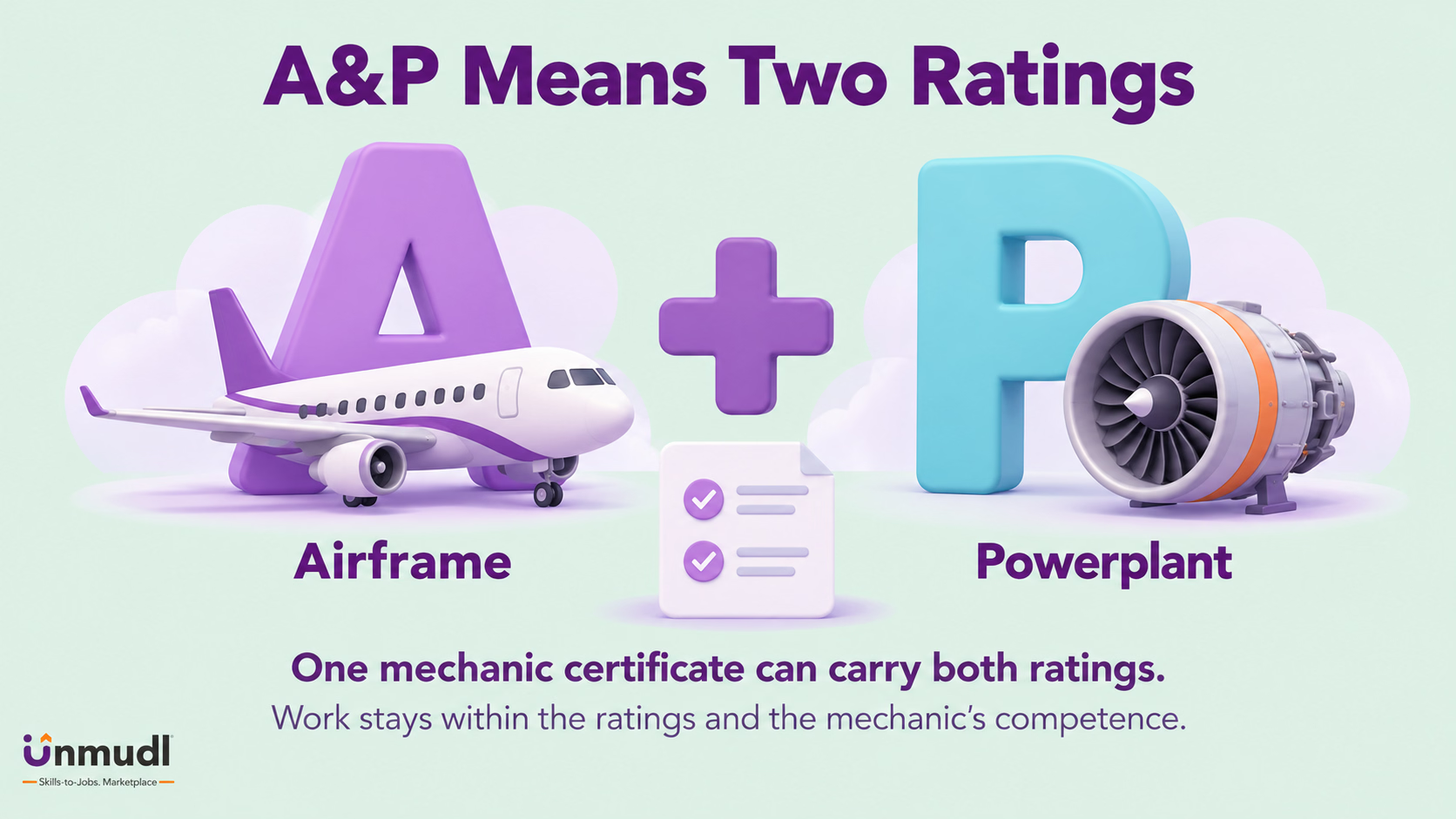
A&P certification is the mechanic certificate carrying both the Airframe and the Powerplant ratings. The two ratings are issued separately, so a mechanic holds one rating, the other, or both. Certain supervised work and repair-station arrangements permit maintenance without every worker personally holding both ratings. A job title proves no rating, because the ratings belong to the person and not to the position.

3.2 What Are the Eligibility Requirements For A&P Certification?

The eligibility requirements for A&P certification are a minimum age of 18, working English, and a qualifying education or experience. Working English means the ability to read, write, speak, and understand the language. The qualifying education is graduation from a Part 147 aviation maintenance technician school. The qualifying experience is at least 18 months of practical work for one rating or 30 concurrent months covering both ratings.

3.3 What Are the Privileges of A&P Certification?

The privileges of A&P certification are the maintenance tasks a mechanic performs and approves within the rating, demonstrated ability, and current instructions. Section 65.81 excludes unlimited instrument repairs and major propeller repairs or alterations from those privileges. Certain inspections and return-to-service approvals require additional authority. Section 65.83 keeps the privileges active only if the mechanic completes qualifying activity for six of the preceding 24 months.

A&P combines Airframe and Powerplant ratings on one mechanic certificate, with work limited by the ratings and the mechanic's competence.

4. What Are the Tests Required For Aviation Technician Certification?

The tests required for aviation technician certification are the FAA knowledge, oral, and practical tests measured against the Airman Certification Standards (ACS). Each rating sought adds its own test set to the General tests. The testing process has three parts: establishing eligibility, sitting the examinations, and finishing inside the test window. The three parts are described below.

4.1 How To Establish Testing Eligibility For Aviation Technician Certification?

Establish testing eligibility by filing the active April 23, 2026 edition of FAA Form 8610-2 with the route-specific evidence. Submit authenticated school graduation documents or an applicable Joint Service Aviation Maintenance Technician Certification Council (JSAMTCC) eligibility certificate. Those applicants need no additional FAA authorization to begin testing. Obtain an FAA airworthiness inspector's review through a Flight Standards District Office when eligibility rests on practical experience. Present dated task records with supervisor verification at that review.

4.2 What Are the Knowledge, Oral, And Practical Tests For Aviation Technician?

The knowledge, oral, and practical tests are the three examinations that measure knowledge, risk management, and practical skills under the General, Airframe, and Powerplant ACS. Obtain an FAA Tracking Number through the Integrated Airman Certification and Rating Application (IACRA) before scheduling the examinations. Submit the mechanic application itself on paper, as the FAA distinguishes the tracking number from the certificate application. Study the General standards first, because airframe and powerplant instruction builds on them.

4.3 What is the Testing Window For Aviation Technician Certification?

The testing window is the 24-month period within which the prescribed tests are completed. The window is a testing rule and not a schooling duration. Specific exceptions and early-testing provisions alter the window for particular applicants. A short exam-preparation course serves an already eligible candidate, as the course replaces no qualifying education or experience.

5. What Are the Additional Authorizations For Aviation Technician?

The additional authorizations for an aviation technician are the authority and competence that a certificated mechanic adds after the A&P certification. The certificate opens the occupation, while the additional authorizations determine which inspections, approvals, and aircraft the mechanic handles. The authorizations are inspection authorization, aircraft-specific competence, and foreign license conversion. The three authorizations are set out below.

5.1 What is the Inspection Authorization For Aviation Technician?

Inspection Authorization (IA) is an additional FAA authorization for a qualified and experienced mechanic. Section 65.91 requires holding the A&P certificate for at least three years and actively maintaining aircraft for the preceding two years, among other conditions. The authorization arrives separately from the A&P certification and never automatically with it. Holding IA extends inspection-related privileges beyond the base ratings.

5.2 What is the Aircraft-Specific Competence For Aviation Technician?

Aircraft-specific competence is demonstrated ability on the particular aircraft, engine, or system that an employer assigns. A certificate evidences no experience on every aircraft, so employers require further instruction and demonstrated competence on their fleet. Document only genuine ratings, experience, systems, and tools in a job application, because employers verify the authorization against the task.

5.3 What is the Foreign License Conversion For Aviation Technician?

Foreign license conversion is the FAA evaluation of a maintenance license issued outside the United States. A foreign license is not exchanged automatically for an FAA certificate. The holder's relevant experience and the Part 65 requirements are evaluated afresh. Test-preparation courses replace none of that qualifying evidence. Following the five stages in order lets a learner match training, credentials, license, tests, and authorizations to the job actually sought. The job sought carries the wage that the occupation reports.

How Much Does Aviation Technician Earn?

An aviation technician earns a median of $38.40 per hour, $6,655.83 per month, $19,967.50 per quarter, and $79,870 per year. The figures come from the May 2025 Occupational Employment and Wage Statistics that BLS released on May 15, 2026 for aircraft mechanics and service technicians. The monthly and quarterly figures are the annual median divided by 12 and by 4, not separately surveyed payroll periods. Avionics technicians hold a higher median of $39.56 per hour and $82,280 per year. The average aviation technician salary stands at $84,740 per year, with an hourly mean of $40.74. The aviation maintenance technician salary rises with industry, as the air-transportation median reaches $96,170 per year. The figures describe the occupation and not a graduate's starting pay, and a graduate's first concern is whether a degree is required at all.

Aircraft mechanics and service technicians earned a U.S. median annual wage of $79,870 in May 2025, an occupation-wide median rather than starting pay.

Does Aviation Technician Need Degree?

No, an aviation technician does not need a college degree, since the FAA mechanic certificate is obtained through the Part 147 school route or the practical-experience route. The required tests follow either route. BLS lists a postsecondary nondegree award as the typical entry education. That award is what an aviation maintenance technician school confers. The aircraft maintenance technician requirements that a provider or an employer adds, such as an associate degree, are local preferences rather than federal rules. A degree supports broader study and confers no mechanic privilege on its own. The route chosen in its place decides how long the qualification takes.

How Long Does It Take To Become Aviation Technician?

It takes at least 18 months of practical experience for one rating or 30 concurrent months for both ratings to become an aviation technician through the experience route. The school route takes the length of a Part 147 program. Learners who ask "how long does it take to get an A&P license" receive the same route-dependent answer. The Pima A&P certificate runs 16 months full-time, the Pima associate degree runs 22 months and the Colorado Northwestern program runs five semesters. Aircraft maintenance technician training ends with a 24-month window for the prescribed tests. Cohort availability, exam scheduling and retests lengthen the route. The finished technician then maintains a defined set of aircraft systems.

Which Systems Does Aviation Technician Maintain?

An aviation technician maintains ten functional aircraft systems. The systems are the structures and surfaces, the flight controls and rotor systems, the landing gear and brakes, the hydraulic and pneumatic systems, the electrical power and wiring, the avionics and instruments, the fuel systems, the powerplant and propellers, the environmental and protective systems, and the cabin, water, waste and emergency equipment. Airplane maintenance groups the ten systems by function. Airframe maintenance covers every group except the powerplant and propellers, which powerplant work covers. Each system is listed below with the technician type that owns it.

  • Structures and surfaces: the structure, the panels and the corrosion protection, owned by airframe and composite technicians.
  • Flight controls and rotor systems: the surfaces, linkages, rotors and drive trains, rigged by airframe specialists and helicopter mechanics.
  • Landing gear and brakes: the supporting, retracting and stopping equipment, inspected and adjusted by airframe technicians.
  • Hydraulic and pneumatic systems: the pressure-operated circuits that power other systems, shared by airframe and powerplant technicians.
  • Electrical power and wiring: the batteries, the distribution equipment and the circuits, where mechanical roles and avionics roles overlap.
  • Avionics and instruments: the communication, navigation, display and sensing equipment, owned by avionics technicians.
  • Fuel systems: the storage, lines, filtering and metering equipment, where airframe responsibility and engine responsibility meet.
  • Powerplant and propellers: the engine, its subsystems and the propeller, owned by powerplant technicians and A&P mechanics.
  • Environmental and protective systems: the pressurization, oxygen, ice protection and fire equipment, maintained by airframe technicians.
  • Cabin, water, waste and emergency equipment: the interior, servicing and safety equipment, owned by interior technicians and serviced by line technicians.

Ground-support equipment is maintained alongside the aircraft and belongs to none of the ten systems. The equipment used to maintain all ten is the subject of the next section.

Which Equipment And Tools Does Aviation Technician Work With?

An aviation technician works with equipment and tools selected by the aircraft, the component and the procedure rather than from a universal kit. The aviation maintenance technician tools map onto the eight technician types. The aviation maintenance technician handbook series of the FAA comprises the 2023 General handbook FAA-H-8083-30B, the Airframe handbook 31B and the Powerplant handbook 32B. The series teaches the use of the tools as an educational reference, while the manufacturer's maintenance data governs the actual task. The equipment is listed first and the hand tools follow, each tied to the types that use it.

  • Engine inspection and test equipment: the gauge, inspection and test apparatus for a specific engine, used by powerplant technicians and A&P mechanics.
  • Electronic test equipment: the oscilloscope, circuit tester and voltmeter set, used by avionics technicians with the wiring diagram.
  • Rotor rigging and track-and-balance equipment: the apparatus that measures blade track and vibration, used by helicopter mechanics.
  • Composite lay-up and vacuum-bagging equipment: the inspection instruments, lay-up tools and bagging materials, used by aircraft composite technicians.
  • Ground-support diagnostic equipment: the hand and diagnostic apparatus for ground-unit systems, used by aviation support equipment technicians.
  • Hand and pneumatic tools: the hand-operated and air-powered fastening tools, used by airframe, interior and support equipment technicians.
  • Rivet tools: the rivet guns and associated rivet tools, used by airframe technicians on skin repairs and by interior technicians on cabin assemblies.
  • Precision measuring tools: the micrometers, calipers and depth gauges that verify a dimension against a limit, used by airframe technicians and A&P mechanics.
  • Torque tools: the torque wrenches and torque screwdrivers that apply a specified preload, used by A&P mechanics and powerplant technicians.
  • Soldering equipment and wiring diagrams: the soldering iron and the schematic, used by avionics technicians on every wiring repair.
  • Cutting, sanding and shaping tools: the saws, shears and sanders that form panels and trim assemblies, used by interior technicians.
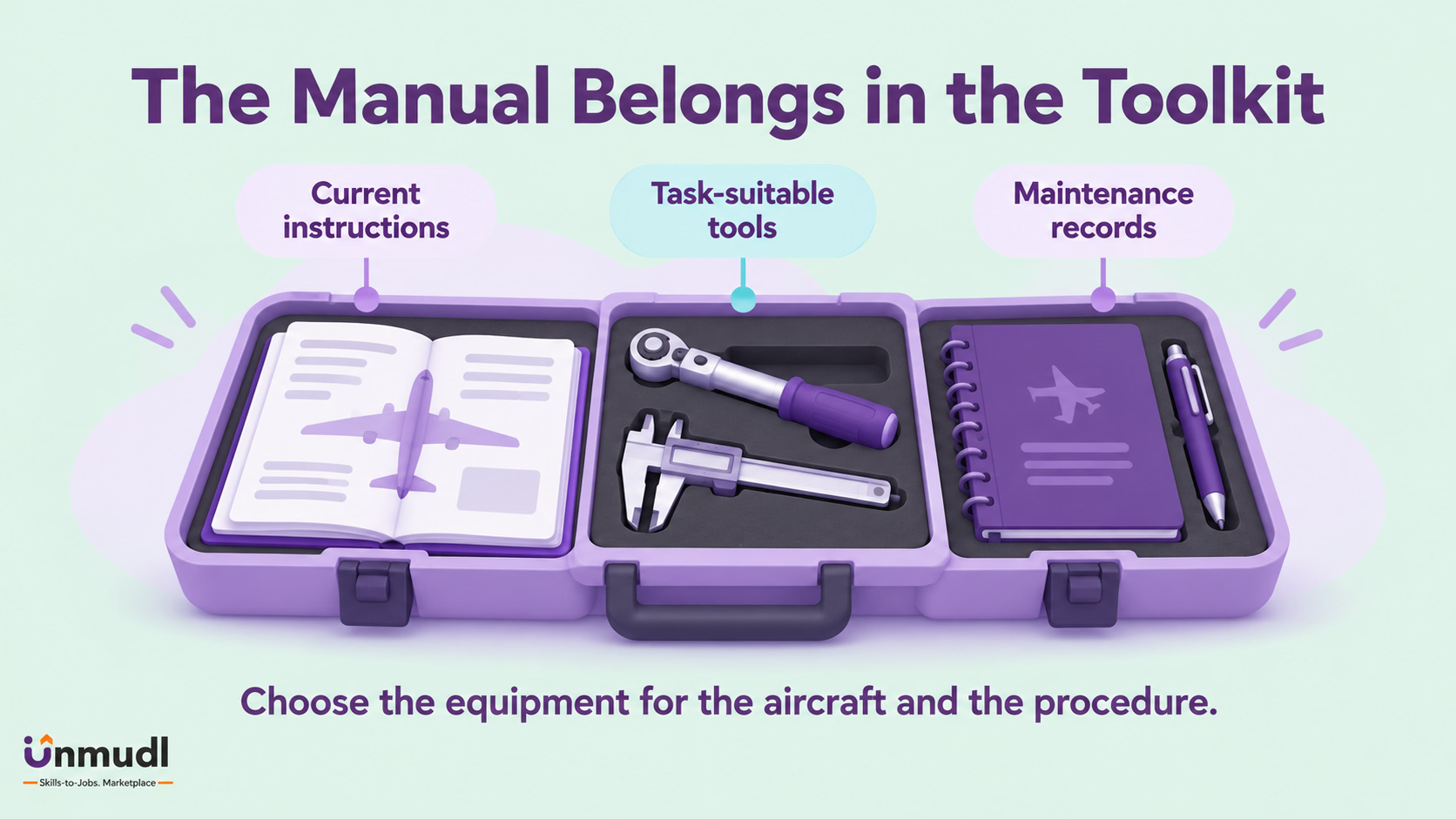
  • Technical publications and maintenance records: the current manuals, the parts data and the logbooks that control every task, used by every type.

Using the publication and the record together makes a technician ready to apply for a job.

An aviation technician's toolkit includes current instructions, task-suitable tools, and maintenance records.

How To Apply For Aviation Technician Jobs?

Applying for aviation technician jobs on Unmudl requires a free account, a completed profile and an application submitted from the job board. Unmudl is a skills-to-jobs marketplace for technicians. Its job board lists aircraft maintenance technician jobs alongside other technician openings posted by employers. There are six steps to apply. The steps are opening the job board, searching the openings, creating the account, building the resume, completing the profile and submitting the application, and they are listed below.

  • Open the job board. Start at the Unmudl homepage and select Get Jobs, or select Browse Open Jobs in the jobs section. Either control resolves to the Unmudl job board at unmudl.com/search-jobs.
  • Search the openings. Search the aviation technician jobs on the board by job title and location. Shortlist the openings that match the rating held.
  • Create the account. Select Create Free Account from the homepage, which opens unmudl.com/signup. Verify the account by email so that the application can be saved.
  • Build the resume. Open the Unmudl resume builder at unmudl.com/resume-builder and select Build My Resume. Enter the experience, the education and the skills, then save or download the resume as a PDF from the account.
  • Complete the profile. Open the chosen job page and select Sign in to apply. Fill in the profile information that the employer requires, including the ratings, the experience and the systems worked on.
  • Submit the application. Select Apply Now on the job page. Follow the employer's application destination to the confirmation screen.

Following the six steps on Unmudl turns a certificate and a resume into a submitted application. The course that prepares a learner for that application sits in the same marketplace.

What is the Best Aviation Technician Course?

The best aviation technician course on Unmudl is Foundations of Automated Equipment Maintenance, an Unmudl Originals course that covers industrial safety, measurement and drawings, pneumatics, hydraulics, electrical circuits, mechanical drives and robotics. The course names aviation among its industries. The course builds the measurement, drawing, hydraulic, pneumatic and electrical knowledge that an aviation maintenance curriculum also teaches. The course therefore serves as foundational preparation before an aviation technician school. Unmudl does not list a Part 147 aviation maintenance technician program, and no general course establishes FAA A&P eligibility on its own. The learner who finishes the foundation then compares the aviation technician role with the three titles it is most often confused with.

What is the Difference Between Aviation Technician And Aircraft Mechanic?

The difference between an aviation technician and an aircraft mechanic is a difference of label rather than of occupation. The Occupational Information Network (O*NET) lists maintenance-technician titles inside the aircraft mechanic occupation. An aircraft mechanic is an explicit mechanical-maintenance occupation whose goal is to maintain and restore aircraft condition within authorization. An aviation technician is a broad maintenance job label whose goal is to maintain and document the assigned systems.

The tools of both are the technical data, the inspection tools, the meters and the specialty equipment, and mechanical work emphasizes gauges and torque tools. For example, a maintenance technician investigates a hydraulic discrepancy, and an aircraft mechanic performs the same investigation. The title change alone changes no privilege. An aviation mechanic salary is therefore the same $79,870 median, because the two labels share one occupational data population.

What is the Difference Between Aviation Technician And Avionics Technician?

The difference between an aviation technician and an avionic technician is the work object. The aviation technician maintains the mechanical and structural systems while the avionics technician specializes in the electronic systems. An avionics technician is an aircraft electronics specialist whose goal is functioning communication, navigation and indication equipment. The aviation technician's goal is mechanical and structural serviceability across the assigned systems. BLS and O*NET code the two as separate occupations.

The aviation technician's tools are manuals, inspection equipment, torque tools, gauges and meters, while the avionics technician's tools are wiring diagrams, multimeters, oscilloscopes and electronic test equipment. For example, the aviation technician investigates a hydraulic leak with the applicable instructions, and the avionics technician isolates a communication-system wiring fault with the prescribed tests. The avionics technician vs aircraft mechanic salary comparison for May 2025 gives $82,280 against $79,870 in annual medians. That $2,410 gap is a measured difference and not a credential premium.

What is the Difference Between Aviation Technician And A&P Mechanic?

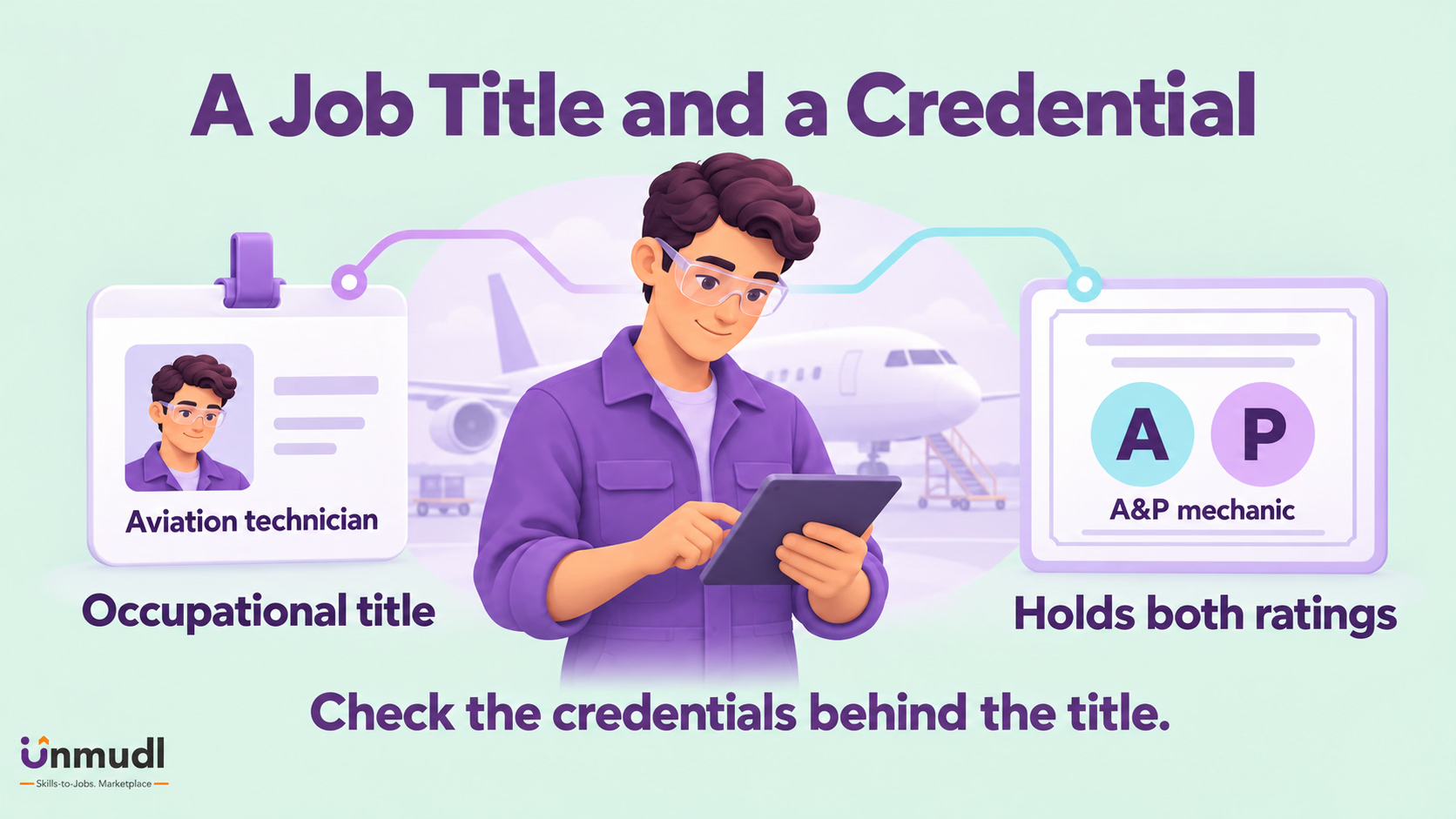
The difference between an aviation technician and an A&P mechanic is the credential. The aviation technician is an occupational label while the A&P mechanic holds both FAA mechanic ratings on one certificate. The answer to what is an A&P mechanic is therefore a person, not a job title. The goal of the A&P mechanic is airframe and powerplant work within the rating, competence and rule limits. The goal of the aviation technician is assigned maintenance within whatever authorization applies.

The tools of the two are identical when the task is identical, and no tool proves an A&P qualification. For example, an entry-level aviation technician carries out permitted work under qualified supervision, while an A&P mechanic exercises both ratings on authorized aircraft and engine tasks. Both ratings confer no Inspection Authorization and no unlimited major-repair or instrument-repair privilege. The cited BLS tables publish no separate A&P wage, so the occupation's single median stands for both.

Aviation technician is an occupational title, while an A&P mechanic holds both Airframe and Powerplant ratings. One worker may fit both descriptions.
Last updated on:
November 2, 2026
No items found.