What is Electronic Technician?
An electronic technician is a technical worker who applies electronics theory to build, test, troubleshoot, repair, calibrate, install, and maintain electronic equipment under the direction of engineering staff. An electronic technician holds a real occupational title that appears under both an engineering-support occupation and a commercial and industrial repair occupation. The engineering-support version assembles prototypes and tests circuitry for engineers, while the repair version diagnoses installed industrial controls and transmitters. Electronics tech is the shorthand for either version, and electronics technician jobs carry that shorthand in their listings.
The occupational record behind the title is the Electrical and Electronic Engineering Technologists and Technicians profile kept by the U.S. Bureau of Labor Statistics (BLS) and the Occupational Information Network (O*NET). The record lists Electronic Technician and Electronics Technician among its reported job titles. The record separates the technician from the electronics engineer by scope, because the engineer designs the equipment while the technician keeps it working. The BLS Occupational Outlook Handbook, last modified on August 27, 2026, counted 96,900 jobs in the occupation in 2025. Each of those jobs runs the same work cycle.
What Does an Electronic Technician Do?
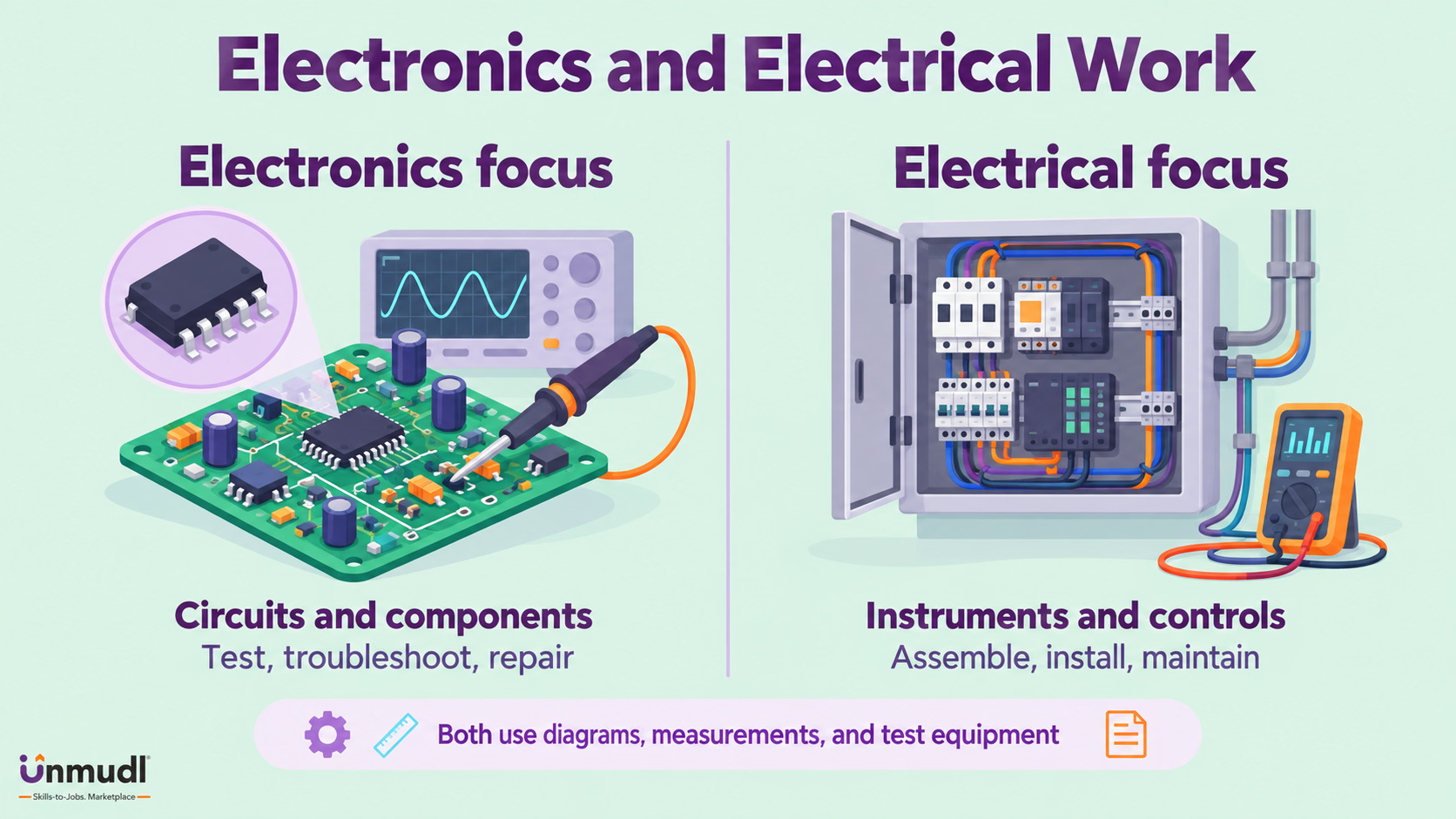
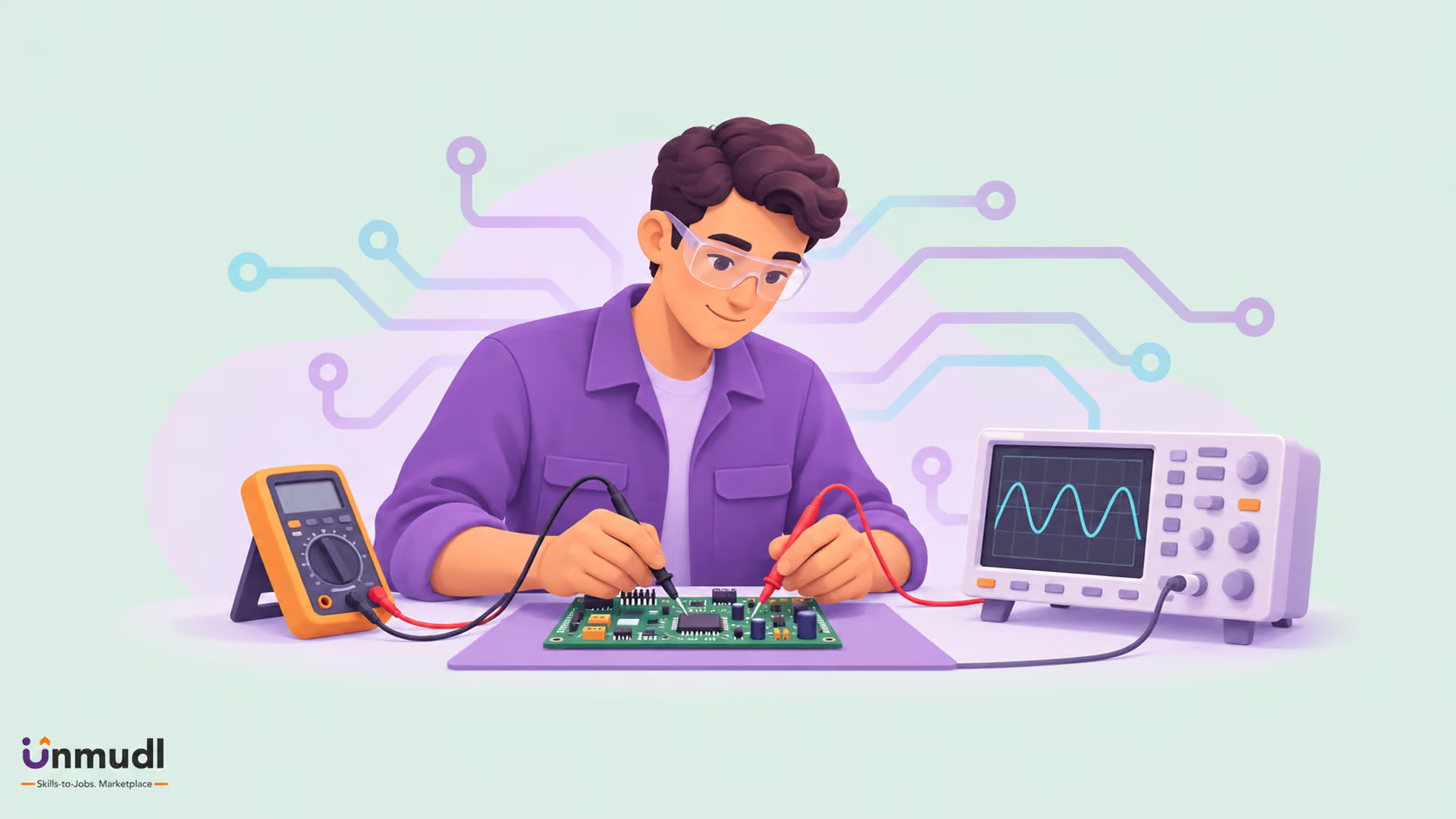
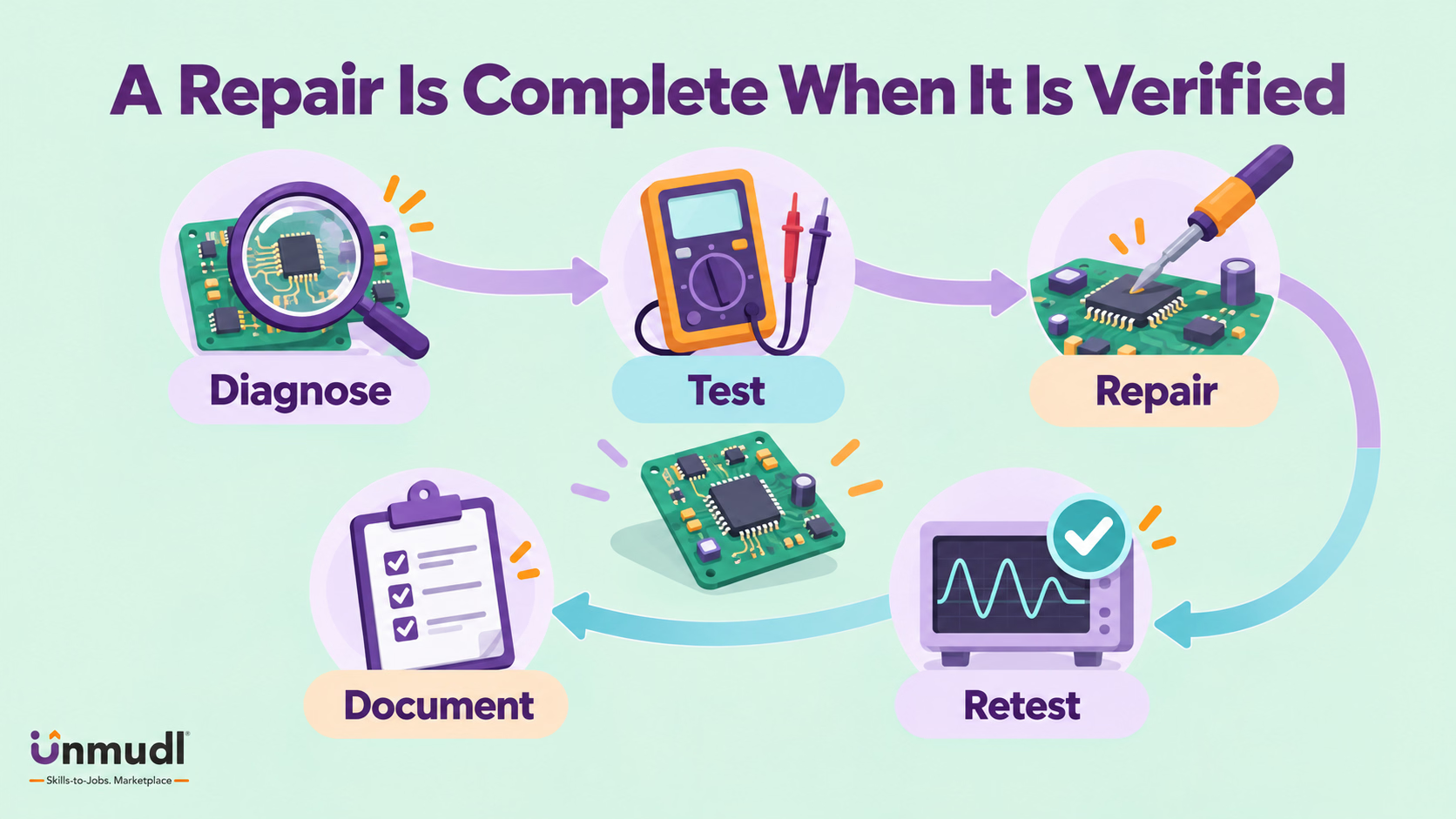
An electronic technician works by turning a reported equipment problem into measured evidence, an authorized repair, and a documented result. The cycle starts with the schematic, wiring diagram, or work order. The technician then tests the equipment with a multimeter, an oscilloscope, or a signal generator. The readings localize the fault to a component, a connection, or a setting. The technician repairs or replaces that part within the authorization the job gives. A second test verifies the specification, and a log entry records the fault, the correction, and the verified reading.
The military version of the same cycle appears in two U.S. Navy ratings. A navy electronics technician maintains, repairs, and calibrates shipboard radar, communications, navigation, and detection equipment. The aviation electronics technician Navy rating is listed separately and maintains the electronic systems aboard Navy aircraft. An aviation electronics technician in civilian classification belongs to the separate avionics technician occupation, which the BLS Occupational Outlook Handbook counted at 19,800 jobs in 2025. Neither rating defines the civilian role as a whole. The civilian role divides instead by its main technical function.
What are the Types of Electronic Technician?
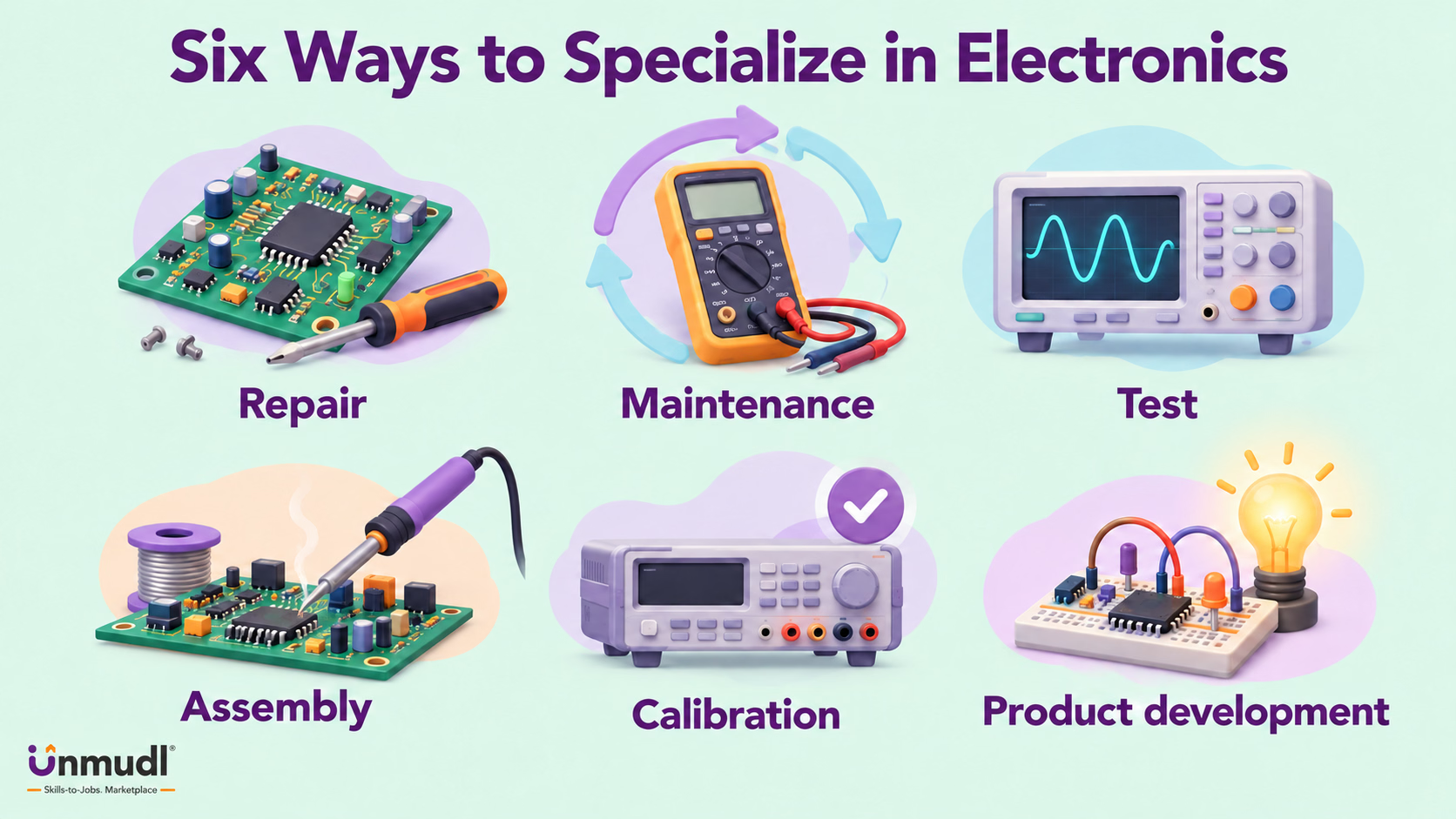
There are six main types of electronic technician based on the primary technical function of the job. The types are electronics repair technician, electronics maintenance technician, electronics test technician, electronics assembly technician, electronics calibration technician, and product development technician, and each type is defined below. The table below pairs each type with its specialist class and its main function.
Type | Specialist Class | Main Function |
|---|---|---|
Electronics repair technician | Service specialist | Finds and restores a malfunction |
Electronics maintenance technician | Sustainment specialist | Keeps installed equipment in condition |
Electronics test technician | Measurement specialist | Records whether behavior meets specification |
Electronics assembly technician | Production specialist | Converts drawings into boards and subassemblies |
Electronics calibration technician | Metrology specialist | Adjusts an instrument to a reference standard |
Product development technician | Engineering-support specialist | Builds and troubleshoots development hardware |
Common misreading | One posting title equals one type | The main function, not the title, fixes the type |
1. Electronics Repair Technician
An electronics repair technician is a service specialist who finds the malfunction in electronic equipment and restores the equipment to its specified condition. The repair specialist diagnoses from measurements before any component is replaced, and a retest proves the restored function. Repair shops and equipment sites employ this specialist for bench and on-site fault work.
2. Electronics Maintenance Technician
An electronics maintenance technician is a sustainment specialist who keeps installed electronic equipment in a required condition through scheduled inspections and corrective work. The maintenance specialist follows the approved interval and preserves the service history of each asset. Verifying performance after every intervention keeps that record accurate. Manufacturing plants and industrial facilities rely on this specialist for installed-equipment care.
3. Electronics Test Technician
An electronics test technician is a measurement specialist who applies a defined test procedure to a circuit or a prototype and records whether the behavior meets specification. The test specialist confirms the calibration status of the instrument before any reading is taken. Separating evidence from assumption keeps the report trustworthy. Production-test areas and engineering laboratories staff this specialist for acceptance testing.
4. Electronics Assembly Technician
An electronics assembly technician is a production specialist who converts drawings and engineering instructions into circuit boards, prototypes, and subassemblies. The assembly specialist works from the current drawing revision and inspects the completed unit. Applying the site's electrostatic discharge (ESD) controls protects sensitive components during handling. Electronics manufacturers and prototype shops recruit this specialist for build and soldering work.
5. Electronics Calibration Technician
An electronics calibration technician is a metrology specialist who compares a measuring instrument against a reference standard and adjusts the instrument until the readings agree. The calibration specialist follows an approved procedure and records every comparison. Treating traceability as separate from fitness for use keeps the calibration defensible. Calibration laboratories and quality departments assign this specialist to instrument control.
6. Product Development Technician
A product development technician is an engineering-support specialist who builds prototypes, runs experiments, and troubleshoots development hardware for a design team. The development specialist preserves the test conditions and documents every deviation. Keeping technical findings separate from engineering judgment protects the design decision. Development laboratories and engineering offices engage this specialist for prototype and evaluation work.
Reading the six types by their main function lets a candidate match a training path to the equipment and the workplace the job involves. Every type performs the same core duties.
What are the Duties of Electronic Technician?
An electronic technician performs six main duties across repair, maintenance, test, and engineering-support jobs. The duties are diagnosing faults, testing performance, assembling circuits, repairing components, performing preventive maintenance, and documenting findings, and each duty is explained below.
1. Diagnosing Faults
Diagnosing faults means examining symptoms, connections, schematics, and test evidence to identify what is malfunctioning before anything is changed. The technician reads the wiring diagram first, then tests the suspected section with diagnostic equipment. Finding the cause narrows the repair to the actual fault instead of a guessed component. Every later duty depends on this first one.
2. Testing Performance
Testing performance covers measuring voltage, current, resistance, and signal behavior against a specified value. The technician connects a multimeter or an oscilloscope and records the conditions and the readings. A measurement converts a suspected problem into data that compares against the expected condition. The same measurement verifies the repair once the work is complete.
3. Assembling Circuits
Assembling circuits turns engineering drawings into circuit boards, components, prototypes, and interconnections. The technician uses hand tools and a soldering iron on small circuitry and inspects the finished unit. Accurate assembly hands a physical unit to the test that follows. Controlled drawings and ESD handling guard the build from the first part to the last.
4. Repairing Components
Repairing components corrects a confirmed fault by replacing, reworking, or adjusting the defective part and reassembling the equipment. The technician follows the authorized service procedure and corrects the cause rather than the visible symptom. The repair restores the lost function, and the retest shows whether the specified performance returned. Only a verified repair returns equipment to service.
5. Performing Preventive Maintenance
Performing preventive maintenance keeps installed electronic equipment inspected, cleaned, checked, and adjusted on a schedule before a failure occurs. The technician keeps to the documented interval and the equipment procedure, then updates the maintenance log. Scheduled checks catch degradation early and keep the equipment available for operation. Corrective work takes over the moment a scheduled check finds a defect.
6. Documenting Findings
Documenting findings records the test result, the faulty component, the correction performed, and the post-repair verification in the required format. The technician separates observed facts from diagnosis and recommendation in the record. Clear documentation makes the equipment's condition and history available to engineering, quality, and future troubleshooting staff. The record closes one job and opens the evidence trail for the next.
Practicing the six duties under supervision is what an electronics technician program at a community college delivers through AC/DC circuits, electronic devices, and laboratory hours. The full set describes an electronics engineering technician most closely, while a service-only job performs the diagnosis, repair, and documentation subset. Which subset a job carries depends on where the job is performed.
Where Does a Electronic Technician Work?
An electronic technician works in engineering laboratories, electronics factories, production-test areas, repair and service shops, installed-equipment sites, and government facilities. Laboratory work centers on prototypes and measurements, factory work on assembly and inspection, and shop work on fault intake and verification. BLS 2025 employment data for the occupation places federal government at 12%, engineering services at 11%, and semiconductor and electronic component manufacturing at 10% of employment.
Electronic engineering technology is the educational field that prepares a learner for those settings rather than a workplace itself. An electronic engineering technology curriculum applies circuit analysis, analog and digital electronics, and measurement to the building, testing, and maintenance of electronic systems. A two-year associate degree in that field connects the classroom laboratory to the employer laboratory, factory, or shop.